American Sea Rocket (Cakile edentula)
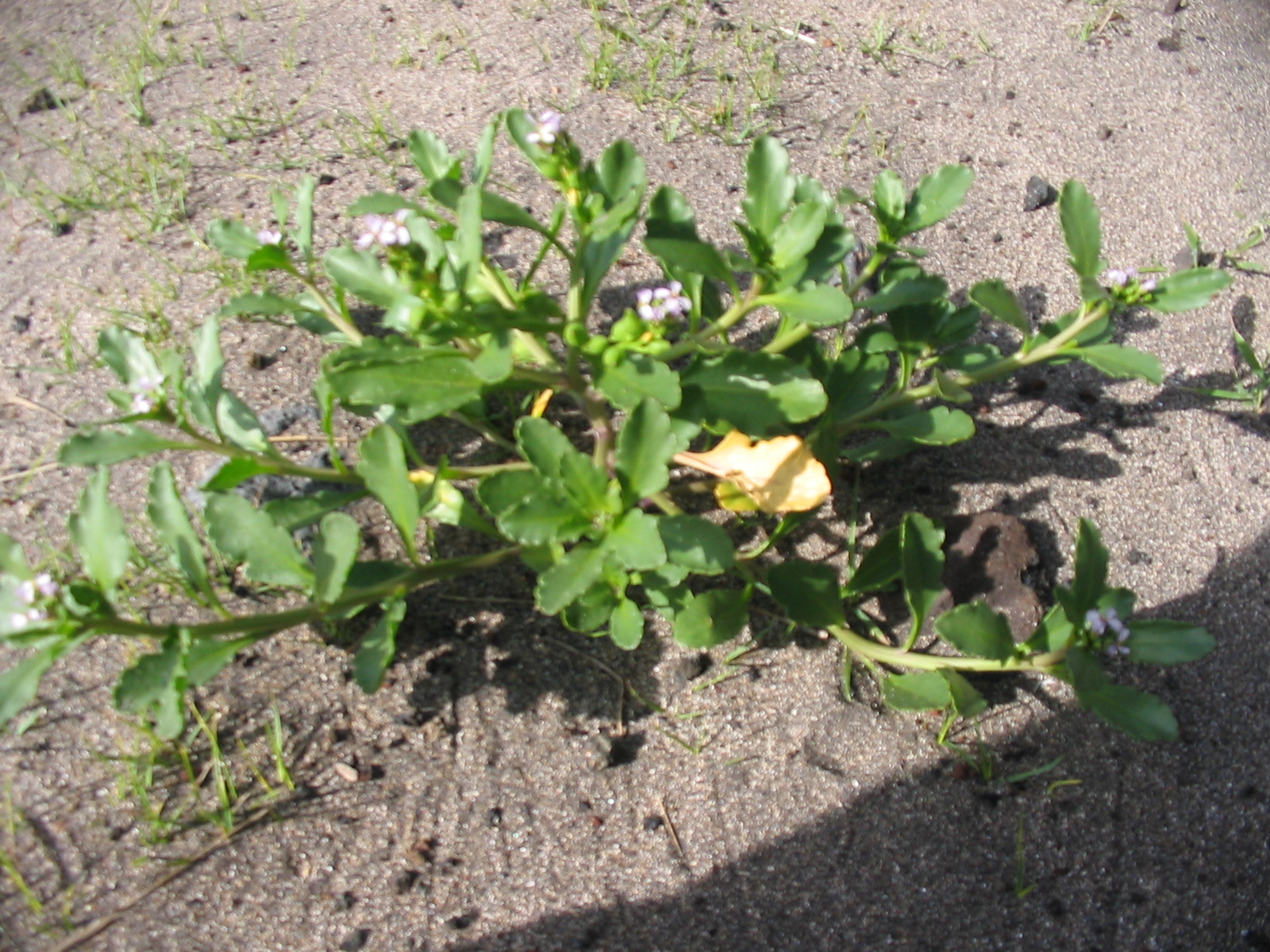
Cakile edentula, commonly called American Sea Rocket or simply Sea Rocket, is a low, fleshy-leaved annual in the mustard family (Brassicaceae) that makes its living on the harshest real estate a plant can choose: the open sand just above the high-tide line. Where most plants cannot survive salt spray, shifting sand, and brutal summer heat reflected off bare beach, Sea Rocket thrives, forming loose, sprawling mounds studded with small, pale lavender-to-white, four-petaled flowers from early summer into fall.
As one of the very first colonizers of disturbed or newly deposited sand, Sea Rocket plays an outsized ecological role for such a small plant. Its roots and low, branching stems help trap windblown sand, giving the first toehold to the dune-building grasses and forbs that follow. Its corky, two-segmented seed pods are built to float, letting the next generation ride ocean currents to colonize fresh stretches of beach up and down the coast and around the Great Lakes.
Sea Rocket is native along the Atlantic coast from the Canadian Maritimes south to the Gulf of Mexico, and around the shorelines of the Great Lakes — but it is important to know where it is not native: the species was introduced to the Pacific coast of Washington, Oregon, and California in the early twentieth century, where it has since spread aggressively and is now considered an invasive threat to native dune plants in that region. This page covers its true native range only.
Identification
Sea Rocket is a succulent, fast-growing annual (occasionally biennial) that forms a low, branching, often sprawling mound 6 to 18 inches tall and 1 to 3 feet across. The whole plant has a fleshy, almost cactus-like quality, an adaptation that helps it store fresh water and resist the drying effects of sun, wind, and salt spray.
Stems
Stems are thick, smooth, pale green, and often tinged purple at the base. They branch freely from a central point low to the ground, sprawling outward across the sand rather than growing upright, which helps the plant shed wind and shifting sand without snapping.
Leaves
Leaves are fleshy and succulent, 1 to 3 inches long, shallowly to deeply lobed with rounded teeth along the margins, and a dull blue-green color that helps reflect intense beach sunlight. The thick, water-storing texture is the single fastest way to recognize Sea Rocket among beach plants — no true leaf in this habitat feels quite so rubbery.
Flowers
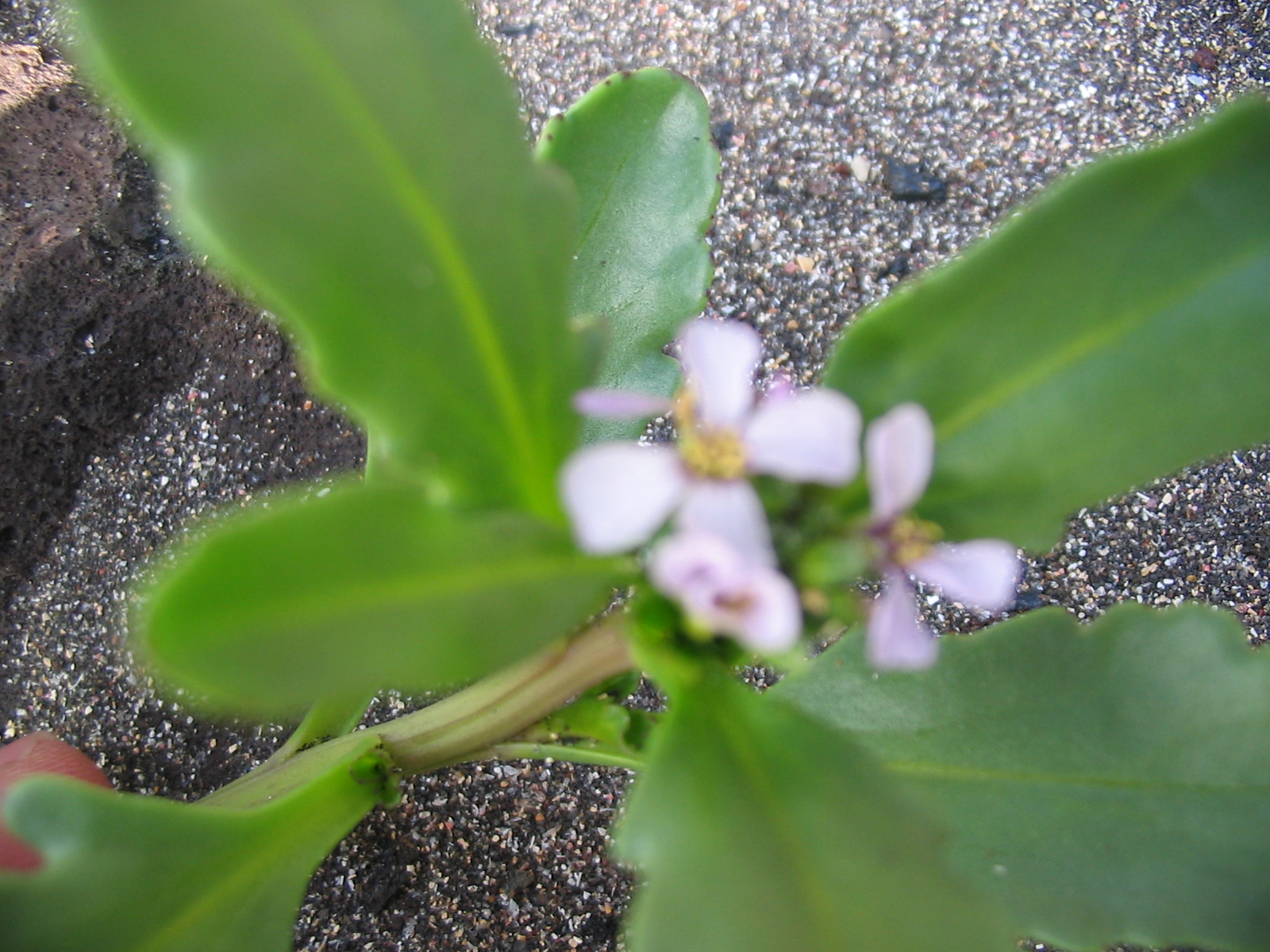
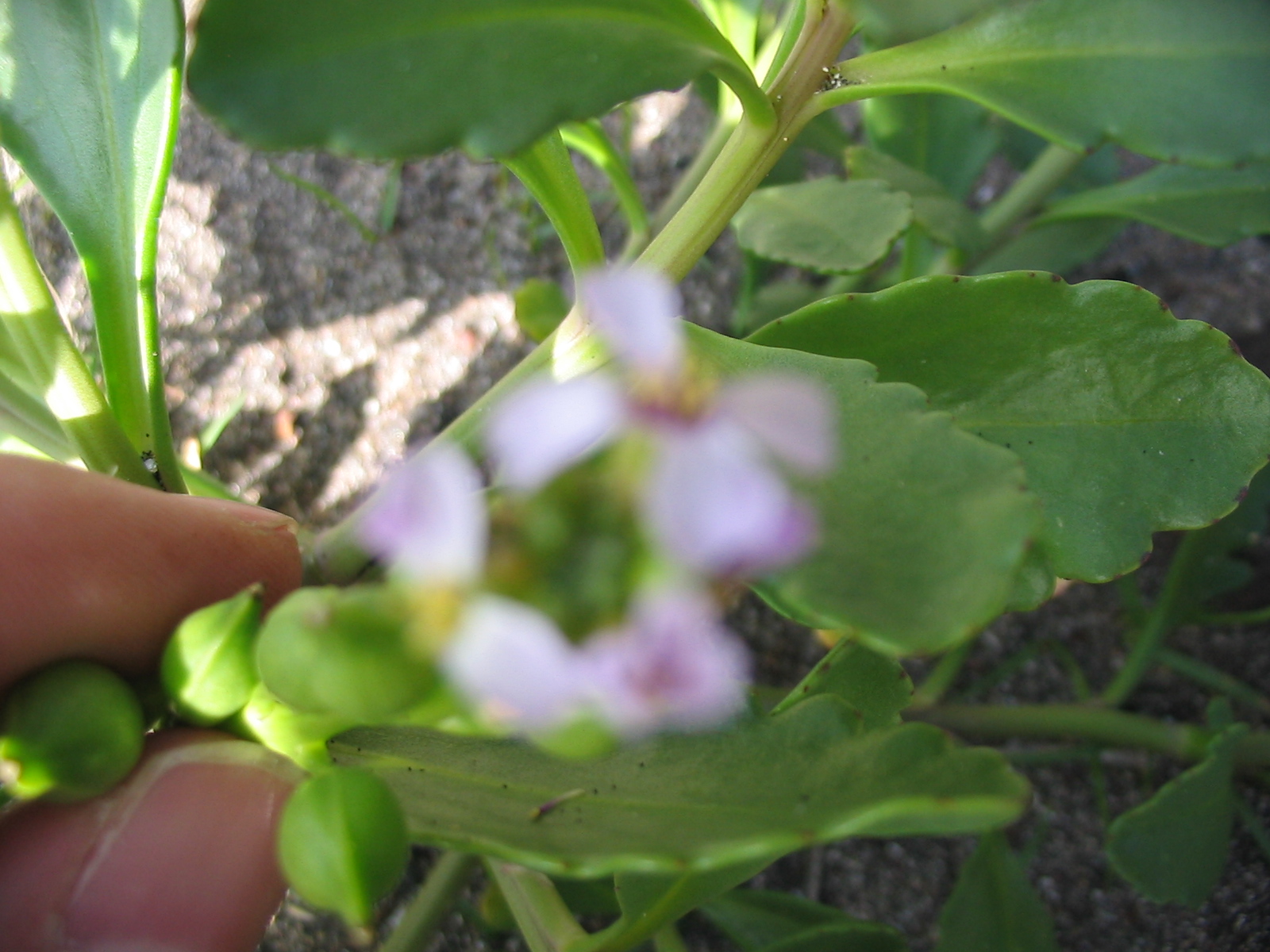
Flowers are small, about ¼ to ½ inch across, with four petals in the characteristic cross-shaped arrangement of the mustard family, colored pale lavender-pink fading to white toward the center. They cluster loosely at the branch tips and open over a long season, typically June through September, with flowering continuing later into fall in the southern part of the range.
Fruit & Seeds
The fruit is an unusual two-segmented silique: a corky, jointed seed pod that, unlike most of its mustard-family relatives, does not split open to release seeds. Instead, the two segments eventually break apart and drop separately, each buoyant enough to float on seawater for weeks. Ocean currents and lake waves carry the segments to new stretches of shoreline, where they wash up and sprout at the next strandline.
Quick Facts
| Scientific Name | Cakile edentula |
| Family | Brassicaceae (Mustard) |
| Plant Type | Succulent Annual Wildflower |
| Mature Height | 6–18 in |
| Mature Spread | 1–3 ft |
| Growth Rate | Fast; completes life cycle in one season |
| Sun Exposure | Full Sun |
| Water Needs | Low |
| Soil Type | Loose beach sand; very well-drained |
| Soil pH | Neutral to slightly alkaline |
| Bloom Time | June – September |
| Flower Color | Pale lavender-pink to white |
| Fall Color | None; plant dies back after seed set |
| Fruit | Corky, two-segmented floating seed pod |
| Deer Resistant | Yes, generally |
| USDA Hardiness Zones | 2–9 |
Native Range
American Sea Rocket has one of the widest native ranges of any U.S. beach plant, stretching from the Canadian Maritimes down the Atlantic seaboard to the Gulf of Mexico, plus the sandy and gravelly shores of the Great Lakes. It is native to Maine, New Hampshire, Massachusetts, Rhode Island, Connecticut, New York, New Jersey, Pennsylvania, Delaware, Maryland, Virginia, North Carolina, South Carolina, Georgia, Florida, Alabama, Mississippi, Louisiana, Minnesota, Wisconsin, Michigan, Illinois, Indiana, and Ohio.
It occupies a narrow but important habitat: the upper beach and foredune zone, just above the reach of normal high tide and often right along the tideline wrack (the band of stranded seaweed and debris left by waves). Here it grows alongside, and sometimes just ahead of, classic dune-building species like American beachgrass and sea oats, helping trap the first sand that eventually builds a stable foredune.
Gardeners on the Pacific coast should know that Sea Rocket growing on West Coast beaches is not native there. It was introduced to Washington, Oregon, and California in the early 1900s and has since become an aggressive invasive on Pacific dunes, where it crowds out native dune species; removing it, not planting it, is the appropriate action in that region.
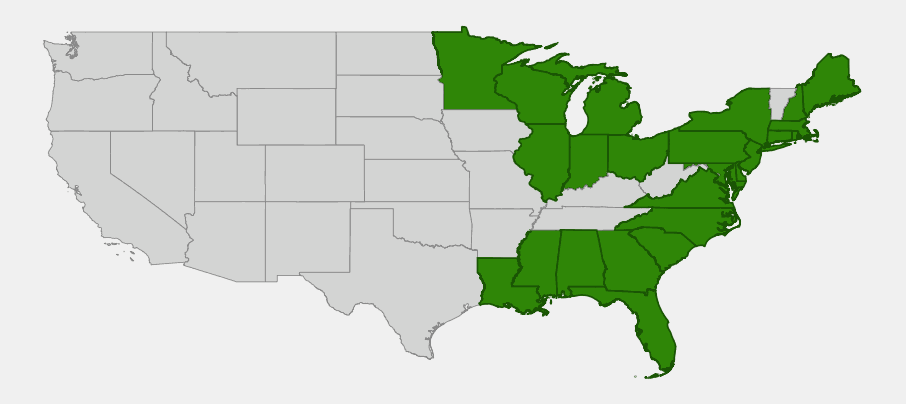
📋 Regional plant lists featuring American Sea Rocket: New Hampshire, Maine & Vermont · Connecticut, Massachusetts & Rhode Island · New York, Pennsylvania & Northern New Jersey · Delaware, Southern New Jersey & Long Island · Maryland, Virginia & West Virginia · North Carolina & South Carolina · Georgia, Alabama & Mississippi · Arkansas, Louisiana, Eastern Oklahoma & Eastern Texas · Ohio & Indiana · Illinois, Iowa & Missouri · Michigan, Wisconsin & Eastern Minnesota
Growing & Care Guide
Sea Rocket is rarely sold at nurseries and is best suited to true coastal gardens, dune restoration plantings, and naturalized beachfront sites rather than typical home landscapes — but where conditions suit it, it needs almost no care at all.
Light
Give it full sun. Sea Rocket is a plant of open, unshaded beach sand and will not persist under any significant shade from buildings, dune grasses, or overhanging vegetation.
Soil & Water
Plant it in pure sand or sandy soil with excellent drainage; it has no tolerance for heavy, poorly drained, or organically rich garden soil. Once established it needs no supplemental irrigation and depends entirely on natural rainfall, surviving extended dry spells thanks to its succulent, water-storing leaves. It also tolerates direct salt spray and occasional wash-over from storm tides, conditions that would kill most garden plants outright.
Planting Tips
Sow seed (the corky pod segments) directly on bare sand in fall or early spring; Sea Rocket germinates and grows quickly without transplant shock because it resents root disturbance. It reseeds itself freely once established, so a single planting in suitable dune or beachfront sand can maintain itself indefinitely. Use it only within its native Atlantic, Gulf, or Great Lakes range — never introduce it to Pacific coast sites, where it is already an invasive problem.
Pruning & Maintenance
None needed. As an annual, Sea Rocket completes its life cycle in a single growing season, flowering, setting seed, and dying back on its own by late fall. There is nothing to prune; simply allow spent plants to remain in place so their seed pods can disperse naturally.
Landscape Uses
Sea Rocket’s uses are specialized but valuable in the right setting:
- Dune and beach restoration as an early sand-stabilizing pioneer species
- Naturalized coastal gardens right at the upper beach edge
- Erosion control on disturbed or recently exposed shoreline sand
- Wildlife plantings supporting beach-dependent insects and shorebirds
Wildlife & Ecological Value
Despite growing in one of the most physically demanding habitats on the continent, Sea Rocket supports a surprising amount of beach-specialist wildlife.
For Pollinators & Insects
The small flowers attract native bees, flies, and other beach-foraging pollinators during a long summer bloom season when few other plants are flowering so close to the water. Sea Rocket is also a larval host for the Great Southern White butterfly in parts of its range, and its foliage and wrack-line neighbors support beach-dependent insects like tiger beetles.
For Birds
Shorebirds and seed-eating songbirds forage among Sea Rocket stands for seeds and the insects the plants attract, particularly where it mixes with stranded wrack debris that concentrates invertebrate prey.
Ecosystem Role
Sea Rocket is a classic pioneer species: it is frequently the very first vascular plant to colonize bare sand left by a retreating storm tide or a newly formed sandbar. Its low, branching stems slow wind and trap the first grains of windblown sand, creating the toehold of stability that allows beachgrass, sea oats, and other true dune-builders to establish behind it. In this role, Sea Rocket is one of the foundational species in the natural process of dune formation and recovery after storms.
Cultural & Historical Uses
Sea Rocket’s fleshy leaves have a sharp, peppery, horseradish-like bite similar to its mustard-family relatives, and coastal foragers in New England and the Canadian Maritimes have historically gathered young leaves and shoots to eat raw in salads or cooked like other wild greens. As with any wild forage, correct identification is essential and only young, tender growth is typically palatable, since older leaves become tough and increasingly bitter.
Beyond its use as a wild edible, Sea Rocket has long been recognized by coastal naturalists and dune managers as a natural indicator species: its presence marks the active, storm-washed edge of the beach, and its disappearance from a stretch of shoreline can signal excessive foot traffic, vehicle damage, or hardened shoreline structures that prevent natural sand movement.
Frequently Asked Questions
Is Sea Rocket native to the Pacific coast?
No. Sea Rocket is native to the Atlantic coast, Gulf coast, and Great Lakes shores, but it was introduced to Washington, Oregon, California and Alaska in the early 1900s, where it is now considered invasive and displaces native dune plants.
Can you eat Sea Rocket?
Yes, young leaves are edible and have a peppery, mustard-like flavor similar to watercress, and coastal foragers have eaten them for generations. Only harvest from clean, unpolluted beaches, and always confirm identification before eating any wild plant.
Why does Sea Rocket grow right at the edge of the beach?
It is adapted to tolerate salt spray, shifting sand, and occasional wash-over from high tides — conditions that exclude almost every other plant. This lets it colonize the bare upper beach zone first, ahead of true dune grasses.
Is Sea Rocket a perennial?
No, it is an annual (occasionally short-lived biennial). It completes its entire life cycle — germinating, flowering, setting seed, and dying — within a single growing season, then regrows from seed the following year.
How do Sea Rocket seeds spread to new beaches?
Its corky seed pod splits into two buoyant segments that float on seawater, sometimes for weeks, allowing currents and waves to carry seeds to new stretches of shoreline far from the parent plant.

Looking for a nursery that carries Sea Rocket?
Browse our native plant nursery directory: Alabama · Connecticut, Delaware, Florida & Georgia · Illinois & Indiana · Louisiana, Maine, Maryland, Massachusetts, Michigan, Minnesota & Mississippi · New Hampshire, New Jersey, New York, North Carolina & Ohio · Pennsylvania, Rhode Island, South Carolina & Virginia · Wisconsin