
Sintenis Vriesea (Vriesea sintenisii)
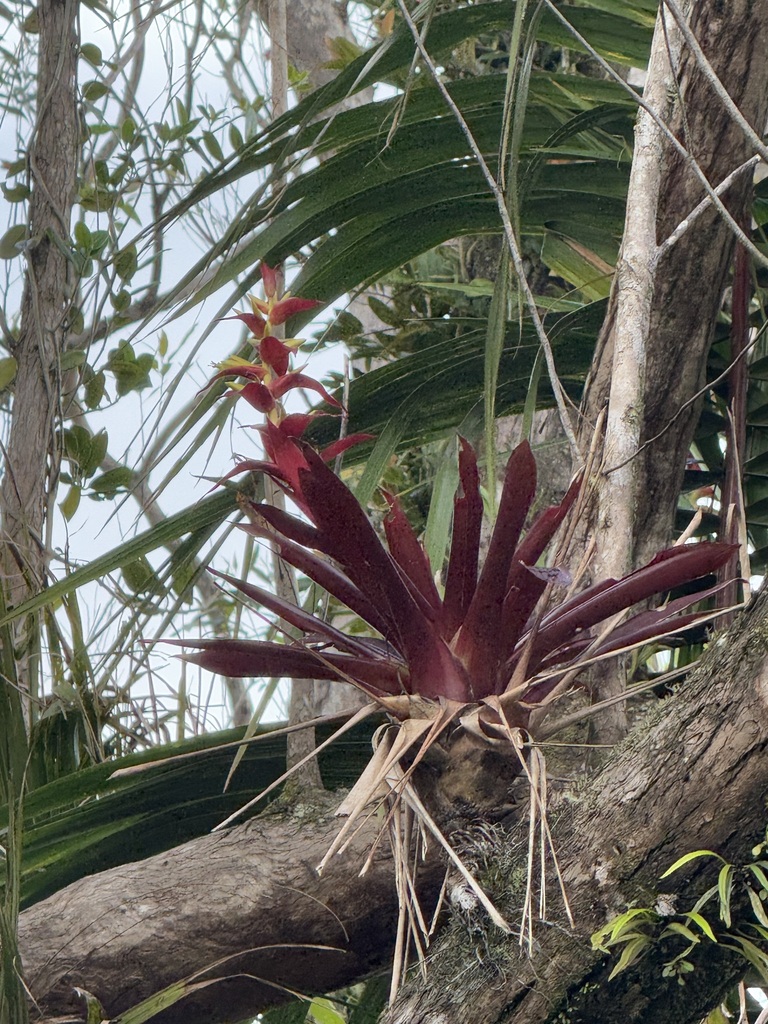
Vriesea sintenisii, here called Sintenis Vriesea and listed by USDA as barkplant, is a striking epiphytic bromeliad of the cloud-draped mountains of Puerto Rico and the other Greater Antilles. It forms a vase-shaped rosette of broad, glossy leaves, often flushed deep wine-red, that clings to tree trunks and branches high in montane forest. Many botanists now place it in the genus Werauhia as Werauhia sintenisii; it has also been called Thecophyllum sintenisii, Guzmania sintenisii and Caraguata sintenisii. It belongs to the pineapple family, Bromeliaceae.
This is a plant of Puerto Rico’s highest, wettest forests. Herbarium records and observations place it in the Luquillo Mountains of El Yunque National Forest, including the elfin (dwarf) forest of El Toro and Pico del Oeste, and along the Cordillera Central in Toro Negro, Carite and Maricao state forests, mostly between about 800 and 1,300 m (2,600 to 4,200 ft). There it perches on trunks and branches in sierra palm, palo colorado and elfin cloud forest, and occasionally grows on the ground or on mossy logs where the canopy is low.
Like other tank bromeliads, Sintenis vriesea collects rainwater and leaf litter in the cups formed by its leaf bases, creating tiny ponds in the treetops that support a host of animals. This guide covers how to identify it, where it grows, what it means for forest wildlife, and why it is a plant to admire in the wild rather than collect.
Identification
Puerto Rico’s mountain forests hold many epiphytic bromeliads, including several species of Guzmania, Vriesea/Werauhia and Tillandsia. Sintenis vriesea is one of the most conspicuous because of its size and its reddish foliage.
Growth Habit
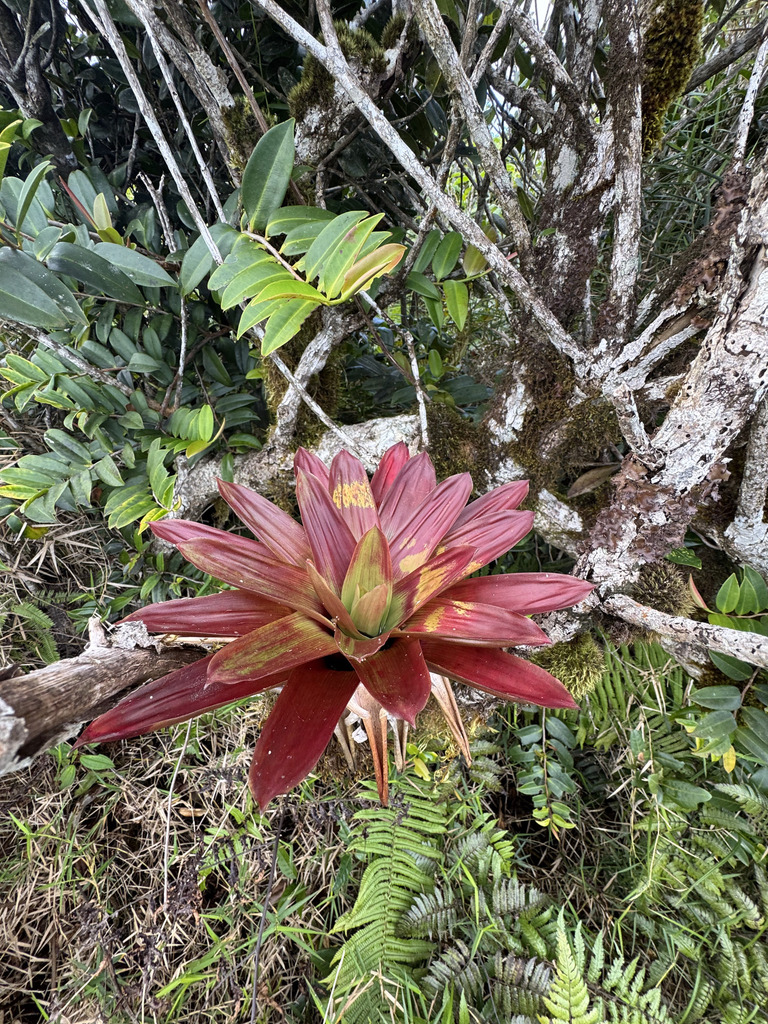
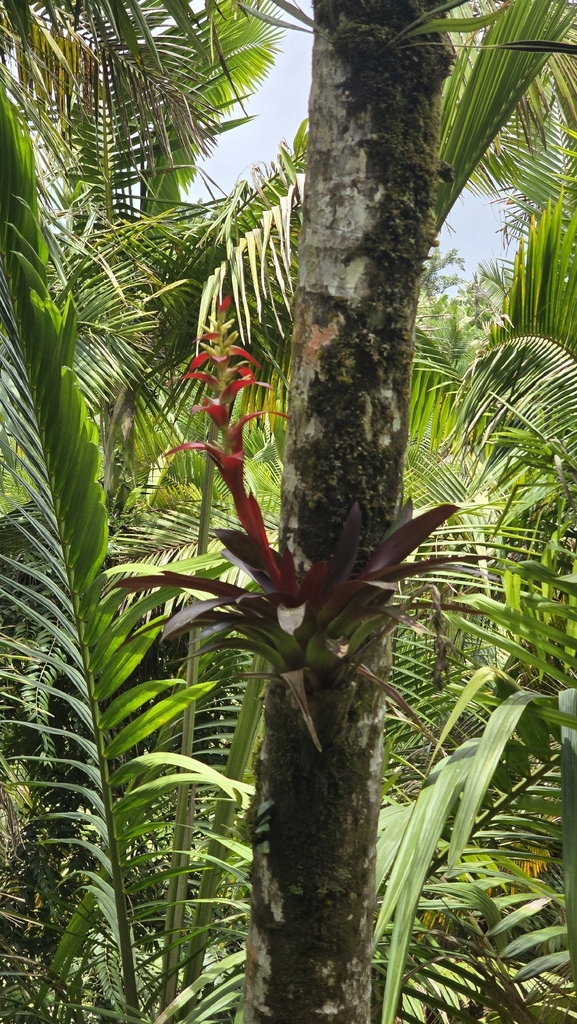
Sintenis vriesea is a stemless, evergreen perennial that grows as a single rosette or a small group of rosettes. Most plants are epiphytes on the trunks and larger branches of trees and palms, held in place by wiry roots that anchor the plant but take up little water. In the low, mossy elfin forest it also grows on fallen logs, rocks and the ground. Each rosette flowers once, then produces offsets (pups) from its base before slowly dying back, a pattern common to bromeliads.
Leaves
The leaves are strap-shaped, broad at the base and tapering to a point, smooth-edged without spines, and arranged in a dense, upright to spreading rosette. Their sheathing bases overlap tightly to form a central tank that holds water. In sun or bright cloud forest light the foliage is usually burgundy to wine-red, sometimes green at the base with red tips or with paler blotches; in deeper shade it can be greener. Dead leaves often hang below the rosette as a pale, papery skirt.
Flowers
The flowering stalk rises from the center of the rosette and carries an upright spike of overlapping bracts, bright red to scarlet in flowering plants. The small, tubular flowers emerge from between the bracts and are much less showy than the bracts themselves; photographs show pale yellow to yellowish-green tips. As in other bromeliads, the flowers have three sepals, three petals and six stamens.
Fruit & Seeds
After flowering, the bracts darken and the flowers develop into slender capsules. When dry they split open and release many small seeds, each with a tuft of fine, silky hairs that lets it drift on the wind and catch on mossy bark, the way new plants reach the high branches of other trees.
Quick Facts
| Scientific Name | Vriesea sintenisii (Baker) L.B. Sm. & Pittendr. (syn. Werauhia sintenisii, Thecophyllum sintenisii) |
| Family | Bromeliaceae (pineapple or bromeliad family) |
| Plant Type | Evergreen epiphytic tank bromeliad; occasionally terrestrial |
| Mature Height | About 1–3 ft including the flower spike |
| Mature Spread | About 1–2 ft per rosette |
| Growth Rate | Slow |
| Sun Exposure | Bright shade to filtered sun |
| Water Needs | High; constant humidity and frequent rain or mist |
| Soil Type | None needed (epiphyte); bark, moss or a very coarse, airy mix |
| Soil pH | Slightly acid (bark and moss) |
| Bloom Time | Irregular; individual rosettes flower once when mature |
| Flower Color | Red to scarlet bracts; small pale yellowish flowers |
| Fall Color | None; foliage is red to burgundy year-round |
| Fruit | Dry capsule with windborne, hair-tufted seeds |
| Deer Resistant | Not applicable; grows above the reach of browsers |
| USDA Hardiness Zones | 10–11 (frost-free, cool and humid); greenhouse elsewhere |
Native Range
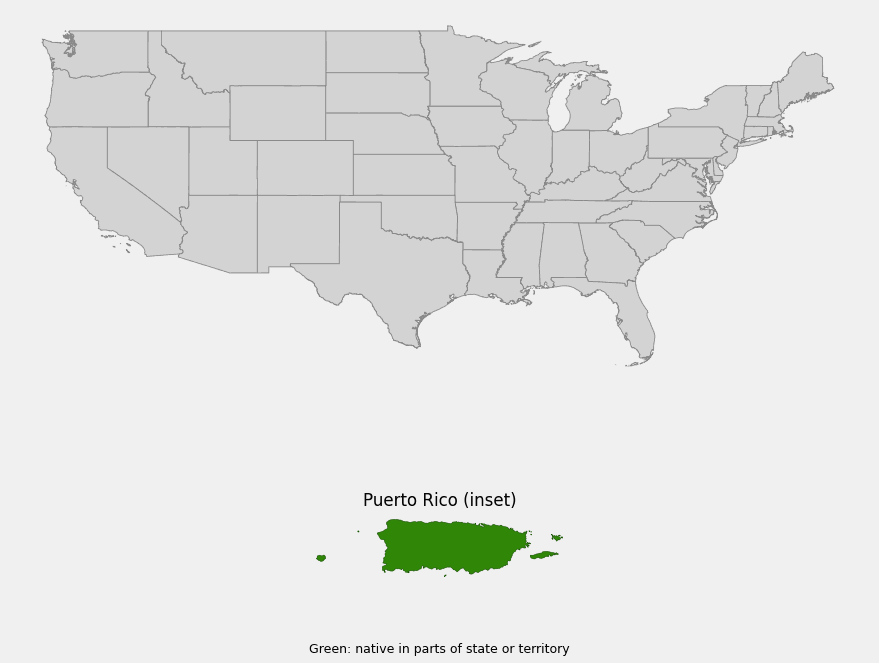
Sintenis vriesea is endemic to the Greater Antilles. The Smithsonian’s Flora of the West Indies records it from Puerto Rico, Hispaniola (Dominican Republic), Cuba and Jamaica. Within the United States it occurs only in Puerto Rico, where USDA PLANTS lists it as native.
In Puerto Rico it is confined to the mountains. Museum specimens summarized by GBIF come from the Sierra de Luquillo (El Yunque National Forest, including El Toro and Pico del Oeste), from Toro Negro State Forest and nearby peaks in Jayuya, from Carite State Forest between Patillas and San Lorenzo, from the Barranquitas highlands, and from the Maricao State Forest in the west. The Institute for Regional Conservation lists it in El Yunque and Maricao and places it at middle to high elevations, above about 500 m. Most specimens were collected between roughly 800 and 1,300 m.
These are Puerto Rico’s cloud forests, where clouds cover the peaks much of the day, rainfall is high, and temperatures stay cool by tropical standards. Sintenis vriesea grows in the sierra palm and palo colorado forests of the Luquillo Mountains, in the stunted, moss-covered elfin forest on the highest ridges, and in the montane forests of the Cordillera Central, including those on the serpentine soils of Maricao.
📋 Regional plant lists featuring Sintenis Vriesea: Puerto Rico
Growing & Care Guide
Sintenis vriesea is rarely cultivated, and it is a challenging plant outside its cloud forest home. It needs constant humidity, frequent moisture and moderate temperatures, and it dislikes both frost and long periods of heat. In Puerto Rico it can be grown on trees in gardens at higher elevations in the mountains; in the lowlands and in South Florida it struggles in hot, dry weather. Elsewhere it is a plant for a cool, humid greenhouse. Never take plants from the wild. Wild collection depletes slow-growing populations in protected forests and is prohibited in El Yunque and the commonwealth forests; look for nursery-grown plants or seed-grown material from bromeliad growers.
Light
Give it bright, filtered light, like that under a broken forest canopy or the cloudy light of a mountaintop. Stronger light brings out the deep red leaf color; full tropical sun at low elevations, however, will bleach and burn the leaves.
Soil & Water
As an epiphyte it needs no soil. Mount it on a piece of rough bark, a tree-fern slab or a branch with a pad of moss, or pot it in a very coarse, fast-draining mix of bark chips and perlite. Keep the central tank partly filled with clean rainwater and flush it occasionally so it does not stagnate. Mist or water the roots often, and keep humidity high. Use rain or other low-mineral water; hard tap water leaves deposits on the leaves.
Planting Tips
In mountain gardens in Puerto Rico, tie a young plant to the trunk or a sturdy fork of a tree with soft cloth or fishing line until its roots grip the bark, usually within a few months. Choose a shaded, humid side of the tree. In a greenhouse, hang mounted plants where air moves freely but humidity stays high.
Pruning & Maintenance
Remove dead outer leaves if you want a neater look, though in the wild they are left to decay. After a rosette flowers, keep caring for it: it will produce one or more pups at its base. These can be left to form a clump or removed when they reach about a third to half the size of the parent. Feed very lightly, if at all, with a weak orchid or bromeliad fertilizer sprayed on the leaves.
Propagation
Separate pups with a sharp knife once they have a few roots and mount or pot them as above. Seed can be sown on moist, sterile milled sphagnum or on fine bark in high humidity; seedlings are slow and may take many years to reach flowering size.
Landscape Uses
- Mountain gardens in Puerto Rico: mounted on trees in cool, humid gardens in the Cordillera Central or the Luquillo foothills
- Greenhouse and conservatory collections: for collectors of Caribbean bromeliads with cool, humid growing space
- Educational plantings: an example of the tank bromeliads that shape Puerto Rico’s cloud forests
- Wildlife viewing: tank bromeliads host frogs, insects and other small animals
Wildlife & Ecological Value
In Puerto Rico’s cloud forests, tank bromeliads like Sintenis vriesea create a world of tiny wetlands in the trees. The water and debris held in their leaf bases support animals that could not otherwise live high above the ground.
For Pollinators
The genus Werauhia, where many botanists now place this species, is noted for flowers adapted to pollination by bats. In Puerto Rico, the red bracts of Sintenis vriesea are also conspicuous to hummingbirds such as the green mango and green-throated carib. The pollination of this species has not been well documented, so both groups are possible visitors.
For Birds
Birds forage among bromeliad rosettes for insects, spiders and small frogs, and some use the water held in the tanks. The Puerto Rican tody and other insect-eating birds of El Yunque and the Cordillera Central hunt in the same mossy, epiphyte-laden branches.
For Mammals
Puerto Rico has few native land mammals other than bats. The plant’s main role for mammals is indirect, as part of the canopy habitat used by foraging bats.
Ecosystem Role
Bromeliad tanks are a key habitat in Puerto Rican forests. Studies of El Yunque bromeliads have found that their water-filled leaf axils hold a rich community of aquatic insect larvae, other invertebrates and decaying organic matter, and several of Puerto Rico’s coquí frogs use bromeliads as daytime retreats, calling sites and places to lay eggs. Because they capture rain, mist and nutrients from the air, epiphytic bromeliads also help cycle water and nutrients in cloud forests.
Cultural & Historical Uses
The species is named for Paul Sintenis, a German botanist and plant collector who collected extensively in Puerto Rico in the 1880s. Many specimens from his expedition, with Latin labels such as “Sierra de Luquillo, in planitie montis Jimenes,” are still in herbaria, and his collections formed the basis for many species described from Puerto Rico, often with sintenisii as the epithet. John Gilbert Baker first described this plant in 1889 as Caraguata sintenisii.
The plant has since moved through several genera, a common fate for bromeliads. Carl Mez transferred it to Guzmania and later to Thecophyllum; Lyman B. Smith and Pittendrigh placed it in Vriesea in 1953; and in 1995 the bromeliad specialist Jason Grant placed it in Werauhia, a genus named for the German botanist Werner Rauh. USDA PLANTS still uses Vriesea sintenisii, so that is the name used here.
In Puerto Rico, epiphytic bromeliads are part of the character of El Yunque and other mountain forests, and they figure prominently in research and education about the island’s cloud forests. Protecting these forests, and leaving their bromeliads in place, protects the frogs, insects and other species that depend on them.
Frequently Asked Questions
Is Sintenis vriesea a Vriesea or a Werauhia?
Both names are in use. USDA PLANTS lists it as Vriesea sintenisii, while many bromeliad specialists use Werauhia sintenisii, following a 1995 revision based on flower structure. They refer to the same plant.
Where can I see it in Puerto Rico?
Look on trees in the higher parts of El Yunque National Forest, especially along trails and roads into the palm and elfin forest, and in Toro Negro, Carite and Maricao state forests. Flowering plants are easy to spot by their red bracts.
Does it harm the trees it grows on?
No. Like other epiphytic bromeliads, it uses the tree only for support and takes water and nutrients from rain, mist and debris. It is not a parasite.
Can I grow it in South Florida?
It is possible but difficult. It comes from cool, cloudy mountain forests, and it suffers in the heat and dry spells of lowland South Florida. A shaded, humid spot or a cool greenhouse gives the best chance. Use only nursery-propagated plants.
Is it endangered?
It is not listed under the U.S. Endangered Species Act. It is restricted to mountain forests in the Greater Antilles, however, and those forests are protected areas in Puerto Rico. Do not remove plants from the wild.

Looking for a nursery that carries Sintenis Vriesea?
Our nursery directory does not yet include Puerto Rico. Browse the native plant nursery directory by state: Alabama–Arkansas · California · Colorado–Hawaii · Idaho–Kansas · Kentucky–Montana · Nebraska–Oklahoma · Oregon · Pennsylvania–Virginia · Washington · West Virginia–Wyoming