
Calabash Tree (Crescentia cujete)
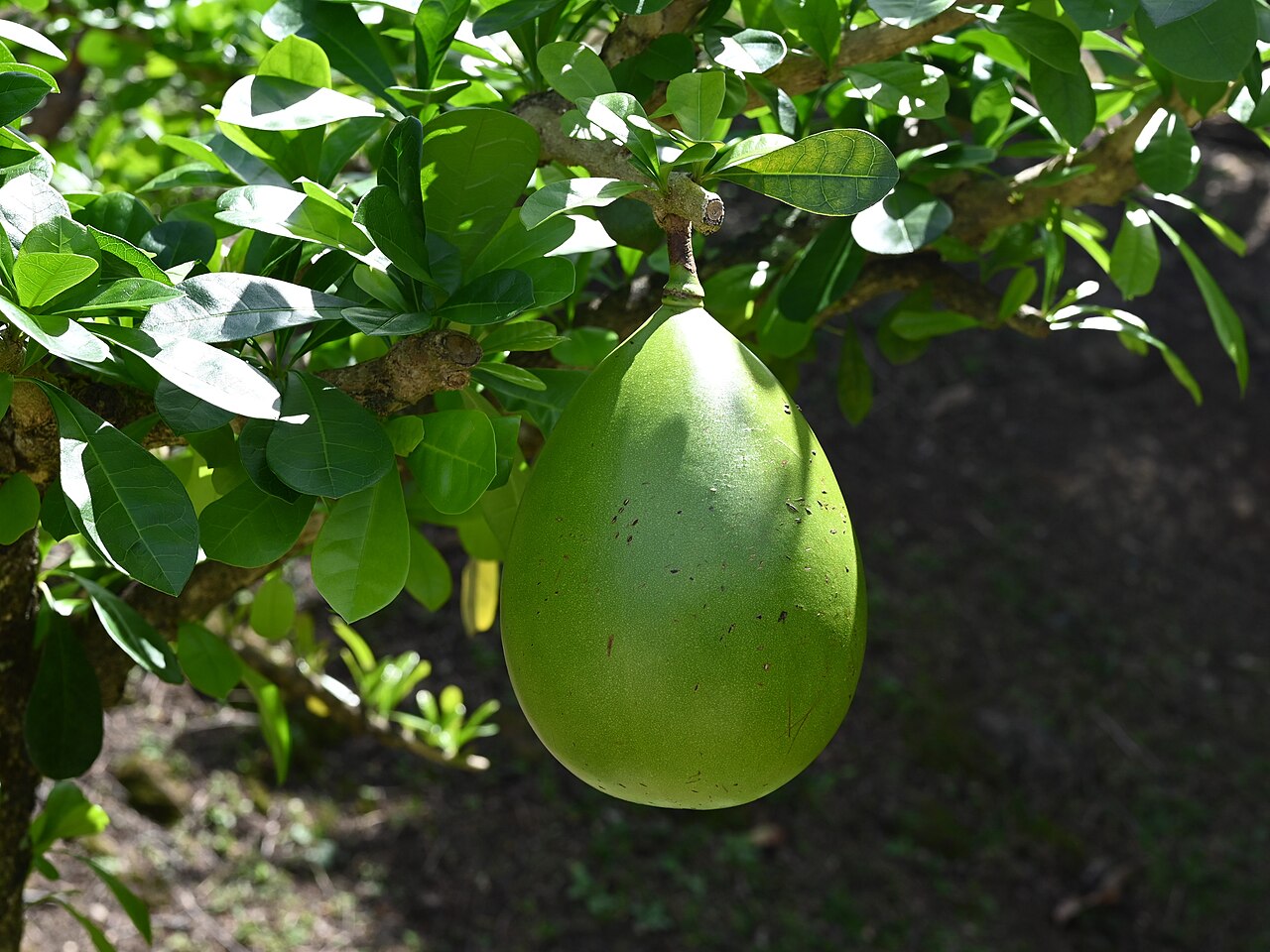
Crescentia cujete, the calabash tree, is known in Puerto Rico as higüera or higüero, and USDA PLANTS lists it as common calabash tree. It is a small, wide-crowned tree of the trumpet-vine family (Bignoniaceae) with long, nearly horizontal branches, clusters of spoon-shaped leaves, and the strangest fruit of any common Caribbean tree: a smooth, hard-shelled gourd up to a foot across, hanging straight off the trunk and limbs.
This is not an ornamental curiosity in Puerto Rico — it is a working tree. The dried shell of the higüera is the raw material for the island’s maracas and for the güiro, the notched scraper that gives Puerto Rican música jíbara and salsa their distinctive rasp, an instrument that descends directly from Taíno practice. Rural households across the Caribbean have used the same gourds for bowls, dippers, cups and storage for centuries.
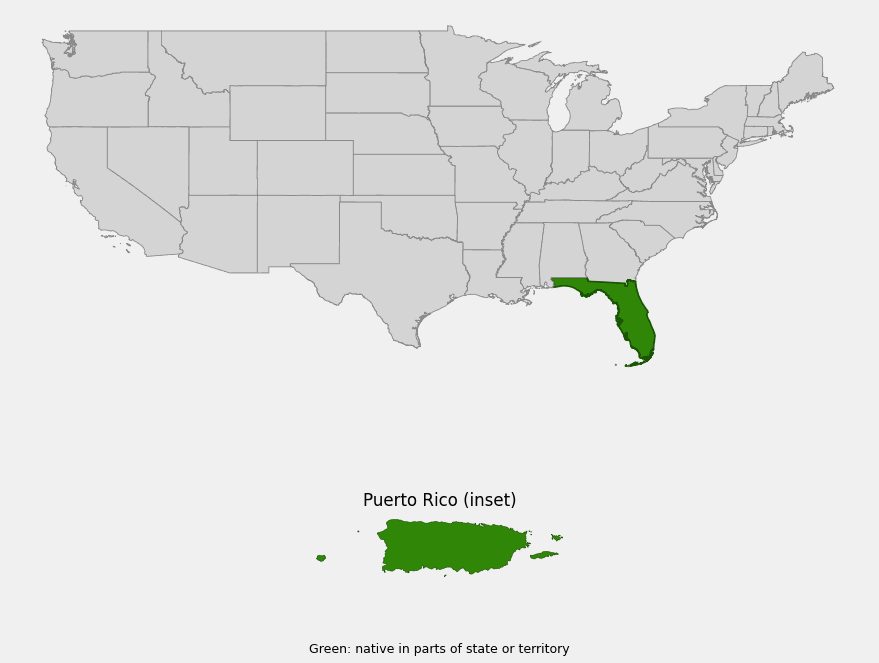
USDA PLANTS lists the calabash tree as native in Puerto Rico, the U.S. Virgin Islands and Florida, though Florida’s own flora project disagrees about the state’s plants (see the range section). For Puerto Rican gardeners it is a small, drought-tough, easy tree with a picturesque habit that fits where most shade trees will not.
Identification
Nothing else in the Puerto Rican landscape combines wide, low, horizontal branching with leaves bunched in tufts and huge gourds growing straight from the wood. Do not confuse the tree with the unrelated bottle gourd vine (Lagenaria siceraria), which produces a similar-looking fruit on a herbaceous vine and shares the English name calabash.
Form & Branching
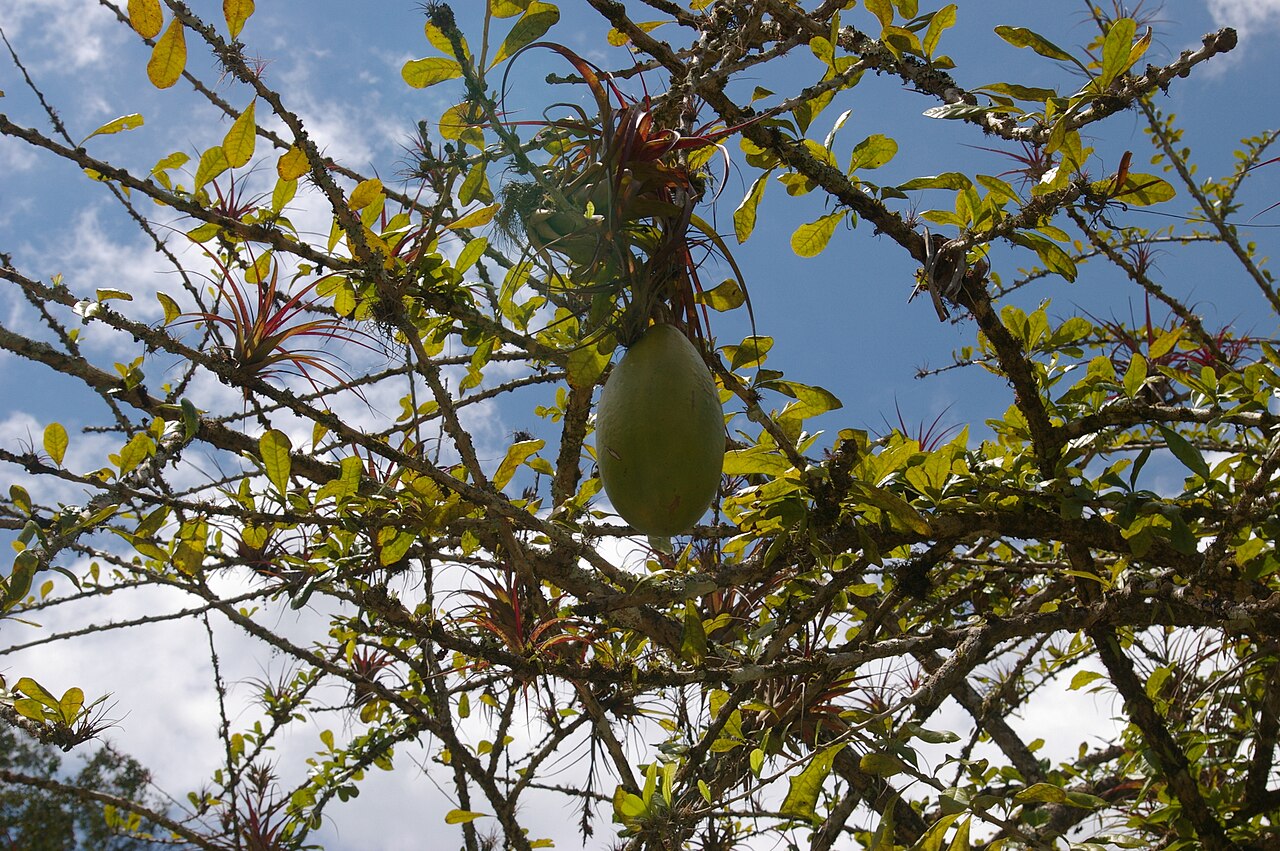
Calabash is a small tree, commonly 15 to 25 feet tall and occasionally to about 33 feet, with a short trunk and a broad, open, flat-topped crown that is often wider than the tree is tall. The main limbs sweep out nearly horizontally, which is why old trees in pastures look like wide green umbrellas. The bark is gray, rough and often deeply furrowed on the trunk, and the limbs commonly carry bromeliads, orchids and lichens.
Leaves
Leaves are simple and arranged alternately, but they are crowded into tight clusters (fascicles) on short spur shoots, so they appear in tufts along the twigs. Each leaf is spatulate — narrow at the base and widening toward a rounded or bluntly pointed tip — roughly 2 to 10 inches long, leathery, dark glossy green above and paler below, with smooth margins and a nearly stalkless base. In dry areas the tree may drop its leaves briefly during drought.
Flowers
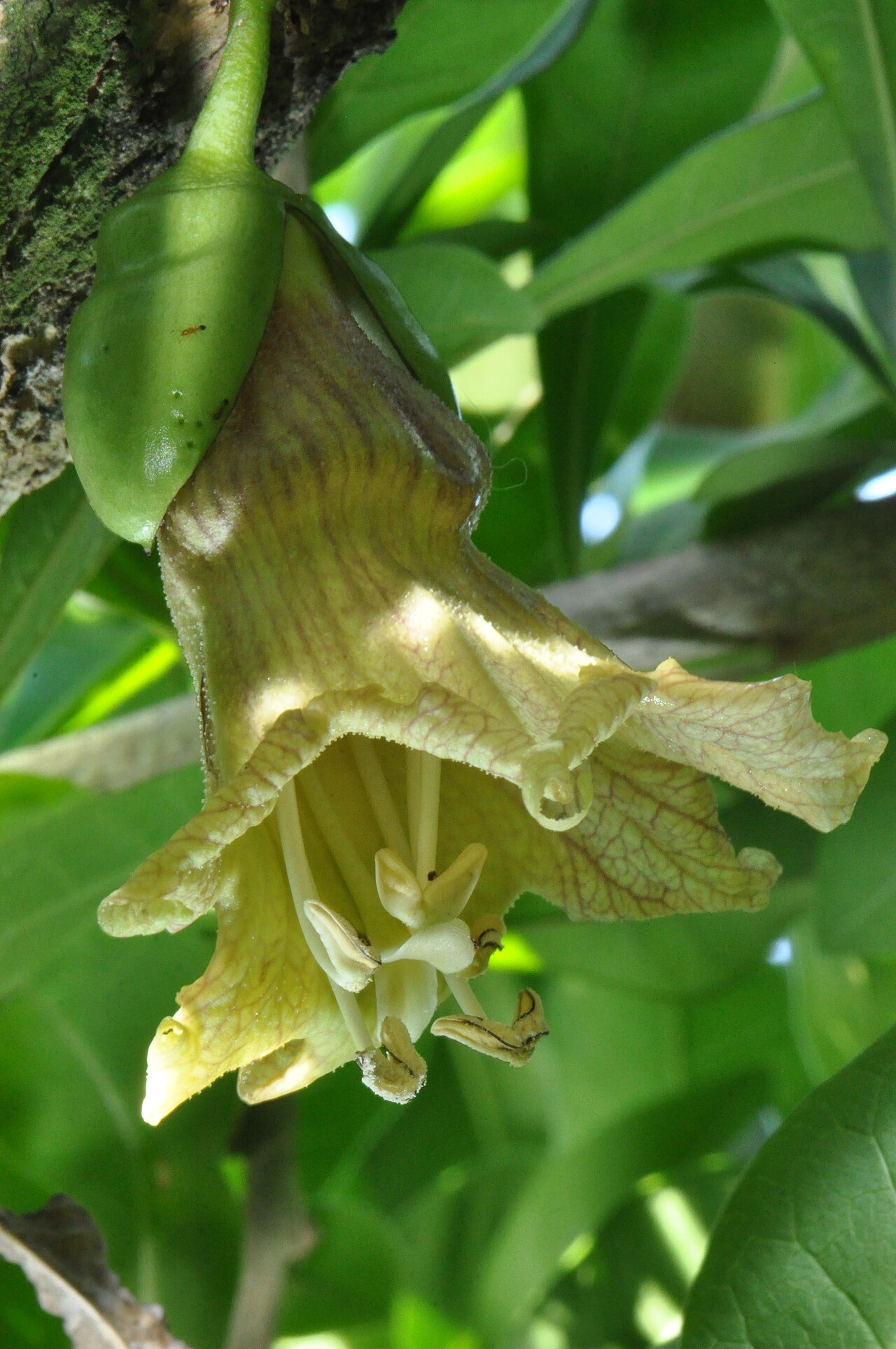
The flowers are cauliflorous, meaning they are produced directly on the trunk and older branches rather than at the shoot tips. Each is solitary or paired, roughly 2 inches long, with a fleshy, bell- or trumpet-shaped corolla that is pale yellow-green heavily veined and flushed with purple-brown, the mouth wrinkled and one-sided. They open in the evening, give off a musty smell, and are pollinated by bats; flowers that are not pollinated drop within a day or two.
Fruit
The fruit is the tree’s signature: a smooth, hard-shelled, green gourd that is round to broadly egg-shaped, commonly 5 to 12 inches across and occasionally larger, hanging on a short stalk from the branch or trunk. Inside is a whitish pulp that turns black and sticky as it ages, holding numerous small, flat, dark seeds. Fruits take months to mature and can stay on the tree for a year. The pulp is not food; the value is in the woody shell.
Growth Habit in the Landscape
Young plants look nothing like old ones. A seedling is an upright, sparse little tree with long whippy shoots and widely spaced leaf tufts, and it takes several years before the horizontal branching and the first flowers appear. Trees usually begin fruiting at about four to six years old in good conditions.
Quick Facts
| Scientific Name | Crescentia cujete L. |
| Family | Bignoniaceae (trumpet-vine family) |
| Plant Type | Small evergreen to briefly deciduous tree |
| Mature Height | 15–25 ft, occasionally to 33 ft |
| Mature Spread | 20–30 ft; crown often wider than tall |
| Growth Rate | Slow to moderate |
| Sun Exposure | Full sun to part shade |
| Water Needs | Low once established; drought tolerant |
| Soil Type | Wide range, including clay, limestone and poorly drained ground |
| Soil pH | Adaptable, roughly 5.5–8.0 |
| Bloom Time | Much of the year; flowers open in the evening |
| Flower Color | Pale yellow-green veined and flushed with purple-brown |
| Fall Color | None; may drop leaves briefly in drought |
| Fruit | Hard-shelled green gourd 5–12 in across, hanging from trunk and branches |
| Deer Resistant | Not applicable in Puerto Rico; no native deer on the island |
| USDA Hardiness Zones | 10–13; frost-sensitive |
| Other Common Names | Higüera, higüero (Puerto Rico); common calabash tree (USDA PLANTS); calabash, totumo, jícaro, kalbas |
Native Range
The calabash tree is native to tropical America and has been carried by people so widely and for so long that its exact original range is hard to reconstruct. USDA PLANTS lists it as native in Puerto Rico, the U.S. Virgin Islands and Florida. Beyond U.S. jurisdictions it occurs through Mexico, Central America, the West Indies and tropical South America, and it is cultivated and naturalized in West Africa, South Asia and Southeast Asia.
Where the sources disagree. The Atlas of Florida Plants treats Florida’s calabash trees as not native to the state, while USDA PLANTS lists the species as native there. Because Florida’s own flora project does not accept it as native, PlantNative does not include this species in its Florida regional lists, and Florida gardeners should treat it as a cultivated tropical tree rather than a Florida native. The map above shades Florida because USDA PLANTS is the mapping source.
In Puerto Rico the tree is everywhere in the lowlands: in pastures and hedgerows, around rural houses, on roadsides and limestone hillsides, and in the dry south as well as the moist north. It tolerates poor drainage better than most dry-country trees and is often seen in low, wet pasture corners where water stands after rain. It is common from sea level up into the foothills, thinning out at higher elevations in the Cordillera Central.
📋 Regional plant lists featuring Calabash Tree: Puerto Rico
Growing & Care Guide
The calabash is among the least demanding trees you can plant in the tropical lowlands. It handles drought, poor soil, wind and periodic wet feet, and its small size suits the kind of yard where a ceiba or a mango would be a mistake.
Light
Full sun produces the broadest crown and the heaviest fruit set. The tree will grow in part shade, but it flowers and fruits far less and tends to stretch. In an open lawn or pasture it develops the characteristic low, horizontal branching that makes it such a distinctive silhouette.
Soil & Water
Calabash grows on almost anything: clay, sand, rocky limestone, acid or alkaline. It is notably tolerant of heavy soils and of ground that floods briefly after storms, which sets it apart from most drought-tolerant tropical trees. Water through the first dry season after planting; afterwards it needs no irrigation in Puerto Rico and holds its leaves through all but the harshest droughts.
Planting Tips
Allow 20 to 30 feet of clear space for the spreading crown, and remember the branches sweep low — do not plant one where you need to drive or walk beneath it, and keep it clear of roof lines. The low limbs are an asset over a seating area or along a pasture fence. Plant at the beginning of the rainy season, mulch out to the drip line, and keep mulch off the trunk.
Pruning & Maintenance
Prune young trees to raise the lowest limbs only if you need headroom; otherwise leave the natural architecture alone, since the horizontal branching is the point. Remove dead wood after storms. If you want gourds for craft work, thin heavy fruit clusters so remaining fruits size up, and support any limb carrying several large gourds. The tree is remarkably free of serious pests in Puerto Rico.
Propagation
Both seed and cuttings work. Cut open a mature gourd, wash the dark pulp off the seeds, dry them in shade and sow fresh in a well-drained mix; germination takes a few weeks and seedlings grow slowly at first. Large hardwood cuttings and truncheons root readily, a method traditionally used for living fence posts, and cutting-grown plants fruit sooner than seedlings. Keep seedlings in deep containers to avoid kinking the taproot.
Landscape Uses
- Small shade trees: a low, wide canopy for yards, patios and pasture corners where a big tree will not fit
- Living fences and hedgerows: rooted truncheons make traditional living fence posts
- Craft and cultural gardens: a working source of gourds for maracas, güiros, bowls and dippers
- Wildlife plantings: evening flowers for bats and horizontal limbs that host bromeliads and orchids
- Wet-corner planting: tolerates low, seasonally wet ground that defeats most dry-country trees
Wildlife & Ecological Value
The calabash is a bat tree from end to end: bats pollinate the flowers at night, and in the wider Neotropics large mammals once handled the seed dispersal. Its spreading limbs also serve as mounting posts for an entire community of epiphytes.
For Pollinators
Flowers open in the evening, smell musty rather than sweet, hang away from the foliage on bare wood, and produce copious nectar — a classic bat-pollination syndrome. Nectar-feeding bats are the main pollinators; in Puerto Rico bats are the only native land mammals. Hawkmoths and other night insects also visit, and bees collect pollen from flowers still open at dawn.
For Birds
Birds do not eat the hard-shelled fruit, but the tree matters to them structurally. The thick horizontal branches are favorite perches, and the bromeliads and other epiphytes that colonize calabash limbs hold water and insects that birds forage in. Hollow older limbs provide nest cavities.
For Mammals
Bats are the key mammal partner. The woody fruit is too hard for most animals to open, and ecologists have long suggested that the calabash’s gourds are a leftover adaptation to large mammals that are now extinct in the Neotropics; today, horses and cattle crack and eat fallen fruit in pastures, which moves seed around.
Ecosystem Role
An old calabash in open country is a miniature ecosystem: its rough bark and horizontal limbs support bromeliads, orchids, ferns, mosses and lichens, and those in turn hold water, insects and tree frogs well above the ground. Because the tree survives in pastures and along fencerows where forest has been cleared, it is often the main refuge for epiphytes across whole stretches of farmed lowland.
Cultural & Historical Uses
In Puerto Rico the higüera is the source of the island’s most characteristic instruments. Dried gourds, cleaned of pulp and filled with seeds or pebbles, become maracas; a long gourd with parallel notches cut across one face becomes the güiro, played with a wire-tined scraper. Both instruments carry forward Taíno practice — the güiro is widely traced to Indigenous Caribbean origins — and both remain central to música jíbara, bomba, plena and salsa.
The same shells have served Caribbean households as bowls, cups, dippers, ladles, bottles, rattles and storage containers for centuries. In Cuba farmers use dried calabashes as coffee cups; in Haiti the plant is called kalbas kouran and supplies the ason, the sacred rattle of the Vodou priesthood; in Brazil the shells are the resonators of the berimbau used in capoeira; in rural Mexico a hollowed fruit becomes a water canteen (a bule or guaje), and the halved shells are the original jícaras. The tree is the national tree of St. Lucia.
Linnaeus described Crescentia cujete in 1753, the specific epithet coming from an Indigenous name for the tree. The species is listed as Least Concern by the IUCN and ranked Apparently Secure by NatureServe. The soft-to-moderately-hard wood has been used for tool handles, saddle frames and small turned goods, but the tree’s real economic history has always been in its fruit rather than its timber.
Frequently Asked Questions
Is the calabash tree native to Puerto Rico?
USDA PLANTS lists Crescentia cujete as native in Puerto Rico and the U.S. Virgin Islands. People have moved the species around the tropics for millennia, so its precise original range is debated, but it is accepted as part of the native flora of Puerto Rico and the West Indies.
Is it native to Florida?
The sources disagree. USDA PLANTS lists it as native in Florida; the Atlas of Florida Plants treats the state’s plants as not native. PlantNative does not include this species in Florida regional lists, so Florida gardeners should treat it as a cultivated tropical tree, not a Florida native.
Can you eat calabash fruit?
No, not as a fruit. The whitish pulp turns black and sticky and is not eaten; the value of the gourd is its hard shell. Various parts of the plant appear in traditional medicine across the tropics, but the fruit is not food and should not be treated as such.
How do I dry a gourd for a maraca or güiro?
Harvest a mature fruit, cut or drill the opening you need, scoop out the pulp and seeds, and let the shell dry in a shaded, airy place for several weeks until it is light and hard. Many makers soak or boil the shell first to loosen the pulp. Once dry it can be sanded, cut, notched and finished.
Why are the flowers growing out of the trunk?
That habit is called cauliflory and is common in tropical trees. The calabash produces its flowers and fruits on the trunk and old branches, where the heavy gourds can be supported by thick wood and where night-flying bats can reach the flowers without pushing through foliage.

Looking for a nursery that carries Calabash Tree?
Our nursery directory does not yet include Puerto Rico. Browse the native plant nursery directory by state: Alabama–Arkansas · California · Colorado–Hawaii · Idaho–Kansas · Kentucky–Montana · Nebraska–Oklahoma · Oregon · Pennsylvania–Virginia · Washington · West Virginia–Wyoming