
Western Skunk Cabbage (Lysichiton americanus)
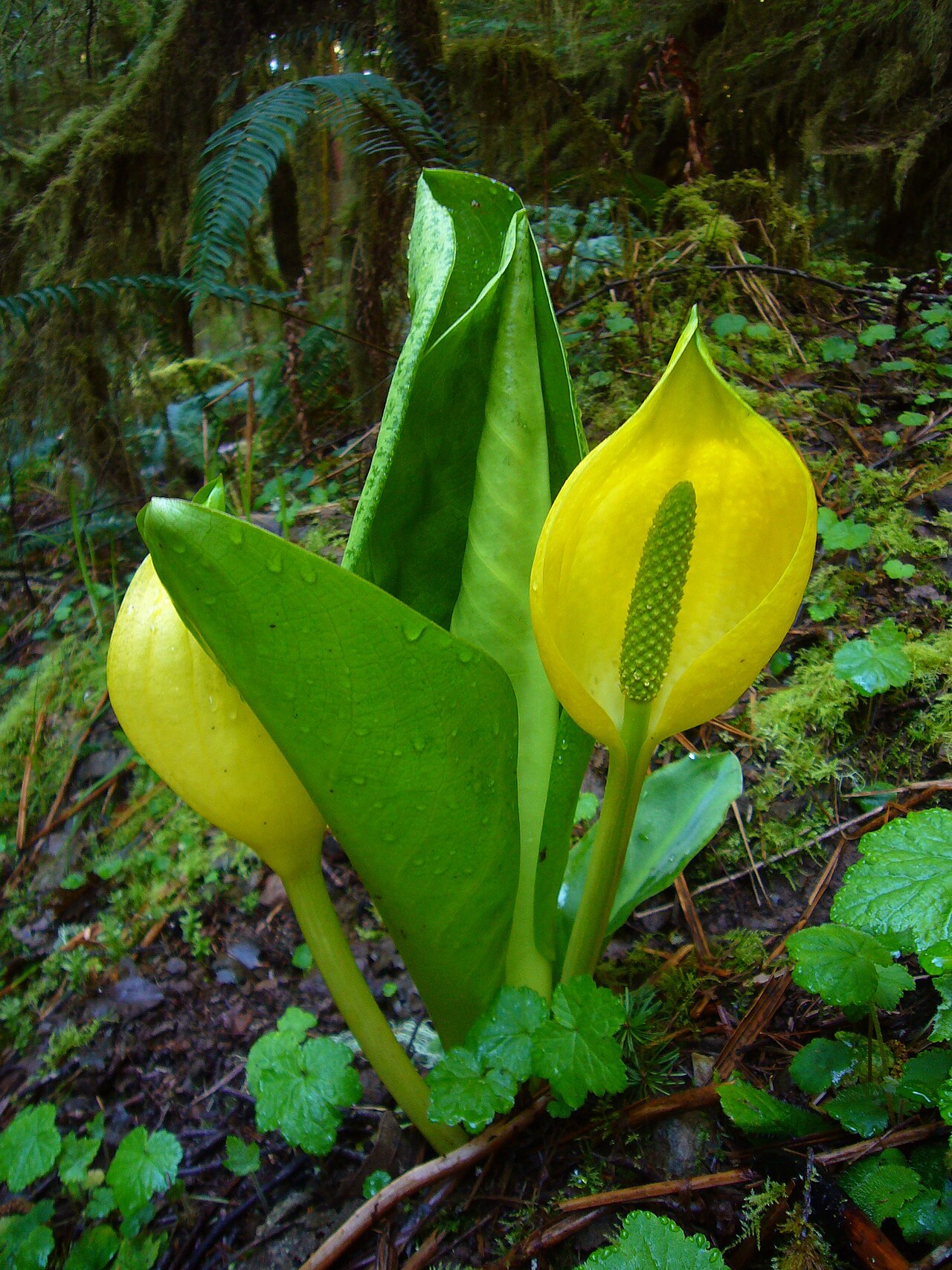
Lysichiton americanus, known as Western Skunk Cabbage, yellow skunk cabbage or swamp lantern (USDA common name American skunkcabbage), is one of the signature plants of Pacific Northwest wetlands. In late winter and early spring it sends up brilliant yellow, hood-like spathes that glow against the dark mud of swamps and forest seeps. Soon afterward it unfurls some of the largest leaves of any native plant in the region, glossy green paddles that can reach 4 to 5 feet long.
It is a member of the arum family (Araceae), along with jack-in-the-pulpit and the eastern skunk cabbage, Symplocarpus foetidus. The two skunk cabbages are not closely related within the family and look quite different: the eastern species has a mottled maroon hood, while the western species has a bright yellow one. Both have a musky, skunk-like odor, which in the western species comes mainly from the flowers and attracts the small beetles that pollinate them.
Safety note: the leaves and roots contain needle-like calcium oxalate crystals that cause intense burning and swelling of the mouth and throat if eaten raw. Western skunk cabbage is a superb plant for a wet, shady native garden, but keep it away from children and pets who might chew on it. This guide covers identification, range, care, wildlife value and the plant’s long history in Indigenous cultures of the Northwest Coast.
Identification
In bloom, western skunk cabbage is unmistakable: no other native wetland plant in the West has a large yellow spathe wrapped around a thick green flower spike. In summer the huge, smooth, untoothed leaves in a basal rosette are equally distinctive. Eastern skunk cabbage does not grow in the West.
Roots & Rhizome
Each plant grows from a thick, upright, fleshy rhizome buried in wet muck, anchored by stout contractile roots that pull it deeper over time. Plants are long-lived, and large clumps may be decades old. There is no above-ground stem; the flowers and leaves rise directly from the rhizome.
Flowers
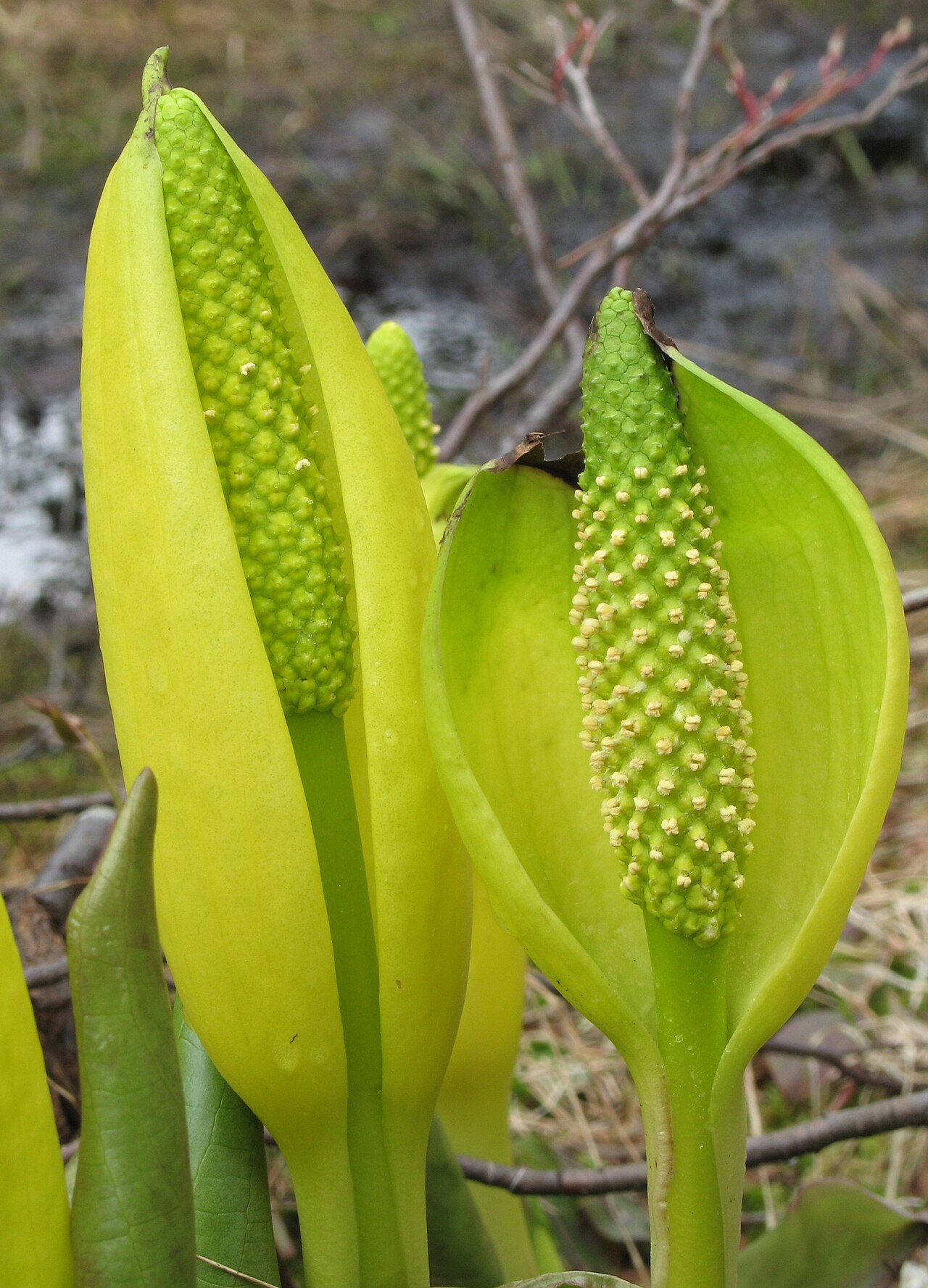
Flowering begins as early as February in lowland areas and continues into May or June at higher elevations and in the north. A thick spadix, 3 to 6 inches long, emerges from the mud on a stout stalk, packed with hundreds of tiny greenish-yellow flowers. It is partly wrapped in a large, bright yellow, hood-shaped spathe up to about 8 inches long. The flowers give off a musky, skunk-like smell, which is strongest on warm days.
Leaves
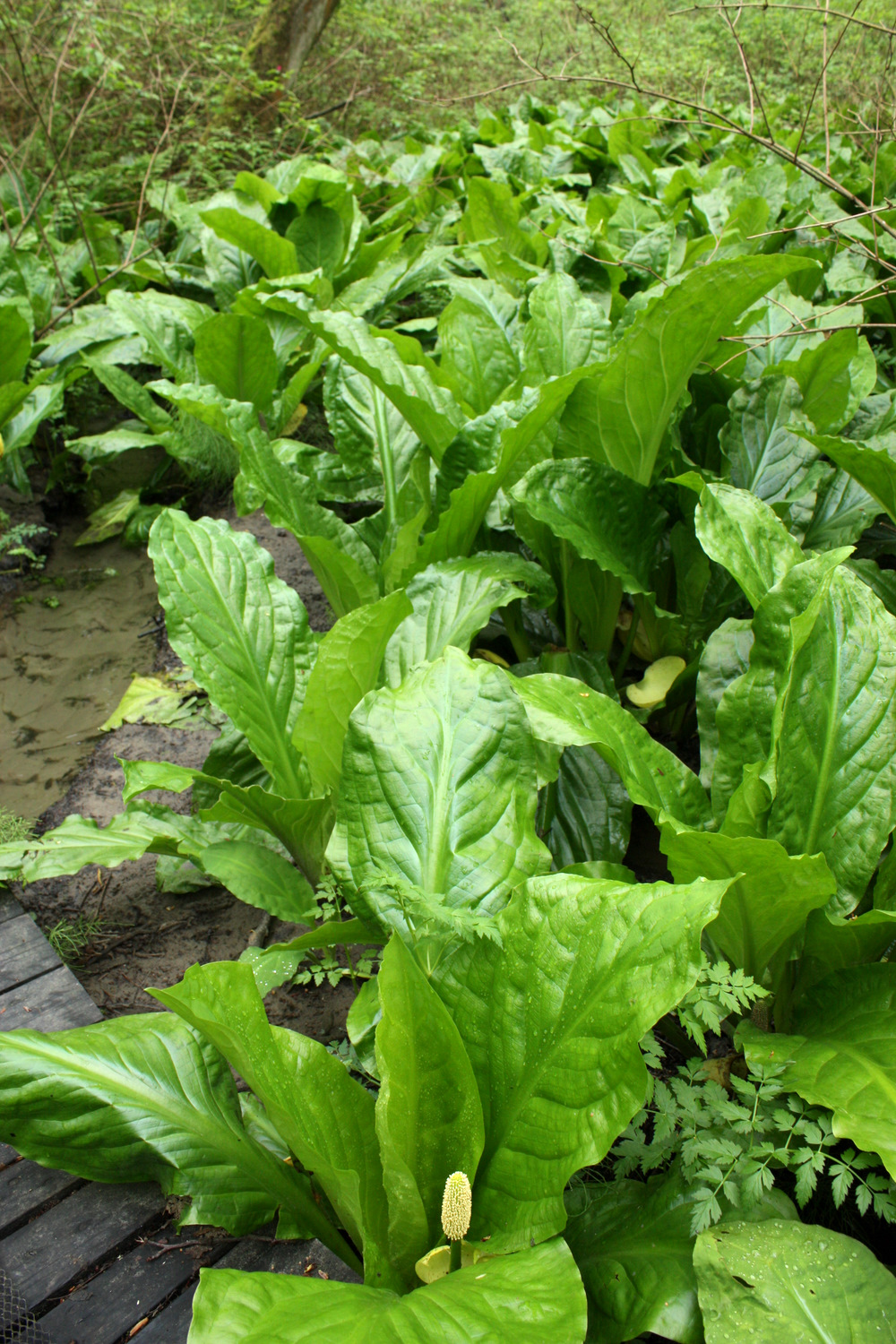
The leaves emerge around the time of flowering and keep growing into summer. They are oval to oblong, smooth-edged, glossy and leathery, with a prominent pale midrib, and they form an upright rosette. Typical leaves are 1 to 3 feet long, and in deep, rich muck they can reach 4 to 5 feet, making a plant up to about 5 feet tall. The leaves die back in fall, and the plant is dormant through winter.
Fruit & Seeds
After flowering, the spathe withers and the spadix swells and turns green as the fruit develops. The fruits are small, pulpy berries embedded in the spadix, each containing one or two seeds. In summer the ripe spadix falls apart and the seeds are released into mud or water, where they may be carried by the current or eaten by animals.
Quick Facts
| Scientific Name | Lysichiton americanus Hultén & H. St. John (USDA common name: American skunkcabbage) |
| Family | Araceae (arum family) |
| Plant Type | Herbaceous wetland perennial (forb) from a thick rhizome |
| Mature Height | 1–3 ft; up to about 5 ft in rich muck |
| Mature Spread | 2–4 ft per plant |
| Growth Rate | Slow to establish; long-lived |
| Sun Exposure | Part shade to full shade; sun if constantly wet |
| Water Needs | Very high; soil must be wet to saturated year-round |
| Soil Type | Wet, organic muck, peat or silt |
| Soil pH | About 5.0–7.0 |
| Bloom Time | February–June (earliest at low elevations) |
| Flower Color | Yellow spathe around a greenish-yellow spadix |
| Fall Color | Leaves yellow and collapse before winter dormancy |
| Fruit | Green berries embedded in the spadix, summer |
| Deer Resistant | Partly; deer and elk may graze leaves, and bears dig and eat the plants |
| USDA Hardiness Zones | 4–9 |
Native Range
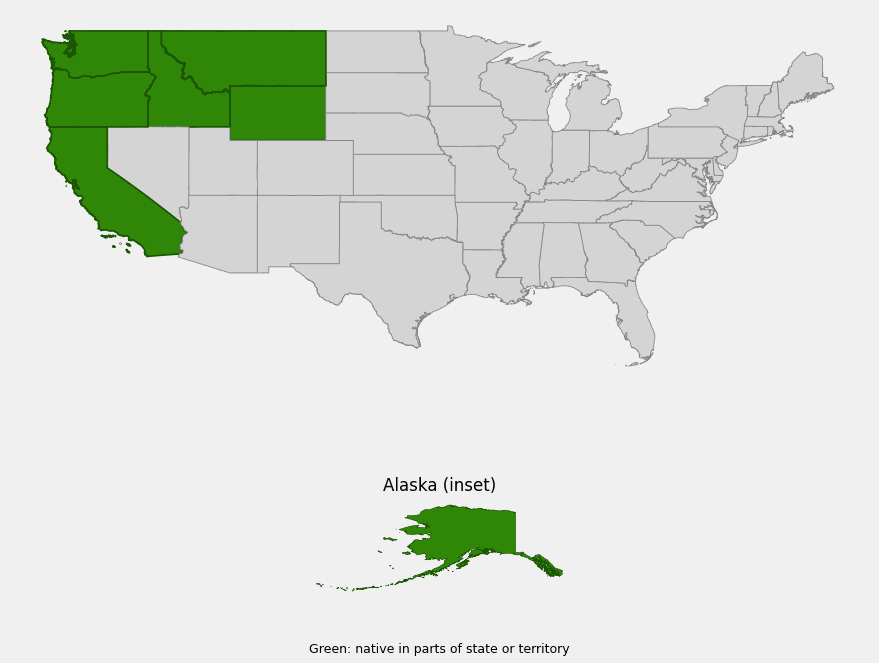
Western skunk cabbage grows along the Pacific Coast of North America from southern Alaska to central California. USDA PLANTS records it as native in Alaska, Washington, Oregon, California, Idaho, Montana and Wyoming, and in Canada in British Columbia, where it is abundant along the coast and on Vancouver Island and Haida Gwaii.
It is most common west of the Cascade and Coast mountains, from southeastern and south-central Alaska through coastal British Columbia, the Olympic Peninsula, the Puget Sound lowlands and western Oregon. In California it is found along the north coast and in the Coast Ranges, reaching south to around Santa Cruz County. Inland it is less common, reaching moist valleys of northern Idaho and northwestern Montana, and USDA also records it in Wyoming at the eastern edge of its range.
Its habitat is consistently wet: swamps, bogs and fens, forested wetlands, wet lowland forests, seeps and springs, stream banks and the margins of ponds. It is often abundant under red alder, western redcedar and Sitka spruce, where the soil stays saturated through the summer. It grows from sea level to well over 4,000 feet in the mountains.
📋 Regional plant lists featuring Western Skunk Cabbage: Idaho, Eastern Oregon & Eastern Washington · Montana & Wyoming · Alaska
Growing & Care Guide
Western skunk cabbage is a striking, nearly tropical-looking plant for wet, shady gardens within its native range. It needs permanently wet soil, so it is suited to pond edges, bog gardens, seeps and wet woodland, not ordinary flower beds. It is slow to establish, but a mature clump is long-lived and almost care-free.
Light
Part shade to full shade is ideal, as under alder or cedar along a stream. It tolerates more sun where its roots stay in cold, saturated soil, but its leaves may scorch in hot, dry summer sun.
Soil & Water
Plant it in deep, rich, organic muck or peat that stays wet year-round. It thrives in soil that is waterlogged and poorly aerated, where most plants would rot, and it will tolerate shallow standing water. It does not tolerate drying out. In dry-summer climates, place it where a spring, stream or pond keeps the soil saturated.
Planting Tips
Plant nursery-grown plants in early spring or fall, setting the crown at the soil surface. Space plants at least 3 feet apart to allow for the large leaves. The plants go fully dormant in winter, leaving a gap, so pair them with evergreen ferns or sedges. Never dig wild plants; their deep rhizomes rarely survive transplanting.
Pruning & Maintenance
Little care is needed. Remove dead leaves in fall if you want a tidier look, and keep the soil wet. Wear gloves when handling broken leaves or roots, as the sap can irritate skin. Slugs may chew the young leaves.
Propagation
Grow it from fresh seed sown in pots of wet, peaty soil kept constantly moist; seedlings take several years to reach flowering size. Large clumps can sometimes be divided carefully in early spring.
Safety
All parts contain sharp calcium oxalate crystals. Chewing raw leaves or roots causes immediate burning pain and swelling of the lips, mouth and throat, and swallowing larger amounts can cause digestive upset. Keep children and pets away from it, and do not experiment with eating it. If someone eats it, rinse the mouth and contact Poison Control (1-800-222-1222 in the United States) or a veterinarian.
Do Not Plant Outside Its Native Range
Western skunk cabbage was introduced to European gardens and has escaped into wetlands in Britain, Ireland, Germany and other countries. The European Union lists it as an invasive species of concern, and planting or selling it is restricted there. Grow it only within its native range in western North America.
Landscape Uses
- Pond and stream edges: bold, tropical-looking foliage for permanently wet, shady banks
- Bog and rain gardens: for sites with saturated soil within its native range
- Wetland restoration: a keystone plant of forested wetlands and seeps in the Pacific Northwest
- Woodland gardens: an early-spring highlight paired with ferns, salmonberry and sedges
Wildlife & Ecological Value
Western skunk cabbage is an important spring food source in Pacific Northwest wetlands, and its huge leaves shade and shelter the forest floor through the summer.
For Pollinators
The main pollinators are small rove beetles, especially Pelecomalium testaceum, which gather in large numbers on the spadix, feeding on pollen, mating and laying eggs. The musky scent attracts them. Flies and bees also visit the flowers, but the beetles appear to do most of the pollination.
For Birds
Birds make little direct use of the plant, but wetlands dominated by skunk cabbage support insects, amphibians and invertebrates that feed wrens, thrushes and other forest birds.
For Mammals
Black and brown bears dig and eat the roots, flower spikes and young leaves in spring, often right after emerging from hibernation, when little other food is available. Deer and elk graze the leaves, and small mammals eat the seeds. Animals that eat the plant appear to tolerate its oxalate crystals better than people.
Ecosystem Role
Western skunk cabbage is a characteristic plant of saturated forest soils. Its rhizomes help stabilize muck and stream banks, and its large leaves shade the soil, keeping wetland surfaces cool and moist. Its presence is a reliable sign of a permanently wet site.
Cultural & Historical Uses
The large, waxy leaves were widely used by Indigenous peoples of the Northwest Coast. They were used like wax paper to line baskets and berry containers, to wrap food for steaming and baking in pits, and to cover drying racks. They also served as cups and as covers for camas and other roots cooked in earth ovens.
The roots and young leaves were eaten in times of famine, but only after thorough roasting or steaming to break down the calcium oxalate crystals. Many traditions describe it as a hunger food rather than a staple. It was also used medicinally, with warmed leaves applied to burns, wounds, swellings and aching joints.
The species was formally described in 1931 by Eric Hultén and Harold St. John. The genus name comes from Greek words for “loosening” and “tunic”, referring to the spathe. Today western skunk cabbage is a beloved early-spring sight in the Pacific Northwest, where its yellow “swamp lanterns” are celebrated at nature centers and parks.
Frequently Asked Questions
Does western skunk cabbage really smell like a skunk?
The flowers give off a musky, somewhat skunk-like odor, strongest on warm spring days, which attracts the beetles that pollinate them. The leaves smell when crushed but are not usually noticeable otherwise. Many people find the smell mild unless they get close.
Is western skunk cabbage poisonous?
It contains calcium oxalate crystals that cause intense burning and swelling of the mouth and throat if chewed raw, and it can upset the stomach. It should not be eaten. Keep children and pets from chewing it.
How is it different from eastern skunk cabbage?
Western skunk cabbage (Lysichiton americanus) has a bright yellow spathe and grows along the Pacific Coast. Eastern skunk cabbage (Symplocarpus foetidus) has a mottled maroon and green spathe and grows in eastern North America. Eastern skunk cabbage also generates notable heat that melts surrounding snow.
Can I grow western skunk cabbage in my garden?
Yes, if you live within its native range and have a site with permanently wet, organic soil in partial shade, such as a pond edge, seep or bog garden. Buy plants from a native plant nursery rather than digging them from the wild. Do not plant it outside western North America, where it can become invasive.
When does western skunk cabbage bloom?
At low elevations along the coast it blooms from February to April, often one of the first plants to flower. In the mountains and in Alaska, flowering continues into May and June.

Looking for a nursery that carries Western Skunk Cabbage?
Browse our native plant nursery directory: Alaska · California · Idaho · Montana · Oregon · Washington · Wyoming