Skunk Cabbage (Symplocarpus foetidus)
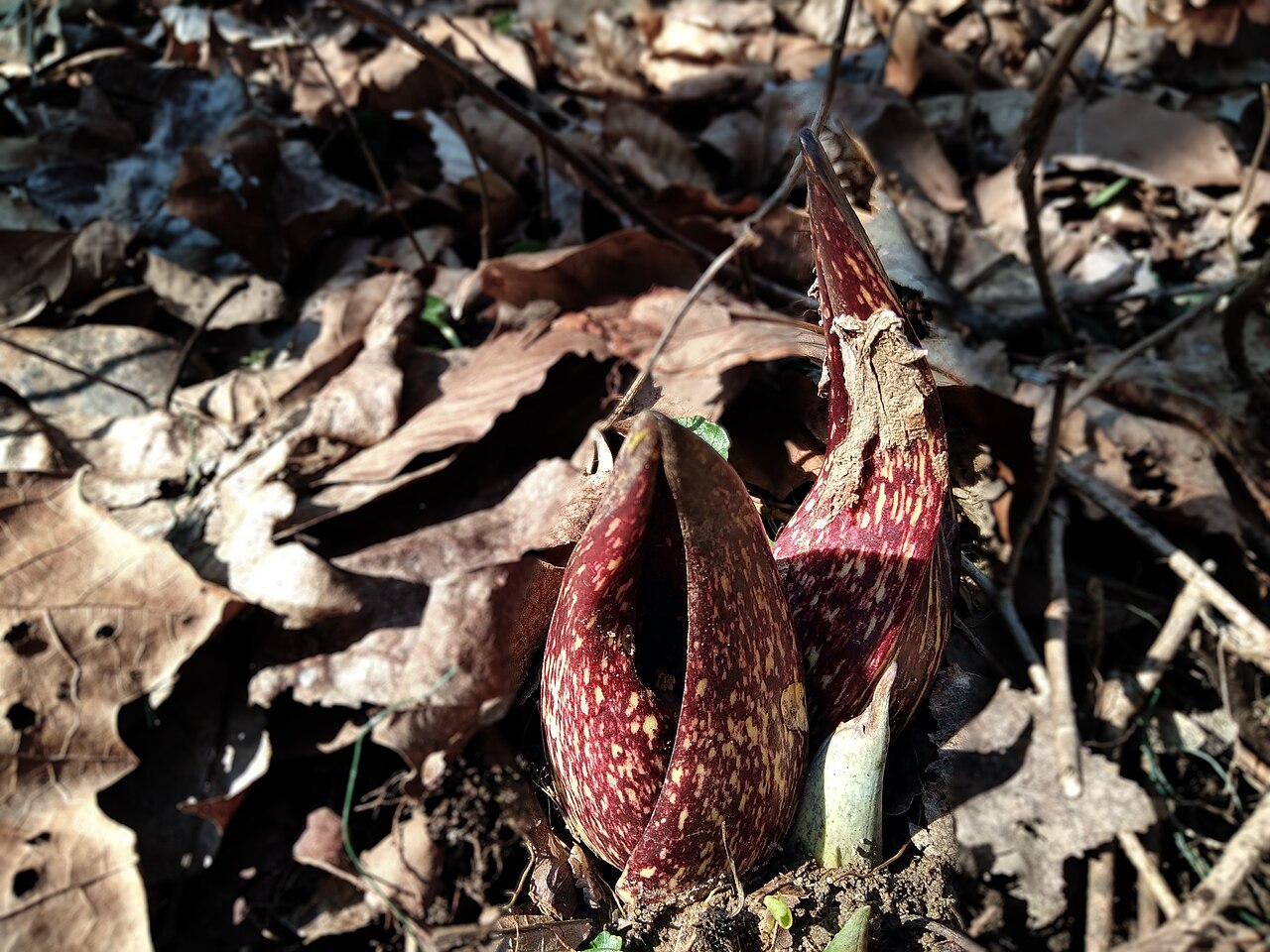
Symplocarpus foetidus, commonly known as Skunk Cabbage or Eastern Skunk Cabbage, is one of the first native wildflowers to appear each year in the wetlands and seepage swamps of eastern North America — sometimes weeks before the last snow has melted. Its hooded, mottled maroon-and-yellow flower structure (the spathe) is unmistakable, and its odd claim to fame is biological: skunk cabbage is one of the few plants on Earth that generates its own heat, melting a path through frozen ground and snow to bloom while almost nothing else is stirring.
The plant belongs to the arum family (Araceae), the same family as jack-in-the-pulpit and calla lily, and it shares their basic flower architecture: a fleshy spike of tiny true flowers (the spadix) wrapped in a showy modified leaf (the spathe). After the flowers finish, skunk cabbage sends up a tight coil of leaves that unfurls into some of the largest simple leaves of any eastern wildflower — broad, cabbage-like blades that can reach nearly two feet long by midsummer, then collapse into black slime and vanish by late summer, leaving almost no trace until the following late winter.
Skunk cabbage is not a plant for a typical flower bed. It belongs in the wet, shaded, low-lying corners of a native landscape — the swampy edge, the spring seep, the streambank that stays soggy all year. Where those conditions exist, it is an outstanding, long-lived, essentially maintenance-free native that provides genuine ecological value, feeding early-emerging insects at a time of year when almost nothing else is blooming.
Identification
Skunk cabbage grows from a thick, deeply anchored rhizome that can be a foot or more long on older plants. The roots are contractile — they physically shorten each year and pull the rhizome deeper into the soil, which is why mature plants are nearly impossible to dig up and why the same clump can persist in the same spot for decades, by some accounts over a century.
Flowers (Spathe and Spadix)
The first visible sign of skunk cabbage each year is the spathe: a thick, hood-shaped structure 4 to 6 inches tall, mottled in maroon, purple-brown, and greenish-yellow, with a tightly curled slit opening on one side. Inside sits the spadix, a ball-like cluster of tiny flowers 2 to 4 inches across. The flowers are perfect (both male and female parts) but mature at different times within the same spadix, which reduces self-pollination. Blooming begins as early as late January in the southern part of the range and continues into April farther north, with spathes often pushing up directly through snow and ice.
Leaves
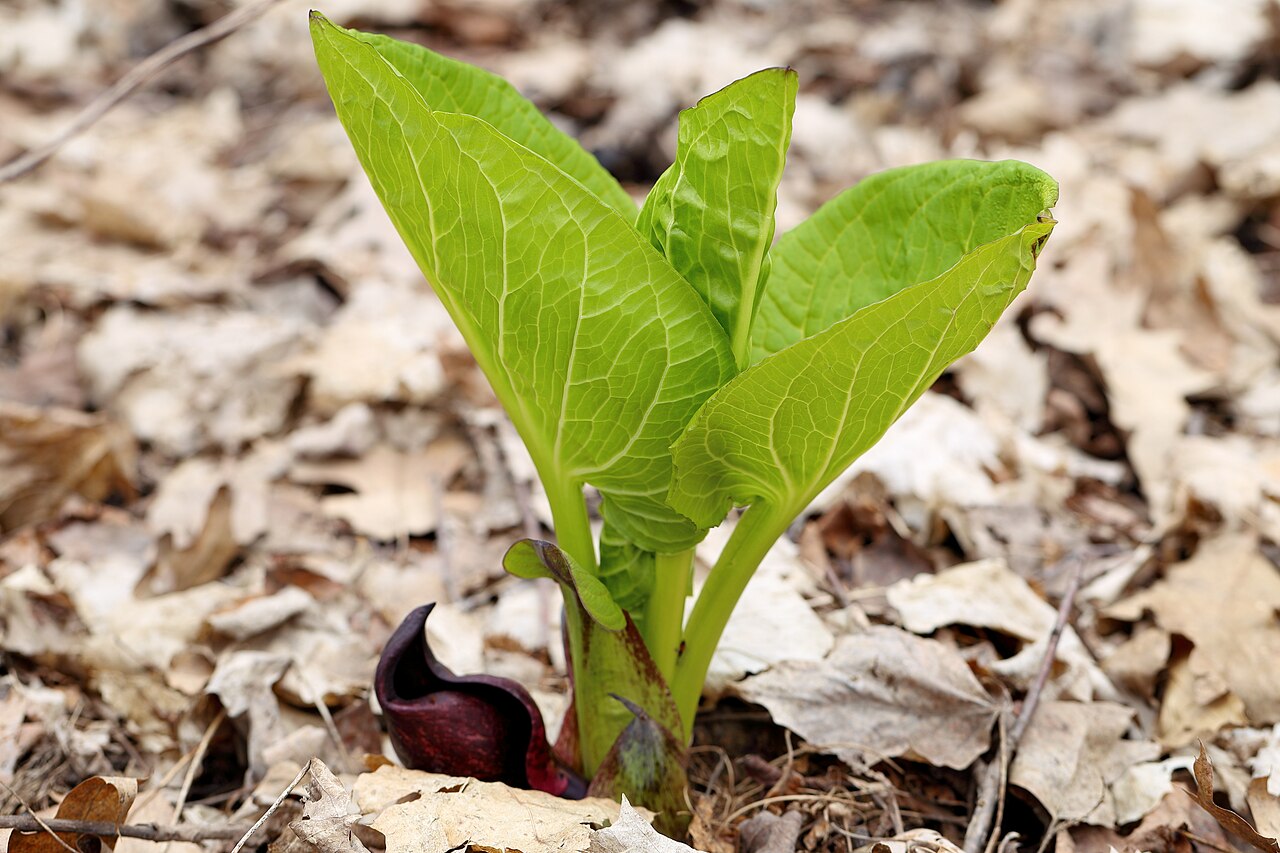
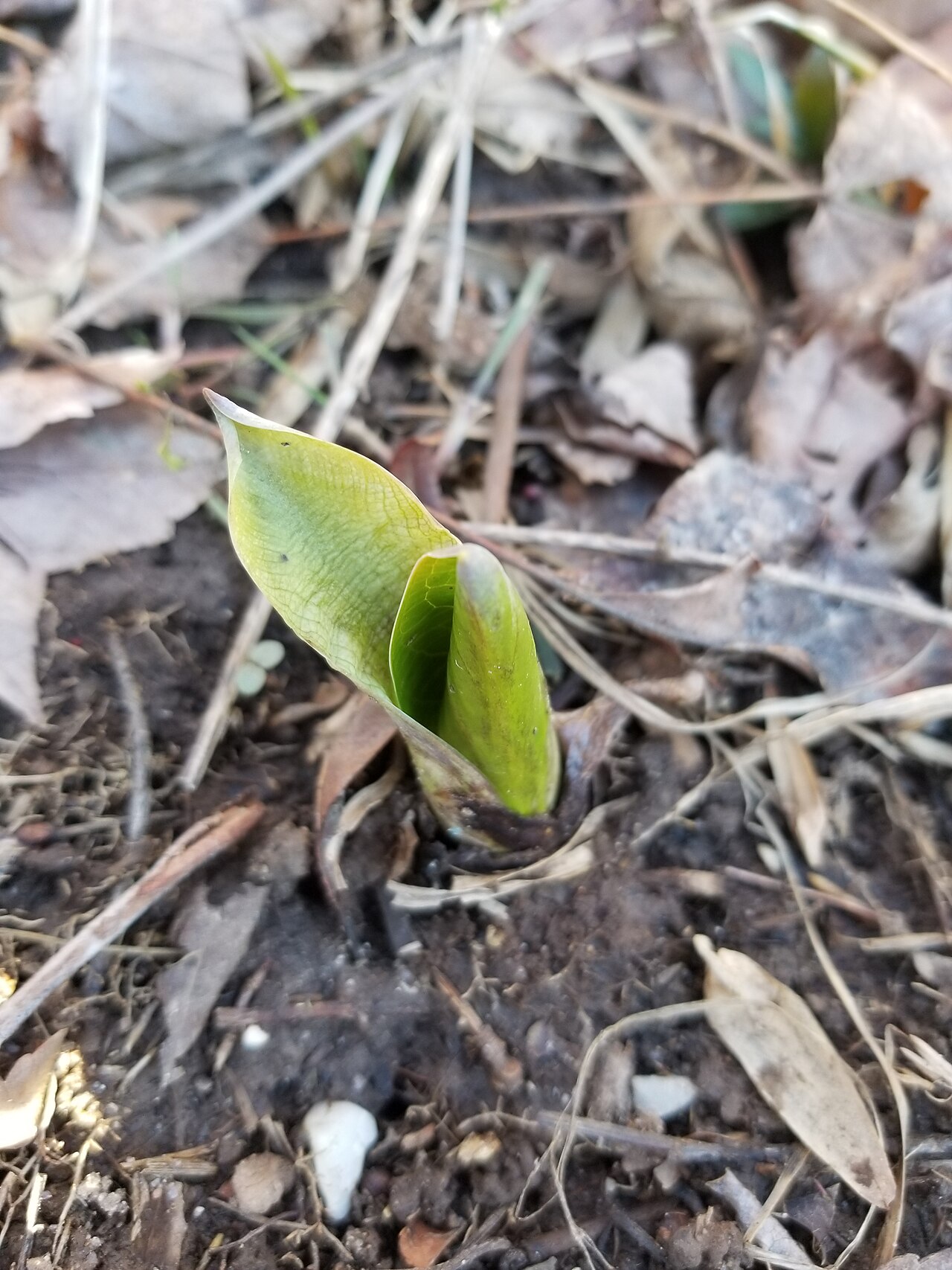
Leaves emerge after flowering as tightly rolled, purplish-green spikes that unfurl into broad, heart- to egg-shaped blades 12 to 22 inches long and 10 to 16 inches wide, with thick midribs and strong parallel-to-netted veining. A single clump may produce half a dozen or more leaves, forming a dense, lush, cabbage-like rosette by late spring. The foliage yellows and collapses into a dark, mucilaginous mass by mid- to late summer as the plant goes dormant, a trait sometimes called “melting away.”
Fruit & Seeds
As the spathe and spadix age over the growing season, the spadix swells into a spongy, dark compound fruit roughly the size of a golf ball, embedded with hard, pea-sized seeds. It eventually slumps to the ground near the base of the plant, where the seeds are scattered locally by gravity, floodwater, and foraging animals.
Odor
Bruised or torn tissue — leaves, flowers, or roots — releases a pungent, skunk-like odor, the source of the common name. The smell, along with the heat the spathe generates, helps attract the carrion-seeking flies and early-season beetles that pollinate the flowers.
Quick Facts
| Scientific Name | Symplocarpus foetidus |
| Family | Araceae (Arum) |
| Plant Type | Herbaceous Perennial Wildflower |
| Mature Height | 1–2 ft in leaf |
| Mature Spread | 2–4 ft per clump |
| Growth Rate | Slow to establish; long-lived once settled |
| Sun Exposure | Part Shade to Full Shade |
| Water Needs | Wet to consistently moist; will not tolerate drought |
| Soil Type | Rich, mucky, saturated organic soils |
| Soil pH | Acidic to neutral |
| Bloom Time | Late winter – early spring (Jan–Apr, by latitude) |
| Flower Color | Mottled maroon, purple-brown and yellow-green spathe |
| Fall Color | None; foliage collapses and disappears by late summer |
| Fruit | Spongy dark compound fruit at ground level |
| Deer Resistant | Yes — acrid, toxic foliage |
| USDA Hardiness Zones | 3–7 |
Native Range
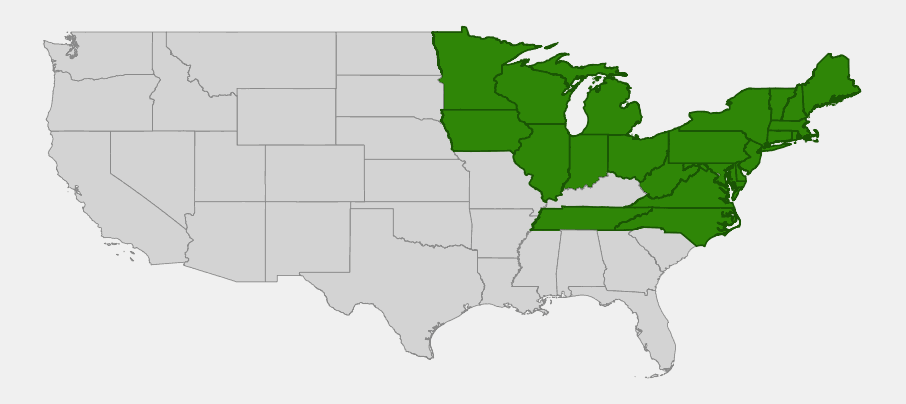
Skunk cabbage is native to eastern North America, from the Maritime Provinces and southern Quebec west through the Great Lakes states to Minnesota and eastern Iowa, and south through the Mid-Atlantic and Appalachians to the mountains of eastern Tennessee and western North Carolina. It is most abundant in the glaciated Northeast and Upper Midwest, where seasonal wetlands, forested swamps, and spring seeps are common; populations thin out toward the southern edge of its range, and it is listed as an endangered species in Tennessee.
Across this range, skunk cabbage occupies wet, mucky ground that rarely dries out: forested floodplains, swamp forests, spring-fed seeps, streambanks, and the margins of ponds and vernal pools. It is a strong indicator of consistently saturated, organically rich soil and is typically found growing in loose colonies rather than as isolated individuals, since established clumps spread very slowly outward over many years.
Despite its wide range, skunk cabbage is a specialist that does not tolerate drying out, which is why it is absent from the drier interior and western portions of the continent even where climate and latitude might otherwise suit it. Gardeners outside its native wetland habitat should not expect it to thrive without a genuinely wet, shaded site.
📋 Regional plant lists featuring Skunk Cabbage: New Hampshire, Maine & Vermont · Connecticut, Massachusetts & Rhode Island · New York, Pennsylvania & Northern New Jersey · Delaware, Southern New Jersey & Long Island · Maryland, Virginia & West Virginia · North Carolina & South Carolina · Kentucky & Tennessee · Ohio & Indiana · Illinois, Iowa & Missouri · Michigan, Wisconsin & Eastern Minnesota
Growing & Care Guide
Skunk cabbage rewards patience rather than effort. It is not difficult to grow in the right spot, but the right spot is specific: a permanently wet, shaded corner of the landscape. Once established, it needs almost no maintenance and will persist for decades.
Light
Part shade to full shade suits it best, mimicking the forested swamps and seepage woods where it grows wild. It can tolerate more open sun in cooler northern climates if the soil never dries out, but in most of its range deep shade with consistently saturated soil produces the healthiest plants.
Soil & Water
This is the one non-negotiable requirement: soil that stays wet or saturated essentially year-round. Skunk cabbage is a plant for rain gardens, pond margins, bog gardens, spring seeps, and the low, soggy edges of a woodland that other plants avoid. It thrives in rich, organic, mucky soil and tolerates standing water for extended periods. It does not tolerate drought, even briefly, and will decline quickly in soil that is allowed to dry out.
Planting Tips
Plant container-grown skunk cabbage in fall or early spring directly into permanently moist, shaded ground; bare-root divisions establish slowly and resent disturbance once their deep, contractile roots take hold. Because mature plants are nearly impossible to transplant, choose the permanent location carefully. Space plants 2 to 3 feet apart to allow room for clumps to fill in over time.
Pruning & Maintenance
None needed. The foliage collapses and disappears naturally by mid- to late summer; simply leave the site undisturbed, since the rhizome persists underground through the dormant season and will send up new growth the following late winter.
Landscape Uses
- Bog gardens and rain gardens where soil stays saturated
- Woodland seeps and stream edges too wet for most other perennials
- Naturalized swamp or wetland restoration plantings
- Early-season wildlife interest — one of the very first native blooms of the year
- Pond margins with consistent shade and moisture
Wildlife & Ecological Value
Skunk cabbage plays an outsized ecological role for its size and season, blooming at a time of year when it has almost no competition for pollinators and offering some of the only shelter and forage available in late-winter wetlands.
For Pollinators
The spathe’s internal temperature can run well above the surrounding air through a process called thermogenesis, and that warmth — combined with the plant’s carrion-like odor — draws early-flying flies, gnats, and some beetles into the chamber to feed and shelter from the cold. In the process they pick up and transfer pollen between spadices, making skunk cabbage an important early nectar-and-pollen stop before most other flowers have opened.
For Wildlife
The heated spathe also functions as a tiny warm shelter on cold late-winter days, used opportunistically by insects seeking refuge. Few mammals browse the foliage because of its acrid taste and calcium oxalate content, which helps the plant persist undisturbed in wetland openings where many other emerging plants are heavily grazed.
Ecosystem Role
By flowering and leafing out before the forest canopy closes, skunk cabbage captures early-spring light and contributes structure to wetland and swamp-forest understories at a time when little else is active. Its dense, broad-leaved clumps also help stabilize saturated soils along seeps and streambanks and contribute substantial organic matter as the leaves collapse each summer.
Cultural & Historical Uses
Numerous Indigenous nations across skunk cabbage’s range, including Ho-Chunk (Winnebago) and Dakota communities, historically used the plant in traditional preparations, particularly as a treatment to help relieve respiratory congestion. The dried and aged root was also used by some communities as a seasoning and held ceremonial or talismanic significance in certain traditions.
In the 19th century, a preparation of the dried rhizome known by the name “dracontium” appeared in American pharmaceutical references from roughly 1820 to 1882, promoted at the time for respiratory and nervous conditions, though such historical medicinal use is not a safety endorsement by modern standards — the fresh plant contains irritating calcium oxalate crystals and is not safe to handle or ingest without extensive processing.
Today skunk cabbage holds its place mainly as a curiosity and a harbinger of spring for naturalists — a plant whose thermogenic blooms and sudden appearance through late-winter snow have made it a minor phenological marker for the turning of the season across the Northeast and Upper Midwest.
Frequently Asked Questions
Is Skunk Cabbage poisonous?
Yes. All parts of fresh skunk cabbage contain calcium oxalate crystals, which cause an intense burning sensation if chewed and can irritate or blister bare skin on contact. It should never be eaten raw, and gloves are recommended when handling or dividing the plant.
Why does Skunk Cabbage smell bad?
Bruised leaves and flowers release sulfur-containing compounds similar to those in actual skunk spray, which is where the common name comes from. The odor, along with the heat the flower generates, helps attract the carrion flies and early insects that pollinate it.
How does Skunk Cabbage melt snow?
Through thermogenesis — the spathe generates metabolic heat through a cyanide-resistant respiration pathway, keeping its internal temperature many degrees above the surrounding air even in freezing conditions. This lets it bloom and melt a path through snow and frozen ground weeks before most other plants emerge.
Can I grow Skunk Cabbage in a regular garden bed?
Not successfully. It requires soil that stays wet or saturated essentially year-round and will decline in anything that dries out between waterings. It belongs in a bog garden, rain garden, pond margin, or a naturally wet, shaded low spot — not a typical perennial border.
Where does Skunk Cabbage foliage go in summer?
The large leaves yellow, collapse, and liquefy into a dark mass by mid- to late summer, and the plant goes fully dormant above ground. The thick rhizome survives underground through fall and winter and sends up a new flower the following late winter.

Looking for a nursery that carries Skunk Cabbage?
Browse our native plant nursery directory: Maine · New Hampshire · Vermont · Connecticut · Wisconsin · Illinois