
Nuttall’s Milkvetch (Astragalus nuttallii)
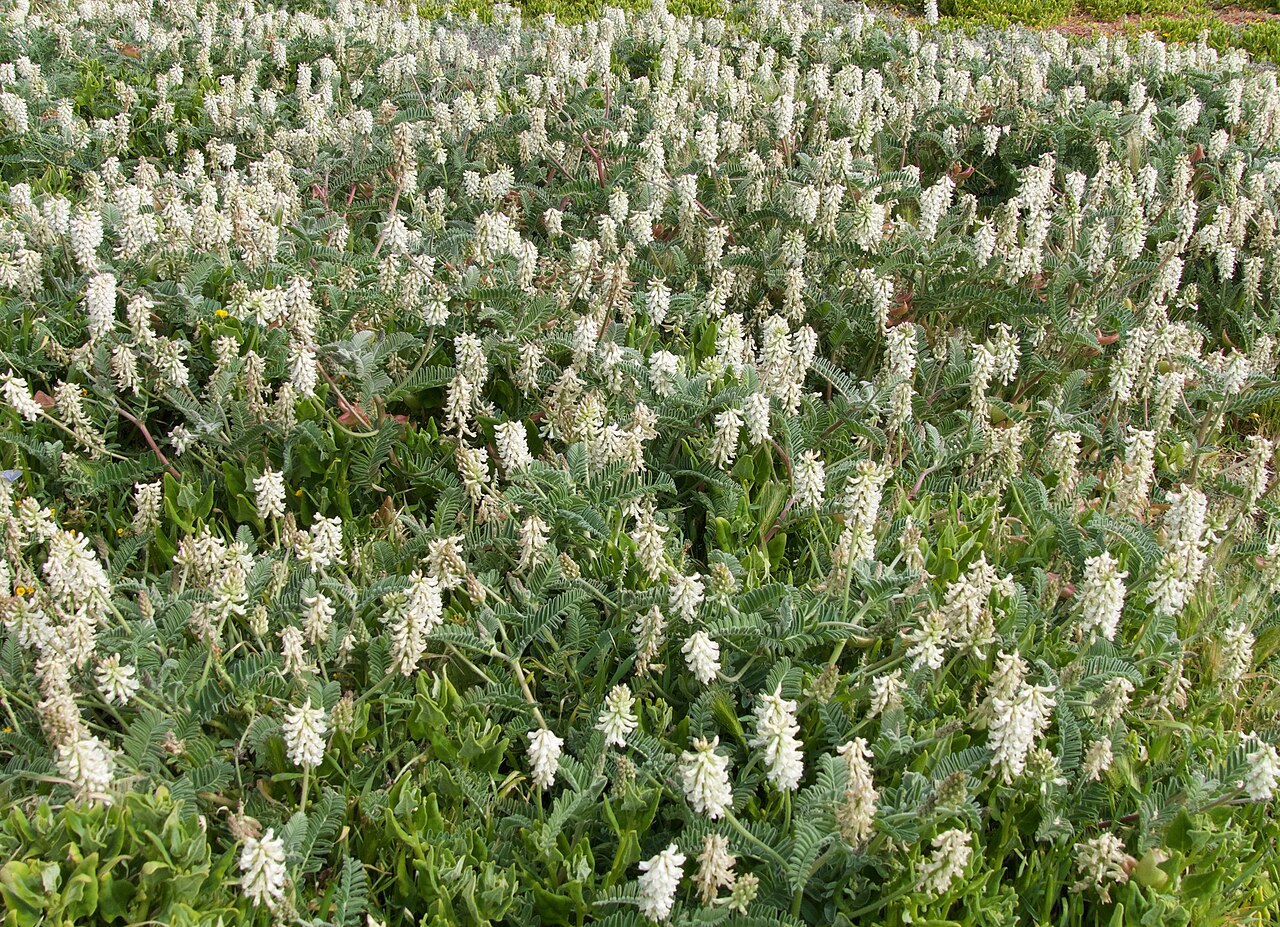
Astragalus nuttallii, known as Nuttall’s Milkvetch, is a large, bushy perennial in the pea family (Fabaceae) that grows on the bluffs, dunes and coastal scrub of the central California coast. It forms thick, tangled mounds up to about 3 feet across, with many leafy stems, long pinnate leaves of small oval leaflets, and dense spikes of cream-white pea flowers, sometimes tinged with purple.
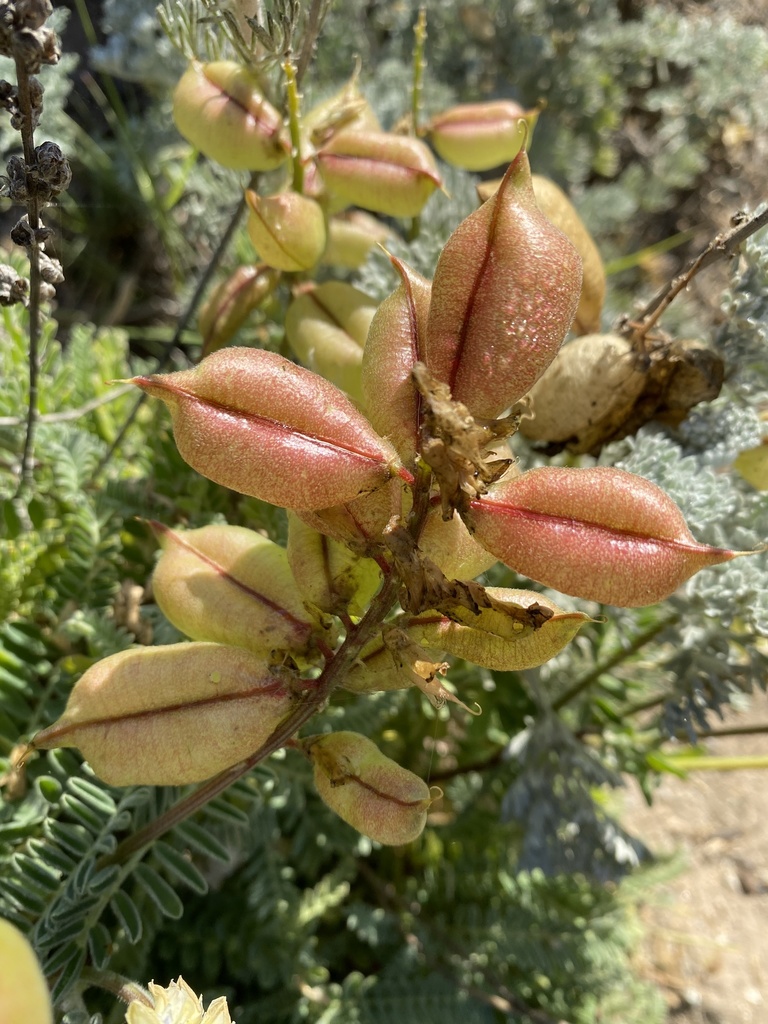
After flowering it produces conspicuous inflated pods up to about 2 1/2 inches long. They dry to a thin, papery shell that often turns pink or red and rattles when the wind blows, which is why the plant is also called rattleweed. Two varieties are recognized: variety virgatus on the north and central coast, and variety nuttallii, ocean bluff milkvetch, on the Monterey, San Luis Obispo and Santa Barbara County coast.
Nuttall’s milkvetch is a good plant for coastal native gardens and dune and bluff restoration, where it tolerates salt spray, sand and wind. Like many milkvetches, it should be kept away from grazing animals: some Astragalus species are poisonous to livestock, and no part of this plant should be eaten.
Identification
Look for a sprawling, mounding coastal perennial with ferny leaves of many small leaflets, dense spikes of cream-white pea flowers, and big, inflated, papery pods.
Growth Habit
A robust herbaceous perennial from a deep taproot, forming thick, tangled clumps of many stems up to about 3 feet (1 meter) long. The stems may be upright, leaning or sprawling across sand and bluff tops. Plants vary from hairy and grayish to nearly hairless and green.
Leaves
The alternate leaves are pinnately compound, up to about 7 inches (17 cm) long, with many pairs of small, oval to oblong leaflets plus a terminal leaflet, giving a soft, ferny look.
Flowers
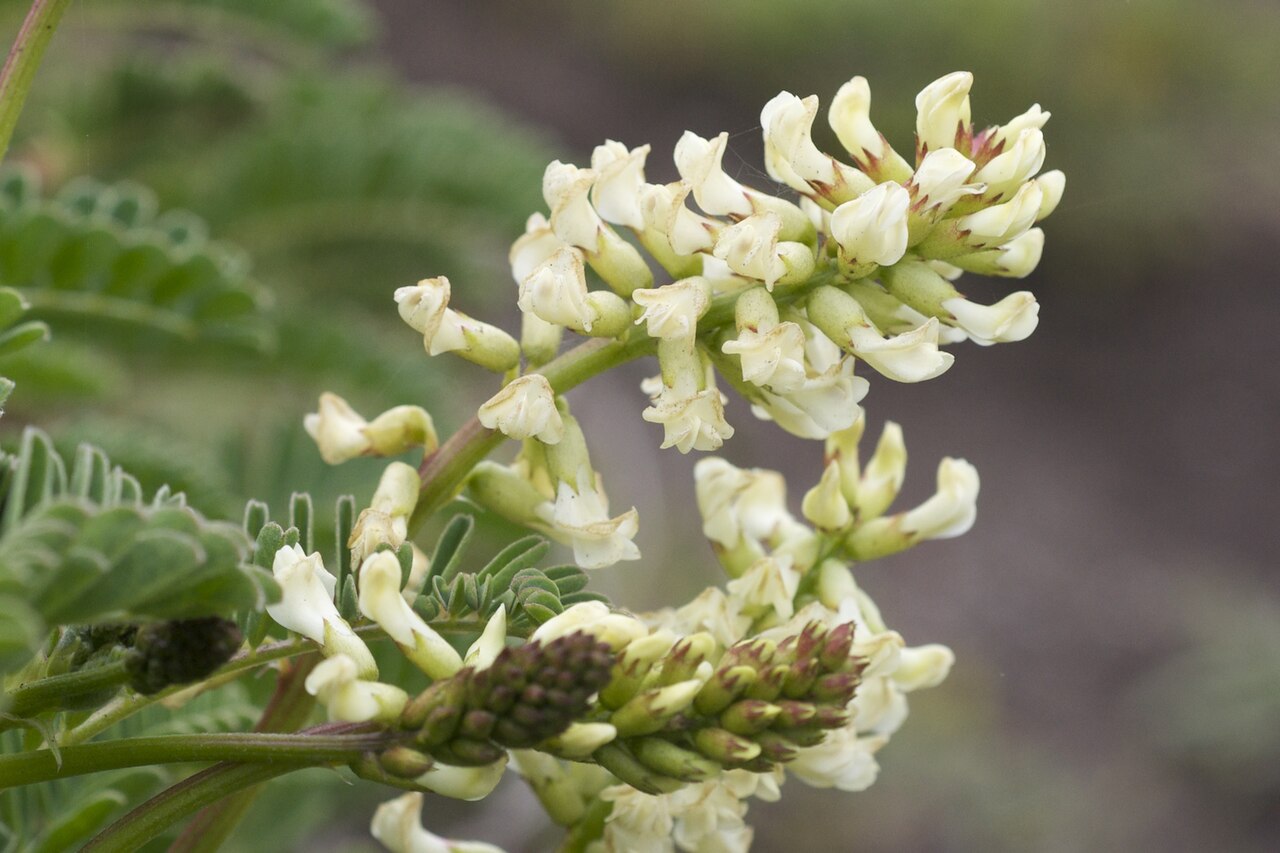
The flowers grow in long-stalked, dense spikes or racemes that can hold dozens to more than a hundred flowers. Each pea flower is about 1/2 inch long, dull cream to white, sometimes purple-tinged, with an upright banner petal and a narrow keel. Flowering runs mainly from late winter through summer, and some plants bloom almost all year near the coast.
Fruit
The fruit is an inflated, one-chambered pod up to about 2 1/2 inches (6 cm) long, green at first, then drying to a thin, papery, straw-colored to reddish shell with many seeds inside. The seeds rattle in dry pods.
Look-alikes
Coastal lupines have palmately compound leaves, not pinnate ones. Other coastal milkvetches, such as Menzies’ milkvetch (Astragalus pycnostachyus, a salt marsh species), differ in pod shape and habitat. Inland milkvetches and locoweeds such as freckled milkvetch are mostly smaller plants of drier, non-coastal sites.
Quick Facts
| Scientific Name | Astragalus nuttallii |
| Family | Fabaceae (pea family) |
| Plant Type | Mounding herbaceous perennial |
| Mature Height | 1–3 ft |
| Mature Spread | 2–4 ft |
| Growth Rate | Moderate to fast |
| Sun Exposure | Full sun |
| Water Needs | Low; summer-dry tolerant near the coast |
| Soil Type | Sandy or rocky, well-drained soils; dunes and bluffs |
| Soil pH | Neutral to slightly alkaline (about 6.5–8.0) |
| Bloom Time | February–September |
| Flower Color | Cream to white, sometimes purple-tinged |
| Fall Color | None |
| Fruit | Inflated, papery pods up to 2 1/2 in |
| Deer Resistant | Moderately; seldom heavily browsed |
| USDA Hardiness Zones | 9–10 |
Native Range
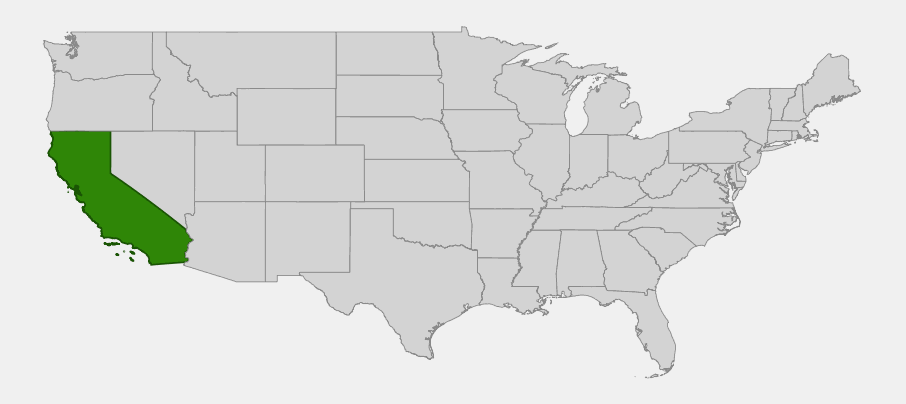
Nuttall’s milkvetch grows along the central coast of California, and USDA PLANTS lists it as native only in California. It is mostly a coastal plant, rarely found more than a short distance inland, from Sonoma and Mendocino Counties south through the San Francisco Bay Area and the Monterey Bay region to San Luis Obispo and northern Santa Barbara Counties.
Variety virgatus occupies the northern part of the range, around Sonoma and Marin Counties, the San Francisco Peninsula and the Monterey Bay area. Variety nuttallii, ocean bluff milkvetch, grows from the Monterey Peninsula south to the Lompoc area of Santa Barbara County and is endemic to that stretch of the Central Coast.
It grows on coastal bluffs and headlands, stabilized dunes, sandy flats and the edges of coastal scrub, usually within reach of fog and salt spray and at low elevations near sea level. It is a familiar plant along coastal trails at places like Point Lobos, Asilomar, Montaña de Oro and Salt Point.
📋 Regional plant lists featuring Nuttall’s Milkvetch: California & Nevada
Growing & Care Guide
Nuttall’s milkvetch is easy in coastal gardens with sandy, well-drained soil and full sun. It is less suited to hot inland gardens and heavy clay.
Light
Full sun. In shade it becomes leggy and flowers poorly.
Soil & Water
Plant in sandy, gravelly or other fast-draining soil. It is adapted to summer-dry coastal climates, where fog provides moisture, and needs little or no summer water once established. Overwatering and heavy, wet soils can cause root rot.
Planting Tips
Plant from containers in late fall or winter, so roots grow with the winter rains. Give each plant 3 to 4 feet of space, as it sprawls widely. It is a good choice for dune gardens, bluff-top plantings and seaside slopes, combined with other coastal natives.
Pruning & Maintenance
Cut back old, woody stems in late fall or winter to keep plants compact. Plants can be short-lived in gardens; letting a few pods ripen allows volunteer seedlings to replace them. Keep plants out of pastures and away from pets and livestock that might graze them.
Propagation
Grow from seed. Nick or sand the hard seed coat, or soak seeds in hot water, then sow in fall or winter in a sandy mix. Seedlings develop a taproot quickly, so move them to their final spot while young.
Landscape Uses
- Coastal gardens: tolerates salt spray, wind and sandy soils
- Dune and bluff restoration: stabilizes sand and fills open ground
- Pollinator gardens: long bloom season for native bees
- Wildflower meadows: cream spikes contrast with blue and yellow coastal flowers
- Seasonal interest: rattling, red-blushed seed pods in summer
Wildlife & Ecological Value
Nuttall’s milkvetch provides nectar, pollen and larval food along the coast, and like other legumes it improves poor, sandy soils.
For Pollinators
Bumble bees and other native bees are the main visitors, opening the pea flowers to reach nectar and pollen. Milkvetches are larval host plants for some butterflies, including blues and sulphurs that feed on Astragalus.
For Birds
The seeds may be eaten by seed-eating birds, and the dense mounds give cover to ground-foraging birds such as sparrows on coastal bluffs.
For Mammals
Small mammals use the dense mounds for cover. Safety note: some Astragalus species (locoweeds and others) are poisonous to horses, cattle and sheep. Toxicity of this species is not well documented, so treat it as potentially toxic, keep it out of pastures and do not eat any part of it.
Ecosystem Role
Like other legumes, it hosts nitrogen-fixing bacteria in its root nodules, adding nitrogen to nutrient-poor dune and bluff soils. Its deep roots and sprawling stems help hold sand on coastal slopes.
Cultural & Historical Uses
The species honors Thomas Nuttall, the English botanist and naturalist who traveled and collected plants along the California coast in the 1830s. The genus name Astragalus is an ancient Greek plant name used for a legume.
The common name “milkvetch” comes from an old European belief that these plants increased milk production in goats. Many milkvetches are also called rattleweeds or rattlepods because of the seeds rattling inside their dry pods, as in this species.
Variety nuttallii, ocean bluff milkvetch, is limited to a short stretch of the Central Coast, where coastal development has reduced its habitat. Protecting coastal bluffs and dunes helps keep it common along trails and parks.
Frequently Asked Questions
Is Nuttall’s milkvetch poisonous?
Some milkvetches and locoweeds are poisonous to livestock. The toxicity of this species is not well documented, so keep it away from grazing animals and pets, and never eat it.
Where does Nuttall’s milkvetch grow?
Only in California, along the central coast from Sonoma and Mendocino Counties south to northern Santa Barbara County, on bluffs, dunes and coastal scrub.
Why is it called rattleweed?
Its inflated pods dry to a thin, papery shell, and the loose seeds inside rattle when the wind shakes the plant.
Can I grow Nuttall’s milkvetch in my garden?
Yes, especially in coastal gardens with sandy, well-drained soil and full sun. It needs little summer water near the coast but dislikes heavy, wet soil.
What insects visit Nuttall’s milkvetch?
Bumble bees and other native bees visit the flowers, and some blue and sulphur butterflies use milkvetches as larval host plants.

Looking for a nursery that carries Nuttall’s Milkvetch?
Browse our native plant nursery directory: California

