
Coast Fawn Lily (Erythronium revolutum)
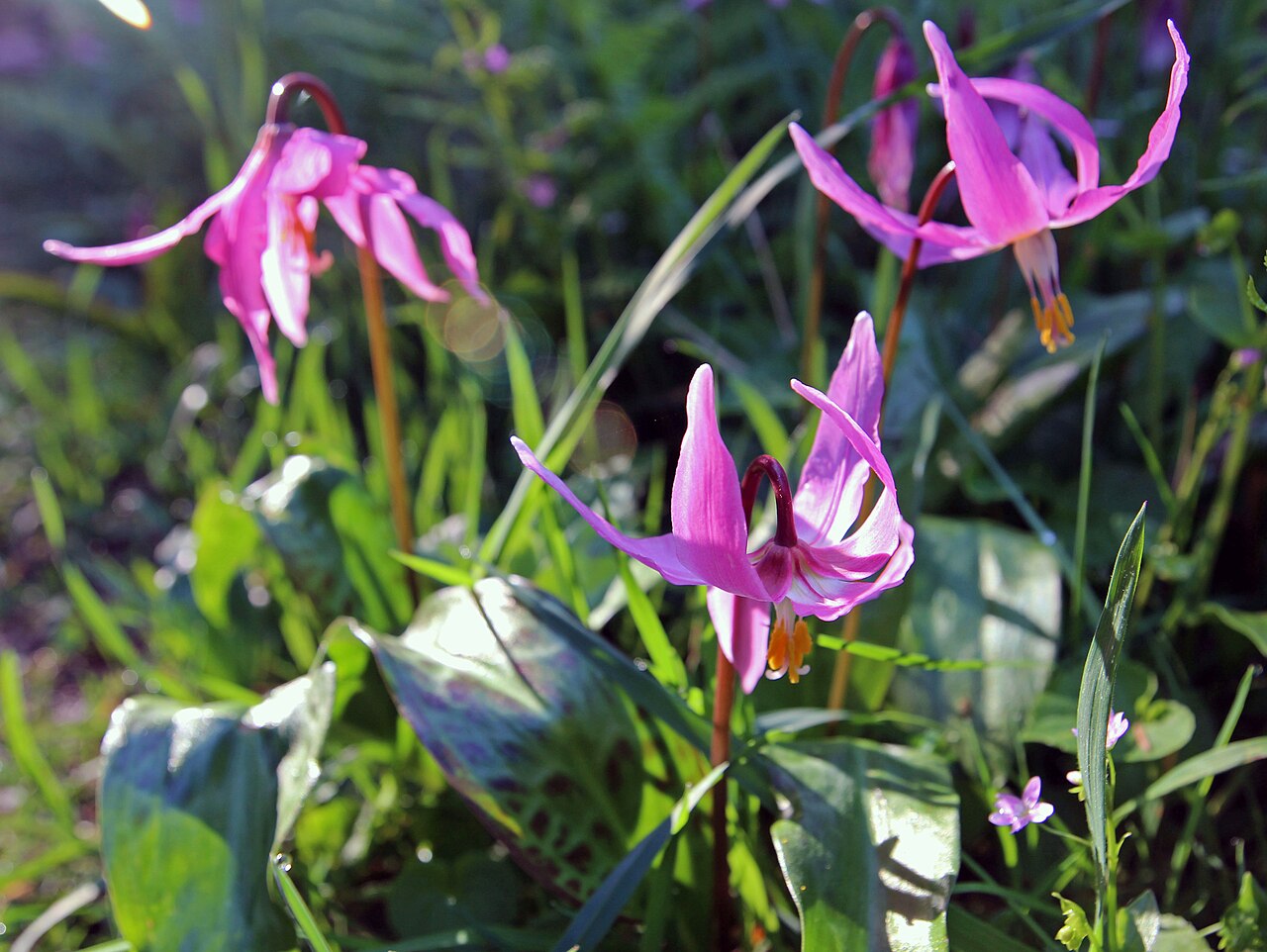
Erythronium revolutum, known as Coast Fawn Lily, pink fawn lily or mahogany fawn lily, is one of the loveliest spring wildflowers of the Pacific Northwest coast. In early spring it opens nodding, rose-pink flowers with swept-back petals above a pair of glossy leaves mottled with brown, carpeting moist forest floors and streambanks from Vancouver Island to northwestern California.
It is the only fawn lily in its range with truly pink flowers, which makes it easy to tell from its close relative White Fawn Lily (E. oregonum), which grows in similar places but has creamy white flowers. Gardeners have prized it for well over a century, and selections such as ‘Knightshayes Pink’ are grown in woodland gardens in Britain and Europe as well as at home in the Northwest.
This guide covers how to identify coast fawn lily, where it grows wild, how to grow it in a shade garden from nursery-propagated bulbs, and why its early flowers matter to queen bumble bees.
Identification
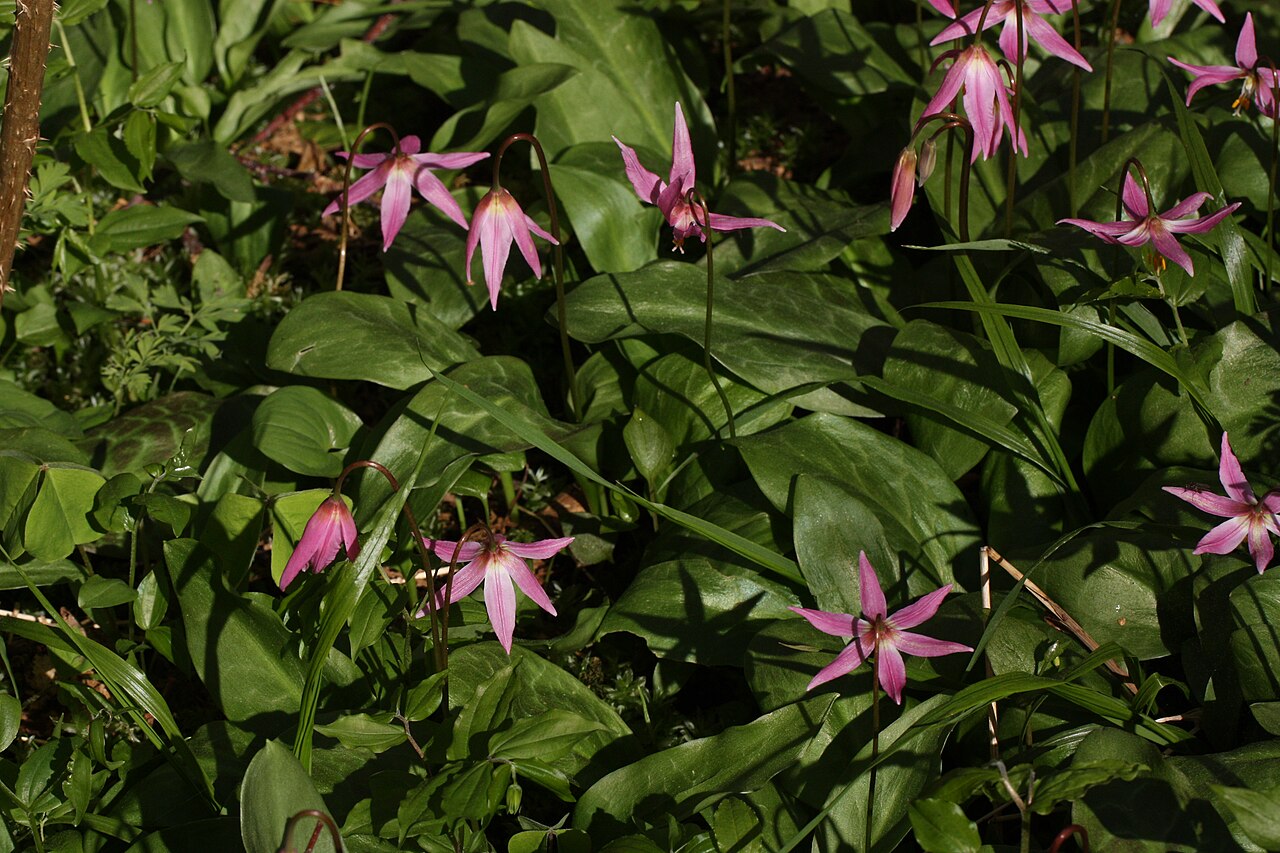
Look for a pair of broad, glossy, brown-mottled leaves at ground level and one to a few nodding pink flowers on leafless stalks 6 to 14 inches tall, blooming from March to May.
Leaves
Each flowering plant has two basal leaves (non-flowering plants have one). They are broadly lance-shaped to elliptic, 4 to 8 inches long, with wavy edges, and distinctly mottled with brown or maroon on a green background. The mottling, which gives fawn lilies their name (it resembles a fawn’s spotted coat), is especially bold on young leaves.
Flowers
The flowers are nodding and about 2 to 3 inches across, with six pink to rose-lavender tepals that curve sharply backward (the “revolute” of the species name). The base of each tepal has yellow bands or a yellow eye. The stamens have broad, flattened white filaments and yellow anthers, and the style ends in three slender, curled stigma lobes. Flowers fade from pink to deeper rose-purple with age.
Bulb & Fruit
Plants grow from a deep, elongated corm-like bulb, often 4 to 8 inches below the surface. After flowering, an upright, club-shaped capsule forms, splitting into three parts to release papery brown seeds. The leaves die back by early summer and the plant is dormant until the next spring.
Look-alikes
White fawn lily has white to cream flowers and grows in somewhat drier, more open sites. Glacier lily has yellow flowers and plain green leaves and grows mostly in the mountains and interior. Pink-flowered fawn lilies in gardens may be hybrids or other species, such as the Sierra fawn lilies; wild pink fawn lilies near the Northwest coast are almost always E. revolutum.
Quick Facts
| Scientific Name | Erythronium revolutum Sm. |
| Family | Liliaceae (lily family) |
| Plant Type | Spring ephemeral perennial from a bulb |
| Mature Height | 6–14 in |
| Mature Spread | 4–8 in per plant; forms drifts over time |
| Growth Rate | Slow (several years from seed to bloom) |
| Sun Exposure | Part shade to light shade |
| Water Needs | Moderate to high; moist in spring, drier in summer is fine |
| Soil Type | Rich, moist, humusy, well-drained woodland soil |
| Soil pH | About 5.5–7.0 |
| Bloom Time | March–May |
| Flower Color | Pink to rose-lavender with a yellow center |
| Fall Color | None; dormant by summer |
| Fruit | Upright three-parted capsule |
| Deer Resistant | Moderate; deer and rodents sometimes eat leaves and bulbs |
| USDA Hardiness Zones | 5–9 |
Native Range
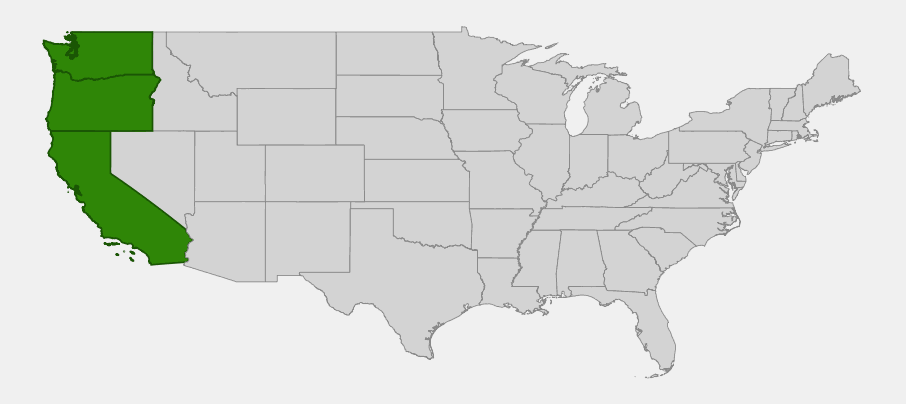
USDA PLANTS lists coast fawn lily as native in Washington, Oregon and California, and it also grows in southwestern British Columbia, including Vancouver Island. It is a plant of the wet Pacific coastal belt, west of the Cascade Range: the Olympic Peninsula, the Puget lowlands, the Oregon Coast Range and the coastal forests of northwestern California.
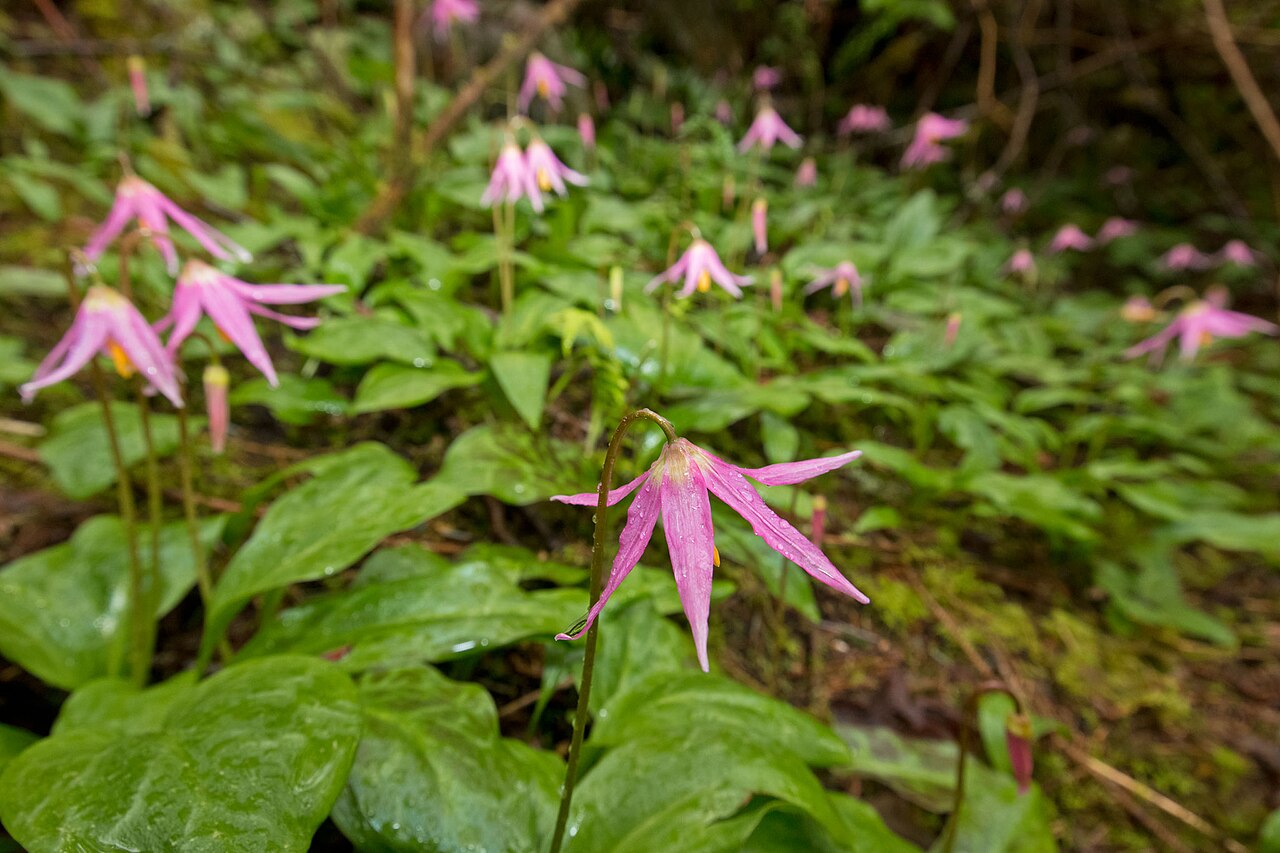
It grows in moist, lowland and foothill forests, along streams and rivers, in wet meadows and at the edges of bogs, often under red alder, bigleaf maple, western hemlock and Sitka spruce. It is mostly found at low elevations, from near sea level to roughly 3,000 feet. It does not grow east of the Cascades.
In California it reaches the southern end of its range in the North Coast region and is uncommon there; it is included in the California Native Plant Society’s Inventory of Rare and Endangered Plants. Elsewhere it can be locally abundant, forming large pink drifts on forest floors in spring.
📋 Regional plant lists featuring Coast Fawn Lily: Western Oregon & Western Washington · California & Nevada
Growing & Care Guide
Coast fawn lily is one of the easiest and most rewarding fawn lilies for a shade garden in the Pacific Northwest and similar mild, moist climates. Buy only nursery-propagated bulbs, and never dig bulbs from the wild. Wild plants take years to reach flowering size, the deep bulbs rarely survive being dug, and the species is rare in California. Reputable bulb growers propagate it from seed or offsets.
Light
Give it part shade or the bright, dappled shade of deciduous trees, where it gets spring sun before the canopy leafs out. Deep, dry shade and hot afternoon sun are both poor choices.
Soil & Water
It needs rich, humusy, moisture-retentive but well-drained soil, like a forest floor. Keep the soil moist from fall through spring while it is growing. In summer it is dormant and tolerates drier soil, but the bulbs should not bake dry for months. Add leaf mold or compost as mulch each fall.
Planting Tips
Plant bulbs in late summer or early fall, as soon as you get them: fawn lily bulbs have no protective tunic and dry out quickly, so they should not sit in a bag for weeks. Plant them 3 to 5 inches deep and 4 to 6 inches apart, in groups. Mark the spot, since the plants disappear by early summer.
Pruning & Maintenance
Let the leaves yellow and die back naturally after flowering so the bulb can store energy for next year. Leave seedheads if you want it to self-sow. Otherwise it needs little care. Protect bulbs from voles and gophers where they are a problem.
Propagation
It self-sows readily in good conditions and can slowly form large drifts. Sow fresh seed in fall outdoors; seedlings grow a single leaf for several years and typically take four or more years to bloom. Established clumps can be divided carefully after the leaves die back.
Landscape Uses
- Woodland and shade gardens: under deciduous trees and shrubs with ferns, trilliums and wood sorrel
- Naturalized drifts: in leaf-mulched areas away from lawns where it can self-sow
- Rain gardens and stream edges: in partly shaded, spring-moist spots
- Early pollinator food: one of the first flowers of spring for emerging bumble bees
Wildlife & Ecological Value
Like other spring ephemerals, coast fawn lily does most of its living in the short window between late winter and the closing of the forest canopy, providing early food when little else is in bloom.
For Pollinators
The nodding pink flowers are visited by queen bumble bees emerging in early spring, as well as mason bees, mining bees and other early native bees, which collect its pollen and nectar.
For Birds
It is not a significant bird food, but the moist forests and streamsides where it grows are rich bird habitat.
For Mammals
Deer and elk sometimes nibble the leaves and flowers, and rodents such as voles and pocket gophers eat the bulbs.
Ecosystem Role
As a spring ephemeral, it takes up nutrients early in the season and returns them to the soil as its leaves decay, part of the nutrient cycle of the forest floor. Its drifts are a hallmark of healthy, undisturbed coastal forest.
Cultural & Historical Uses
English botanist James Edward Smith named Erythronium revolutum in the early 1800s, from specimens collected on the Northwest coast by Archibald Menzies during the Vancouver expedition of the 1790s. Revolutum means “rolled back,” describing the sharply reflexed tepals.
Coast fawn lily quickly became a favorite of British gardeners, and it thrives in the cool, moist woodland gardens of the UK. The pink selection ‘Knightshayes Pink’ comes from the garden at Knightshayes Court in Devon, England. In cultivation it can hybridize with other fawn lilies, so seed from mixed plantings may not come true.
Indigenous peoples of the Northwest coast harvested the bulbs of some fawn lilies and avalanche lilies as food, but today wild bulbs should be left in place: harvesting is slow to recover from, and coast fawn lily is rare in parts of its range.
Frequently Asked Questions
Where does coast fawn lily grow?
In the moist coastal forests of British Columbia, Washington, Oregon and northwestern California, west of the Cascades. It favors streambanks, wet meadows, bog edges and moist woods at low elevations.
How is coast fawn lily different from white fawn lily?
Coast fawn lily has pink to rose flowers and prefers wetter sites. White fawn lily (E. oregonum) has creamy white flowers and grows in somewhat drier, more open woods and meadows.
Can I dig coast fawn lily bulbs from the wild?
No. Buy nursery-propagated bulbs instead. The bulbs are deep and rarely survive digging, wild plants take years to reach flowering size, and the species is rare in California.
When should I plant fawn lily bulbs?
Plant them in late summer or fall, as soon as you get them, 3 to 5 inches deep in rich, moist, well-drained soil in part shade. The bulbs have no protective skin and should not be allowed to dry out.
Why did my fawn lily disappear in summer?
That is normal. Coast fawn lily is a spring ephemeral: the leaves die back by early summer and the bulb stays dormant underground until the next spring.

Looking for a nursery that carries Coast Fawn Lily?
Browse our native plant nursery directory: California · Oregon · Washington

