
Golden Paintbrush (Castilleja levisecta)
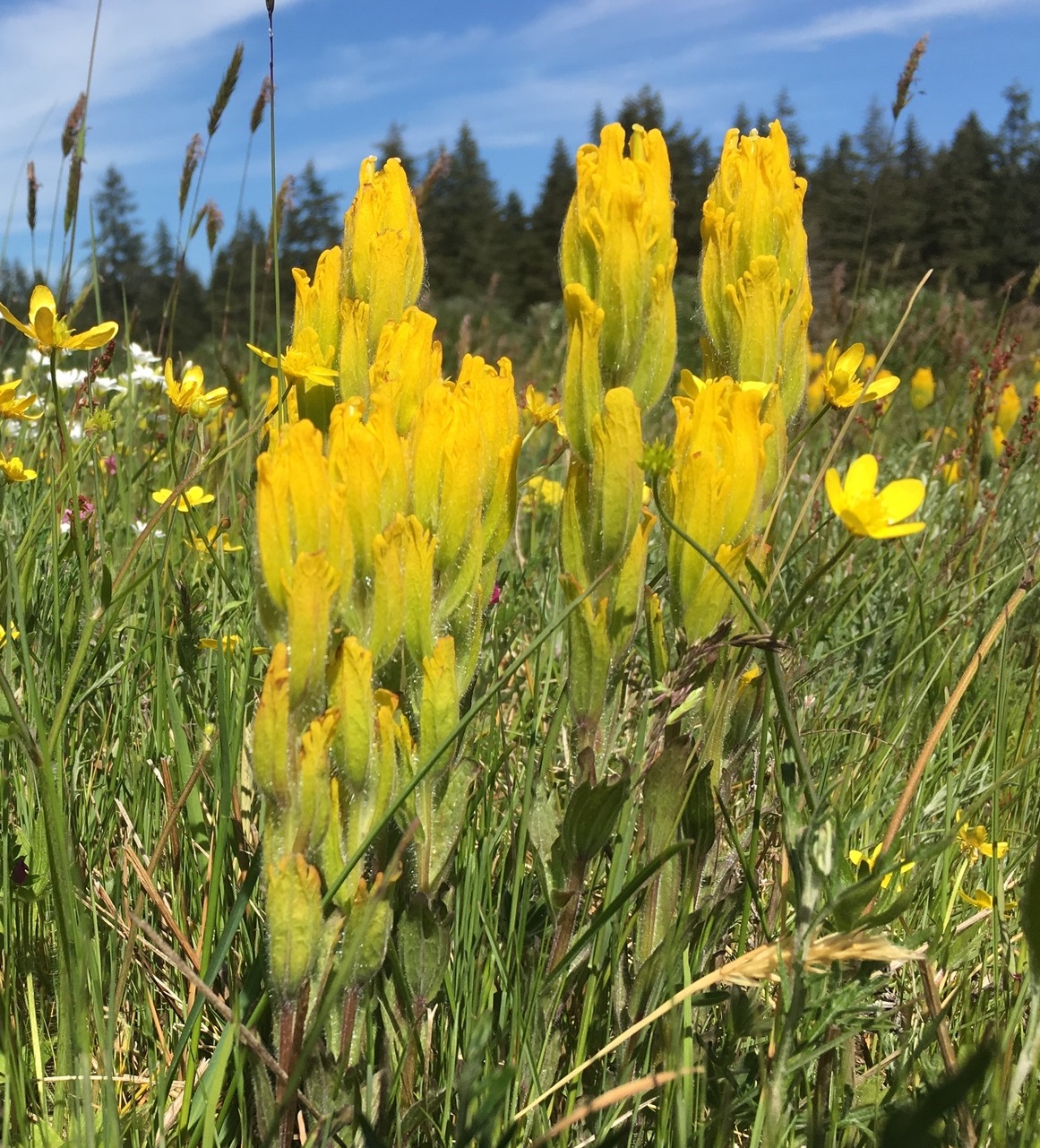
Castilleja levisecta, the Golden Paintbrush (USDA: golden Indian paintbrush), is a rare wildflower of the prairies and grassy coastal bluffs of the Pacific Northwest. It grows only in the Puget Trough of western Washington, the Willamette Valley of western Oregon and southwestern British Columbia. In spring its clumps of upright stems are crowned with soft, bright golden-yellow bracts, one of very few yellow paintbrushes in the region.
Golden paintbrush is also a conservation success story. By the 1990s, the conversion of prairies to farms and cities, fire suppression and invasive plants had reduced it to only about ten populations in Washington and British Columbia, and the U.S. Fish and Wildlife Service listed it as threatened in 1997. Decades of seed banking, nursery propagation and reintroduction to restored prairies followed, and in 2023 the Service removed it from the federal list of threatened and endangered plants because it had recovered (final rule published July 19, 2023, effective August 18, 2023). It remains rare and is still listed as endangered in Canada.
Like other paintbrushes, it is a hemiparasite: it makes its own food through photosynthesis but also taps the roots of nearby plants for water and nutrients. This guide covers identification, range, how it is grown from nursery stock with host plants, and its value to pollinators. Never dig wild plants; they rarely survive transplanting, and wild populations are still small and carefully managed.
Identification
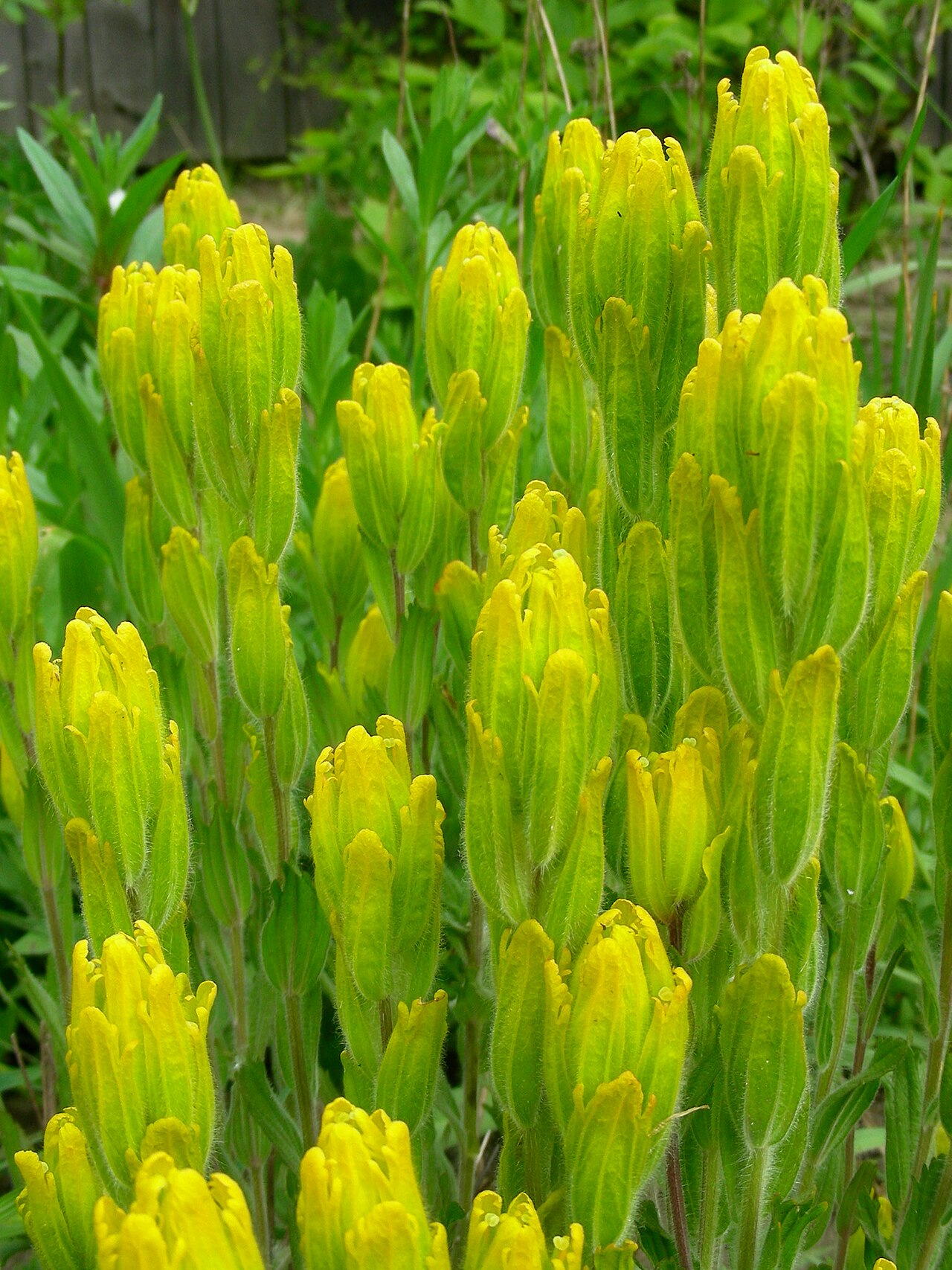
Golden paintbrush is a clump-forming perennial with several upright, sticky-hairy stems and spikes of golden-yellow bracts. Within its range, the yellow color and soft, hairy, lobed bracts make it easy to recognize.
Stems & Leaves
Plants grow from a woody base and produce several to many stems 4 to 20 inches tall, often curving up from the base. Stems and leaves are covered in soft, sticky hairs. The leaves are alternate, lance-shaped to oblong, ¾ to 1½ inches long; lower leaves are mostly entire, and upper leaves often have one to three pairs of short lobes near the tip.
Flowers & Bracts
From April to June, the stems end in dense spikes of broad, hairy bracts that are golden yellow, sometimes greenish at the base. The bracts are rounded with a few short lobes and hide most of the actual flowers. The flowers are tubular and greenish yellow, about ¾ inch long, with a beak-like upper lip barely sticking out from the bracts.
Fruit
The fruit is a small capsule about ½ inch long that splits to release many tiny, netted seeds in summer. After seed set, the plants die back to the woody base and resprout the following spring.
Look-alikes
Most paintbrushes in western Washington and Oregon are red or orange. Harsh paintbrush (C. hispida) and Scarlet Paintbrush have red to orange-red bracts, though occasional yellow forms of harsh paintbrush occur, and the two can hybridize with golden paintbrush where they grow together. Golden paintbrush has softer, stickier hairs and more rounded, golden bracts. Yellow-flowered plants such as Oregon Sunshine are daisies, not spikes of bracts.
Quick Facts
| Scientific Name | Castilleja levisecta Greenm. |
| Family | Orobanchaceae (broomrape family; formerly Scrophulariaceae) |
| Plant Type | Hemiparasitic herbaceous perennial |
| Mature Height | 4–20 in |
| Mature Spread | 6–12 in |
| Growth Rate | Moderate |
| Sun Exposure | Full sun |
| Water Needs | Moist in winter and spring, dry in summer |
| Soil Type | Glacial outwash gravel, sandy loam, prairie loam |
| Soil pH | About 5.5–7.0 |
| Bloom Time | April–June |
| Flower Color | Golden-yellow bracts, greenish-yellow flowers |
| Fall Color | Dormant to woody base by late summer |
| Fruit | Small capsule with many tiny seeds |
| Deer Resistant | Low; deer, voles and rabbits browse it |
| USDA Hardiness Zones | 7–9 |
Native Range
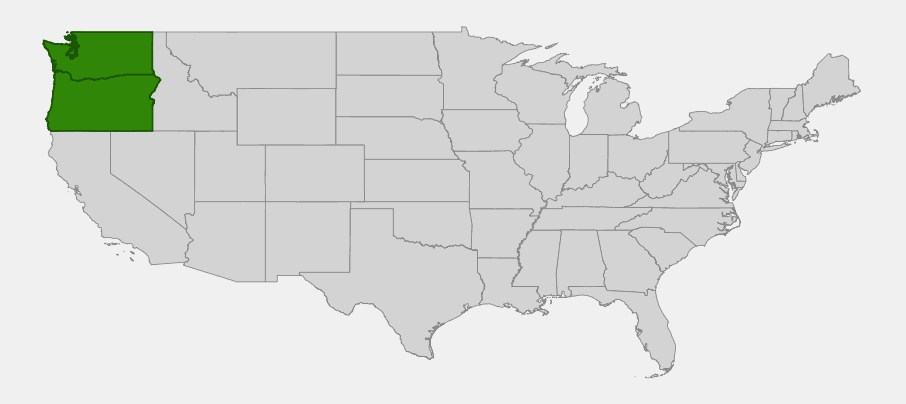
Golden paintbrush is native to the Pacific Northwest, west of the Cascade Range. USDA PLANTS lists it in Washington and Oregon, and it also grows in southwestern British Columbia, on southeastern Vancouver Island and nearby islands. In Washington it grows in the Puget Trough, on the prairies south of Puget Sound in Thurston County and on grassy coastal bluffs and prairies of Whidbey Island and the San Juan Islands. In Oregon it historically grew in the Willamette Valley.
Its habitat is open, low-elevation grassland: glacial outwash prairies with native bunchgrasses, grassy coastal bluffs and, in Oregon, upland and wet prairies of the Willamette Valley. These grasslands were maintained by fires set by Native peoples. As fires stopped and the prairies were plowed, developed or invaded by Scotch broom, tall non-native grasses and Douglas-fir, golden paintbrush disappeared from most of its range, including all of Oregon by the mid-20th century.
Its recovery came from intensive work by federal and state agencies, tribes, conservation groups, botanical gardens and nurseries. Seed from the remaining populations was grown in nurseries and planted into restored prairies, and new populations were established in Washington and reintroduced into the Willamette Valley of Oregon. When it was delisted in 2023, the Service found that enough large, protected populations exist that it no longer needs the Endangered Species Act’s protection, though populations will be monitored and still depend on active prairie management.
📋 Regional plant lists featuring Golden Paintbrush: Western Oregon & Western Washington
Growing & Care Guide
Golden paintbrush is grown mostly for prairie restoration, but specialist native nurseries in the Pacific Northwest occasionally offer plants or seed. Buy only nursery-propagated stock, and never dig or collect from wild or restored populations; paintbrushes rarely survive transplanting because their roots are attached to host plants, and every wild plant still matters. Because it is a hemiparasite, it must be grown together with a host plant.
Light
Full sun, in an open, prairie-like setting. It does not tolerate shading by shrubs, trees or tall grasses.
Soil & Water
It needs well-drained, gravelly or sandy loam, moist through winter and spring and dry in summer, like the Pacific Northwest prairies. Avoid summer irrigation and rich soil, which encourage competing plants and root rot.
Planting Tips
Plant nursery plugs in fall or late winter, right next to a host plant such as Oregon sunshine (Eriophyllum lanatum), Roemer’s fescue, California oatgrass or yarrow, so its roots can connect with the host’s roots. Nurseries often grow golden paintbrush in the same pot as a host. Keep the area open and free of aggressive grasses.
Pruning & Maintenance
Remove competing weeds by hand, especially tall non-native grasses and Scotch broom. Cut back dry stems after seed has dropped in summer. In restorations, periodic prescribed fire or mowing keeps the prairie open.
Propagation
From seed only. Sow tiny seeds in fall on the surface of a gritty mix, or with a host plant, and leave them outdoors over winter for cold, moist stratification. Seedlings grow best when they can attach to a host plant within the first months. Avoid planting near red-flowered harsh paintbrush, since the two can hybridize and dilute the genetics of golden paintbrush populations.
Landscape Uses
- Prairie restoration: a key species for Puget Trough and Willamette Valley prairies
- Native wildflower meadows: golden color in spring with camas and buttercups
- Pollinator gardens: bumble bee and hummingbird nectar plant
- Rock and gravel gardens: in sunny, summer-dry spots with a host plant
Wildlife & Ecological Value
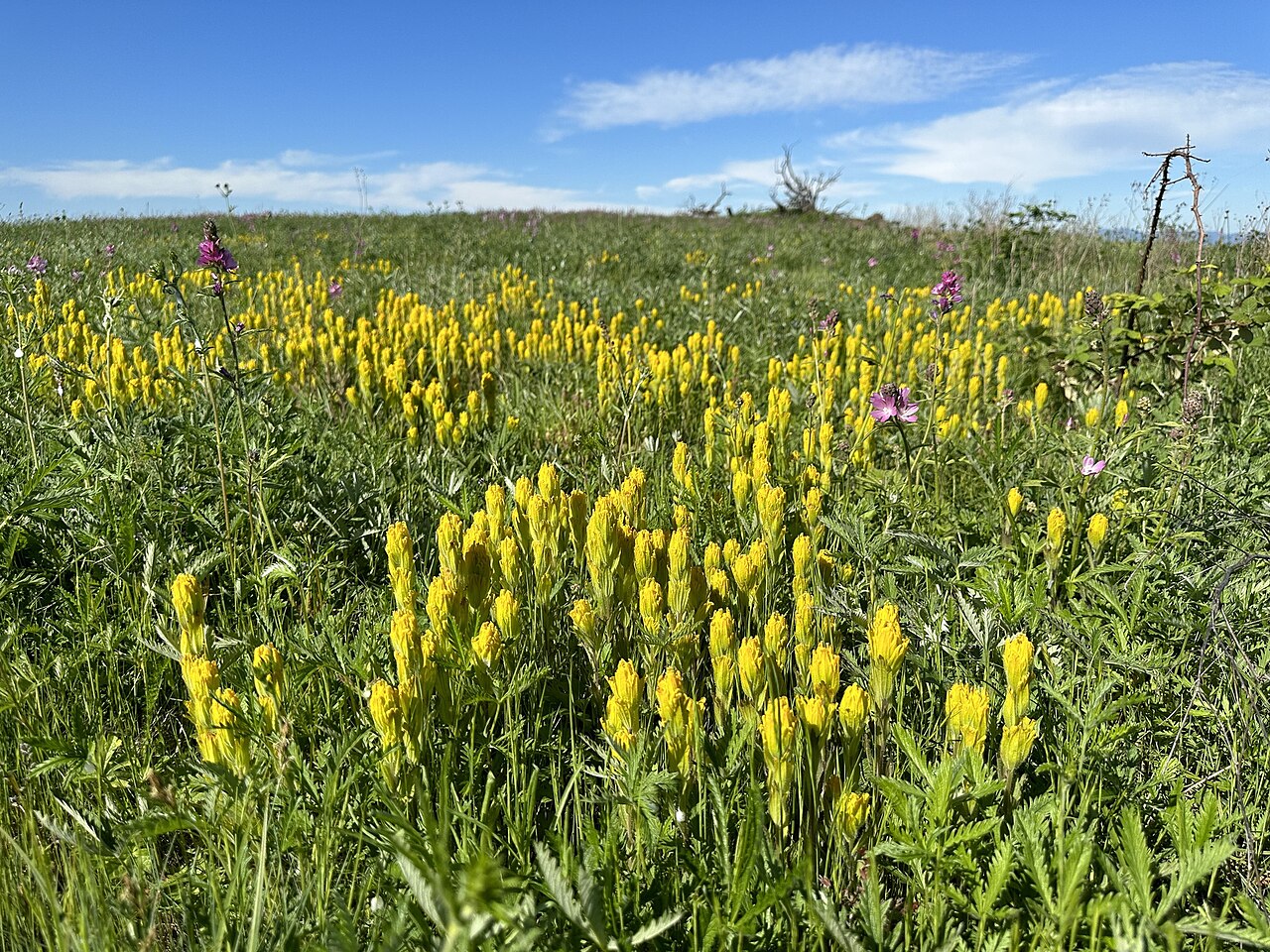
Golden paintbrush is part of the spring wildflower display of the rare Pacific Northwest prairies, which support many specialized animals.
For Pollinators
Bumble bees are the main pollinators, pushing into the tubular flowers among the bracts for nectar. Other bees visit as well. The South Puget Sound prairies where it grows are home to rare butterflies such as Taylor’s checkerspot, whose caterpillars feed on paintbrushes, plantains and other prairie plants.
For Birds
Hummingbirds sometimes visit paintbrushes for nectar. The prairies it helps define support grassland birds such as the streaked horned lark and western meadowlark.
For Mammals
Deer, rabbits and voles browse the plants, and restoration plantings are sometimes caged to protect them.
Ecosystem Role
As a root hemiparasite, it draws water and nutrients from neighboring grasses and wildflowers, which can reduce the vigor of dominant plants and help keep prairie plant communities diverse. Its recovery has been a flagship for the restoration of Pacific Northwest prairies, among the most endangered ecosystems in the region.
Cultural & Historical Uses
Jesse More Greenman described Castilleja levisecta in 1898. Castilleja honors the Spanish botanist Domingo Castillejo, and levisecta, roughly “lightly cut,” refers to its leaves and bracts, which have only shallow, short lobes compared with many paintbrushes.
The prairies of the Puget Sound and Willamette Valley were tended for thousands of years by Native peoples, who burned them to encourage camas and other food plants. Golden paintbrush depended on these open, fire-maintained landscapes. When burning stopped and settlers converted the land, it declined sharply.
Its recovery shows what long-term conservation can achieve. Botanists banked seed, nurseries learned to grow it with host plants, and partners planted it into restored prairies across western Washington and Oregon. After 26 years on the threatened species list, golden paintbrush became one of the few plants delisted because of recovery. It is still a rare plant that needs ongoing prairie management.
Frequently Asked Questions
Is golden paintbrush still endangered?
No longer under federal law. It was listed as threatened in 1997, and the U.S. Fish and Wildlife Service removed it from the federal list in 2023 because it had recovered (final rule July 19, 2023, effective August 18, 2023). It remains rare, is monitored, and is still listed as endangered in Canada.
Is golden paintbrush a parasite?
It is a hemiparasite. It has green leaves and makes its own food, but its roots attach to the roots of nearby plants to take water and nutrients. It grows best with a host plant such as Oregon sunshine or native bunchgrasses.
Where does golden paintbrush grow?
In the Puget Trough of western Washington (South Puget Sound prairies, Whidbey Island and the San Juan Islands), in the Willamette Valley of Oregon where it has been reintroduced, and in southwestern British Columbia.
Can I grow golden paintbrush?
Yes, if you can find nursery-propagated plants or seed from a specialist Pacific Northwest native nursery. Plant it in full sun in well-drained soil beside a host plant. Never dig plants or collect seed from wild or restored populations.
Why is golden paintbrush yellow when most paintbrushes are red?
The color comes from the bracts around the flowers, which in golden paintbrush are golden yellow. It is one of the few consistently yellow paintbrushes in the Pacific Northwest.

Looking for a nursery that carries Golden Paintbrush?
Browse our native plant nursery directory: Oregon · Washington

