Woolly Sunflower (Eriophyllum lanatum)
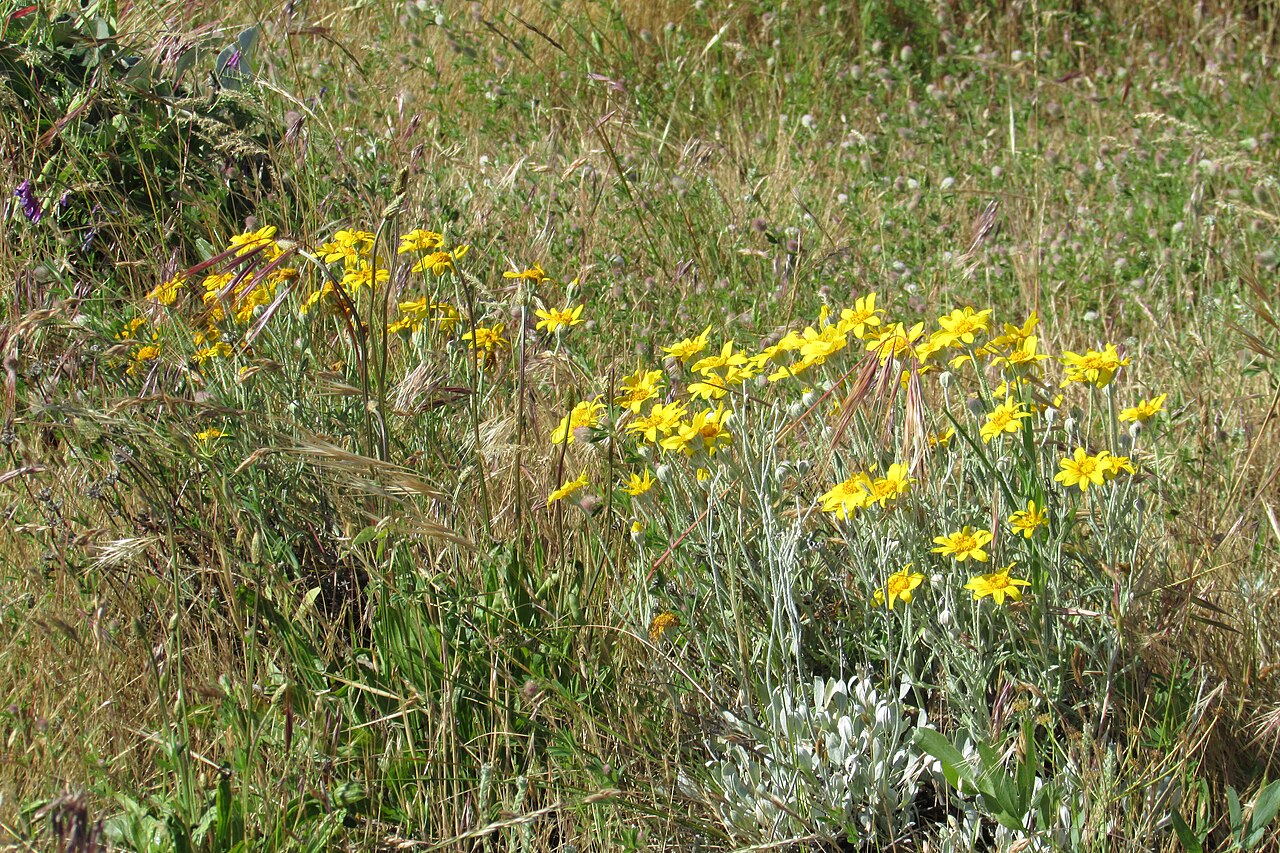
Woolly sunflower, also called Oregon sunshine, brings bright yellow flower heads above a pale, woolly mound of foliage. The botanical name is Eriophyllum lanatum. It is a western native in the aster family, but it is not a small version of the tall annual sunflower grown for seed. Its compact forms belong near the front of a dry border, on open slopes, or among well-spaced native bunchgrasses where their leaves and flowers can be seen.
This is a variable species, with multiple recognized varieties and populations adapted to quite different settings. Some are low and spreading; others become much taller and somewhat woody at the base. The Idaho, eastern Oregon, and eastern Washington table originally gave a 6–12-inch height, which suits some compact plants but does not cover the whole species. Many garden and regional plants reach roughly 6–24 inches in flower, while larger forms can approach 3 feet.
The practical lesson is to buy the right form and provenance rather than relying on the common name alone. A coastal Oregon source, a Montana interior source, and a California woodland source all may be Eriophyllum lanatum without being interchangeable in every garden. Choose a well-drained site, allow enough light, and use establishment watering thoughtfully. Once rooted in suitable soil, many forms handle summer drought well and provide useful flowers for a range of insects.
Identification
Stems and overall habit
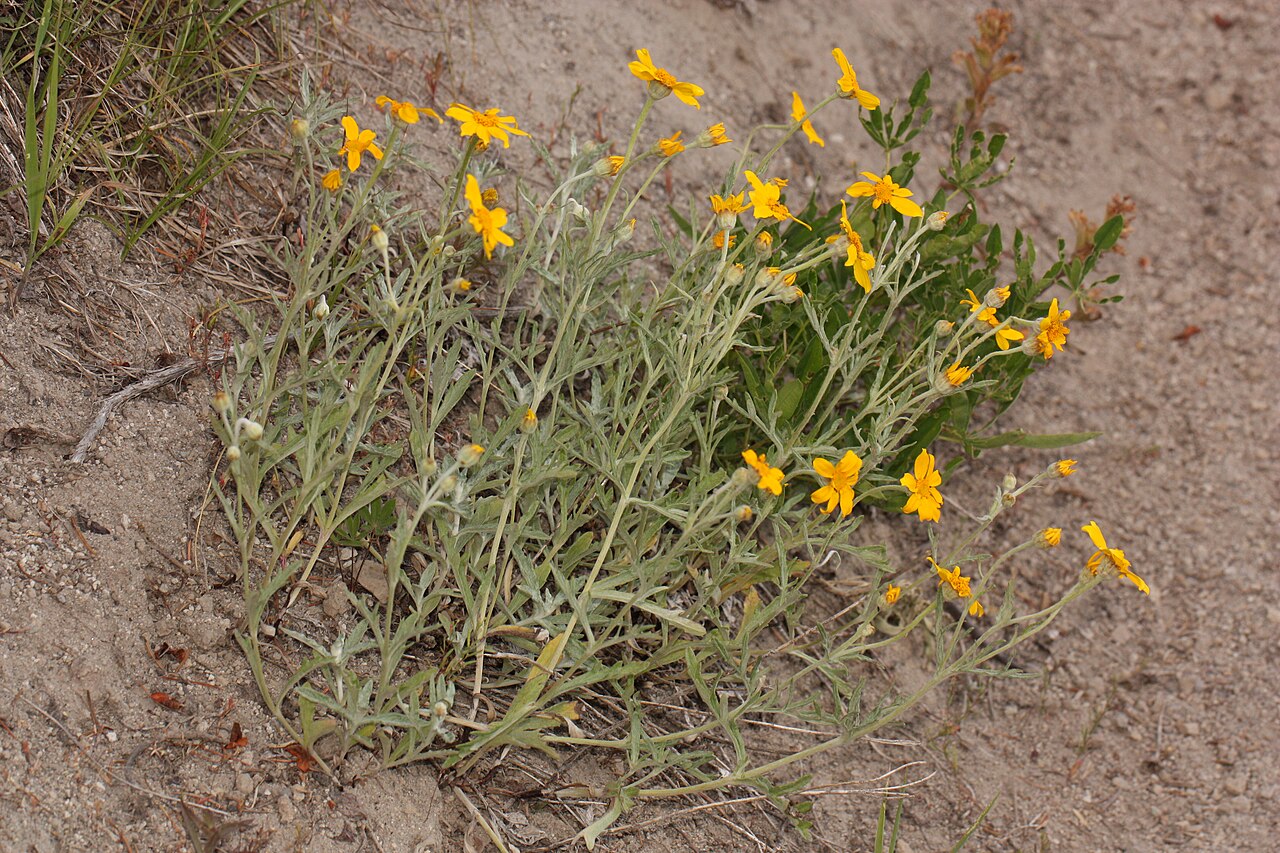
Woolly sunflower is usually a perennial herb or low subshrub with several stems from a persistent base. Some plants flower during their first year. The stems and foliage are often conspicuously covered with pale hairs, giving the plant a silvery appearance even between flowering periods. The degree of woodiness and the size of the plant vary across the species, so a low cushion and a more upright branching specimen should be evaluated with foliage and floral characters rather than height alone.
Leaves
Leaves are alternate along the stems and can be undivided, lobed, or deeply divided. That variation is one reason the species has a complicated infraspecific classification. The woolly surface is a useful field feature, but many other western plants also have gray foliage. Observe how the leaves attach, the shape of the flowering head, and the surrounding habitat. The interior variety integrifolium often has comparatively simple leaves, although a garden photograph alone may not establish the variety.
Flowers
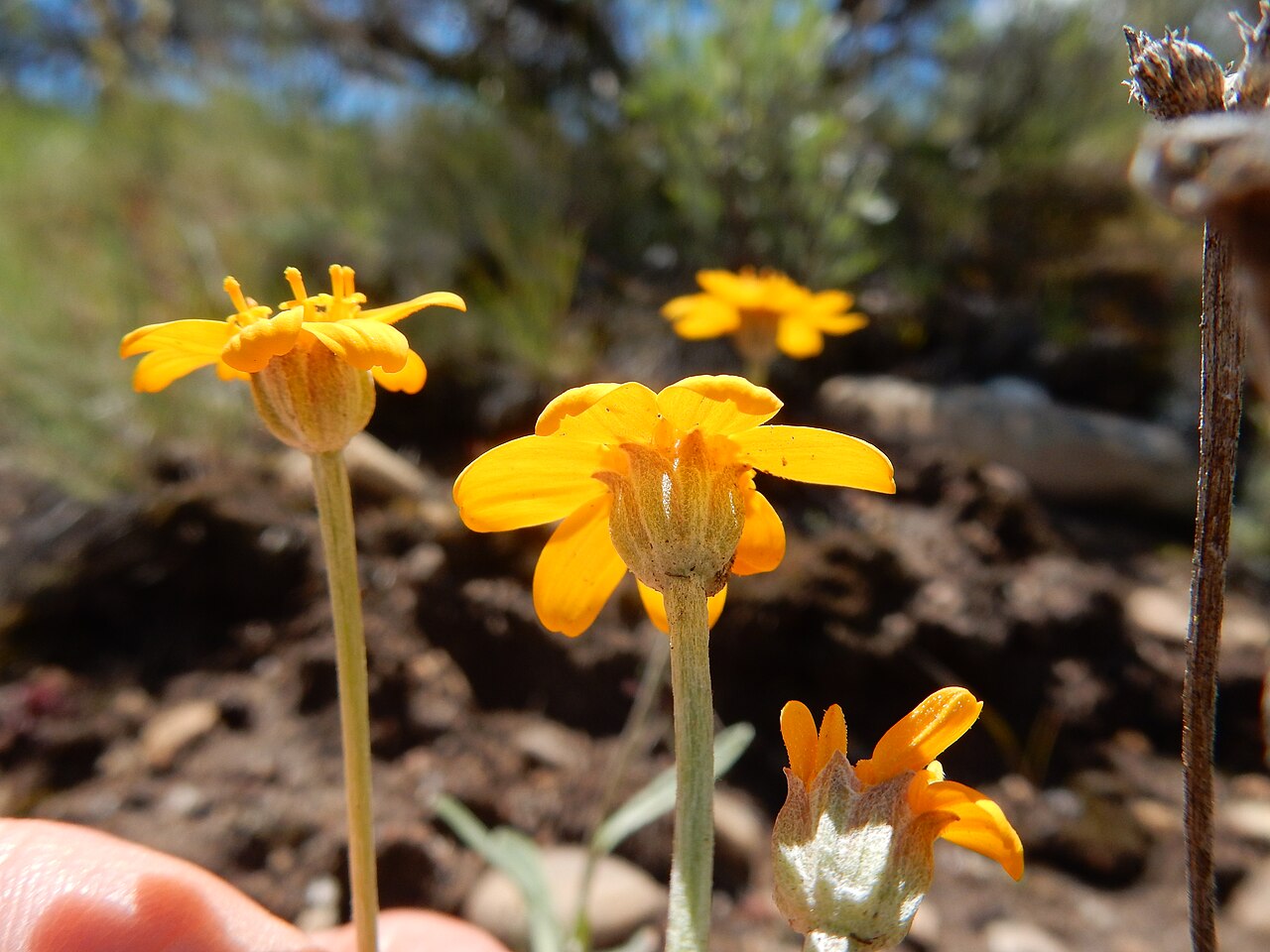
Flower heads have yellow disk florets in the center and usually a ring of yellow rays. Beneath the head are broad involucral bracts, often visibly keeled. Flowers are carried on stalks that lift them above the foliage. Bloom season is not restricted to spring: the Forest Service review records flowering from April through August across varieties and elevations. In the interior Northwest, late spring and summer are more useful expectations than a guaranteed date for every planting.
Fruit and lookalikes
The small dry fruits are narrow and four-sided, with a short crown or scales rather than the long feathery tuft seen in some other asters. Mature heads lose the fresh yellow display and become dry seed structures. A blue cornflower is not Eriophyllum lanatum, even if an image caption mistakenly says so. Yellow flowers alone also do not distinguish this species from buttercups, goldfields, or other daisies. Confirm the woolly foliage, alternate leaves, and aster-family heads together.
Quick Facts
| Scientific Name | Eriophyllum lanatum |
| Family | Asteraceae (aster family) |
| Plant Type | Usually herbaceous perennial or low subshrub; highly variable species |
| Mature Height | Common regional forms about 6–24 inches; larger forms can approach 3 feet |
| Mature Spread | Variable mound; allow about 1–2 feet initially and check the nursery form |
| Growth Rate | Often establishes readily; some plants flower in their first year |
| Sun Exposure | Full sun; some provenances tolerate open, light shade |
| Water Needs | Dry to average, well drained; drought tolerant after establishment |
| Soil Type | Rocky, sandy or other freely draining soils; avoid prolonged saturation |
| Soil pH | Broadly variable among habitats and provenances; no universal narrow target |
| Bloom Time | Spring through summer by provenance and elevation; broadly April–August |
| Flower Color | Yellow rays and yellow disk florets |
| Fall Color | Not grown for autumn color; pale foliage and dry heads provide texture |
| Fruit | Small, narrow, four-sided dry fruits |
| Deer Resistant | Not guaranteed; herbivores may browse plants or consume seed |
| USDA Hardiness Zones | Variety- and provenance-dependent; check locally grown nursery stock rather than a universal zone claim |
Native Range
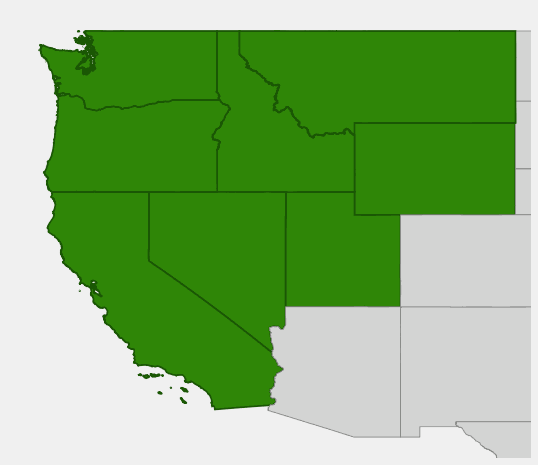
Woolly sunflower is native across western North America, including British Columbia and the western United States from Washington and Oregon through California and inland to Idaho, Montana, Wyoming, Nevada, and Utah. Kew’s current treatment also includes northwestern Mexico. The eight U.S. states highlighted on this map agree with the distribution summarized by the Forest Service review and Kew; neither Alaska nor Hawaii is included.
The species occupies a remarkable range of habitats, from coastal and lowland settings to dry interior grasslands, open woods, and alpine sites. That breadth belongs to the species as a whole, not necessarily to each variety. The Forest Service review recognizes ten varieties and explains that some populations are intermediate. For the Idaho and interior Oregon/Washington region, nursery material of known interior provenance is often more informative than simply choosing any plant labeled Oregon sunshine.
The state map is an overview rather than a local occurrence map. Even in a native state, wet shaded ground may be unsuitable for a form from a rocky sagebrush slope. The Forest Service review gives a total elevation span from near sea level to about 11,500 feet, with much narrower ranges for individual varieties. Use local records and the source of the stock to match a garden or restoration site, particularly when moving between coastal and inland climates.
📋 Regional plant list: Idaho, Eastern Oregon and Eastern Washington
Growing & Care Guide
Light
Full sun is a good starting point for many interior Northwest forms. Some populations occupy open woodland or partly shaded habitats, but that does not make every nursery selection a shade plant. Observe the parent habitat when known. In a border, keep the plant outside the dense shade of taller perennials and shrubs. A silvery mound at the front of a sunny bed provides both visibility and room for air movement around the foliage.
Soil and water
Use soil that drains rather than remaining saturated around the crown. The species occurs in a variety of textures and does not demand a single potting recipe. Avoid responding to its wild drought tolerance by withholding all water from a newly planted plug: small nursery root systems need time to occupy the surrounding bed. Water deeply during establishment, then let the soil approach the appropriate dryness before watering again. Excessive summer watering has caused fungal problems and root rot in nursery work described by the Forest Service.
Planting tips
Plant at the original crown level and firm the soil gently around the roots. Prepare the area by reducing competing weeds instead of filling a small hole with very rich compost. For several plants, allow space based on the mature form being purchased; the name covers both compact and relatively tall material. Cool, moist seasonal conditions can simplify establishment, but the best planting window varies with local winter severity. Harden greenhouse-grown plugs before exposing them abruptly to wind and hot sun.
Pruning and maintenance
Remove dead flowering stems or damaged branches selectively when tidying is needed. Leaving some dry heads allows seed production and preserves seasonal habitat. Do not automatically cut a woody-based specimen as if it were a completely herbaceous annual. Clear fallen debris away if it mats heavily over the crown, and watch for grasses that grow through the mound. A modest amount of routine hand-weeding is more useful than trying to force dense growth with repeated fertilizer applications.
Propagation
Seed propagation is widely used, but the treatment should follow the lot and provenance. Published nursery protocols include fall or winter outdoor sowing and periods of cold treatment followed by warmer germination conditions. Sow shallowly in a well-drained medium, maintain moisture during emergence, and avoid leaving mature seedlings continually waterlogged. Label the seed source and separate different accessions. The species includes several varieties and variable reproductive systems, so collecting seed from mixed garden material is not the same as obtaining documented local restoration seed.
Competition and containers
Young plants can be overwhelmed by established grasses and annual weeds. Keep an open establishment area, then allow suitable companions to fill around rather than through the crown. Containers and green roofs are different from deep native soils: research found that plants in shallow roof substrates were much less drought tolerant than their wildland reputation suggested. A pot can need summer watering even when an established plant in the ground does not. Check the actual root zone instead of applying one schedule to every situation.
Landscape Uses
- Yellow spring-to-summer flowers in a locally appropriate native border.
- A low, pale-foliaged foreground for taller interior Northwest plants.
- Rock gardens and well-drained gravel beds using a suitable compact form.
- Small groups in open pollinator gardens rather than isolated single flowers.
- Regionally sourced restoration stock for suitable grassland or disturbed-site projects.
Wildlife & Ecological Value
For pollinators
The Forest Service synthesis documents visits by mining bees, sweat bees, mason bees, flies, wasps, beetles, and butterflies. A group of plants can create a useful flowering patch. The same review notes strong self-incompatibility in studied populations, illustrating why pollinator visits and compatible neighboring plants matter for seed production. Avoid turning those population studies into an exact rule for every variety, but do provide more than a single isolated specimen when space allows.
For birds
The plant contributes to diverse herbaceous communities used by wildlife, including sage-grouse habitat in parts of its range. In a garden, retaining seed heads and supporting insects is a practical way to leave those ecological pathways intact. It is too low to provide substantial bird nesting cover by itself. Combine it with appropriate grasses and shrubs rather than expecting one flower species to serve every bird-habitat function.
For mammals and other herbivores
Seed predation and herbivore interactions are part of the species’ natural ecology. Woolly leaves are not proof of complete browsing resistance. Protect small transplants if local animals repeatedly remove new growth, and identify the cause of damage before intervening. A few nibbled leaves and complete loss of a young plug call for different responses. This guide does not assign a deer-proof rating unsupported by the evidence.
Ecosystem role
Woolly sunflower has been used in revegetation, roadside work, and pollinator plantings because it can establish readily and contribute flowers and soil cover. Results depend strongly on competition, seed quality, site preparation, and source. The restoration literature describes variable success, not a universal formula. For a home garden, that translates into selecting an adapted form, starting with healthy material, and controlling weeds while the new planting develops.
Cultural & Historical Uses
The botanical epithet lanatum refers to woolliness, a conspicuous feature of the foliage. Oregon sunshine and woolly sunflower emphasize the yellow display, while older scientific names include Actinella lanata and Bahia lanata. Those names are useful when reading historical material; they should not be mistaken for separate plants without checking the taxonomic treatment.
The Forest Service review summarizes culturally specific historical uses recorded for Chehalis, Skagit, and Miwok communities, including ceremonial and external applications. Those records show that the plant’s human history is broader than modern ornamental gardening. They should be attributed rather than collapsed into a generic claim about all Native peoples. Historical use does not by itself establish safety or medical effectiveness, and this page is a horticultural guide rather than a treatment manual.
Modern work with Eriophyllum lanatum includes studies of varieties, chromosome variation, pollination, seed production, and restoration. Its adaptability makes it useful, but the same diversity makes provenance important. Buying propagated stock, recording the supplier’s variety or collection region, and avoiding removal of wild plants are practical ways for gardeners to support responsible use of this native species.
Frequently Asked Questions
Is Oregon sunshine a true sunflower?
It belongs to the sunflower or aster family, but its genus is Eriophyllum, not Helianthus. It is generally much smaller and has different foliage and fruit characters from the familiar annual sunflower.
Why is my plant taller than the table’s old 6–12-inch range?
The species contains many forms. Common regional plants may reach 6–24 inches and some varieties are substantially taller. Check the nursery’s provenance and mature-size information rather than treating one short range as universal.
Does it flower only in spring?
No. Flowering across the species extends from spring into summer, broadly April–August in the Forest Service review. Elevation, variety, and local weather shift the season.
Can I grow it without summer watering?
Established plants in suitable ground may need little water, but new plugs, pots, and shallow roof plantings can dry much faster. Establish the roots first and assess the actual site instead of applying a blanket no-water rule.
Should all Oregon sunshine plants be called the same variety?
No. The species has recognized varieties and intermediate populations. Retain a documented nursery variety when available; otherwise use the species name rather than inventing a finer identification.
Sources & Further Reading
- USDA Forest Service: Common woolly sunflower species review
- University of Washington Burke Herbarium: Eriophyllum lanatum
- Kew Plants of the World Online: taxonomy and distribution
- USDA NRCS: common woolly sunflower plant guide
Find Native Plants
Ask growers about nursery propagation and regional provenance. Browse our ID native plant nurseries, OR native plant nurseries, WA native plant nurseries directory for suppliers. Explore the native nursery finder.