Snow Buckwheat (Eriogonum niveum)
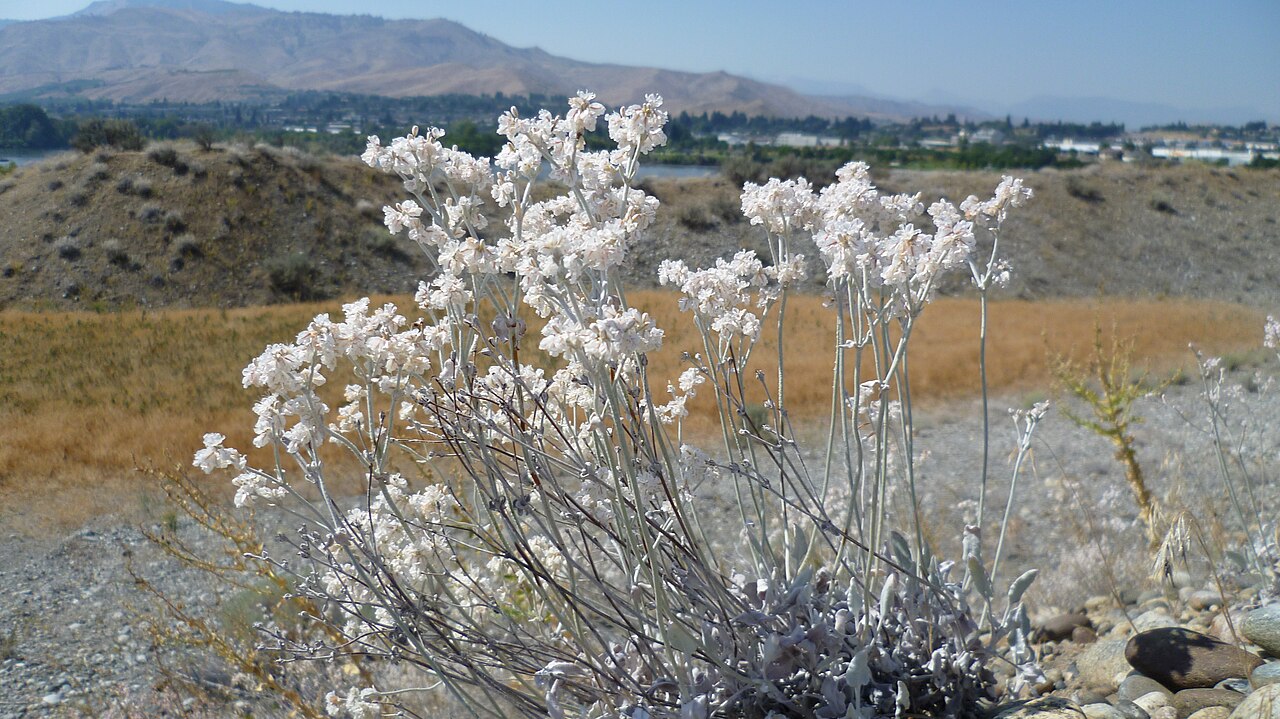
Snow buckwheat is one of the interior Northwest’s most useful late-flowering natives. A low woody base and woolly gray leaves support branching sprays of small white flowers that often take on pink tones as the season advances. The scientific name is Eriogonum niveum, and canyon heather is another recorded common name. Despite those names, it is neither a true heather nor the agricultural buckwheat grown for grain.
Its natural home includes dry slopes, rocky grasslands, and shrub-steppe east of the Cascade Range. In an appropriate garden it offers a different kind of display from a large daisy: numerous tiny flowers create an airy cloud above a compact base. The effect is especially valuable after many spring wildflowers have finished. Allow room for the flowering branches, not just for the basal mound visible when a young nursery plant arrives.
For the Idaho, eastern Oregon, and eastern Washington list, dry soil is the important message. The older average-moisture shorthand understates this species’ adaptation to droughty sites. A mature plant can thrive with little supplemental water once its root system is established, while a new transplant still needs moisture to root. Its value is highest where irrigation, soil drainage, and neighboring plants are selected around that difference.
Identification
Woody base and branching stems
Snow buckwheat is a perennial halfshrub: its lower framework persists and becomes woody, while the seasonal display is carried on finer shoots. Plants may grow upright or more spreading depending on site and population. Many are around 1–2 feet tall in flower; favorable sites can produce plants approaching 3 feet tall and wide. An old plant therefore should not be mistaken for a small annual simply because its flowers are delicate.
Leaves
Most conspicuous foliage is clustered toward the lower plant. Leaves are oval to broadly lance-shaped and covered with a pale woolly surface. Small leaflike bracts also occur along the branching flowering structure. That last feature is useful when distinguishing snow buckwheat from similar Eriogonum strictum forms. Identification should consider the full set of features and location, not just whether a leaf looks gray in a photograph.
Flowers
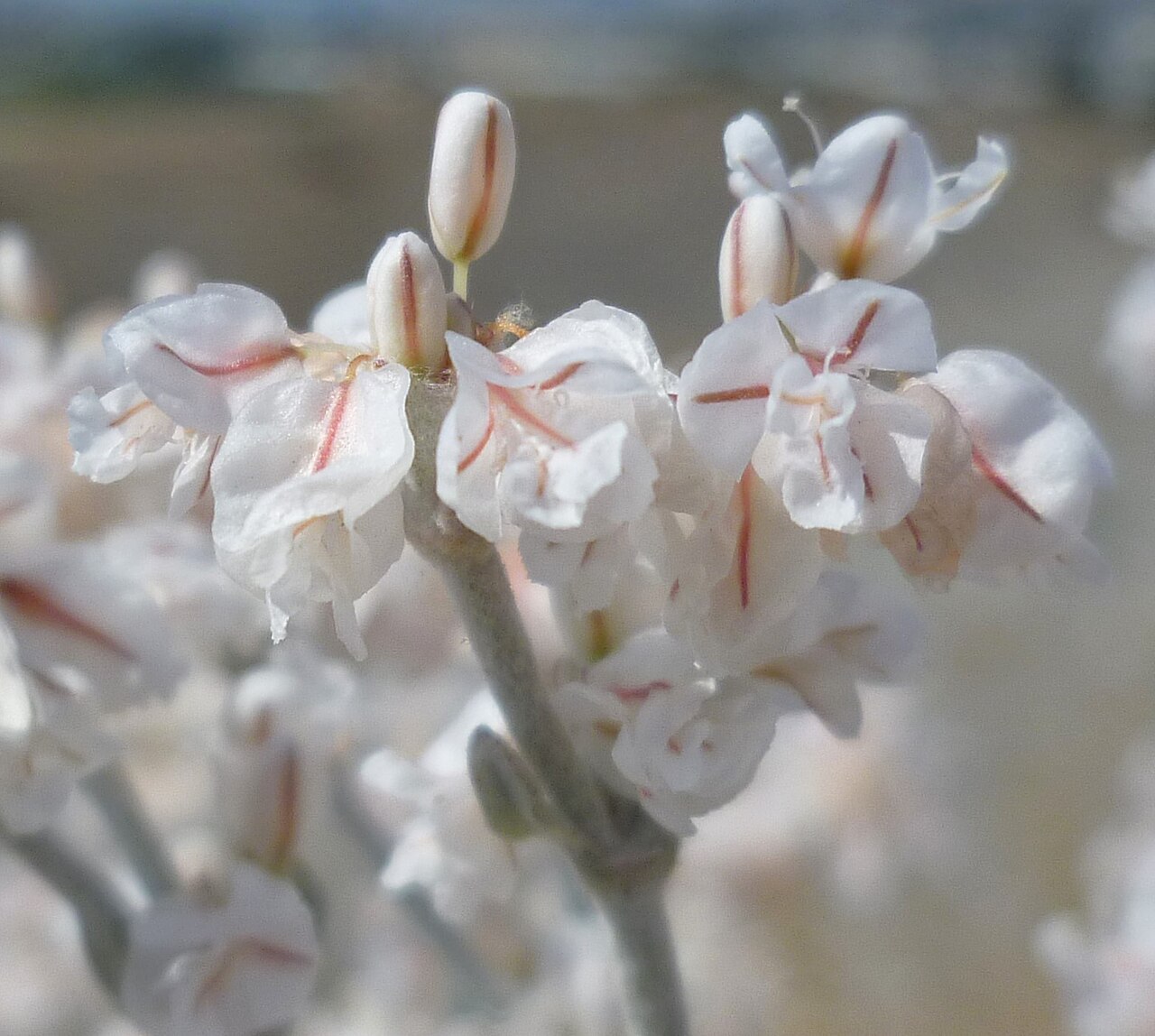
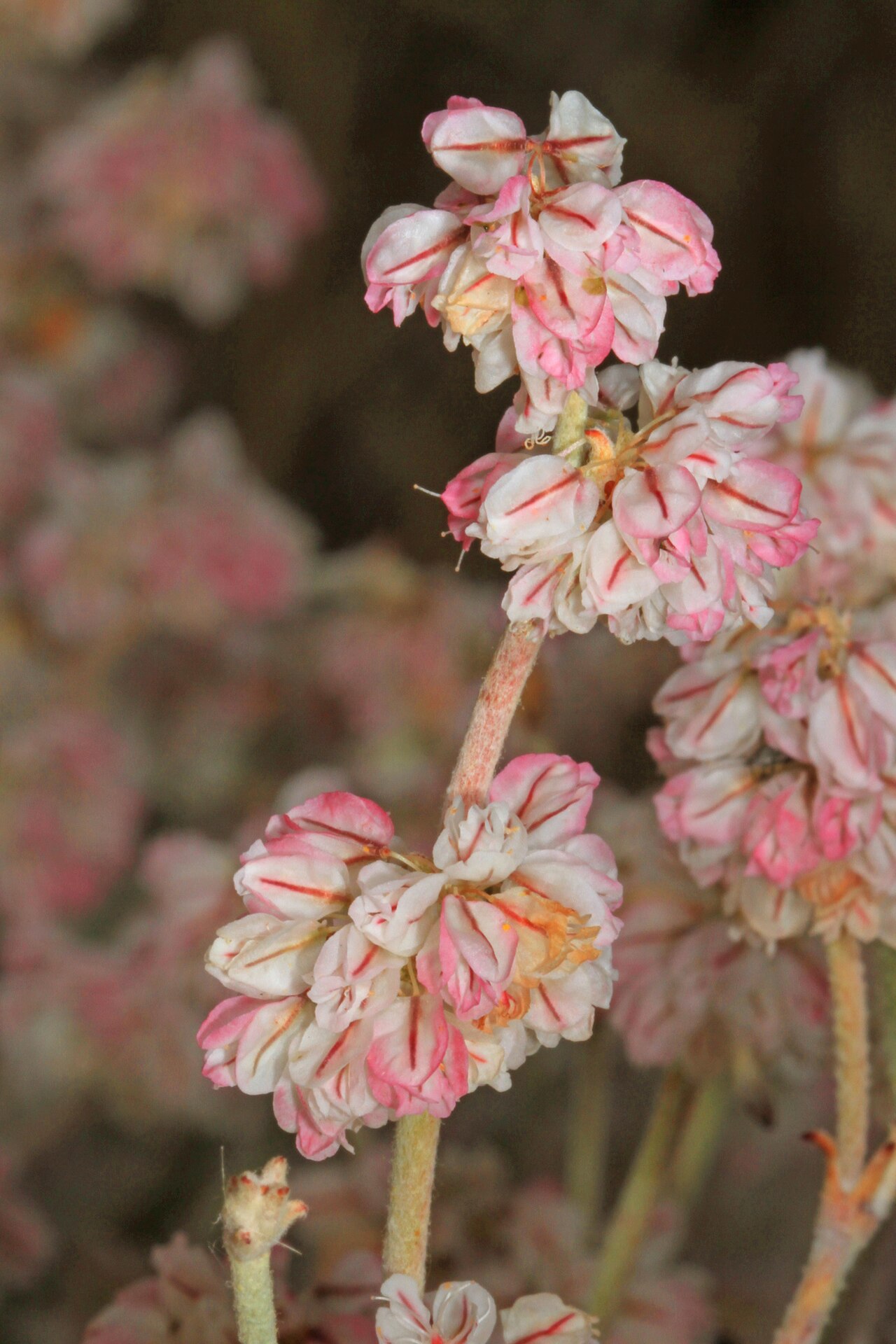
The flowers are small, cream-white to pinkish, and grouped along repeatedly branching stems. Each individual flower has six tepals rather than the petal-and-sepal pattern familiar from some other garden flowers. The branches create a broad, airy outline. Bloom can continue late into the growing season, commonly from late summer into fall in the interior Northwest. The exact start and finish vary with weather, elevation, and the plant’s provenance.
Fruit and seasonal appearance
Small dry, three-sided fruits develop as the flower display ages. Persistent floral parts often turn pinkish and eventually brown, so the plant can remain attractive beyond peak bloom. Harvesting seed requires watching the heads rather than relying on a calendar date; mature seed can fall quickly. Winter foliage retention is variable. Describe it as a persistent woody-based perennial rather than promising that every garden specimen will remain fully evergreen.
Quick Facts
| Scientific Name | Eriogonum niveum |
| Family | Polygonaceae (buckwheat family) |
| Plant Type | Woody-based perennial or halfshrub |
| Mature Height | Usually about 12–24 inches; occasionally around 3 feet on favorable sites |
| Mature Spread | Often 1–2 feet; potentially about 3 feet on favorable sites |
| Growth Rate | Establishes from nursery plugs; persistent and long-lived once rooted |
| Sun Exposure | Full sun; tolerates light, open woodland shade |
| Water Needs | Low once established; dry, freely drained soil |
| Soil Type | Well-drained sandy, gravelly or rocky soils; can tolerate draining clay soils |
| Soil pH | Not a narrowly acid-soil specialist; use local soil and drainage as guides |
| Bloom Time | Late summer into fall, varying by site |
| Flower Color | White to cream, often becoming pinkish with age |
| Fall Color | Pink to brown aging flower clusters above gray foliage |
| Fruit | Small dry three-angled fruits |
| Deer Resistant | No guarantee; mule deer and bighorn sheep browse it |
| USDA Hardiness Zones | USDA NRCS guide gives zones 5a–7a; provenance and site influence performance |
Native Range
Snow buckwheat is native to a relatively focused part of the Pacific Northwest: southern British Columbia and portions of Washington, Oregon, and Idaho. The Flora of the Pacific Northwest checklist places its main distribution east of the Cascades, including eastern Washington, northeastern Oregon, and west-central Idaho. The USDA guide also describes its occurrence south into central Oregon. These are regional patterns rather than a claim that every shaded state is uniformly occupied.
The native-range map therefore highlights Washington, Oregon, and Idaho only. British Columbia is discussed in the text because this is a U.S. state map. Do not read the shaded outline as a recommendation for wet coastal beds or densely shaded forest gardens. The plant’s association with dry interior landscapes is as important as its state distribution. Verify county-level records and local seed origin when planning ecological restoration.
Wild habitats include rocky slopes, scablands, canyon grasslands, sagebrush country, and open ponderosa pine settings. Its roots can exploit moisture in rock cracks where neighboring vegetation remains sparse. The USDA adaptation guide gives an elevation band around 500–4,900 feet and annual precipitation around 6–18 inches for its described plant materials. Those figures help explain its dryland character, but they are not a substitute for observing drainage at the individual planting site.
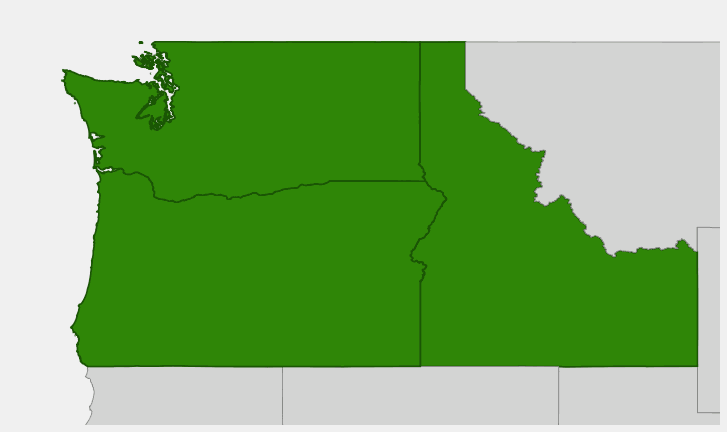
📋 Regional plant list: Idaho, Eastern Oregon and Eastern Washington
Growing & Care Guide
Light
Full sun is the most straightforward choice for a dry garden. The species can grow in open ponderosa pine landscapes, so light filtered shade is not automatically disqualifying. Dense shade, however, is not equivalent to an open woodland slope. Give the flowering branches enough clearance to form their natural outline and avoid tucking a small plug beneath a shrub that will later overtop it. A south- or west-facing bank can work well if the young plant is watered appropriately during establishment.
Soil and water
Choose a freely draining site and avoid a low spot that receives runoff from frequently watered lawn. The USDA guide describes tolerance of a range of soil textures, from sand to clay, provided drainage is adequate. That should not be interpreted as approval for stagnant clay basins. Water thoroughly after planting, then check how quickly the root zone drains and dries. Reduce irrigation gradually after the roots extend into surrounding soil; repeatedly soaking an established dryland plant is not a way to improve its native drought tolerance.
Planting tips
Start with nursery-grown plugs or containers rather than removing a wild halfshrub. The established root system is difficult to extract intact, and digging a wild plant also disturbs a site vulnerable to weeds. Set the crown at its original level and use the surrounding soil for backfill. Avoid a richly amended pocket that behaves very differently from the bed around it. Cool-season planting allows root growth before severe summer drought, with timing adjusted for local freezing conditions.
Pruning and maintenance
Light shaping can keep the plant compact, but preserve the woody crown and living framework. The USDA guide warns that cutting woody stems back severely can reduce longevity and subsequent seed production. Trim spent flowering tips selectively rather than treating it like a perennial that is cut to the ground every spring. Leaving some dry heads preserves seasonal texture and seed. Remove cheatgrass and other competing annuals early, particularly while the planting is becoming established.
Propagation
Fall sowing is a practical outdoor method because seedlings naturally establish during cool, moist weather. Sow shallowly; the USDA guide gives a maximum depth of about one-quarter inch for field seeding. In pots, use a freely draining medium and avoid prolonged saturation. Seed maturity is indicated by browning flower parts, but ripe seed may shatter quickly. Store cleaned seed cool and dry, label its provenance and collection year, and check viability rather than assuming an old packet will behave like fresh seed.
Garden placement and troubleshooting
The flowering canopy is wider than the young basal mound, so allow spacing for a rounded mature plant. If stems become crowded by neighboring grasses, thin the competition rather than automatically cutting back the buckwheat. Decline in a wet bed calls for examining drainage. Browse damage is also possible: despite its drought tolerance and woolly appearance, this is not reliably deer-proof. Where deer pressure is high, protect establishing plants or place them in an area where browsing is acceptable.
Landscape Uses
- Late-season flowers in a sunny, low-water native border.
- A rounded gray-green accent among locally appropriate bunchgrasses.
- Dry banks and rocky garden margins with room for the flowering canopy.
- Native pollinator plantings that need flowers after the spring bloom peak.
- Professionally planned revegetation of suitable dry disturbed ground using regionally appropriate seed.
Wildlife & Ecological Value
For pollinators
The many small flowers are visited by bees and butterflies. Their late timing can extend the garden’s food supply beyond the flush of spring flowers. A planting is most useful when flowering plants of several seasons are available nearby and pesticide exposure is minimized. Buckwheats have important relationships with a variety of insects, but a genus-level host claim should not be converted into a promise that every butterfly uses this particular species.
For birds
The low canopy contributes small-scale cover within an open native planting. Seed and insects associated with the plant are part of the broader food web, but this guide does not claim an unsupported number of bird species fed by snow buckwheat. Combine the halfshrub with native grasses and larger shrubs if bird shelter is an objective. A single isolated plant cannot provide all the nesting and escape cover of an intact shrub-steppe patch.
For mammals
Mule deer use in winter and early spring is documented in the USDA guide, as is browsing by bighorn sheep. Sheep may take the flowering tips while ignoring much of the rest of the plant. These observations explain why snow buckwheat should not be labeled unpalatable or deer-proof. In a home garden, damage levels will depend on local animal abundance, season, and the other food available.
Ecosystem role
Snow buckwheat can colonize harsh, dry disturbed substrates and help protect exposed soil with its canopy and roots. Plant-material research has examined its use on road cuts and mine spoils. That is a useful restoration role, not a reason to introduce it beyond its native range or rely on it alone for slope engineering. Successful restoration still requires the right seed source, control of competing weeds, and attention to the rest of the native community.
Cultural & Historical Uses
The name snow buckwheat refers to the pale flowering display, while the scientific epithet niveum likewise evokes whiteness. Older accounts also call it canyon heather. These names describe appearance and setting rather than botanical relationship to true heathers. It is part of the diverse North American wild-buckwheat genus Eriogonum, distinct from the grain crop Fagopyrum.
The USDA plant guide summarizes historical medicinal records for snow buckwheat and related buckwheats in Indigenous communities of the interior Northwest. It also notes suggestions of dye use, which should not be presented as a precisely established use for every species or community. Such records belong in their original cultural and documentary context. They do not establish safety, dosage, or effectiveness for modern home remedies, and this page does not recommend medicinal preparation.
The selection Umatilla was released by the USDA Pullman Plant Materials Center in 1991 from a collection in Umatilla County, Oregon. Its development illustrates the species’ value for dryland revegetation and landscape work. A named restoration selection is not automatically the right provenance for every native planting, however. Ask suppliers whether their material is local wild-origin stock, a selection, or material of unspecified origin, and choose according to the project’s goals.
Frequently Asked Questions
Is snow buckwheat edible grain buckwheat?
No. Eriogonum niveum is a native wild buckwheat, not the agricultural grain crop Fagopyrum. Do not infer food use from the shared common name.
How tall will it get?
Many plants are about 1–2 feet tall in flower, but favorable sites can produce plants around 3 feet tall and wide. The old 6–18-inch table range can understate mature flowering size.
Can I keep it in average garden irrigation?
It generally performs best in a low-water, freely draining setting once established. A newly planted plug still needs establishment water. Avoid coupling it to the same frequent irrigation used for thirsty lawn or vegetables.
Should I cut it to the ground after flowering?
No. Preserve the woody crown and living lower branches. Light tip pruning or removal of spent flower stalks is different from severe cutting into the persistent framework.
Why do the white flowers turn pink?
Pink tones commonly develop as the floral display ages, followed eventually by brown dry heads. That seasonal change is part of its ornamental value and is not by itself a disease symptom.
Sources & Further Reading
- USDA NRCS Pullman Plant Materials Center: Snow buckwheat plant guide
- Flora of the Pacific Northwest checklist: Eriogonum niveum
- University of Washington Burke Herbarium: Snow buckwheat identification
- Utah State University Native Plants Cooperative report (2012)
Find Native Plants
Ask growers about nursery propagation and regional provenance. Browse our ID native plant nurseries, OR native plant nurseries, WA native plant nurseries directory for suppliers. Explore the native nursery finder.