Alaska Birch (Betula neoalaskana)
Betula neoalaskana, commonly called Alaska Birch or Resin Birch, is the characteristic white-barked birch of Alaska’s interior forests. It is the tree most Alaskans picture when they say “birch” — the slender, chalk-white trunks that line the Parks Highway, ring the edges of black spruce muskeg, and turn whole hillsides gold every September. Alaska birch belongs to the paper birch group (section Betula within the genus) and is closely related to, and sometimes lumped with, the more widespread paper birch, Betula papyrifera, but foresters and botanists in Alaska and the Yukon generally treat it as its own species.
In the wild, Alaska birch is a medium-sized deciduous tree, usually 30 to 60 feet tall, with a narrow, open crown and the glossy white, papery bark typical of birches. What sets it apart in the field is its young twigs: they are covered in small, raised, resinous warty glands (hence “resin birch”), which make the new growth feel slightly sticky and rough to the touch — a quick and reliable way to separate it from true paper birch, whose twigs are smoother. The tree is extremely cold-hardy, tolerating winter lows that would kill most other broadleaf trees, and it is one of the few hardwoods that thrives on the permafrost-influenced soils of interior Alaska.
For gardeners in Alaska, Alaska birch is one of the few truly native shade and specimen trees available, and it is an obvious choice for naturalistic plantings, windbreaks, and reforestation after fire or land clearing. It grows fast for a northern tree, colonizes disturbed ground readily, and its bright white trunks and gold fall color give real presence to a yard even in the depths of a long Alaska winter, when the pale bark stands out against the snow.
Identification
Alaska birch is a single- or occasionally multi-trunked deciduous tree reaching 30 to 60 feet (9–18 m) in height, with a trunk 8 to 18 inches (20–45 cm) in diameter at maturity. In cold, exposed sites or on thin permafrost soils it stays smaller and more shrub-like, while in favorable river-terrace sites it can approach 70 feet. The crown is narrow and open, with ascending branches, giving the tree an airy, light-filtering canopy rather than dense shade.
Bark & Stems
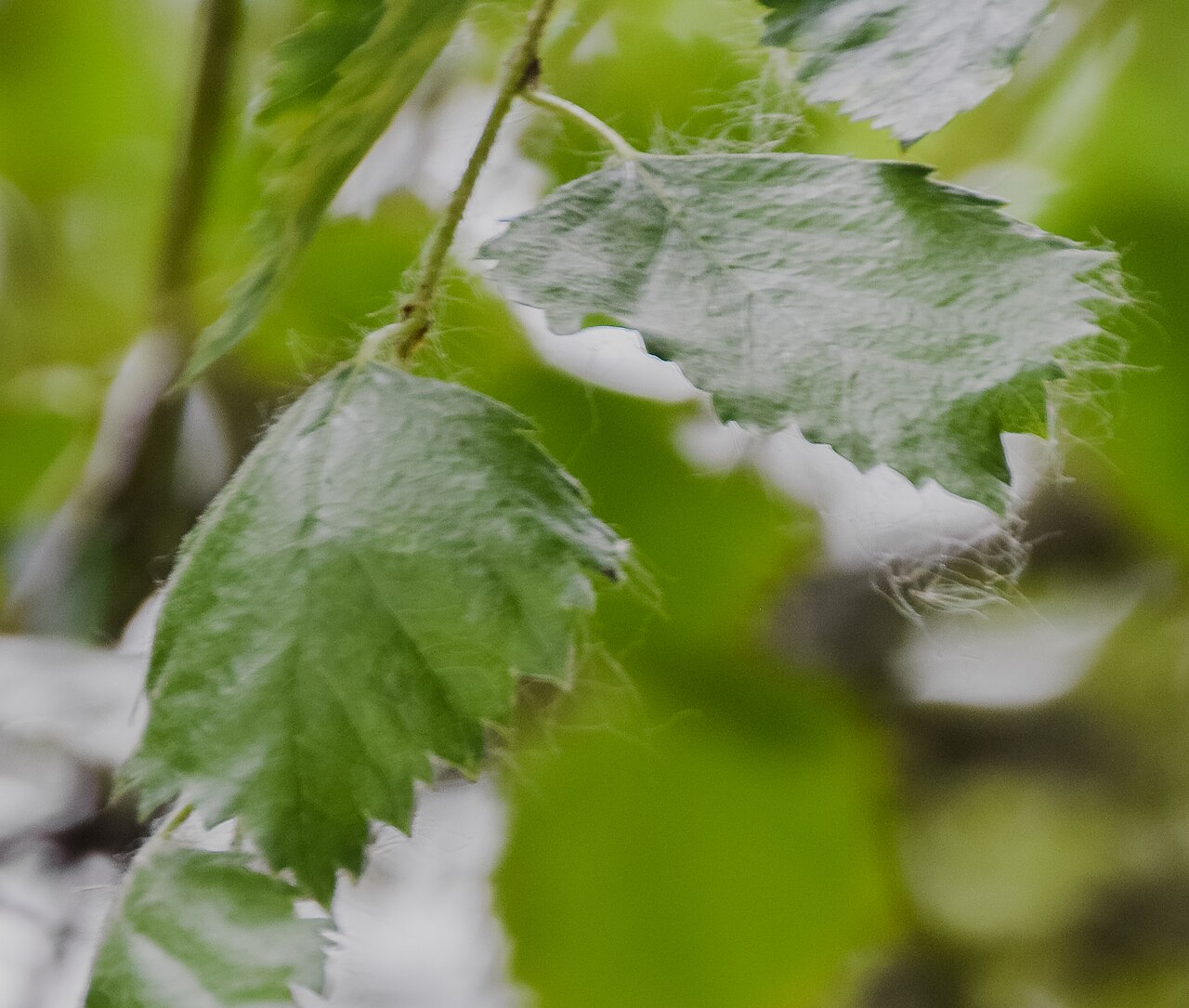
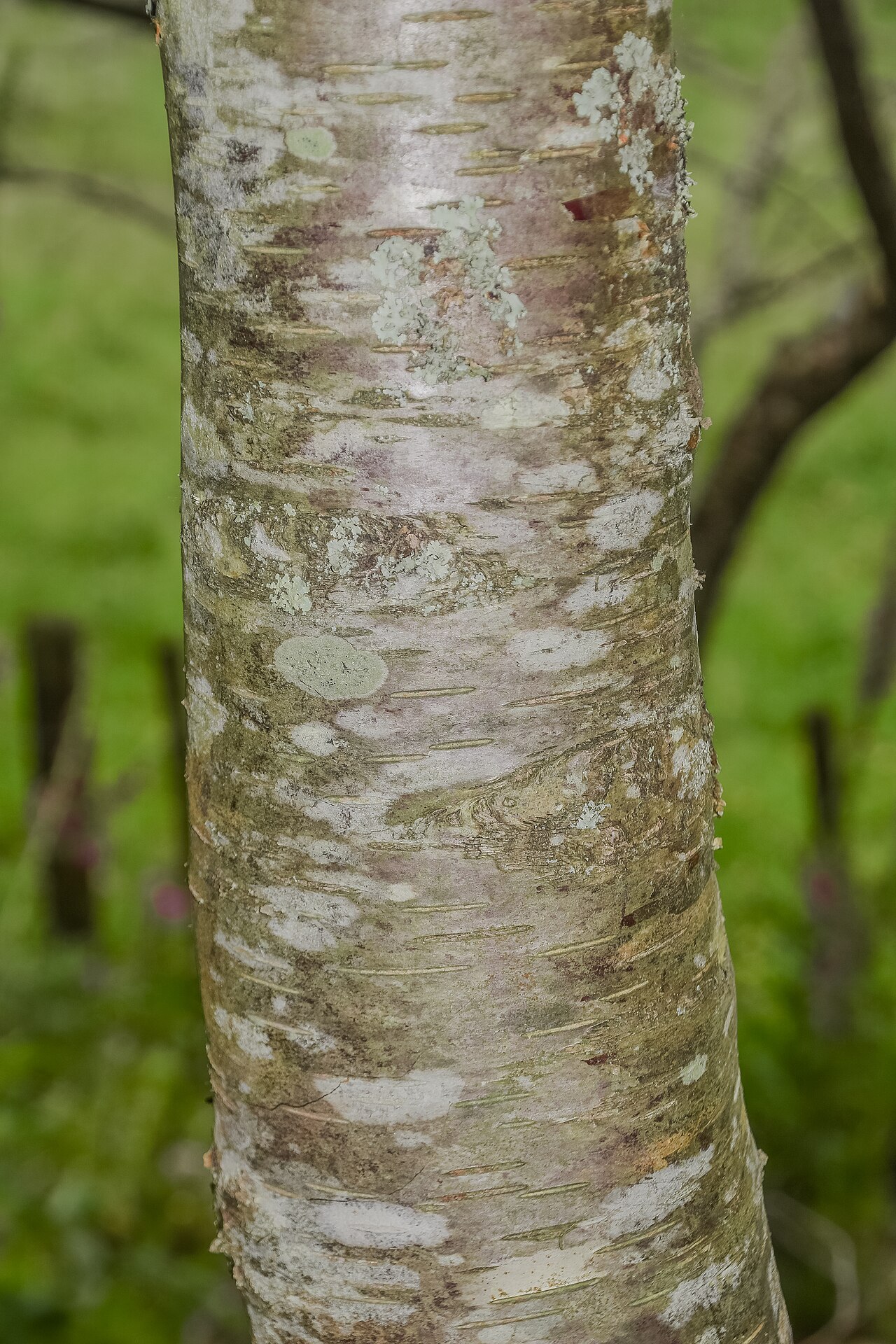
Young trees have smooth, reddish-brown to chestnut bark that begins peeling into white, papery curls by the time the tree is a few inches in diameter. Mature bark is chalky to creamy white, marked with narrow horizontal lenticels (the dark dashes on birch bark) and peels in thin papery sheets, exposing orange-brown inner bark beneath. The single best field character for Alaska birch is its young twigs: they are densely covered in small, raised, wart-like resin glands that feel gritty or slightly sticky when rubbed between the fingers. Paper birch twigs, by contrast, are mostly smooth or only lightly glandular — the same bark-and-twig approach used to tell birches apart in our guide to identifying birch trees works well here, even though that guide covers a different region.
Leaves
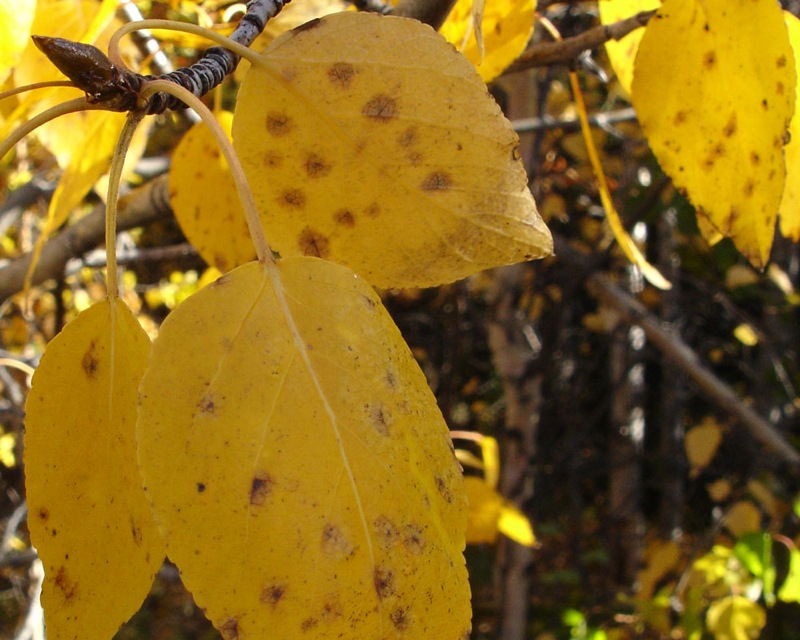
Leaves are simple, alternate, and ovate to triangular, 2 to 4 inches (5–10 cm) long, with a pointed tip, a rounded to broadly wedge-shaped base, and sharply, doubly serrated margins (a larger tooth with smaller teeth riding on it). The upper surface is dark yellow-green and the lower surface paler, often with tiny resin dots visible with a hand lens. Leaves emerge with a faint reddish cast, mature to deep green through summer, and turn a clear, bright gold in early fall — often the first color change visible across the interior Alaska landscape, typically by late August.
Flowers
Alaska birch is monoecious, with separate male and female catkins on the same tree. Male catkins form in late summer, overwinter exposed at branch tips, and elongate to 2 to 3 inches the following spring, dangling and releasing wind-borne pollen in May. Female catkins are smaller, upright to spreading, and appear with the unfolding leaves.
Fruit & Seeds
Pollinated female catkins develop into cylindrical, drooping seed cones about 1 to 1.5 inches long that disintegrate at maturity in late summer and fall, releasing thousands of tiny, winged nutlets that scatter on the wind — often visible as a fine confetti blowing across snow in late autumn and winter. The abundant, wind-dispersed seed is a major reason Alaska birch is such an effective pioneer species after fire, flooding, or other ground disturbance.
Quick Facts
| Scientific Name | Betula neoalaskana |
| Family | Betulaceae (Birch) |
| Plant Type | Deciduous Tree |
| Mature Height | 30–60 ft (9–18 m) |
| Mature Spread | 15–25 ft (4.5–7.5 m) |
| Growth Rate | Fast for a boreal tree |
| Sun Exposure | Full Sun to Part Shade |
| Water Needs | Average to Moist |
| Soil Type | Well-drained loam, sand or gravel; tolerates thin, rocky or permafrost-influenced soils |
| Soil pH | 5.5–7.0 (acidic to neutral) |
| Bloom Time | May (catkins) |
| Flower Color | Yellow-brown (catkins, not showy) |
| Fall Color | Bright gold to yellow |
| Fruit | Small winged nutlets in drooping cone-like catkins |
| Deer Resistant | No (moose and hares browse twigs and bark heavily) |
| USDA Hardiness Zones | 1–4 |
Native Range
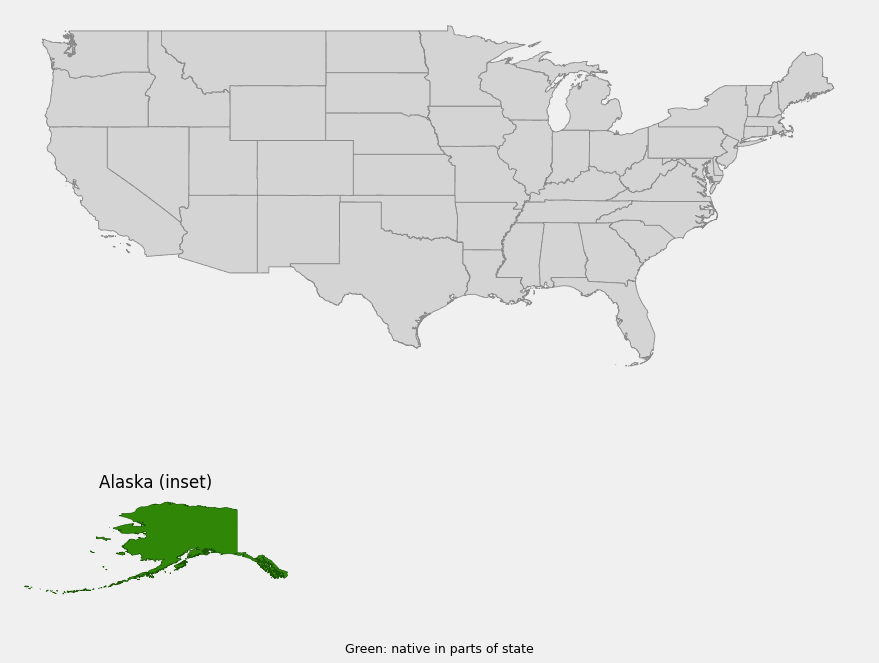
Alaska birch is a boreal species found through most of mainland Alaska and across the Yukon and far northwestern Canada, reaching its southern limit near the Alaska-British Columbia border and its northern limit along the edge of the Arctic tundra. Within the United States it is essentially an Alaska-only tree; USDA PLANTS and botanical treatments do not list it as native in any of the Lower 48 states, and while some foresters treat it as part of a variable paper-birch complex, it is generally kept as a distinct, cold-adapted species found in interior and south-central Alaska.
It is the dominant hardwood of interior Alaska’s boreal forest, forming pure stands after fire and mixing with white spruce, aspen and balsam poplar as succession proceeds. It is common along the Tanana and Yukon River valleys, around Fairbanks and Denali, and through the Matanuska-Susitna Valley, typically on well-drained river terraces, south-facing slopes and gravelly uplands rather than in the wet black-spruce muskeg where it struggles to establish.
Because Alaska birch is adapted to a short, intense growing season and extreme winter cold, it is not a practical choice outside its natural cold-climate range — gardeners in the contiguous states should look to native Paper Birch (Betula papyrifera) or River Birch (Betula nigra) instead, both of which are better suited to warmer zones. For general planting and pruning guidance that applies across birch species, see our birch tree growing guide.
📋 Regional plant lists featuring Alaska Birch: Alaska
Growing & Care Guide
Alaska birch is one of the easiest native trees to grow within its own hardiness range, and it rewards gardeners who simply give it room, decent drainage, and sun. Because almost everyone who plants it lives within its native range, the main job is matching it to the right spot rather than fighting the climate.
Light
Give Alaska birch full sun to light shade. It grows fastest and develops the fullest crown in open sun, which also encourages the strongest fall color. In denser shade under taller spruce it survives but grows slowly and leans toward available light.
Soil & Water
This tree wants well-drained soil — sandy loam, gravelly river terrace soil, or disturbed mineral soil all suit it well. It does not tolerate standing water or permanently saturated ground, which is why it avoids the wet black-spruce muskeg even within its own range. Young trees need regular watering through their first two summers; established trees handle the naturally dry interior Alaska summers well once their roots are established, though supplemental water during unusually dry, hot spells helps maintain vigor.
Planting Tips
Plant in spring once the ground has thawed, choosing a site with good air and soil drainage — a slight slope or raised position is ideal where permafrost or heavy clay is a concern. Because Alaska birch produces huge amounts of wind-blown seed and colonizes bare ground readily, it often shows up on its own in disturbed yards; transplanting small volunteer seedlings in early spring works well if nursery stock is not available. Keep new trees 15 to 20 feet from structures and septic systems, since the root system is wide-spreading.
Pruning & Maintenance
Prune in late winter while the tree is fully dormant; birches “bleed” sap heavily if cut in spring. Remove dead, crossing, or storm-damaged branches, and avoid heavy pruning, which stresses the tree and invites decay. Watch for bronze birch borer in warmer, more stressed plantings — keeping trees well-watered during drought is the best prevention, since the borer targets weakened trees.
Landscape Uses
Alaska birch earns its keep in several garden roles:
- Specimen or shade tree — the white bark is a focal point year-round, especially against snow
- Windbreaks and screens planted in groups or rows
- Reforestation and fire-recovery plantings on cleared or burned ground
- Naturalistic and wildlife gardens paired with spruce and native shrubs
- Erosion control on gravelly slopes and riverbanks
Wildlife & Ecological Value
Alaska birch anchors much of interior Alaska’s wildlife food web, especially through the long winter when little else is available to browse.
For Birds
Chickadees, redpolls, and pine siskins feed heavily on birch seeds through fall and winter, and the peeling bark and insect life it hosts attract woodpeckers and nuthatches. Ruffed grouse browse the buds and catkins in late winter when other food is scarce.
For Mammals
Moose are the signature browser of Alaska birch, feeding on twigs and saplings throughout winter — birch thickets are classic moose winter range across the interior. Snowshoe hares girdle young stems, and red squirrels and voles eat the seed. Porcupines gnaw the bark of larger trees.
For Pollinators
Birch catkins are wind-pollinated rather than insect-pollinated, but the pollen is an important early-season protein source for some native bees emerging in spring, and the trees provide structural habitat for many insects that in turn feed birds.
Ecosystem Role
As one of the first trees to recolonize burned ground, Alaska birch plays an outsized role in boreal forest succession, stabilizing soil, shading out competing vegetation, and gradually giving way to longer-lived white spruce. Its fast-decomposing leaf litter, unlike spruce needles, enriches soil and supports a more diverse understory beneath birch stands.
Cultural & Historical Uses
Birch has deep cultural importance across interior Alaska and the Yukon among Athabascan peoples, who traditionally used the bark — stripped in sheets in spring when it separates easily from the trunk — to build canoes, baskets, and container vessels valued for being lightweight, waterproof, and durable. Birch bark baskets, sewn with spruce root and sealed with spruce pitch, remain a living craft tradition today.
The wood, though not as prized commercially as paper birch farther south, has long been used locally for tool handles, sleds, and firewood, burning hot and clean. Birch sap, like that of other northern birches, can be tapped in early spring and reduced into syrup, though the much lower sugar content compared to maple sap means a far larger volume of sap is needed per gallon of syrup.
Today, Alaska birch remains one of the most recognizable and valued native trees across the interior, prized by homeowners for its hardiness and its white, snow-season beauty as much as for any practical use.
Frequently Asked Questions
Is Alaska birch the same as paper birch?
They are closely related and sometimes confused, but most Alaska and Yukon botanists treat Alaska birch (Betula neoalaskana) as a distinct species, separable in the field by its warty, resin-dotted young twigs. Paper birch (Betula papyrifera) occurs farther south and east and has smoother twigs; some older floras lump the two or treat Alaska birch as a variety, but it is generally kept separate in current USDA and regional treatments.
Can I grow Alaska birch outside Alaska?
It is adapted to an extreme cold, short-season climate and is not a practical landscape tree outside USDA zones 1–4. Gardeners in milder regions should choose a birch species native to their own area, such as paper birch or river birch, instead.
Why are moose always eating my birch saplings?
Birch twigs and bark are a staple winter food for moose across interior Alaska, and young, tender saplings are especially attractive. Protecting new plantings with fencing or tree guards for the first several winters is the most reliable way to let a sapling get established.
Does Alaska birch produce usable syrup?
Yes — like other birches, its sap can be tapped in early spring and boiled down into syrup, though birch sap has far less sugar than maple sap, so it takes roughly 80 to 100 gallons of sap to make one gallon of syrup.
How fast does Alaska birch grow?
It grows quickly for a boreal species, often 1 to 2 feet per year while young in good soil and full sun, slowing as it matures. This fast growth, combined with abundant wind-dispersed seed, is why it is often the first tree to reclaim burned or cleared ground.

Looking for a nursery that carries Alaska Birch?
Browse our native plant nursery directory: Alaska