American Wisteria (Wisteria frutescens)
Wisteria frutescens, commonly called American Wisteria, is a vigorous native woody vine native to the southeastern United States that has earned a devoted following among gardeners seeking a spectacular flowering climber without the invasive drawbacks of its Asian relatives. Unlike the aggressive Japanese or Chinese wisterias (W. sinensis and W. floribunda), American Wisteria is a well-behaved, ecologically responsible choice that supports native wildlife while delivering breathtaking floral displays.
This large shrub-vine can climb 25 to 30 feet or more, winding its way up trellises, arbors, pergolas, and tree trunks with a clockwise twining habit. From late spring into early summer, it produces spectacular hanging clusters (racemes) of pea-like flowers ranging from violet-blue to lilac and occasionally pink or white, carrying a light, sweet fragrance. The foliage is compound and glossy, turning clear yellow in autumn before the vine goes dormant, revealing its gnarled, attractive woody stems.
American Wisteria is deeply valuable to native ecosystems. It serves as a larval host plant for long-tailed skipper butterflies and provides nectar for hummingbirds, bees, and a wide array of beneficial insects. Where Asian wisterias escape cultivation and smother native trees, W. frutescens offers the same visual drama while remaining proportional, manageable, and safe for neighboring plants. Named cultivars like ‘Amethyst Falls’ and ‘Longwood Purple’ have made this native vine increasingly accessible at nurseries across the Mid-Atlantic region.
Identification
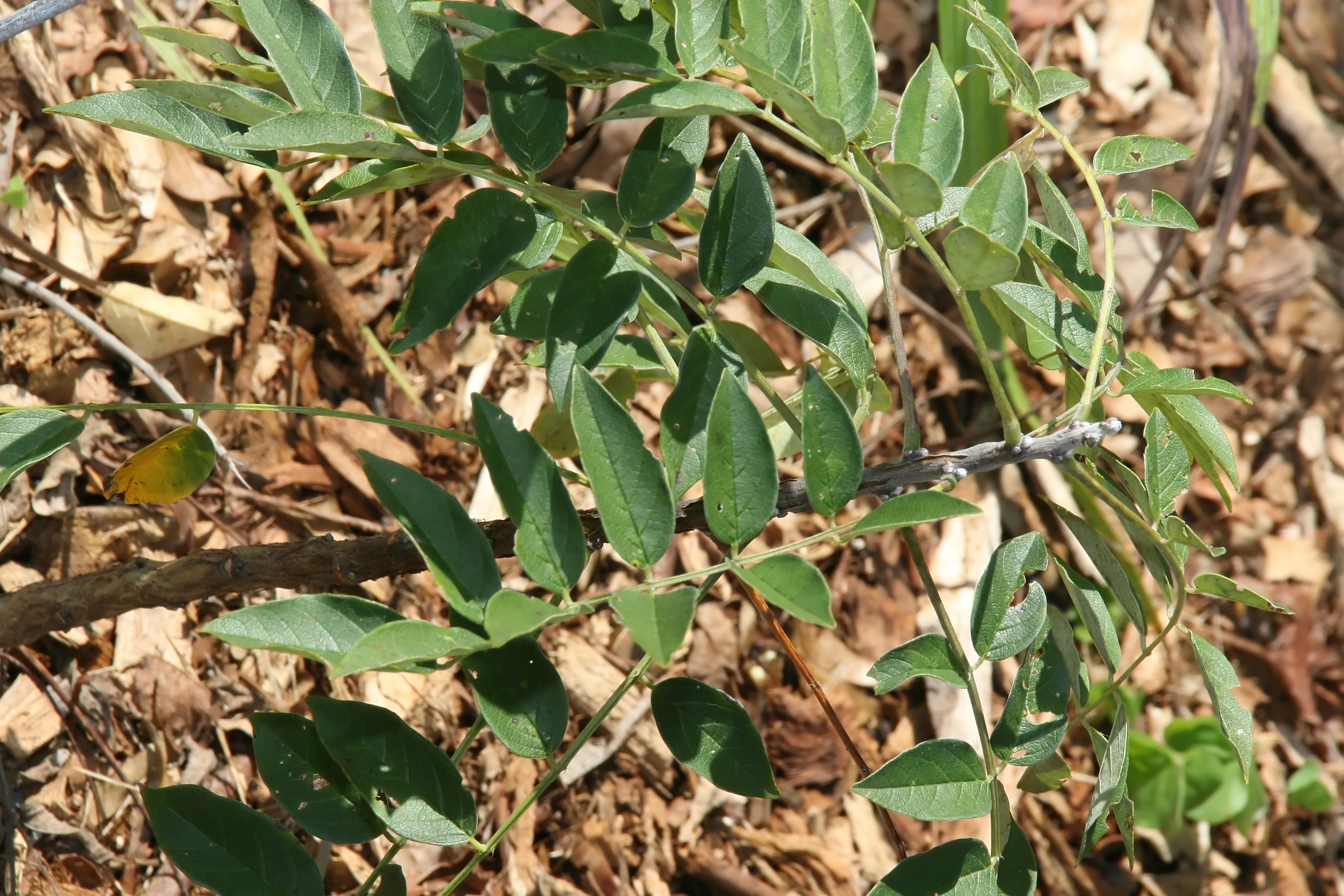
American Wisteria is a deciduous, woody, twining vine that ascends by wrapping its stems in a clockwise direction around any available support. Mature specimens develop thick, rope-like stems that can reach several inches in diameter at the base, giving well-established vines a dramatic sculptural quality when dormant in winter.
Leaves & Stems
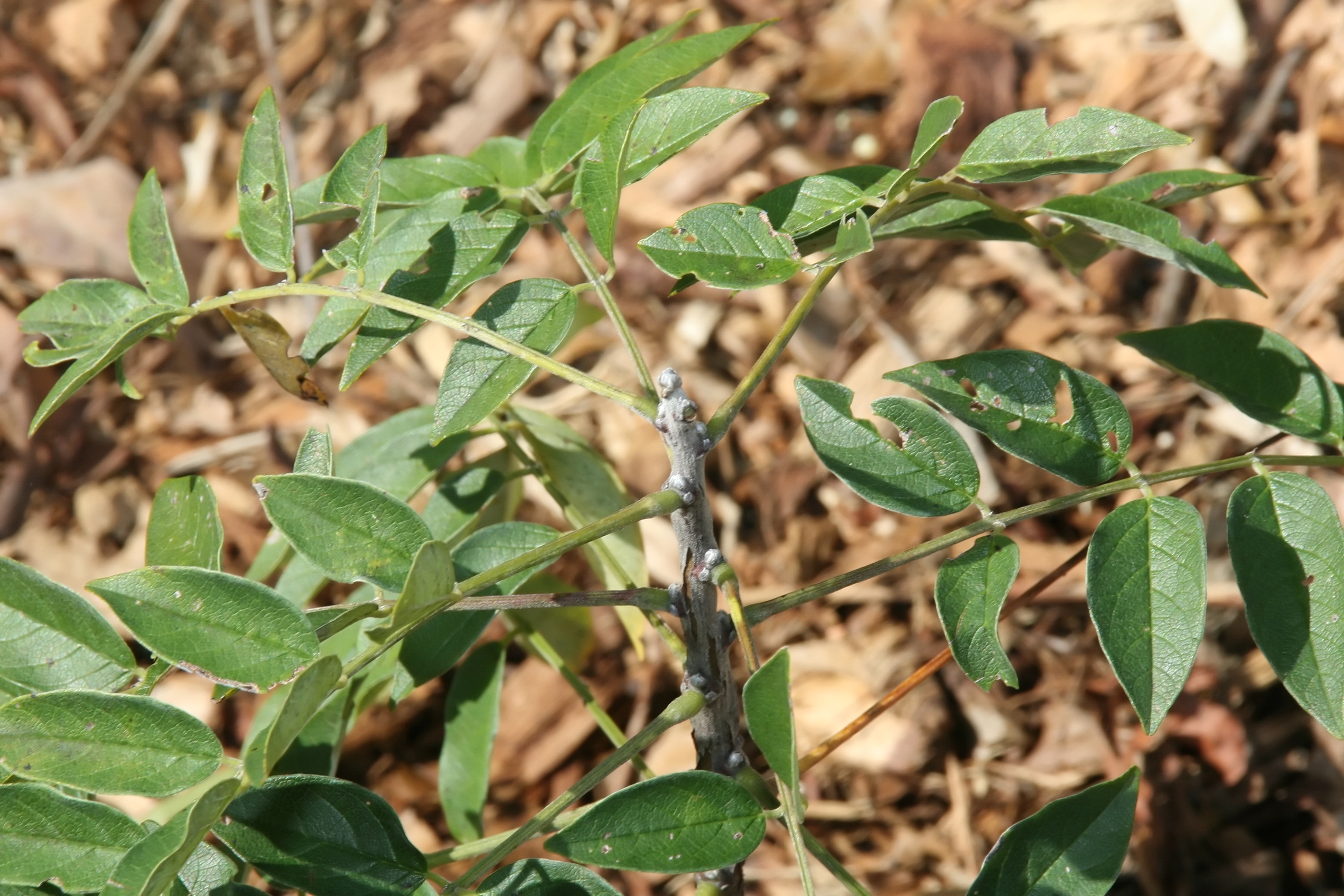
The leaves are pinnately compound, 7 to 12 inches long, composed of 9 to 15 oval leaflets each 1 to 2.5 inches long. The leaflets are dark green above, slightly paler beneath, and hairless (or nearly so) — distinguishing them from Chinese Wisteria, whose leaflets are finely hairy when young. New growth emerges in a fresh, bright green. The stems are slender and green when young, becoming gray-brown and woody with age.
Flowers & Fruit
The flowers appear in mid to late spring (May–June in Maryland and Virginia), after the leaves have already emerged — another key difference from Asian wisterias, which bloom on bare stems. The flower clusters (racemes) are 4 to 12 inches long and somewhat shorter than those of Chinese or Japanese wisteria. Each cluster bears dozens of pea-like flowers in shades of violet, lilac, or rosy-purple (rarely white), with a light sweet fragrance. In warm climates and with the right cultivar, American Wisteria may produce a second, lighter flush of bloom in late summer.
The fruit is a smooth, flattened, bean-like pod 2 to 4 inches long that ripens in fall. Unlike Asian species, the pods do not explode violently when dehiscing, and seed dispersal is more limited. The seeds are round, flattened, and brown; they are toxic if ingested.
Quick Facts
| Scientific Name | Wisteria frutescens |
| Family | Fabaceae (Legume / Pea) |
| Plant Type | Deciduous Woody Vine / Large Shrub-Vine |
| Mature Height | 30 ft |
| Sun Exposure | Full Sun to Part Shade |
| Water Needs | Moderate |
| Bloom Time | May – June (occasionally reblooms in late summer) |
| Flower Color | Violet-blue, lilac, pink, or white |
| USDA Hardiness Zones | 5–9 |
Native Range
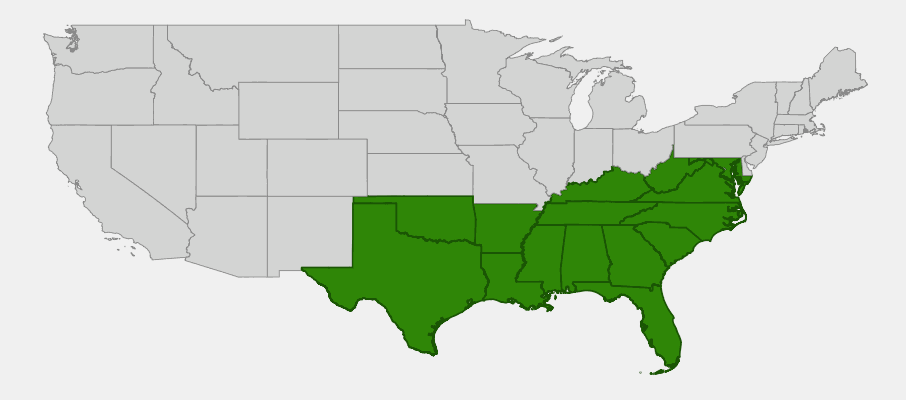
American Wisteria is native to the southeastern United States, growing naturally from Virginia and Maryland south through the Carolinas, Georgia, and Florida, and west to Texas, Oklahoma, and Missouri. It is found primarily in the coastal plain and piedmont regions, growing along stream banks, floodplain forests, woodland edges, and in moist thickets. In Maryland and Virginia, it occurs naturally in low-lying areas near rivers and wetland edges.
Unlike Asian wisteria species, W. frutescens is not invasive and does not escape cultivation to form problematic monocultures. Its natural range closely mirrors the Mid-Atlantic and southeastern coastal regions where it has evolved alongside native pollinators, birds, and insects that have co-adapted with it over millennia.
In its native floodplain habitat, American Wisteria typically grows alongside Swamp Rose (Rosa palustris), Buttonbush (Cephalanthus occidentalis), and various native willows, draping over shrubs and into the edges of tree canopies. It is less tolerant of consistently saturated soils than true wetland plants, preferring the moist but periodically drained soils of floodplain margins.
📋 Regional plant lists featuring American Wisteria: Maryland, Virginia & West Virginia
Growing & Care Guide
American Wisteria is far more manageable than its Asian counterparts but still requires thoughtful siting and a sturdy support structure. Given the right conditions, it will reward you with decades of spectacular spring bloom.
Light
For the most abundant flowering, plant American Wisteria in full sun — at least 6 hours of direct sunlight daily. It will grow in part shade (3–5 hours of sun), but flower production decreases noticeably. In the Mid-Atlantic region, a south- or west-facing exposure maximizes bloom. Avoid deeply shaded sites where the vine will put all its energy into vegetative growth with few flowers.
Soil & Water
American Wisteria is adaptable to a range of soil types, from clay to loam to sandy soils. It prefers moderately moist, reasonably fertile soil but tolerates brief drought once well established. It is notably more tolerant of wet, poorly drained soils than Asian wisteria species, reflecting its floodplain origins. In the first 1–2 years after planting, water deeply and regularly to support establishment; afterward, supplemental watering is needed only during extended dry spells.
Planting Tips
Plant container-grown specimens in spring or fall. Choose a site carefully — this vine can eventually create significant weight on structures. A sturdy pergola, heavy-gauge trellis, or strong fence post can support a mature American Wisteria. Leave at least 10 feet of horizontal space for the vine to spread. Named cultivars like ‘Amethyst Falls’ and ‘Longwood Purple’ bloom more reliably and at a younger age than seedling-grown plants and are widely available at native plant nurseries in Maryland and Virginia.
Pruning & Maintenance
American Wisteria blooms on new wood, so timing of pruning is important. The primary pruning season is late winter or early spring before new growth begins — remove dead, damaged, or excessively long shoots. A second, lighter pruning immediately after flowering (removing spent racemes and shortening side shoots to 5–6 leaves) encourages a second bloom flush in some cultivars and keeps the vine tidy. Unlike Asian wisterias, W. frutescens rarely needs aggressive root pruning to encourage blooming.
Landscape Uses
American Wisteria excels in multiple landscape roles:
- Pergola or arbor cover — creates a spectacular flowering canopy
- Trellis specimen against a wall or fence
- Hummingbird garden — reliable nectar source in late spring
- Butterfly garden — larval host for Long-tailed Skipper
- Naturalized stream bank planting — well-suited to moist, low-lying areas
- Native woodland edge — especially ‘Amethyst Falls’ in part-shade settings
Wildlife & Ecological Value
American Wisteria plays a meaningful ecological role that is not replicated by invasive Asian wisteria species, which have co-evolved with a completely different suite of insects and birds.
For Pollinators
The large, showy flower clusters are highly attractive to native bumblebees, which are the primary pollinators. The flowers are also visited by carpenter bees, mason bees, and other native solitary bees. The timing of bloom (after leaves have emerged) coincides with peak native bee activity in spring, making American Wisteria a particularly valuable nectar resource when bees are raising their first broods.
For Birds
Ruby-throated Hummingbirds visit the flowers for nectar, drawn by the lavender-blue color and the dense floral clusters that offer multiple nectar sources in a single visit. The tangled vine structure also provides excellent nesting habitat for Song Sparrows, Yellow Warblers, and other shrub-nesters that build cup nests in dense vegetation.
For Butterflies
American Wisteria is a documented larval host plant for the Long-tailed Skipper (Urbanus proteus), a distinctive butterfly of the eastern United States. In addition to skippers, Silver-spotted Skippers also use leguminous vines and may use American Wisteria. The flowers attract numerous nectaring butterfly species including Eastern Tiger Swallowtails, Spicebush Swallowtails, and various fritillaries.
Ecosystem Role
As a legume, American Wisteria harbors nitrogen-fixing bacteria in root nodules, enriching the soil in which it grows — a genuine ecological service. The dense vine structure it creates becomes shelter for small mammals, reptiles, and nesting birds. Unlike its invasive Asian counterparts, American Wisteria does not smother forest understories or outcompete native trees, maintaining its role as a productive participant in native plant communities rather than a destructive element.
Cultural & Historical Uses
American Wisteria has a long history of appreciation among North American peoples. Indigenous communities in the southeastern United States recognized the plant’s presence as an indicator of moist, fertile soils near water sources. The Cherokee people used root preparations medicinally, though all parts of the plant — especially the seeds and pods — are toxic if ingested and should never be consumed without expert guidance from a qualified ethnobotanist or herbalist.
European colonists quickly recognized the ornamental potential of American Wisteria. Thomas Nuttall, the English botanist who explored North America extensively in the early 1800s, described and popularized native wisteria species. The genus was named by Thomas Nuttall in honor of Caspar Wistar (1761–1818), a prominent Philadelphia physician and anatomist who championed early American science and education. By the mid-1800s, American Wisteria was a fixture in southern plantation gardens and formal estate landscapes up and down the Atlantic coast.
In the 20th century, American Wisteria was largely overshadowed by showier but invasive Asian species, particularly Japanese Wisteria (W. floribunda), which produces longer flower clusters and a stronger fragrance. However, as awareness grew of the ecological damage caused by invasive Asian wisterias — which can girdle and kill mature trees and form dense monocultures in disturbed forests — native plant advocates began championing W. frutescens as the responsible alternative. The introduction of compact, free-flowering cultivars like ‘Amethyst Falls’ in the late 20th century renewed widespread interest, and today American Wisteria is considered one of the finest native flowering vines for gardens throughout the Mid-Atlantic and Southeast.
Beyond its garden use, American Wisteria has been studied for its potential in phytoremediation — the use of plants to remove contaminants from soil. Like other legumes, its nitrogen-fixing root associations make it valuable for restoring disturbed or nutrient-depleted soils.
Frequently Asked Questions
Is American Wisteria invasive?
No. Unlike Japanese Wisteria (Wisteria floribunda) and Chinese Wisteria (W. sinensis), American Wisteria is not invasive. It is native to the eastern United States and does not spread aggressively outside of gardens. If you have Asian wisteria and want to replace it, American Wisteria is the ideal native substitute.
How long does American Wisteria take to bloom?
Seedling-grown plants can take 5–10 years to bloom. However, named cultivars grown from cuttings (such as ‘Amethyst Falls’ and ‘Longwood Purple’) typically bloom in their first or second year after planting. Always purchase from a reputable nursery and ask specifically for a named, vegetatively-propagated cultivar.
Can American Wisteria grow in Maryland and Virginia?
Absolutely — it is native to both states and thrives throughout the Mid-Atlantic region. It performs best in the warmer portions of both states (Zones 6–7) but can be grown successfully in Zone 5 areas of western Maryland and Virginia with some winter protection for young plants.
Does American Wisteria need a strong support?
Yes. Mature vines can be very heavy, and a robust support structure — steel arbor, heavy wooden pergola, or substantial trellis — is essential. Do not plant it to grow over a small, lightweight arbor, and avoid planting it where it will climb into trees, as even native wisteria can eventually stress heavily shaded trees by adding weight and shading lower branches.
Is American Wisteria toxic?
Yes — all parts of wisteria, including the native American species, contain toxic lectins and wisterin glycoside, with the seeds and pods being especially dangerous. Keep children and pets away from the seed pods. The flowers are considered mildly toxic. The vine should not be grown where children frequently play without adult supervision.

Looking for a nursery that carries American Wisteria?
Browse our native plant nursery directory: Maryland · Virginia · West Virginia