Atlantic White Cedar (Chamaecyparis thyoides)
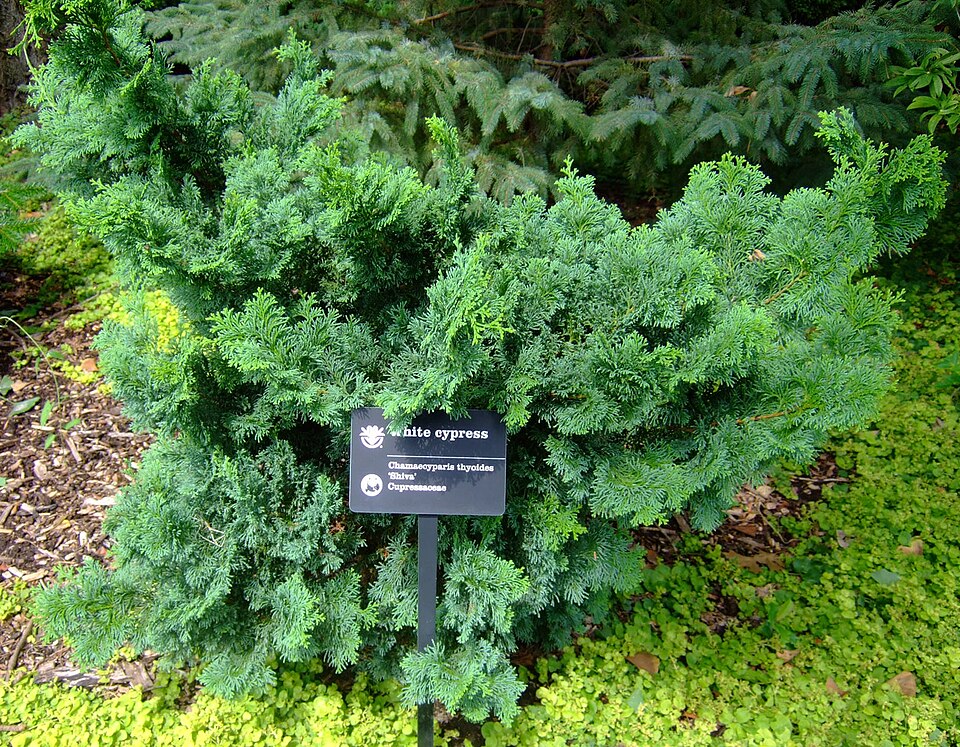
Chamaecyparis thyoides, commonly known as Atlantic White Cedar or Atlantic White Cypress, is a stately native evergreen conifer of the eastern coastal plain, prized for its elegant narrow form, aromatic wood, and remarkable ecological importance in Atlantic white cedar swamps — one of the most biologically significant wetland communities in eastern North America. This member of the Cupressaceae family grows naturally in dense, cathedral-like stands along the Atlantic Seaboard and Gulf Coast, forming some of the most distinctive and threatened ecosystems in the region.
Reaching 40 to 50 feet tall in typical conditions and occasionally exceeding 80 feet in undisturbed stands, Atlantic White Cedar is a beautifully columnar or narrowly conical tree with dense, blue-green, scale-like foliage that carries a pleasant, resinous fragrance when crushed. The foliage displays distinctive white markings on the undersides of the leaves, giving the tree its name and a subtle two-toned appearance. This is not merely an ornamental species — Atlantic White Cedar swamps provide critical habitat for several rare and endangered species including the endangered Hessel’s Hairstreak butterfly and the federally threatened bog turtle, and support important breeding populations of migratory songbirds.
Historically, Atlantic White Cedar was one of the most economically important timber trees in the eastern United States. Its lightweight, aromatic, rot-resistant wood was prized for shingles, boat building, fence posts, and barrel construction. Extensive logging, combined with drainage of coastal wetlands for agriculture and development, has reduced Atlantic White Cedar swamps to a fraction of their historical extent — making this species both ecologically critical and worth celebrating in the native landscape.
Identification
Atlantic White Cedar is a medium to large conifer with a distinctive narrow, columnar to conical crown. Young trees have a particularly graceful pyramidal form, while mature specimens in the open develop a denser, more irregular crown. Trees typically grow 40 to 50 feet tall with a trunk 1 to 2 feet in diameter, though ancient individuals in undisturbed swamps may reach considerably greater dimensions.
Bark
The bark of Atlantic White Cedar is reddish-brown to gray, fibrous, and stringy — exfoliating in narrow vertical strips that may hang loosely from the trunk in thin, fibrous sheets. The bark texture is similar to other members of the cypress family. On older trunks, the bark becomes deeply furrowed with a distinctive interwoven, ropelike pattern. The inner bark is reddish and aromatic when freshly cut, containing the resins that give the wood its remarkable durability and decay resistance.
Leaves
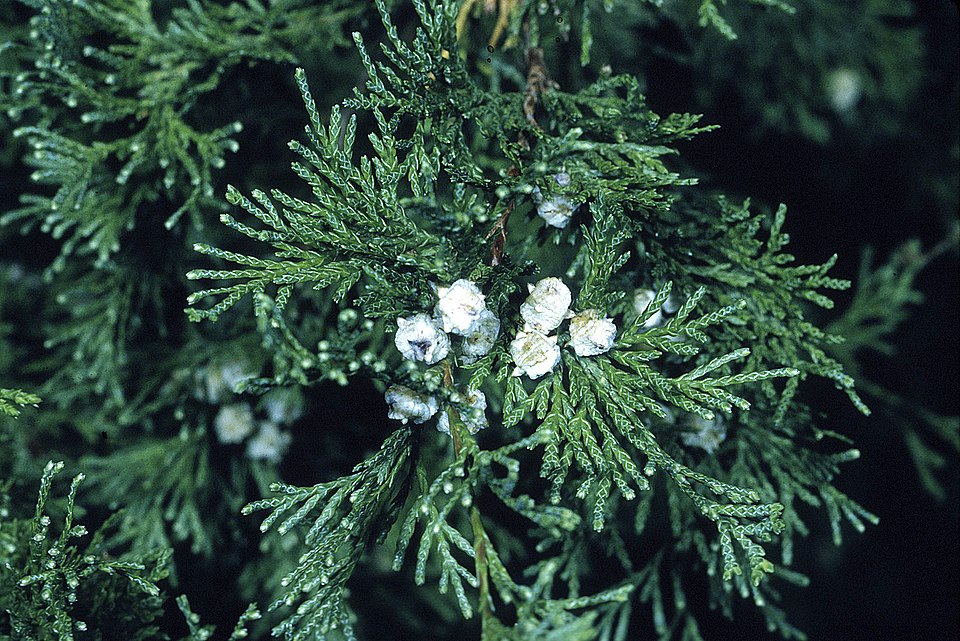
The leaves are tiny, scale-like, and overlapping — characteristic of the Cupressaceae family. Each scale is approximately ⅛ inch long, pressed flat against the twig in opposite pairs, and tipped with a minute point. The upper surface is dull blue-green; the underside shows distinctive white X-shaped markings (stomatal bloom) that help distinguish this species from similar conifers. The foliage has a pleasant resinous-cedar aroma when crushed. Branchlets are flattened and somewhat fan-shaped, arranged in flat sprays.
Cones
Atlantic White Cedar is monoecious — both male and female cones appear on the same tree. Male (pollen) cones are tiny, just ⅛ inch long, appearing at the tips of small branchlets in early spring (March–April) and releasing clouds of yellow pollen. Female (seed) cones are small, round, and hard — only ¼ inch in diameter — ripening from bluish-purple to brown in autumn of the first year. Each cone has 6 to 8 scales, and the seeds are small, winged, and dispersed by wind. The cones persist on the tree for one to two years after ripening.
Quick Facts
| Scientific Name | Chamaecyparis thyoides |
| Family | Cupressaceae (Cypress) |
| Plant Type | Evergreen Conifer |
| Mature Height | 40–50 ft |
| Sun Exposure | Full Sun |
| Water Needs | Moderate to High |
| Soil Type | Wet, acidic; peat, muck, or sandy wetland soils |
| Soil pH | 3.5–6.0 (strongly to moderately acidic) |
| Bloom Time | March – April (pollen cones) |
| Cone Color | Bluish-purple ripening to brown |
| Foliage | Blue-green scale-like leaves with white markings |
| Deer Resistant | Moderate |
| USDA Hardiness Zones | 4–9 |
Native Range
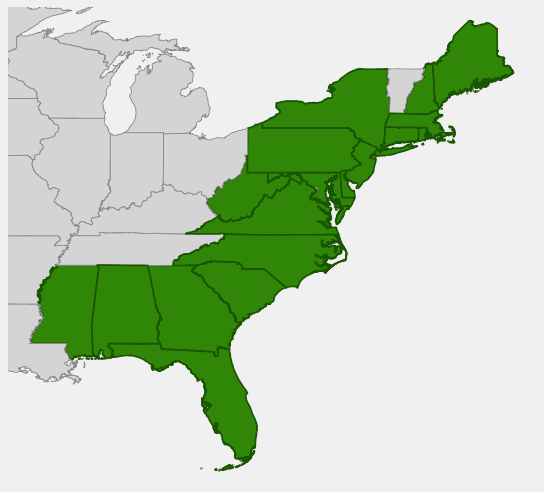
Atlantic White Cedar is native to the Atlantic Coastal Plain and Gulf Coastal Plain of the eastern United States, ranging from southern Maine south to Florida and west along the Gulf Coast to Mississippi and Alabama. The species occurs in scattered, disjunct populations — often forming dense, nearly pure stands called Atlantic white cedar swamps — along the coastal plain from sea level to about 200 feet in elevation. It is not a widespread upland tree but rather a specialist of specific wetland habitats where it can dominate entire ecosystems.
In the Mid-Atlantic region, Atlantic White Cedar swamps are particularly significant. The New Jersey Pine Barrens contains the largest remaining expanse of Atlantic white cedar swamp in the world, with ancient stands dating back centuries. Maryland, Virginia, and West Virginia harbor important populations as well, particularly along the coastal plain and in wetland areas of the Delmarva Peninsula. These swamps are often associated with sphagnum moss, high-bush blueberry, leatherleaf, and other acid-bog plants that create some of the most botanically diverse wetland communities in the region.
Historically, Atlantic White Cedar swamps extended across the entire Atlantic coastal plain in a nearly continuous band, but drainage for agriculture, urban development, and 200 years of intensive logging have reduced their extent by an estimated 50 to 70 percent. Today, the remaining swamps are recognized as priority conservation targets, and restoration plantings of Atlantic White Cedar are actively underway in multiple states.
📋 Regional plant lists featuring Atlantic White Cedar: Maryland, Virginia & West Virginia
Growing & Care Guide
Atlantic White Cedar is a specialist species best suited to wet, acidic sites where few other conifers can thrive. When placed in the right location, it is a durable, long-lived, and remarkably beautiful specimen tree that requires very little maintenance.
Light
Atlantic White Cedar requires full sun for optimal growth and development. In shaded locations, the tree becomes leggy, loses its characteristic dense conical form, and is more susceptible to disease. In its natural swamp habitat, it typically grows in tight, dense stands where individual trees compete vigorously for light — producing tall, straight trunks with relatively small crowns. For landscape use, give Atlantic White Cedar an open, sunny position for the best ornamental form.
Soil & Water
This species is highly adapted to wet, strongly acidic soils — conditions that most plants cannot tolerate. In the wild, it grows in sphagnum peat, muck, and saturated sandy soils with pH values as low as 3.5. For landscape use, Atlantic White Cedar grows best in consistently moist to wet soils with good acidity (pH 4.0–6.0). It can tolerate standing water for extended periods and is an excellent choice for rain gardens, wet swales, and pond margins. Avoid dry, compacted, or alkaline soils, which will cause decline and eventual death. Do not apply lime near this species.
Planting Tips
Plant Atlantic White Cedar in early spring or fall for best establishment. Container-grown specimens transplant readily; balled-and-burlapped trees transplant well if root disturbance is minimized. Choose a permanently moist or wet site in full sun, away from the shade of buildings or larger trees. Acidify soil if necessary with elemental sulfur before planting. Mulch with pine bark or wood chips to maintain moisture and acidity — avoid gravel or limestone-based mulches. Space trees 8–12 feet apart for naturalistic swamp restoration or screening; allow more space for specimen plantings.
Pruning & Maintenance
Atlantic White Cedar is a low-maintenance tree that requires no regular pruning. Remove dead, damaged, or crossing branches in late winter as needed. The natural conical form is self-maintaining and should not be sheared or heavily pruned. In a naturalistic planting, fallen dead wood from this species provides important habitat for cavity-nesting birds and wood-boring beetles. The tree is generally pest- and disease-resistant, though bagworm (Thyridopteryx ephemeraeformis) can occasionally defoliate individual branches.
Landscape Uses
Atlantic White Cedar is an outstanding choice for wet, challenging sites where most conifers fail:
- Wet swales and rain gardens — thrives in consistently wet areas
- Pond and stream margins — provides year-round structure and wildlife habitat
- Wetland restoration — ideal for restoring Atlantic white cedar swamp habitat
- Privacy screening — dense evergreen form creates excellent year-round screens
- Specimen tree — striking narrow conical form with aromatic blue-green foliage
- Bog gardens — pairs beautifully with native bog shrubs and acid-loving perennials
- Windbreak — dense evergreen foliage provides effective wind protection
Fire Ecology
Atlantic White Cedar has a complex relationship with fire. In its natural coastal plain swamp habitat, periodic fire is essential for regeneration — seeds germinate readily on bare, mineral soil exposed after fire burns away the thick sphagnum and peat layer. Without periodic fire or other disturbance, competing hardwoods such as Red Maple gradually overtop and shade out Cedar, leading to successional replacement. The peat soils in Cedar swamps can burn deeply during droughts, killing the root systems and permanently altering the ecosystem.
Wildlife & Ecological Value
Atlantic White Cedar swamps are among the most ecologically important wetland communities on the Atlantic Coastal Plain, supporting an array of rare and specialized wildlife species. The dense stands provide nesting and roosting habitat, while the seeds, foliage, and associated invertebrates support diverse food webs.
For Birds
The dense, impenetrable stands of Atlantic White Cedar provide critical nesting, roosting, and thermal cover for a remarkable diversity of birds. In the New Jersey Pine Barrens and similar Cedar swamps, species such as the endangered Black-throated Green Warbler and the Pine Warbler use Cedar stands heavily during breeding season. Hermit Thrush, Brown Creeper, Winter Wren, and numerous sparrow species roost in Cedar swamps during winter. The small seeds are consumed by finches, including Pine Siskin and American Goldfinch. The sharp-pointed foliage also provides nest sites protected from predators for warblers and other small songbirds.
For Mammals
Atlantic White Cedar swamps are important refugia for white-tailed deer, black bear, and river otter in the Mid-Atlantic region. The dense, low-hanging foliage provides critical thermal cover during winter, and the interior of Cedar swamps — often difficult to penetrate — provides secure denning and escape habitat for many mammals. Deer browse the foliage, particularly during harsh winters when other food is scarce. Small mammals including shrews, voles, and woodland jumping mice inhabit the sphagnum mat beneath Cedar stands.
For Pollinators
While Atlantic White Cedar is a wind-pollinated conifer, the associated understory plants in Cedar swamps are extraordinarily important for pollinators. The swamps provide habitat for several specialist bee species, and the rare Hessel's Hairstreak butterfly (Callophrys hesseli) is entirely dependent on Atlantic White Cedar as its larval host plant — making Cedar conservation directly critical to this butterfly's survival.
Ecosystem Role
Atlantic White Cedar swamps function as critical watershed protection systems, intercepting runoff, filtering nutrients, and storing enormous quantities of water. The peat soils beneath Cedar swamps are significant carbon stores — when drained or burned, they release decades worth of sequestered carbon. The dense canopy of mature Cedar swamps creates a distinctive microclimate: cool, dark, and humid year-round, supporting a community of mosses, ferns, orchids, and carnivorous plants found nowhere else in the region.
Cultural & Historical Uses
Atlantic White Cedar has one of the most impressive economic histories of any eastern North American tree. From the earliest European settlements through the early twentieth century, its aromatic, lightweight, and extraordinarily rot-resistant wood was the material of choice for a remarkable range of applications. Native American peoples of the Atlantic coast used Cedar bark for weaving baskets, mats, and clothing, and the wood for dugout canoes, arrow shafts, and construction materials. The resinous foliage and bark were used medicinally for respiratory ailments, fevers, and skin conditions by several coastal tribes.
European colonists quickly recognized the exceptional qualities of Atlantic White Cedar wood. Its low weight, straight grain, and remarkable resistance to rot and insects made it the premier shingle-making wood in the eastern colonies — millions of Cedar shingles were split by hand and shipped to Europe and the Caribbean in the colonial era. The wood was also widely used for boat building (particularly small coastal craft and duck-hunting skiffs), water pipes, storage tanks, and cooperage. Its impermeability to water made it ideal for cisterns and barrels. So valuable was the wood that Cedar swamps were among the first natural resources explicitly protected by colonial governments.
Today, Atlantic White Cedar wood is still sought by craftspeople for specialty applications including guitar soundboards, small boat building, and decorative woodworking — its acoustic properties rival those of Sitka Spruce for certain musical applications. The tree is increasingly recognized as a critical component of coastal wetland restoration, with nurseries and conservation organizations across the Mid-Atlantic producing containerized seedlings for large-scale replanting efforts. Landowners and municipalities are rediscovering Atlantic White Cedar as an unparalleled solution for wet, problematic sites that would otherwise remain unplanted.
Frequently Asked Questions
What is the difference between Atlantic White Cedar and Eastern Red Cedar?
Despite sharing the common name "cedar," these are completely different trees. Eastern Red Cedar (Juniperus virginiana) is a juniper that grows in dry, upland soils and is extremely common. Atlantic White Cedar (Chamaecyparis thyoides) is a true member of the cypress family, grows exclusively in wet, acidic wetlands, and is far less common. The foliage of Atlantic White Cedar is blue-green with white markings; Red Cedar foliage is dark green to reddish-brown.
Can Atlantic White Cedar grow in average garden soil?
Atlantic White Cedar is highly specialized for wet, acidic conditions and will decline or die in typical well-drained garden soils. It is best planted only in sites with consistently moist to wet, acidic soils (pH 4.0–6.0). Rain gardens, wet swales, pond margins, and seasonally flooded low spots are ideal locations.
How fast does Atlantic White Cedar grow?
Growth rate is moderate — typically 12 to 18 inches per year under good conditions. In its natural swamp habitat, growth can be much slower due to competition and flooding. In a landscape setting with good sun and consistent moisture, it is a reasonably fast-growing screening tree that will reach 20 feet within 10 to 15 years.
Is Atlantic White Cedar endangered?
Atlantic White Cedar is not federally listed as endangered, but its associated swamp habitat has been reduced by 50–70% from historical levels due to logging, drainage, and development. The species is considered a conservation priority throughout its range, and large-scale restoration efforts are underway in New Jersey, Maryland, Virginia, and the Carolinas.
Does Atlantic White Cedar have ornamental value beyond wetland sites?
Yes — several cultivated varieties (cultivars) of Atlantic White Cedar have been developed for ornamental use in a wider range of conditions. 'Heatherbun,' 'Ericoides,' and other compact forms are grown by specialty nurseries. However, the straight species is best reserved for authentically wet, acidic sites where it will truly thrive and provide maximum ecological value.

Looking for a nursery that carries Atlantic White Cedar?
Browse our native plant nursery directory: Maryland · Virginia · West Virginia