Blue Sage (Salvia pitcheri)
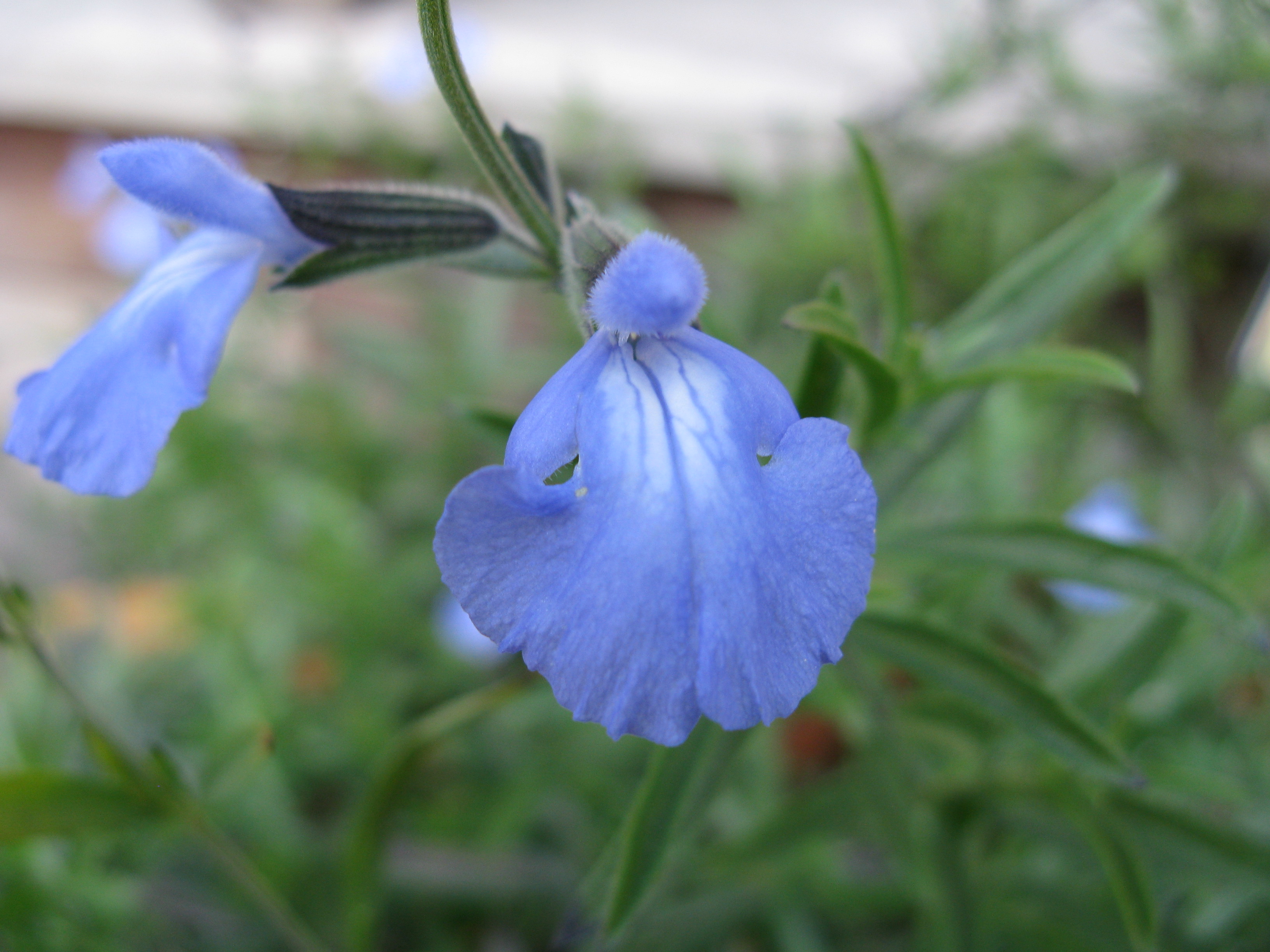
Salvia pitcheri (syn. Salvia azurea var. pitcheri), commonly known as Blue Sage, Pitcher’s Sage, or Azure Blue Sage, is one of the most brilliantly colored wildflowers of the American Great Plains and tallgrass prairie. Named in honor of Dr. Zina Pitcher, a 19th-century American botanist and physician who collected plants in the western territories, this native perennial produces upright, somewhat sprawling stems that erupt in vivid sky-blue flowers every fall — precisely when most prairie plants have finished blooming. It belongs to the Lamiaceae (mint) family and is a close relative of culinary sage, sharing the characteristic square stems and aromatic foliage of that group.
Blue Sage is a plant of the prairies, open woodlands, and disturbed uplands across the central and eastern United States. It thrives in poor, dry, sandy or rocky soils — the kinds of challenging sites where lush garden perennials struggle to survive. Its drought tolerance is exceptional: once established, it can persist through Nebraska and Kansas summers with minimal irrigation, drawing on deep taproots that allow it to mine moisture from far below the parched surface soil. This toughness, combined with its late-season spectacular color, makes it an irreplaceable element of any native prairie garden.
Despite its “lanky” reputation — Blue Sage often flops over neighboring plants as it reaches for autumn light — its display of true azure-blue flowers from August through October is simply unmatched in the prairie palette. Few wildflowers produce this particular shade of blue, which stands out dramatically against the bronze and gold of fall-ripening grasses. Monarchs, swallowtails, and other butterflies find Blue Sage irresistible, as do Ruby-throated and Rufous hummingbirds fueling up for their southward migration. Growing Blue Sage is a tangible contribution to butterfly and hummingbird conservation.
Identification
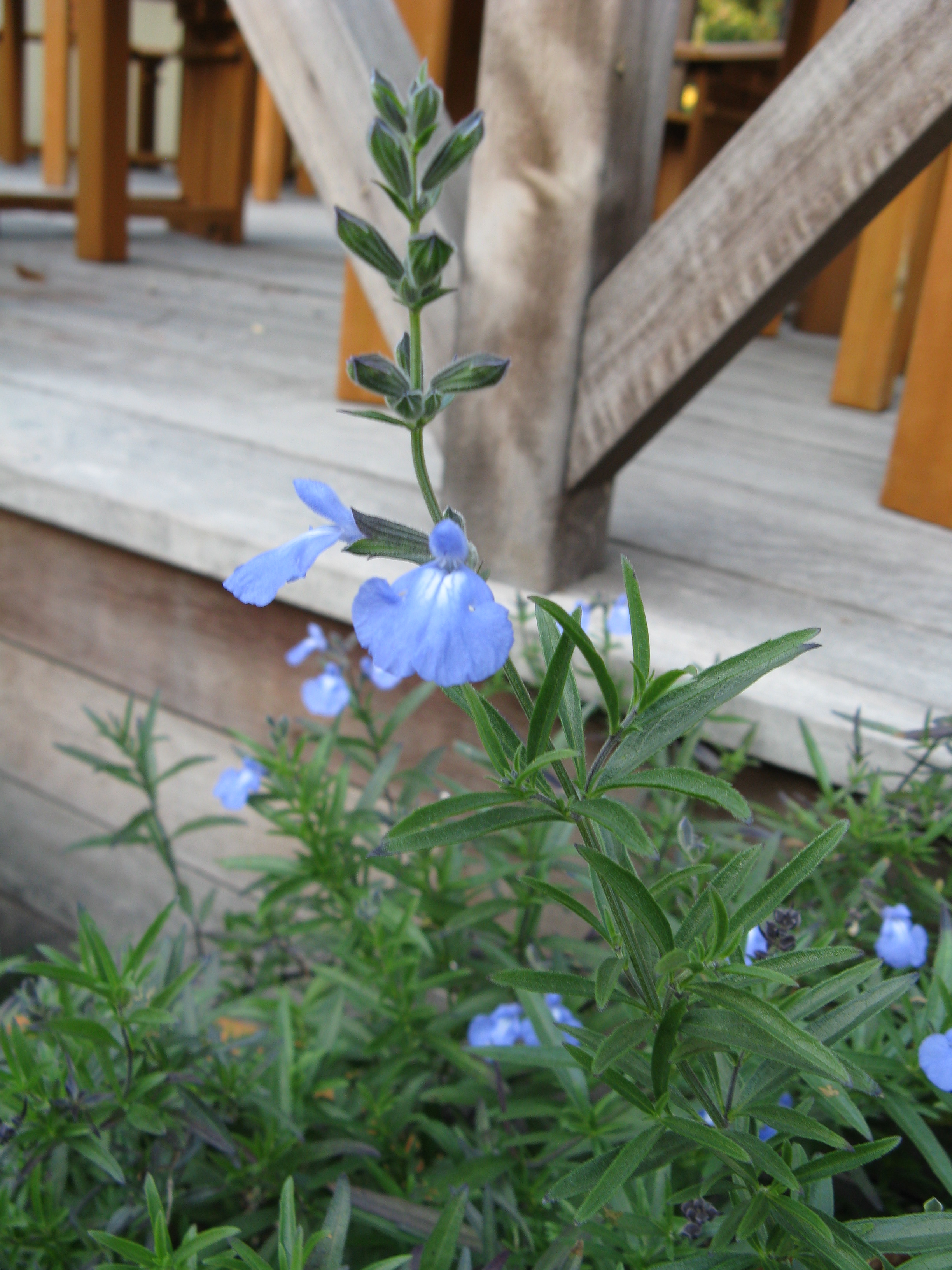
Blue Sage is an upright herbaceous perennial arising from a stout, branched rootstock. Plants typically grow 2 to 4 feet tall but can reach 5 feet in rich soil, with stems that become somewhat lax and lean against neighboring vegetation — a characteristic that is actually an adaptation to support weight in wind-prone prairie environments. The entire plant has a subtle sage-like fragrance when foliage is rubbed.
Stems & Leaves
The stems are square in cross-section (characteristic of the mint family), slender, and softly hairy or nearly smooth. They are typically branched in the upper portions where flowering occurs. The leaves are narrow to lance-shaped, 1 to 3 inches long, and arranged in opposite pairs along the stem. Lower leaves may have short stalks; upper leaves are sessile. The leaf surface is rough-textured and gray-green, with a distinctive herbal scent. The margins are finely toothed or almost entire. This narrow leaf form reduces water loss — an important adaptation for a drought-tolerant prairie species.
Flowers
The flowers are the defining feature of Blue Sage: they are a rich, vivid azure to sky-blue, forming two-lipped tubular blooms (typical of the mint family) about ¾ inch long. The upper lip arches forward; the lower lip is larger and spreading, providing a landing platform for pollinators. Flowers are arranged in whorls of 2 to 6 along elongated terminal and axillary spikes. The calyx (flower cup) is purplish-green and persistent. Flowering begins in August and continues through October or even November in mild years, making Blue Sage one of the last blooming plants of the prairie season. The color is notably purer and more saturated than most “blue” garden salvias — a true azure that photographs beautifully in the autumn light.
Fruit & Seeds
After flowering, Blue Sage produces small, dry nutlets (four per flower) enclosed in the persistent calyx. The seeds are small, oval, and dark brown to black. The dried seed heads are attractive in winter, providing visual interest and food for small seed-eating birds. Seeds require stratification (cold-moist period) to germinate, which occurs naturally in the ground over winter, leading to spring seedlings.
Quick Facts
| Scientific Name | Salvia pitcheri (syn. Salvia azurea var. pitcheri) |
| Family | Lamiaceae (Mint) |
| Plant Type | Herbaceous Perennial |
| Mature Height | 2–4 ft |
| Sun Exposure | Full Sun |
| Water Needs | Low (Drought Tolerant) |
| Bloom Time | August – October |
| Flower Color | Azure blue / sky blue |
| USDA Hardiness Zones | 3–9 |
Native Range
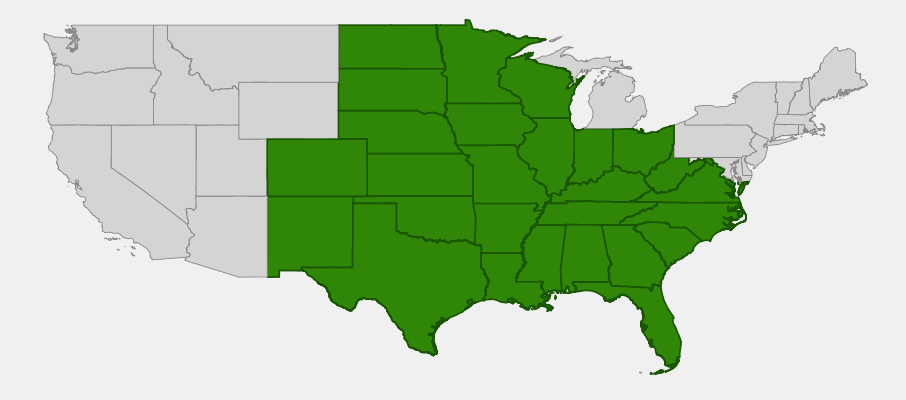
Blue Sage is native to the central and eastern United States, with its core range concentrated in the tallgrass and mixed-grass prairies of the Great Plains. It is most abundant in Kansas, Nebraska, Oklahoma, Texas, and Missouri, where it occurs on upland prairies, sandy plains, open roadsides, and disturbed grasslands. The species extends east into Illinois, Indiana, Wisconsin, Minnesota, Ohio, and the mid-Atlantic states, and south through Mississippi, Alabama, Tennessee, Kentucky, and into Florida. Its western range extends into Colorado and New Mexico along the eastern edge of the Rocky Mountains.
Within its range, Blue Sage is characteristic of dry to moderately dry prairies and open savannas. It favors well-drained, often sandy or silty soils with low fertility — the kind of nutrient-poor conditions that allow it to compete effectively without being crowded out by more aggressive grasses. It is commonly found along roadsides, railroad right-of-ways, old fields, and the edges of dry open woodlands, and is a reliable indicator of intact or recovering prairie vegetation.
Blue Sage is especially prominent in the Flint Hills of Kansas and the Loess Hills of western Iowa, where it forms spectacular masses of blue color against the autumn gold of big bluestem and indiangrass. These areas represent some of the best remaining tallgrass prairie in North America, and Blue Sage is one of the characteristic wildflowers of this imperiled ecosystem.
📋 Regional plant lists featuring Blue Sage: Nebraska & Kansas
Growing & Care Guide
Blue Sage is one of the most rewarding — and one of the most forgiving — native perennials for dry prairie gardens. It thrives on neglect, survives drought, and rewards patient gardeners with an autumn flower display that few other native plants can match. The key to success is planting it in the right conditions: full sun and excellent drainage.
Light
Full sun is essential. Blue Sage is a prairie species that evolved in open, treeless landscapes with maximum light exposure. In partial shade, plants become lankier, produce fewer flowers, and are more likely to flop over. On a full-sun site with poor, dry soil, Blue Sage performs at its absolute best. Six or more hours of direct sunlight per day is the minimum; eight or more is ideal.
Soil & Water
Blue Sage is extremely drought tolerant and actually prefers lean, low-fertility soils. Sandy, rocky, or silty soils with excellent drainage are ideal. Rich, heavily amended garden soil produces lush, floppy growth that requires staking. Avoid clay soils or sites with standing water — wet roots in winter are the primary cause of plant loss. Once established (typically after one full growing season), Blue Sage requires no supplemental irrigation in most of its native range. During the establishment year, water deeply every 1–2 weeks if no rain falls.
Planting Tips
Plant Blue Sage in spring or early fall as container-grown plants or bare-root divisions. Space plants 18 to 24 inches apart — they spread slowly by rhizomes and self-seeding and will fill in over several years. Blue Sage grows well in prairie mixes and naturalistic plantings, where neighboring plants provide the support its somewhat lax stems need. It also does well in a cutting garden where the stems can be propped up for display. Pinching stems back by one-third in early summer (before July 1) encourages bushier growth and may help prevent flopping.
Pruning & Maintenance
Cut plants back to within a few inches of the ground in late winter or early spring before new growth emerges. This stimulates vigorous new growth and maintains a tidy appearance. Alternatively, leave standing stems over winter — they provide excellent winter interest, and the seed heads feed birds. Blue Sage is generally pest- and disease-free. Divide clumps every 3–4 years to maintain vigor.
Landscape Uses
- Prairie meadow plantings — spectacular autumn display among native grasses
- Dry garden borders — excellent drought-tolerant accent at the back of borders
- Butterfly and pollinator gardens — essential late-season nectar source
- Roadsides and slopes — naturalizes well in poor soils
- Cutting garden — stunning long-lasting cut flower
- Mass plantings — creates seas of blue in fall
Wildlife & Ecological Value
Blue Sage’s late-season bloom timing makes it critically important for wildlife preparing for winter or migration. Its azure flowers are produced at a time when most prairie wildflowers have already set seed, providing nectar to animals that need it most urgently.
For Birds
While Blue Sage is primarily pollinated by insects, the small nutlet seeds are consumed by a variety of small seed-eating birds including American Goldfinches, White-crowned Sparrows, and Dark-eyed Juncos. The standing stalks left through winter provide perching sites and food for seed-eating birds well into the cold months. Ruby-throated Hummingbirds actively visit Blue Sage flowers during their fall southward migration, making this plant a valuable fueling station.
For Mammals
Deer generally avoid Blue Sage due to its aromatic foliage — the same essential oils that give the plant its sage-like scent are mildly deterrent to browsing deer. This deer resistance is a significant advantage in areas with high deer pressure. Small mammals such as voles and mice may consume the seeds.
For Pollinators
Blue Sage is exceptional for pollinators, especially in autumn when few other wildflowers are blooming. Monarch butterflies, Painted Ladies, Swallowtails, Cloudless Sulphurs, and dozens of other butterfly species are major visitors. Long-tongued native bumblebees and leafcutter bees are important pollinators, along with honeybees. The two-lipped flower structure is perfectly adapted to these long-tongued pollinators, excluding short-tongued insects from accessing the nectar. Migrating hummingbirds are frequent visitors and effective pollinators as well.
Ecosystem Role
As a late-season bloomer in dry prairies, Blue Sage occupies an ecological niche that few other plants can fill. It extends the nectar-producing season deep into fall, supporting migrating butterflies and hummingbirds at a critical time. Its deep, extensive root system helps stabilize dry, sandy soils and contributes organic matter as the plant dies back each winter. Over time, Blue Sage can spread into small colonies through both rhizomes and self-seeding, gradually restoring disturbed prairie areas.
Cultural & Historical Uses
Indigenous peoples across the Great Plains used various species of prairie sage in spiritual, medicinal, and practical applications. Blue Sage was used by several nations including the Lakota and Pawnee as a ceremonial smudge plant. The smoke produced by burning dried sage foliage was used for purification of spaces, sacred objects, and persons before ceremonies — a practice that continues among many Indigenous communities today. The aromatic leaves contain volatile oils with mild antimicrobial properties, which gave practical validity to the spiritual cleansing use.
Medicinally, Blue Sage was employed as a treatment for headaches, digestive complaints, and respiratory conditions. A tea made from the leaves was used by some nations as a remedy for colds and coughs, exploiting the expectorant properties of the aromatic oils. The plant was also used topically as a wound-healing poultice. European settlers adopted some of these uses, and prairie sage preparations appeared in early American herbal medicine traditions throughout the 19th century.
In modern horticulture, Blue Sage has gained recognition as a superb drought-tolerant garden perennial and has been used in multiple prairie restoration and roadside seeding projects across the central United States. It is frequently included in butterfly garden seed mixes and native prairie restoration blends. The species is also valued as a cut flower — the long-lasting azure spikes make beautiful fresh or dried arrangements — and it has been the subject of breeding programs aimed at producing more compact, less floppy cultivars for formal garden settings.
Frequently Asked Questions
Is Blue Sage the same as culinary sage?
No. Culinary sage is Salvia officinalis, a native of the Mediterranean. Blue Sage (Salvia pitcheri) is a native North American species in the same genus, but it is not used in cooking. The two plants share a family resemblance and similar aromatic properties, but are distinct species with different uses and growing requirements.
Why does my Blue Sage fall over?
Flopping is a natural characteristic of Blue Sage, especially in rich soil or partial shade. To minimize it: plant in full sun with lean, dry soil; pinch stems back by one-third in early June; or plant it among native grasses or other sturdy perennials that provide natural support. Some gardeners embrace the floppy habit as part of the naturalistic prairie aesthetic.
When does Blue Sage bloom?
Blue Sage is a fall bloomer, typically opening its first flowers in late July or August in Kansas and Nebraska, with peak bloom in September through October. This late-season timing makes it especially valuable in the garden when most other perennials have finished. In mild years, it may still be blooming well into November.
How drought-tolerant is Blue Sage really?
Very drought-tolerant once established. It is native to the dry prairies and sandy plains of the Great Plains, where summer rainfall is sparse and unpredictable. Established plants can survive weeks without rain during summer and typically require no supplemental watering after the first full growing season. It is one of the best native perennials for xeriscape and water-wise garden designs.
Does Blue Sage spread?
Blue Sage spreads slowly by rhizomes and self-seeding. In suitable conditions, plants will gradually form small colonies. Self-seeded plants are easy to transplant or remove. This gentle spreading habit makes it useful for naturalizing prairie areas but does not make it a problem plant — it is not aggressive or invasive.