Cream False Indigo (Baptisia leucophaea)
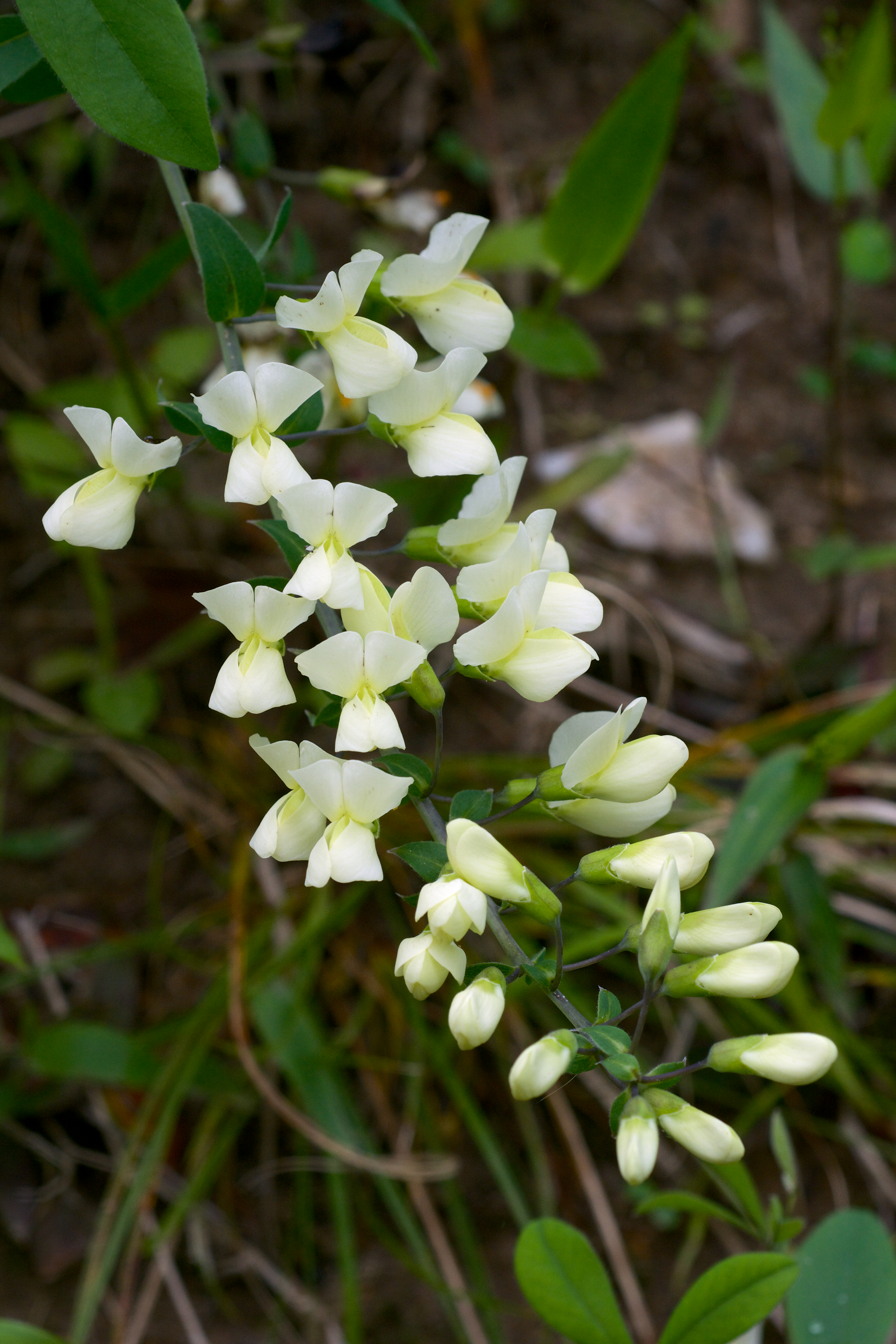
Baptisia leucophaea (syn. Baptisia bracteata var. leucophaea), commonly known as Cream False Indigo, Plains Wild Indigo, or Cream Wild Indigo, is a striking spring-blooming perennial of the tallgrass and mixed-grass prairies of the central United States. It belongs to the Fabaceae (legume) family and shares the genus Baptisia with the more widely known Blue Wild Indigo (B. australis), though it stands apart with its distinctive long, drooping flower clusters in creamy yellow tones rather than blue or yellow. The species name leucophaea means “pale” or “whitish” in Greek, referring to the cream to pale yellow color of the flowers.
Cream False Indigo is a deep-rooted prairie perennial that emerges dramatically in early spring, sending up thick, blue-green stems that fan out into a broad, rounded mound. The cone-shaped flower clusters — technically called racemes — arch gracefully outward and downward, covered in cream to pale yellowish flowers that give the plant an almost exotic, legume-like appearance. This spring display is relatively brief, lasting 2–3 weeks, but is among the most eye-catching of any Great Plains wildflower. After flowering, the plant develops attractive blue-green compound leaves and inflated seed pods that turn charcoal-black at maturity, rattling when shaken — a feature that earned the genus its common name “rattleweed” in some regions.
Like all Baptisia species, Cream False Indigo develops an enormous, deeply penetrating root system that makes it virtually impossible to transplant once established, but also makes it extraordinarily drought-resistant and long-lived. Individual plants can persist for decades, slowly increasing in size to form impressive multi-stemmed clumps 3 to 4 feet wide. This longevity, combined with its spring flower display and year-round structural interest, makes it one of the most valuable native perennials for prairie gardens in Nebraska and Kansas.
Identification
Cream False Indigo is a robust herbaceous perennial arising from a massive, branched root system. It grows 1 to 3 feet tall and typically spreads 3 to 4 feet wide, forming a broad, vase-shaped to mounded clump. The plant is unmistakable in spring when its flower racemes are drooping and cream-colored — no other prairie wildflower has quite this appearance.
Stems & Leaves
The stems are stout, smooth, and distinctly blue-green to gray-green, a color due to a waxy bloom on the surface. They are branched and spread outward from the crown. The leaves are alternate, trifoliate (three leaflets), with leaflets that are oval to oblong, 1 to 2½ inches long, smooth on both surfaces, and the same distinctive blue-green color as the stems. Large, prominent bracts subtend the flowers and are a distinguishing characteristic of this species compared to other Baptisia. When all parts of the plant dry, they turn a striking charcoal-black, making dried specimens highly decorative in fall and winter arrangements.
Flowers
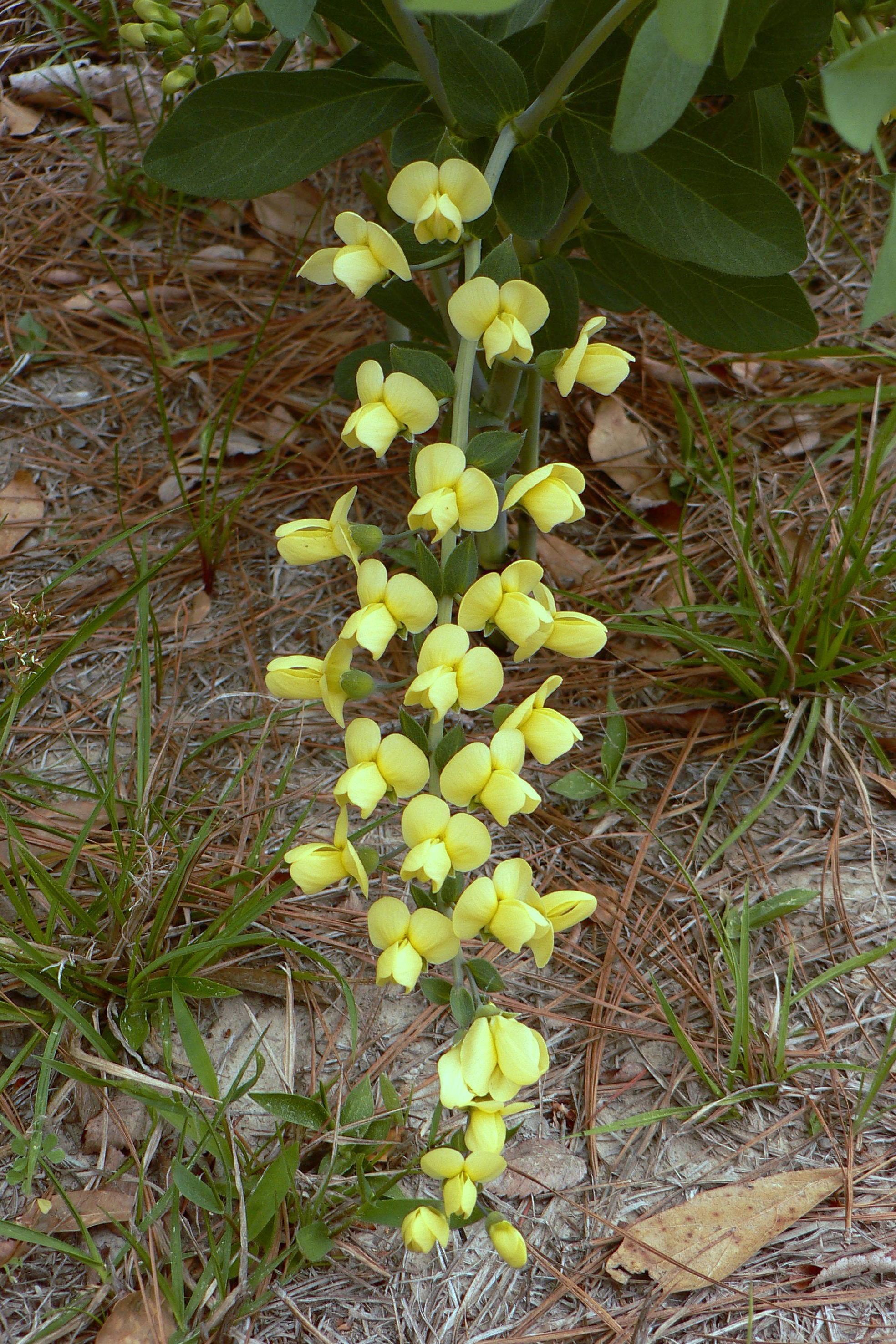
The flowers are typical of the pea family: five petals arranged in the characteristic “banner, wings, and keel” pattern. They are cream to pale yellowish-white, about ¾ inch long, and borne in dense, elongated, cone-shaped racemes 4 to 8 inches long. The racemes arch and droop gracefully away from the plant, a feature that distinguishes this species from the more upright flower spikes of Blue Wild Indigo. Flowering occurs in April through May, making this one of the earliest-blooming prairie wildflowers. Large, leafy bracts are present at the base of each flower, contributing to the lush, full appearance of the flower clusters.
Fruit
After pollination, the flowers develop into inflated seed pods about 1 to 2 inches long and ½ inch wide. The pods start light green and gradually turn charcoal-black by late summer. When fully dry, they rattle with the seeds inside — hence the common name “rattleweed.” These decorative black pods persist through winter and are excellent in dried arrangements. Each pod contains several hard, kidney-shaped seeds.
Quick Facts
| Scientific Name | Baptisia leucophaea (syn. Baptisia bracteata var. leucophaea) |
| Family | Fabaceae (Legume / Pea) |
| Plant Type | Herbaceous Perennial |
| Mature Height | 1–3 ft |
| Sun Exposure | Full Sun to Part Shade |
| Water Needs | Moderate to Low (Drought Tolerant) |
| Bloom Time | April – May |
| Flower Color | Cream to pale yellowish-white |
| USDA Hardiness Zones | 4–8 |
Native Range
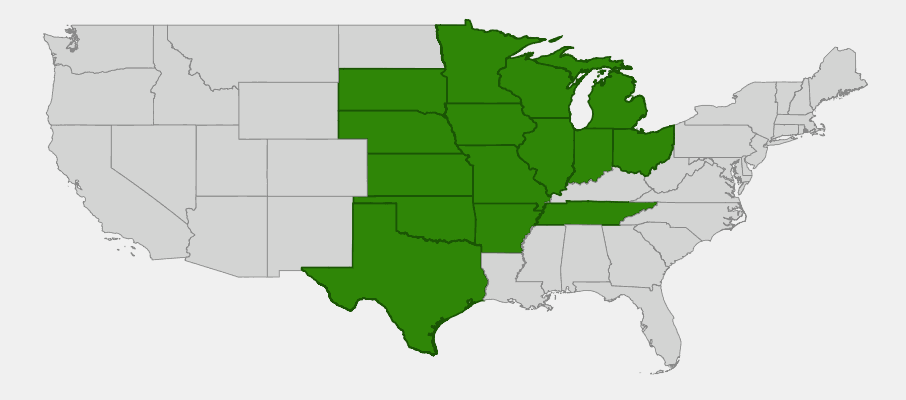
Cream False Indigo is native to the tallgrass and mixed-grass prairie region of the central United States, with its core range centered on the upper Midwest and Great Plains. It is most commonly found in Nebraska, Kansas, Iowa, Missouri, Illinois, Indiana, Wisconsin, and Minnesota. Its range extends south into Oklahoma, Texas, and Arkansas, and east into Ohio and Michigan. It is a characteristic species of mesic (moderately moist) upland prairies and open savannas.
Within its range, Cream False Indigo grows in full sun to partial shade on well-drained to moderately dry soils. It is most characteristic of upland prairie remnants on loamy or silty soils, but also occurs in open oak savannas and along the margins of prairie-woodland ecotones. Unlike some of its Baptisia relatives, it is rarely found in wetlands or bottomlands; it prefers the better-drained upland sites.
Prairie remnants in the Midwest have shrunk dramatically over the past two centuries, and Cream False Indigo has declined along with them. It remains relatively common in the Flint Hills of Kansas and in Iowa’s scattered prairie preserves, where it can form spectacular spring displays. Its presence is often used as an indicator of high-quality prairie remnants, since it establishes poorly on highly degraded sites and rarely colonizes new areas without human assistance.
📋 Regional plant lists featuring Cream False Indigo: Nebraska & Kansas
Growing & Care Guide
Cream False Indigo is a slow-starting but extraordinarily long-lived prairie perennial. The key to success is patience — it invests heavily in root development in its first few years before putting on impressive above-ground growth. Once established, it is essentially indestructible and will outlive most other garden plants.
Light
Full sun to light shade. Cream False Indigo performs best in full sun, where it flowers most abundantly and maintains a more compact, mounded shape. In part shade, it grows slightly taller and more open, and may produce fewer flowers. Unlike many sun-loving prairie plants, it can tolerate the shifting light of savanna settings with morning sun and afternoon shade.
Soil & Water
Well-drained to moderately dry soil is essential. Cream False Indigo will not tolerate waterlogged soils, especially in winter — wet roots cause root rot and plant death. It prefers loamy or silty soils but adapts to sandy or rocky substrates. As with most legumes, it fixes atmospheric nitrogen through root bacteria and thrives in lower-fertility soils where it can outcompete grass without being crowded. Once established, it is drought tolerant and requires no supplemental watering except during severe drought in its first year.
Planting Tips
Plant in fall or spring as container-grown plants. Choose your site carefully — once established, Cream False Indigo forms a massive taproot and cannot be moved without severe damage. Space plants 3 to 4 feet apart to allow room for their full spread. Germination from seed is possible but slow: seeds require scarification (nicking the hard seed coat) and cold stratification before spring planting. Expect 3 to 5 years before a seedling-grown plant reaches flowering size.
Pruning & Maintenance
Leave the entire plant standing through winter. The charcoal-black stems and rattling seed pods are ornamentally attractive and provide winter bird interest. Cut back to ground level in late winter before new growth emerges. Cream False Indigo rarely needs division — it does not spread aggressively and improves in size over decades. Fertilizing is unnecessary and may produce excessive vegetative growth at the expense of flowering.
Landscape Uses
- Prairie meadow plantings — spectacular spring focal point amid native grasses
- Perennial borders — attractive blue-green foliage as a summer backdrop
- Savanna gardens — adapted to filtered light under oaks
- Wildlife gardens — exceptional host plant for butterfly larvae
- Winter interest — charcoal-black stems and rattling pods remain attractive
- Restoration plantings — indicator and anchor species for high-quality prairie restorations
Wildlife & Ecological Value
Cream False Indigo is one of the most ecologically important plants in the tallgrass prairie ecosystem. Its value extends across all seasons and spans a remarkable diversity of wildlife interactions.
For Birds
The inflated seed pods that rattle in winter are visited by seed-eating birds such as Wild Turkey, Northern Bobwhite, and various sparrow species. The dense, mounded structure of the plant provides excellent cover for ground-nesting birds. During spring, the flowers attract many of the same insects that form the foundation of songbird diet during breeding season.
For Mammals
Cream False Indigo is avoided by deer due to the presence of alkaloids in the plant that make it somewhat toxic. This deer resistance is a significant advantage in landscapes with heavy deer pressure. Small mammals may cache the hard seeds for winter food.
For Pollinators
Cream False Indigo is among the most important spring nectar and pollen plants for native bees in the Midwest. Bumblebees are the primary pollinators — their weight is necessary to depress the keel of the flower and expose the pollen. Mason bees, mining bees, and leafcutter bees also visit regularly. The flowers are a critical early-season food source when few other prairie plants are blooming. This species is also a host plant for the caterpillars of multiple butterfly and moth species, including Wild Indigo Duskywing, Clouded Sulphur, Painted Lady, and Genista Broom Moth.
Ecosystem Role
As a nitrogen-fixing legume, Cream False Indigo improves soil fertility by capturing atmospheric nitrogen through symbiotic bacteria in root nodules. This makes it a valuable restoration plant for degraded soils. Its deep taproot system reaches moisture and nutrients far below the surface, and organic matter from decaying roots enriches the soil profile. The large, mounded plant structure creates habitat complexity in what might otherwise be an open, monotonous grassland.
Cultural & Historical Uses
Several species of Baptisia, including the creamy false indigos of the Great Plains, were used by Indigenous peoples for a variety of practical applications. The Ojibwe and other Great Lakes nations used wild indigo species medicinally as a treatment for toothaches, applying a decoction of the root directly to affected areas. Infusions of the root were used to reduce fever and treat infections — applications supported by modern research showing that wild indigo contains compounds with immunostimulant properties.
The genus name Baptisia comes from the Greek word meaning “to dye,” reflecting a historical use of related species as blue dye plants — a substitute for true indigo (Indigofera tinctoria) before the development of synthetic dyes. While the cream-flowered species produces a weaker dye than the blue-flowered ones, Indigenous peoples and early European settlers used Baptisia roots and leaves to produce blue-gray to blue-black dyes for textiles and basketry.
In contemporary botany and ecology, Cream False Indigo is recognized as a “foundation species” of tallgrass prairie — one of the key plants whose presence anchors and defines the ecological community. Native plant nurseries across the Midwest actively propagate this species for prairie restoration projects, and it has gained popularity in native plant gardening for its unusual appearance, wildlife value, and exceptional toughness. The charcoal-black dried seed pods have become popular in floral design, appearing in dried flower arrangements and autumnal decorations.
Frequently Asked Questions
How long does Cream False Indigo live?
Cream False Indigo is extremely long-lived. Individual plants can persist and grow for 50 years or more, slowly expanding into larger and larger clumps. It is one of the most permanent fixtures you can add to a native plant garden. The deep taproot makes it very difficult to kill once established.
Why is it called “false” indigo?
The “false” in the name refers to the fact that while Baptisia plants were historically used as a substitute for true indigo dye (from Indigofera tinctoria), they are not true indigo. The blue-flowered species like Blue Wild Indigo (B. australis) produce a somewhat similar blue dye, though less vivid and colorfast than true indigo.
Is Cream False Indigo toxic?
Yes, all parts of Baptisia species contain alkaloids (primarily cytisine and related compounds) that are toxic if ingested in quantity. This toxicity is what makes the plant deer-resistant. Keep away from children and pets. The plant is safe to handle; toxicity requires ingestion.
When should I plant Cream False Indigo?
Both spring and fall are suitable. Container plants can be established in spring or fall. For direct seeding, plant in fall to allow natural cold stratification over winter. Choose your site carefully before planting — established plants cannot be moved without damage.
Can Cream False Indigo grow in clay soil?
It prefers well-drained soils and performs poorly in heavy, wet clay — especially in winter, when waterlogged roots can rot. On heavier soils, amend the planting area with coarse grit or plant in a raised bed for better drainage. Sandy to loamy soils are ideal.