Great St. John’s Wort (Hypericum pyramidatum)
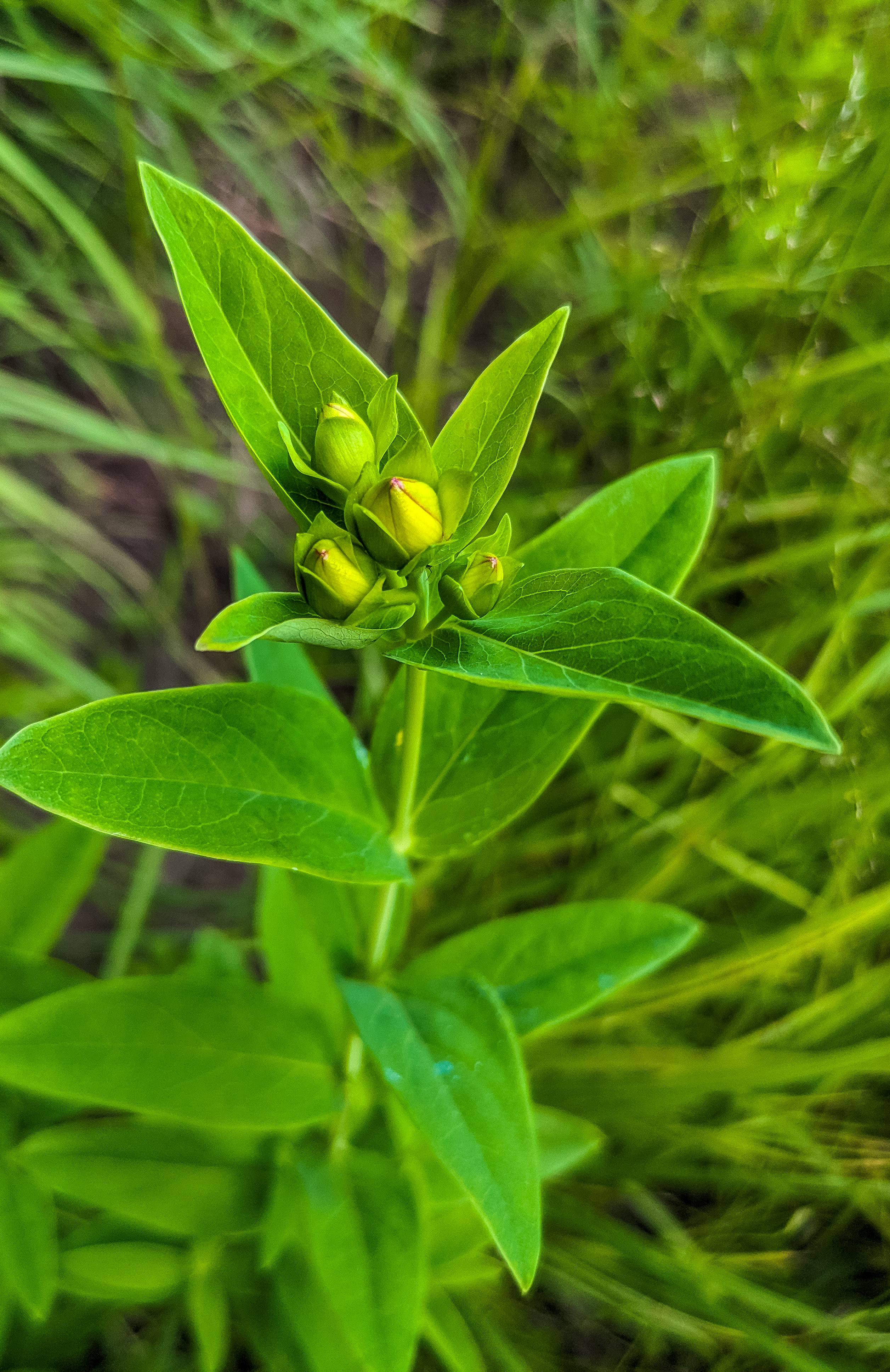
Hypericum pyramidatum (syn. Hypericum ascyron), commonly known as Great St. John’s Wort or Giant St. John’s Wort, is the largest-flowered native member of the Hypericum genus in North America, and it delivers a spectacular summer display that few native shrubs can match. Growing 2 to 6 feet tall in shaded to partly-shaded moist settings, it produces enormous golden-yellow flowers — up to 2 inches across — that appear in glowing contrast against its rich, dark green, stalkless leaves. This combination of large, bright flowers with dark, lustrous foliage is precisely what makes Great St. John’s Wort such a memorable and valuable plant for native gardens in the upper Midwest and northeastern United States.
Despite the “wort” in its name (an Old English word for plant, not a skin condition), Great St. John’s Wort is an elegant and refined-looking plant that behaves more like a shade-tolerant shrub than a weedy herb. It spreads slowly by rhizomes to form attractive colonies in moist, partially shaded sites, where it blooms in July and August — the height of summer — when shaded garden spaces often suffer from a lack of color. Unlike its aggressive invasive relative, Common St. John’s Wort (H. perforatum), this native species stays in its place and improves with age rather than taking over.
The species name pyramidatum refers to the pyramid-shaped arrangement of its branching, while ascyron (an alternate name) is an ancient Greek word for a plant in this genus. Great St. John’s Wort occurs across a broad swath of the northern and central United States and into southern Canada, growing in a variety of moist, partially shaded habitats from streamside thickets to boggy meadow edges. For gardeners struggling with the challenging combination of shade and moisture, this plant offers a native solution that is both ecologically sound and visually stunning.
Identification
Great St. John’s Wort is a clump-forming perennial subshrub with multiple upright stems arising from a spreading rhizomatous rootstock. Plants grow 2 to 6 feet tall and gradually expand into colonies several feet wide. The overall form is vase-shaped to broadly upright, with branches that become more numerous and spreading toward the top.
Stems & Leaves
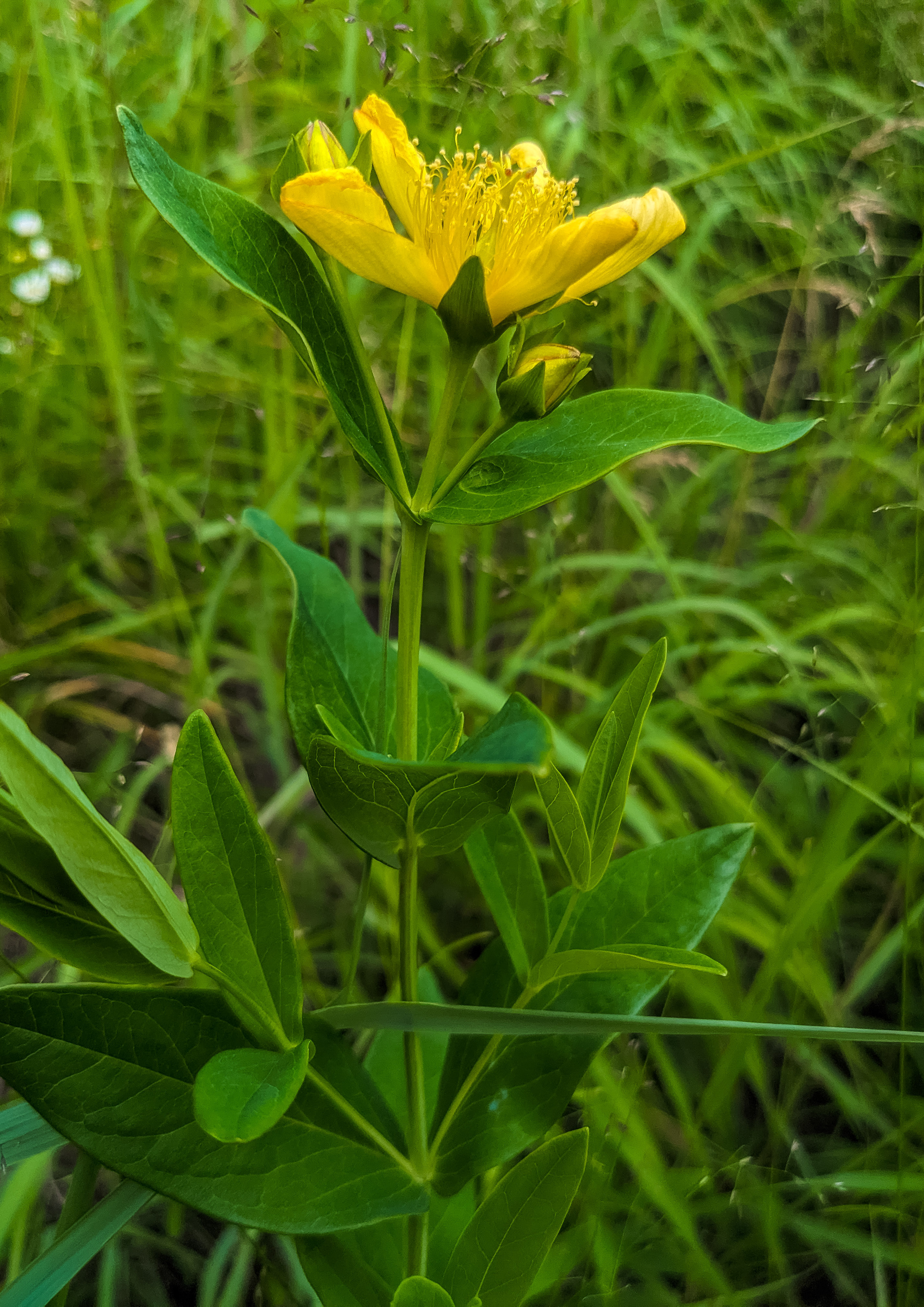
The stems are erect, smooth, and slightly four-angled or flattened on opposite sides — a subtle but identifying characteristic. They are green to reddish-green and become somewhat woody at the base. The leaves are simple, opposite, and stalkless (sessile), with the base of each leaf clasping the stem. Each leaf is narrowly oval to oblong, 2 to 4 inches long, with a smooth margin. The upper surface is dark, rich green; the lower surface is paler. Tiny, translucent dots are visible when leaves are held up to the light — a characteristic feature of the Hypericaceae family. These dots are oil glands containing the aromatic compounds that give St. John’s Wort species their medicinal properties.
Flowers
The flowers are the defining feature of Great St. John’s Wort and truly live up to the name “great” — they are among the largest flowers of any native North American Hypericum, measuring 1½ to 2 inches across. Each flower has five broad, bright golden-yellow petals, giving it a simple, open, buttercup-like appearance. The center is filled with a prominent mass of numerous long yellow stamens arranged in 5 clusters, creating a dramatic starburst effect. Flowers are borne in terminal and axillary clusters (cymes) at the tips of branches. The blooming period extends from July through August, with peak bloom in mid-July. The flowers are attractive both up close and from a distance, where the bright yellow stands out boldly against the dark foliage.
Fruit
After flowering, the plant produces attractive, pyramid-shaped seed capsules that split open to release tiny seeds. The capsules are reddish-brown at maturity and persist through early winter, adding modest ornamental interest. The capsule shape is one reason for the species name pyramidatum.
Quick Facts
| Scientific Name | Hypericum pyramidatum (syn. H. ascyron) |
| Family | Hypericaceae (St. John’s Wort) |
| Plant Type | Herbaceous Perennial / Subshrub |
| Mature Height | 2–6 ft |
| Sun Exposure | Part Shade to Full Shade |
| Water Needs | Moderate |
| Bloom Time | July – August |
| Flower Color | Bright golden yellow |
| USDA Hardiness Zones | 3–7 |
Native Range
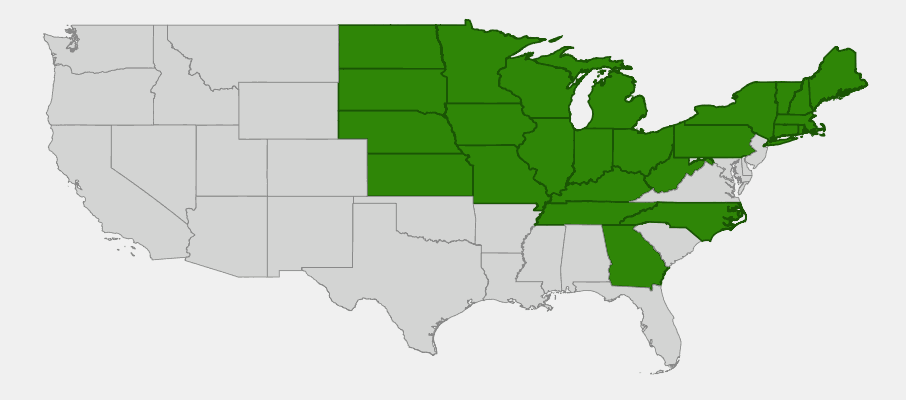
Great St. John’s Wort has one of the broadest distributions of any Hypericum species in North America, ranging from the Prairie Provinces of Canada south through the Upper Midwest and Northeast to the Appalachian Mountains. In the United States, it occurs in Minnesota, Wisconsin, Michigan, Illinois, Indiana, Ohio, Pennsylvania, New York, Vermont, New Hampshire, Maine, Massachusetts, Connecticut, Rhode Island, West Virginia, Kentucky, Tennessee, North Carolina, and Georgia, with outlier populations in Nebraska, Iowa, Missouri, Kansas, South Dakota, and North Dakota.
Throughout its range, Great St. John’s Wort inhabits moist, partially shaded environments: streamside thickets, wet meadow edges, moist open woods, shrubby bogs, and the margins of swamps and fens. It is typically found in sites with consistent soil moisture but good drainage — not actually waterlogged but reliably moist through the growing season. It tolerates both calcareous and acidic soils and grows from near sea level to moderate mountain elevations in the Appalachians.
In Nebraska and Kansas — the outer western edge of its natural range — Great St. John’s Wort is associated with stream corridors, moist ravines, and the shaded margins of riparian woodland. These moist, sheltered microsites provide the consistent moisture and light shade that the species requires, contrasting sharply with the dry upland prairies that dominate the surrounding landscape.
📋 Regional plant lists featuring Great St. John’s Wort: Nebraska & Kansas
Growing & Care Guide
Great St. John’s Wort fills a valuable niche in native plant gardening: it is one of the few native plants that produces large, showy flowers in moist, shaded conditions. For anyone with a problem spot that’s both wet and shaded — along a stream, near a downspout, or under a tree canopy with moist soil — this plant is a genuine solution.
Light
Part shade to full shade is preferred. Great St. John’s Wort is a shade-tolerant species that actually performs best with some protection from intense afternoon sun. Morning sun with afternoon shade is ideal. It can grow in fairly deep shade as long as moisture is adequate, though flowering will be reduced in the deepest shade. In northern gardens, it handles more sun if moisture is consistently available.
Soil & Water
Consistently moist soil is essential. Great St. John’s Wort grows naturally along streams, in wet meadows, and at the edges of wetlands — it needs soil that stays reliably moist through summer. It tolerates brief flooding but not permanent waterlogging. Humus-rich, loamy or silty soils are ideal; it adapts to a wide pH range from moderately acid to neutral or slightly alkaline. In dry summer climates, supplemental irrigation is necessary to maintain the consistent moisture this species requires.
Planting Tips
Plant in spring or fall as container-grown plants. Space plants 3 to 4 feet apart — they spread slowly by rhizomes to form colonies and appreciate room to expand. Excellent for massing in moist woodland garden settings. This species transplants well when young but resents disturbance once established. Mulch generously with organic material to retain soil moisture and maintain the cool, moist root zone the plant prefers.
Pruning & Maintenance
Cut back to ground level in late winter or early spring. The plant may become somewhat leggy in the second half of summer after flowering; light trimming of spent flower clusters is optional and may stimulate a modest second flush of bloom. Great St. John’s Wort is generally pest-free and disease-resistant, though it may show some leaf spotting in very humid conditions. Divide clumps every 4–5 years to rejuvenate and control spread.
Landscape Uses
- Rain gardens and bioswales — excellent for seasonally moist sites
- Streamside and pondside planting — colonizes moist banks naturally
- Shade gardens — provides bold summer color in shaded spaces
- Woodland edge plantings — thrives at forest margins with partial shade
- Native shrub borders — mass plantings create impressive colonies
- Pollinator corridors — large flowers attract many native bee species
Wildlife & Ecological Value
Great St. John’s Wort’s large, open flowers and moist habitat associations give it a distinctive ecological role supporting wetland and forest-edge wildlife communities.
For Birds
The seed capsules are eaten by a variety of birds including chickadees, finches, and warblers. The dense colony structure created by established plants provides excellent nesting cover for shrub-nesting songbirds such as Yellow Warblers and Common Yellowthroats. The moist habitat that Great St. John’s Wort favors supports abundant invertebrate communities that many birds rely on for food.
For Mammals
Deer generally avoid Great St. John’s Wort, making it a reliable choice for deer-pressured landscapes. Small mammals may browse young growth, but established plants are rarely significantly damaged. The moist, thicket-like habitat that established colonies create provides cover for rabbits, muskrats along waterways, and other small mammals.
For Pollinators
The large, open flowers of Great St. John’s Wort are a generous pollen and nectar resource for native bees, especially bumblebees and large carpenter bees. The prominent stamens make pollen easily accessible, and the flowers attract a diverse array of native bee species, beetles, and flower-visiting flies. Mining bees and sweat bees are among the many smaller bee species that visit regularly. The July-August bloom period coincides with peak native bee activity.
Ecosystem Role
In the moist, shaded habitats it occupies, Great St. John’s Wort contributes to riparian and wetland-edge vegetation structure. Its spreading habit creates mid-height shrubby colonies that stabilize stream banks, filter runoff, and provide transitional habitat between upland and wetland zones. The plant’s substantial rhizome system binds soil effectively and contributes to erosion control along streambanks and pond edges.
Cultural & Historical Uses
The St. John’s Worts have a long and fascinating history of human use that spans cultures and continents. The genus is named for St. John the Baptist, as the common European species (Hypericum perforatum) traditionally bloomed around St. John’s Day (June 24) and was gathered on that day for good luck and protection against evil spirits in European folk tradition. The North American Great St. John’s Wort shares this cultural heritage through its genus affiliation, though it was Native Americans — not European immigrants — who first documented its uses on this continent.
Several Indigenous nations of the Great Lakes region and Northeast used Hypericum species medicinally. The Ojibwe used a root decoction as a diuretic and for kidney conditions, while Iroquois nations used related species to treat venereal disease and as a general tonic. The plant was incorporated into some traditional healing ceremonies as well. European settlers adopted and expanded on these uses, and preparations of Hypericum appeared in American herbal medicine traditions through the 19th and early 20th centuries.
Modern research on the genus Hypericum has confirmed that several species, including the common European St. John’s Wort (H. perforatum), contain compounds (particularly hypericin and hyperforin) with documented antidepressant and antiviral properties. While Great St. John’s Wort (H. pyramidatum) has not been as extensively studied as its European relative, the presence of similar oil glands and the ancestral chemical pathways of the genus suggests it likely contains related compounds. Today, however, this plant’s greatest value lies in its ecological role and garden beauty rather than medicinal applications.
Frequently Asked Questions
Is Great St. John’s Wort the same as common St. John’s Wort?
No. Common or Perforate St. John’s Wort (Hypericum perforatum) is a European species that has naturalized extensively across North America and is considered invasive in many areas. Great St. John’s Wort (H. pyramidatum) is a native North American species that is not invasive — it stays in place and is an ecologically appropriate choice for native gardens.
Can Great St. John’s Wort grow in dry conditions?
No — this is one species where moisture requirements must be respected. In dry conditions, Great St. John’s Wort will struggle and may die. It is a moisture-loving plant that needs reliably moist soil throughout the growing season. For dry garden sites, consider drought-tolerant native alternatives like Blue Sage or Purple Coneflower instead.
How tall does Great St. John’s Wort get?
It typically grows 2 to 4 feet tall in average garden conditions, but can reach 5 to 6 feet in ideal moist, partly shaded sites with rich soil. In full shade, plants tend to be taller and more open; in brighter light with consistent moisture, they remain more compact.
Does Great St. John’s Wort spread aggressively?
It spreads slowly and moderately by rhizomes, gradually forming colonies over several years. This spreading behavior is easy to manage — simply remove unwanted shoots with a shovel. Unlike invasive exotic St. John’s Worts, it does not spread aggressively by seed and will not overtake a garden.
What’s the difference between Great St. John’s Wort and Shrubby St. John’s Wort?
Shrubby St. John’s Wort (Hypericum prolificum) is a compact, truly woody shrub with small flowers, while Great St. John’s Wort is a taller, herbaceous-to-subshrubby plant with very large flowers. Both are native, but Great St. John’s Wort prefers moister, shadier conditions and has the largest flowers in the genus.