Prairie Blazing Star (Liatris pycnostachya)
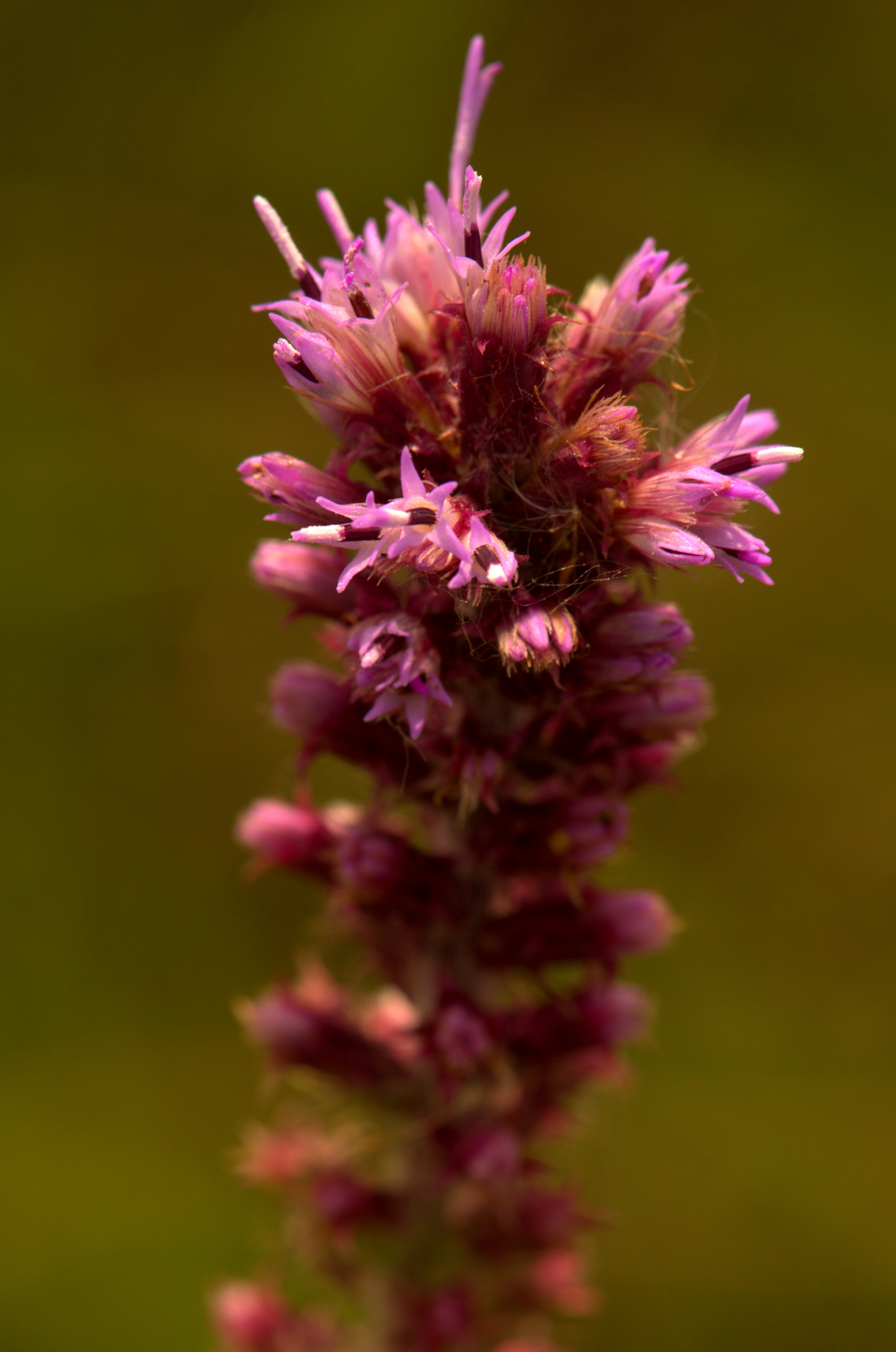
Liatris pycnostachya, commonly known as Prairie Blazing Star or Cattail Gayfeather, is one of the most visually spectacular wildflowers of the American tallgrass prairie — a towering spike of dense, rounded, rose-purple flowerheads that erupts in July and August with startling intensity. This member of the Asteraceae (daisy) family is one of the tallest and most robust of the approximately 45 Liatris species native to North America, reaching heights of 2 to 5 feet on its stout, unbranched stems. The species name pycnostachya means “dense spike” in Greek — a fitting description of the closely packed flowerheads that crowd along the upper two-thirds of each stem.
What makes Prairie Blazing Star ecologically and visually unique among its Liatris relatives is the sheer density of its flower clusters: while other blazing stars have more widely spaced heads, Prairie Blazing Star packs its flowerheads so tightly together that the entire upper portion of the plant appears as a continuous column of rose-purple color. Each individual flowerhead contains 5 to 10 tubular disc flowers surrounded by purple-fringed bracts, and like all Liatris, the flowers open from the top of the spike downward — a progression opposite to most flowering plants. This downward progression means Prairie Blazing Star puts on a gradually unfolding show that lasts for 3 to 4 weeks.
Prairie Blazing Star grows from a corm — a bulb-like underground storage structure — that accumulates energy over many years and allows the plant to survive prairie fires, drought, and the most challenging growing conditions of the Great Plains. It is deeply adapted to the tall-grass prairie ecosystem, requiring the disturbance, fire, and competition of the prairie environment to remain vigorous and competitive. In cultivation, it is similarly tough, thriving in poor, dry soils in full sun, and drawing monarchs, painted ladies, swallowtails, and hummingbirds to its nectar-rich blooms at the height of summer and early fall.
Identification
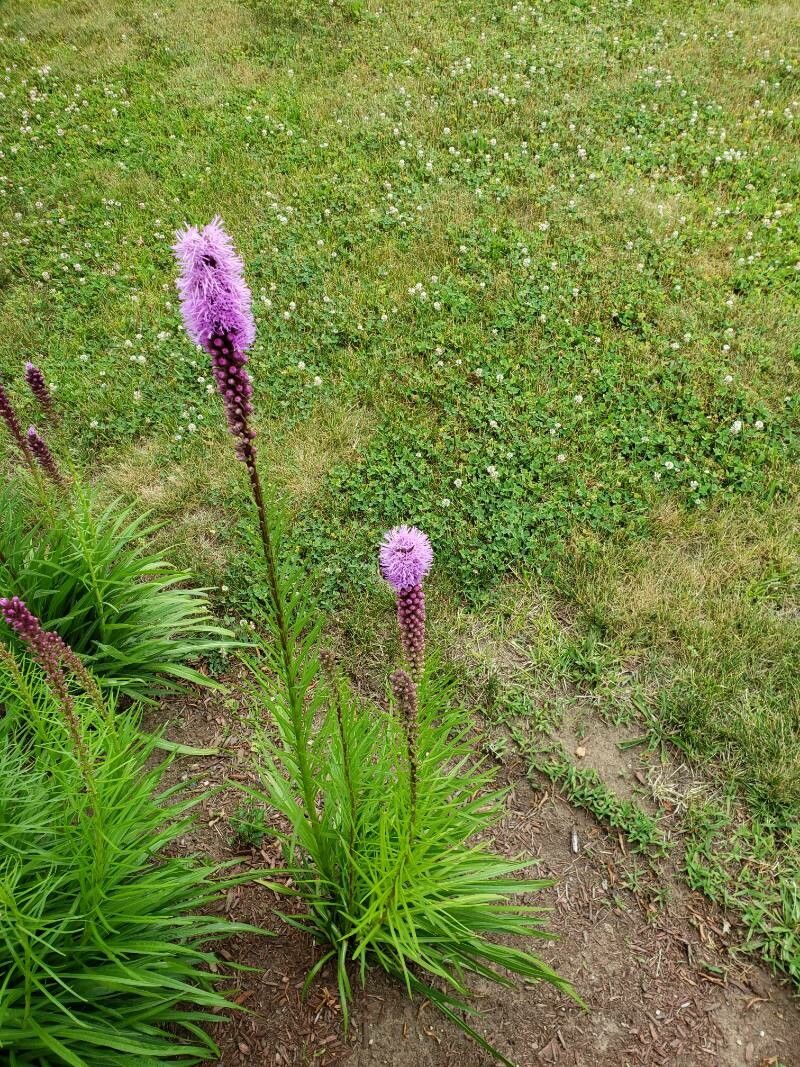
Prairie Blazing Star is an herbaceous perennial arising from a rounded corm (underground storage organ). Plants produce a single, erect, unbranched stem from each corm, growing 2 to 5 feet tall. The stem is stout and leafy throughout its length, narrowing to a dense flowering spike in the upper portion.
Stems & Leaves
The stem is smooth to slightly hairy, erect, stout, and typically green. Leaves are alternate, linear (grass-like), and numerous — the stem is densely clothed in leaves from top to bottom. Lower leaves are 8 to 16 inches long and up to ½ inch wide; upper leaves decrease in size as they progress up the stem. All leaves have a single prominent midvein, are smooth, and dark green. The overall appearance of the vegetative stem resembles a tall grass or rush before flowering. The leaves lack stalks (sessile).
Flowers
The flowers are the defining feature of Prairie Blazing Star. Individual flowerheads (capitula) are ½ to ¾ inch wide, rounded, and densely packed with 5 to 10 tubular disc florets. The flowerheads are crowded into a dense spike covering the top 12 to 24 inches of the stem. The involucral bracts (the scale-like structures beneath each flowerhead) have spreading, purple-tipped, fringe-like margins — a diagnostic feature distinguishing this species from similar blazing stars. Flower color is a vivid rose-purple to magenta, and the overall effect of the dense spike in bloom is stunning. Flowering progresses from the top of the spike downward over a period of 3 to 4 weeks, from late July through August. The flowers are highly fragrant, attracting pollinators from considerable distances.
Fruit & Seeds
After pollination, each flower produces a dry achene (seed) tipped with a feathery pappus of plumose (feather-like) bristles that facilitate wind dispersal. The mature seed heads are silky and attractive in fall, and seeds are distributed by wind into surrounding prairie vegetation.
Quick Facts
| Scientific Name | Liatris pycnostachya |
| Family | Asteraceae (Daisy / Composite) |
| Plant Type | Herbaceous Perennial |
| Mature Height | 2–5 ft |
| Sun Exposure | Full Sun |
| Water Needs | Moderate to High |
| Bloom Time | July – September |
| Flower Color | Rose-purple / magenta |
| USDA Hardiness Zones | 3–9 |
Native Range
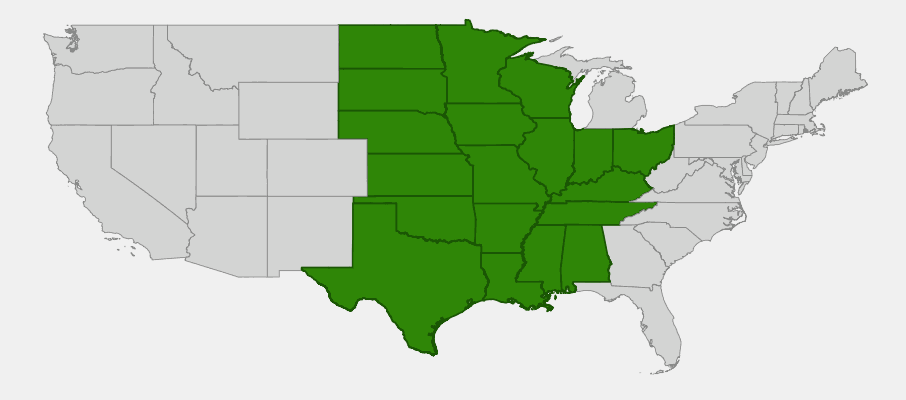
Prairie Blazing Star is native to the tallgrass prairie and mixed-grass prairie regions of the central United States, with its core range centered in the Great Plains. It is most abundant in Kansas, Nebraska, Missouri, Iowa, Illinois, and Indiana, where it is a characteristic species of mesic (moderately moist) tallgrass prairies. Its range extends north into South Dakota, North Dakota, and Minnesota; south into Oklahoma, Texas, Arkansas, and Louisiana; and east through Wisconsin, Ohio, Kentucky, Tennessee, Alabama, and Mississippi.
Unlike some of its more drought-tolerant Liatris relatives (such as Dotted Blazing Star, L. punctata), Prairie Blazing Star is associated with moister, deeper soils. It is particularly characteristic of the deep, fertile soils of the tallgrass prairie region — the same soils that were converted almost entirely to row-crop agriculture after European settlement. As a result, Prairie Blazing Star has declined substantially across its range, and populations of hundreds or thousands of plants in intact prairie remnants represent conservation treasures.
Prairie Blazing Star reaches its greatest density and most spectacular displays in the Flint Hills of Kansas and the Loess Hills of western Iowa, where extensive tracts of tallgrass prairie have been preserved, primarily as grazing land. These areas hold some of the last great blazing star populations in the world, and their July-August bloom creates landscapes of purple and gold that attract visitors from across the country.
📋 Regional plant lists featuring Prairie Blazing Star: Nebraska & Kansas
Growing & Care Guide
Prairie Blazing Star is among the most rewarding native perennials you can grow. Given the right conditions — full sun and adequate moisture — it is vigorous, floriferous, and long-lived, producing increasingly impressive flower spikes year after year as the corm matures.
Light
Full sun is essential. Prairie Blazing Star is a prairie species that evolved in open, unshaded landscapes. In partial shade, plants grow taller but produce fewer, smaller flower spikes and are more susceptible to flopping. Plant in a site with at least 6 to 8 hours of direct sun daily for the best performance.
Soil & Water
Prairie Blazing Star prefers moist to moderately moist, well-drained soil. Unlike the drought-tolerant Dotted Blazing Star, this species needs consistent moisture — it naturally occurs in the deep, moist soils of mesic tallgrass prairies rather than dry uplands. Average garden soil with regular rainfall is usually sufficient; in drier climates, supplemental watering during summer dry spells improves flowering. It tolerates clay soil better than many prairie plants as long as drainage is adequate. Avoid chronically waterlogged sites — wet roots in winter cause corm rot.
Planting Tips
Plant corms or container-grown plants in fall or spring. Set corms 3 to 4 inches deep. Space plants 12 to 18 inches apart for a prairie effect; 2 feet apart for individual specimen planting. Germination from seed is reliable but slow — plants grown from seed typically bloom in their second or third year. Commercial corms are available and bloom sooner. Prairie Blazing Star performs beautifully in prairie-style plantings alongside grasses and other tall perennials like Cup Plant and Wild Bergamot.
Pruning & Maintenance
Leave flower spikes standing through winter for bird interest — the feathery seed heads are eaten by finches, sparrows, and especially American Goldfinches. Cut back in late winter before new growth emerges. Deadhead if you want to prevent self-seeding, or allow seeds to spread for naturalization. Divide clumps every 4–5 years to maintain vigor. Prairie Blazing Star is generally pest-free, though aster yellows (a phytoplasma disease) can occasionally distort plants.
Landscape Uses
- Prairie meadow plantings — creates spectacular summer color amid native grasses
- Pollinator gardens — unmatched for attracting monarchs, swallowtails, and bumblebees
- Cut flower garden — excellent long-lasting cut and dried flower
- Back of border — tall upright spikes create vertical interest in sunny borders
- Rain gardens — tolerates occasional wet conditions better than dryland blazing stars
- Mass plantings — en masse creates unforgettable July displays
Wildlife & Ecological Value
Prairie Blazing Star is one of the most wildlife-valuable native plants in the Great Plains ecosystem, with documented interactions spanning birds, mammals, butterflies, native bees, and other invertebrates.
For Birds
American Goldfinches are among the most enthusiastic consumers of Prairie Blazing Star seeds. The feathery seed heads produce abundant, easily accessible seeds in late summer and fall, and goldfinch flocks are a common sight around blazing star patches. Eastern and Western Meadowlarks, Dickcissels, Indigo Buntings, and various sparrow species also consume seeds. The dense, tall stands that Prairie Blazing Star creates provide important upland cover for ground-nesting birds including Bobolinks and prairie sparrows.
For Mammals
The corm is consumed by ground squirrels, prairie dogs, and other burrowing rodents. Prairie voles cache the seeds for winter food. Deer occasionally browse the foliage, but the plant is generally not heavily grazed and recovers quickly from moderate browsing pressure.
For Pollinators
Prairie Blazing Star is one of the single most important nectar plants for Monarch butterflies during their late summer and fall migration southward to Mexico. The highly fragrant flowers, produced at the exact time when migrating monarchs need to fuel up, make this plant a conservation priority. Painted Ladies, Swallowtails, Skippers, and many other butterflies visit regularly. For native bees — particularly bumblebees, mining bees, and sweat bees — the dense spikes of nectar-rich flowers are a major late-summer food source. The fragrance alone can draw pollinators from distances of several hundred feet.
Ecosystem Role
Prairie Blazing Star’s deep corm and fibrous roots are part of the intricate underground architecture of tallgrass prairie that makes this ecosystem exceptionally resilient to fire and drought. As a corm-forming species, it stores carbon and energy underground, contributing to the prairie’s substantial below-ground biomass. After prairie fires, it regrows rapidly from the corm, often producing more vigorous growth than unburned plants — a fire adaptation that has co-evolved with periodic grassland burning over millennia.
Cultural & Historical Uses
Various Liatris species, including Prairie Blazing Star, were important medicinal and food plants for Indigenous peoples of the Great Plains. The Omaha and Ponca peoples used a decoction of the roots as a treatment for kidney and urinary ailments. The Pawnee used blazing star roots in steam baths for treating rheumatism and joint pain, and the Meskwaki ground the corms to make a poultice for sore throats and neck pain. The Cheyenne used blazing star medicinally for kidney problems and also as a ceremonial plant.
The corm was eaten by at least several Plains nations, either raw or cooked, as a starchy food source — not a primary food crop, but an emergency and supplemental food. The roots contain inulin, a carbohydrate that is also present in Jerusalem artichoke, dahlia tubers, and chicory root, and which serves as a prebiotic fiber in the human gut. Some early European botanical explorers noted the use of Liatris corms as food by Indigenous peoples and experimented with them in early American botanical gardens as potential food crops.
In the cut flower trade, Prairie Blazing Star has become one of the most commercially important native wildflowers in North America. Its upright spikes hold exceptionally well in a vase — fresh spikes last 1 to 2 weeks, and dried spikes retain their color and form for months. It is grown commercially for both the fresh-cut and dried-flower markets, and its distinctive spikes are a regular feature in summer floral arrangements worldwide. Multiple cultivars have been developed for the ornamental and cut-flower trade, though straight species plants are preferred for ecological restoration and wildlife plantings.
Frequently Asked Questions
Why do Prairie Blazing Star flowers open from the top down?
This is a characteristic of all Liatris species — flowers open from the top of the spike downward, the opposite of most plants. The reason is thought to be related to pollinator foraging behavior: pollinators moving downward on a spike (from open to unopened flowers) transport pollen more efficiently. The gradual downward progression also extends the overall blooming period of each spike to 3–4 weeks.
Will Prairie Blazing Star grow in clay soil?
Yes, better than many prairie plants. Prairie Blazing Star is native to the deep, moist, sometimes heavy soils of mesic tallgrass prairies, which are often clay-based. As long as drainage is adequate — not chronically waterlogged — it tolerates clay well. Amend very compacted or poorly draining clay with organic matter to improve aeration.
How do I attract Monarch butterflies with Prairie Blazing Star?
Plant Prairie Blazing Star in full sun with consistent moisture, and avoid pesticides within the garden. The highly fragrant July-August flowers coincide perfectly with the monarch’s southward migration, and established plants in bloom are one of the most reliable monarch attractants available. Groupings of 5 or more plants create a stronger nectar signal and attract more butterflies than isolated specimens.
Is Prairie Blazing Star the same as Dotted Blazing Star?
No. Dotted Blazing Star (Liatris punctata) is a different, more drought-tolerant species native to drier plains soils. Prairie Blazing Star (L. pycnostachya) has much denser, taller flower spikes and prefers moister conditions. There are approximately 45 Liatris species in North America, adapted to a wide range of habitats.
Can I grow Prairie Blazing Star from seed?
Yes. Seeds require cold stratification (2–3 months of moist cold) to break dormancy. Direct sow outdoors in fall for natural stratification and spring germination, or cold-stratify seeds in the refrigerator for indoor spring sowing. Seedlings grow slowly at first, investing in corm development; expect flowering in year 2 or 3.