Bottlebrush Squirreltail (Elymus elymoides)
Elymus elymoides, commonly known as Bottlebrush Squirreltail, is a native bunchgrass of the American West whose elaborate, spiky seed heads are among the most distinctive in any western meadow or rangeland. The common name perfectly describes this grass: the seed spikes — cylindrical spikes with long, spreading awns — resemble both a bottle brush and a squirrel’s plumed tail, arching and fluffing outward as they mature. This hardy, cool-season perennial bunchgrass is native to a vast swath of the western United States, from the desert grasslands of Arizona and New Mexico northward through the Great Basin, Rocky Mountains, and intermountain plateaus to Oregon, Washington, and the northern plains. Standing just 12–18 inches tall, Bottlebrush Squirreltail may be modest in stature, but it punches well above its weight in ecological importance.
Bottlebrush Squirreltail is one of the most drought-tolerant and disturbance-tolerant native grasses in the West, often being one of the first native species to colonize disturbed soils, burned areas, and degraded rangelands. Its ability to establish in harsh conditions — rocky, shallow, or nutrient-poor soils — combined with its palatability to wildlife and its value as a soil stabilizer make it a cornerstone species in rangeland restoration throughout the West. It is also increasingly used as a low-maintenance ornamental grass in naturalistic gardens and rain gardens, where its dramatic seed heads provide months of visual interest from late spring through winter.
Ecologically, Bottlebrush Squirreltail is notable for its aggressive seed dispersal strategy: the long, sharp awns attach to passing animals and clothing, enabling seeds to travel long distances. This same mechanism helps anchor the seeds in soil crevices once they fall free, improving germination rates in the thin, rocky soils the grass typically inhabits. Its combination of early establishment, drought tolerance, and wildlife value makes it one of the most recommended native grasses for western restoration projects and natural gardens. The Arizona regional plant list specifies it needs “more water & shade at lower elevations,” reflecting its preference for the cooler conditions found at higher elevations within its Arizona range.
Identification
Bottlebrush Squirreltail is a cool-season bunchgrass forming tufted clumps 12–18 inches (30–45 cm) tall in flower and seed, with basal leaf blades typically 6–12 inches long. The overall plant appearance is fine-textured and airy.
Leaves
The leaf blades are narrow, flat to slightly inrolled, and 2–4 mm wide, with a blue-green to gray-green color that provides attractive contrast in the garden. The blades are somewhat rough to the touch due to fine scabrous texture. Like all cool-season grasses, Bottlebrush Squirreltail is actively growing in spring and fall, going semi-dormant during the hottest part of summer. The leaves often turn attractive shades of gold and tan in summer as the plant enters dormancy, providing persistent color even when growth has slowed.
Seed Heads
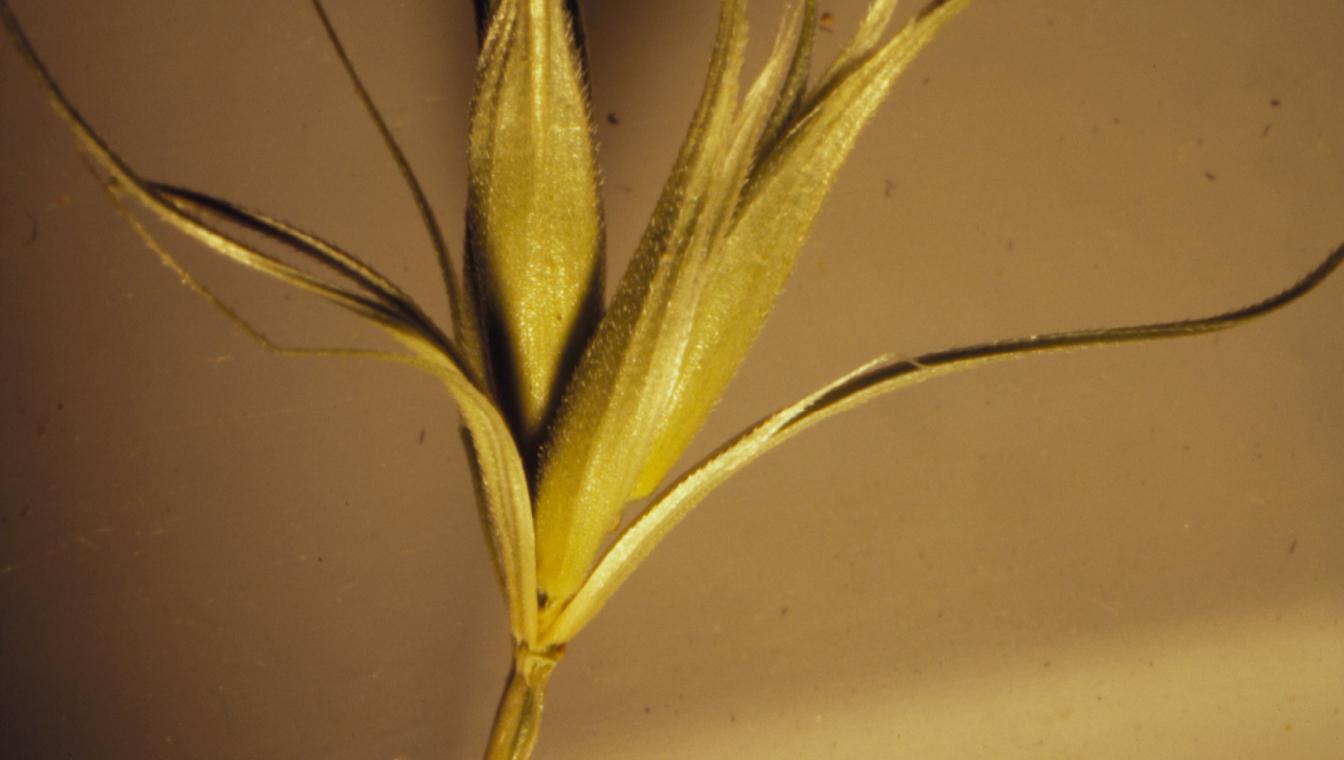
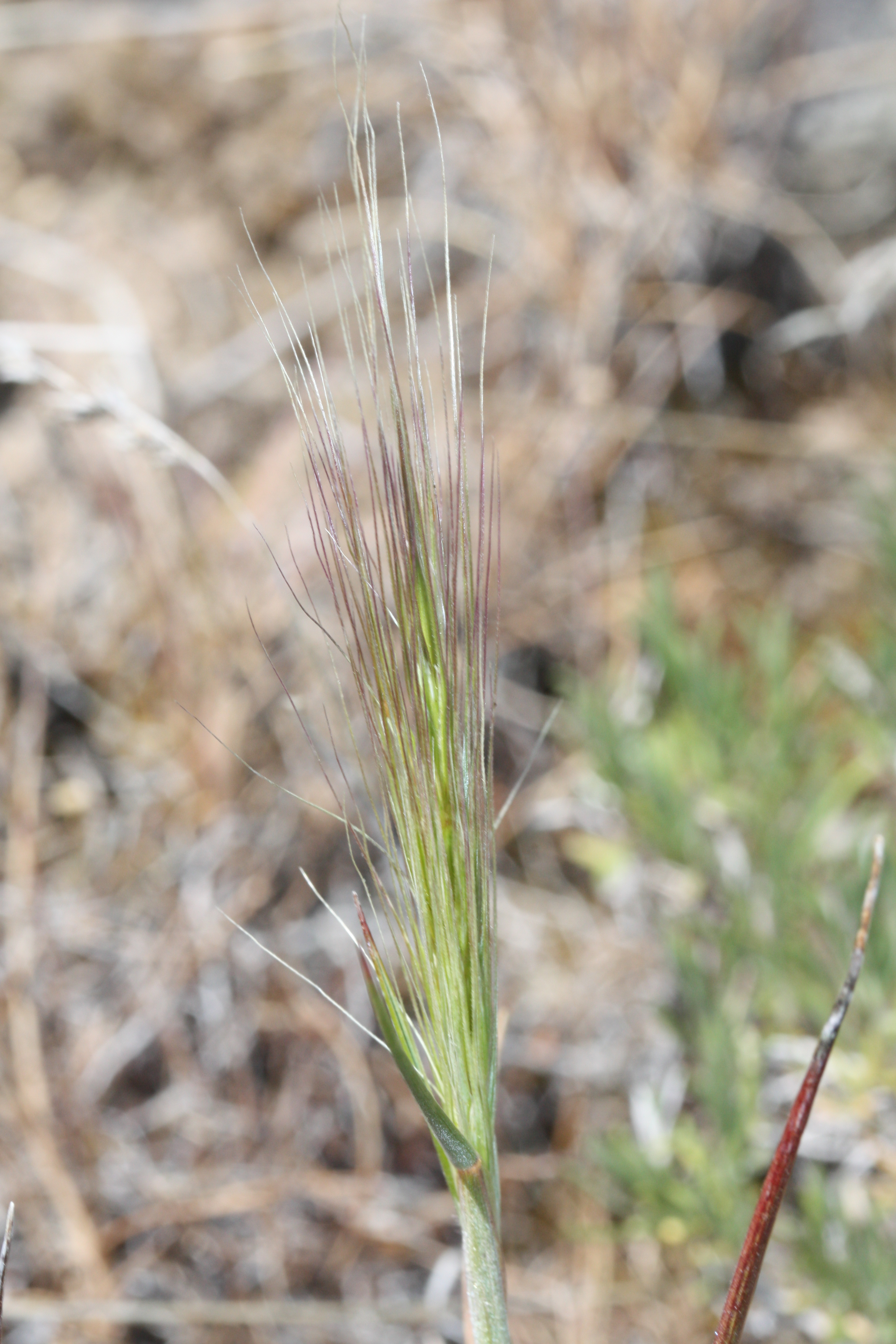
The most distinctive feature of this grass is its spectacular seed spike — a dense, cylindrical spike 3–6 inches (7–15 cm) long with spreading awns up to 2–3 inches (5–8 cm) long. The awns diverge dramatically from the rachis, creating the characteristic “bottlebrush” appearance. The spikes emerge in late spring through summer, starting erect and green before maturing to straw-golden. As seeds ripen, the awns spread wide and the spike becomes bushy and eye-catching. Multiple seed spikes typically arise on each plant, creating a display that lasts for weeks. The awns are designed to catch on animal fur and clothing for dispersal.
Quick Facts
| Scientific Name | Elymus elymoides |
| Family | Poaceae (Grass Family) |
| Plant Type | Cool-Season Perennial Bunchgrass |
| Mature Height | 1.5 ft |
| Sun Exposure | Part Shade |
| Water Needs | Moderate |
| Bloom Time | May – July (seed heads); active growth spring & fall |
| Flower Color | Wind-pollinated (inconspicuous) |
| USDA Hardiness Zones | 3–9 |
Native Range
Bottlebrush Squirreltail has one of the broadest native ranges of any western North American bunchgrass, occurring from sea level in coastal Oregon and Washington to over 11,000 feet in the Rocky Mountains. Its range spans from British Columbia in the north to Baja California in the south, and from the Pacific Coast east to the central Great Plains states. It is especially common throughout the Great Basin, Intermountain West, Colorado Plateau, and the mountain grasslands and foothills of the Rockies.
In Arizona and New Mexico, Bottlebrush Squirreltail occurs at middle elevations, typically between 4,000 and 9,000 feet, where it inhabits open woodlands, mountain meadows, rocky slopes, and semi-arid grasslands. At lower desert elevations, it requires supplemental irrigation and protection from afternoon heat, reflecting its preference for cooler conditions. It is commonly found in ponderosa pine openings, pinyon-juniper woodlands, and montane meadows throughout the Arizona Sky Islands and Colorado Plateau.
The species is highly adaptable and can be found on granitic, limestone, and volcanic soils alike, in heavy clay as well as sandy loam, and on both north and south-facing slopes. This substrate flexibility, combined with its ability to establish after fire and disturbance, makes it one of the most ecologically versatile native grasses of the West. It is a key component of Great Basin restoration seed mixes used by the Bureau of Land Management and US Forest Service.
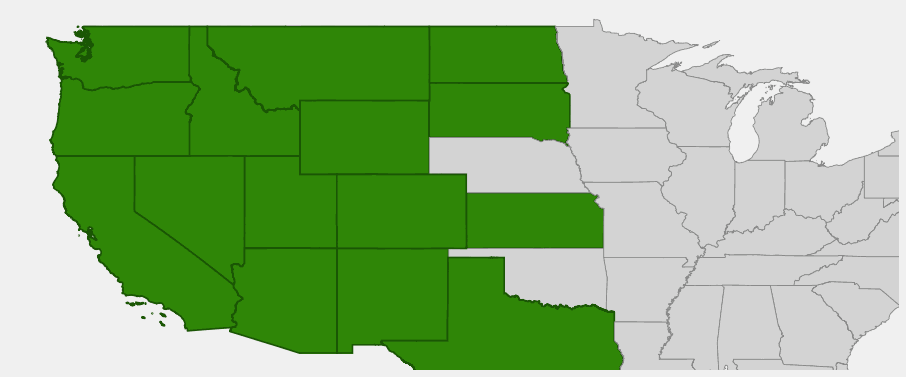
📋 Regional plant lists featuring Bottlebrush Squirreltail: Arizona
Growing & Care Guide
Bottlebrush Squirreltail is a rewarding and low-maintenance native grass for western gardens, particularly in naturalistic, xeriscape, and habitat garden designs. Its primary requirements are good drainage, some moisture, and protection from the most intense desert heat at low elevations.
Light
Bottlebrush Squirreltail performs best in partial shade at lower elevations (below 4,000 feet in Arizona), where it is protected from the most intense afternoon sun and heat. At higher elevations (above 5,000 feet), it can handle full sun well, reflecting its natural habitat in mountain meadows and open woodlands. For Arizona valley gardens, a site with morning sun and afternoon shade will produce the healthiest plants with the most ornamental seed heads.
Soil & Water
This species tolerates a wide range of soils — from sandy loam to clay — but requires well-drained conditions. Drought tolerant once established at appropriate elevations but needs supplemental irrigation at low desert elevations, especially during summer. Established plants at correct elevations thrive with biweekly deep watering during dry periods. The regional plant list notes it “requires more water and shade at lower elevations” — heed this advice for the best results.
Planting Tips
Direct seed in fall or early spring, or transplant container-grown plants in spring. Scarify seed by rubbing lightly between sandpaper before planting to improve germination. Sow seeds at a depth of ¼ inch in prepared soil, or broadcast over disturbed areas for natural seeding. Space plants 18–24 inches apart for a naturalistic colony planting.
Pruning & Maintenance
Minimal maintenance required. The spent seed heads can be removed after dispersal (mid to late summer) by cutting plants back to 4–6 inches to encourage fresh fall growth. In naturalistic plantings, allow seeds to self-sow for colony expansion. Remove any thatch or old foliage in late winter before spring growth begins. Naturally resistant to pests and diseases.
Landscape Uses
- Naturalistic grass garden — mass plant for a flowing meadow effect
- Erosion control on rocky slopes and disturbed areas
- Dryland seed mixes for rangeland restoration and revegetation
- Wildlife garden — seeds attract finches, sparrows, and other seed-eating birds
- Dry stream beds and rain garden edges
Wildlife & Ecological Value
For Birds
The seeds are consumed by a wide variety of seed-eating birds, including Lesser Goldfinches, Pine Siskins, Dark-eyed Juncos, White-crowned Sparrows, Horned Larks, and Mourning Doves. The dense tufts of foliage provide shelter for ground-nesting birds such as Vesper Sparrows and Horned Larks. In fall, migrating sparrows often forage among stands of squirreltail for seeds.
For Mammals
Bottlebrush Squirreltail is an important forage grass for pronghorn antelope, deer, and elk during the green growth phases of spring and fall. It is also palatable to livestock. Many small rodents — including kangaroo rats, deer mice, and pocket mice — cache the seeds as winter food stores. The grass-covered ground beneath established clumps provides habitat for lizards, small snakes, and invertebrates.
For Pollinators
As a wind-pollinated grass, it does not produce nectar or attract pollinators directly. However, its role in stabilizing soils that allow wildflowers to establish makes it an indirect but important supporter of pollinator habitat across western rangelands. Including it in seed mixes helps create the structural matrix within which flowering plants can establish.
Ecosystem Role
Bottlebrush Squirreltail is a critical pioneer species in western rangeland restoration. Its ability to establish in harsh conditions after fire, overgrazing, or other disturbances makes it one of the first native species to colonize degraded sites. In doing so, it stabilizes eroding soils, reduces weed invasion, and creates conditions for other native plants to establish. It is a key component of restoration seed mixes used by land management agencies throughout the West.
Cultural & Historical Uses
Bottlebrush Squirreltail has been an important plant for Indigenous peoples throughout its range. The seeds were gathered and eaten by many Great Basin, Plateau, and Southwestern tribes, including the Paiute, Shoshone, and various Pueblo peoples. The seeds were typically ground into flour or pinole (a traditional food of powdered seeds mixed with water), or parched and eaten whole. The grass was also used as thatching material and for weaving baskets by some Great Basin peoples, who valued its strong, flexible stems.
In historic and modern rangeland management, Bottlebrush Squirreltail has been recognized as one of the most valuable native grasses for stabilizing degraded western rangelands. Early range managers noted its ability to establish on poor soils where other grasses fail, and it has been included in commercial seed mixes for revegetation of mine tailings, road cuts, burned areas, and overgrazed rangelands for over a century. Modern restoration ecologists continue to prize it as a highly effective and reliable native pioneer grass for western landscapes.
In contemporary horticulture, Bottlebrush Squirreltail has found an enthusiastic audience among native plant gardeners who appreciate its ornamental seed heads, easy establishment, and ecological value. Its dramatic spiky seed clusters have made it a favorite in contemporary prairie-style gardens, where it is often combined with native wildflowers such as penstemon, phlox, and blanketflower for a naturalistic, low-water-use landscape that also supports abundant wildlife.
Frequently Asked Questions
Why is it called Bottlebrush Squirreltail?
The name describes the plant’s spectacular seed head, which has long, spreading awns (bristles) radiating in all directions from a central spike — resembling both a bottle brush used for cleaning narrow containers and the fluffy, curved tail of a squirrel. The comparison becomes even more apt when the seed heads are backlit by sunlight and appear golden and plumed.
Can Bottlebrush Squirreltail grow in the Phoenix or Tucson valley?
It can, but it requires a site with afternoon shade and regular moisture at low desert elevations. It performs much better above 4,000 feet, where temperatures are cooler. For low desert gardens, plant it in a shaded north or east-facing exposure. In the Tucson foothills (above 2,500 feet), it performs considerably better than in the Phoenix basin.
Is Bottlebrush Squirreltail invasive?
No. It is a well-behaved native grass that self-seeds at a moderate rate in appropriate conditions. Unlike some introduced grasses (such as buffelgrass), it does not spread aggressively into undisturbed native plant communities and does not create fire-fuel ladders. It can be easily managed by removing seed heads before dispersal if self-seeding is not desired.
What wildlife does it support?
The seeds attract numerous seed-eating birds including juncos, sparrows, goldfinches, and doves. Deer, elk, and pronghorn graze the green foliage in spring and fall. Small mammals cache the seeds. The clumps provide cover and nesting material for ground-nesting birds and small mammals.
How do I propagate Bottlebrush Squirreltail?
The easiest method is direct seeding in fall or early spring. Seeds can be harvested when seed heads mature and turn golden-brown, then stored dry and planted the following fall. Lightly scarify the seeds before planting to improve germination rates. Container plants are available from native plant nurseries and should be planted in fall or early spring.

Looking for a nursery that carries Bottlebrush Squirreltail?
Browse our native plant nursery directory: Arizona