Desert Olive (Forestiera neomexicana)
Forestiera neomexicana, known as Desert Olive or New Mexico Privet, is a tough and versatile native shrub or small tree of the olive family (Oleaceae) adapted to the arid and semi-arid environments of the American Southwest and Great Basin. Reaching up to 12 feet tall, Desert Olive is a deciduous to semi-evergreen plant with small, oval leaves, inconspicuous yellow flowers in early spring (often before the leaves emerge), and clusters of small blue-black olive-like drupes that ripen by late summer and are eagerly consumed by dozens of species of wildlife. The Arizona regional plant list highlights it specifically for its fruit, noting it is “great for wildlife” — an apt summary of this plant’s most significant ecological contribution.
Desert Olive is exceptionally valuable to the desert landscape because of its combination of toughness and wildlife utility. It tolerates drought, alkaline soils, reflected heat, and temperatures well below zero, while producing abundant fruit that birds and mammals depend on during late summer and fall when other food sources are dwindling. The small blue-black berries, while not particularly palatable to humans, are a critical fall food source for dozens of songbird species migrating through the Southwest. In the wild, Desert Olive often grows in dense thickets along arroyos, canyon bottoms, and rocky slopes where it provides cover as well as food.
For gardeners, Desert Olive is a nearly ideal native shrub for low-water landscapes. It can be trained as a specimen tree, grown as a large informal hedge or screen, or left to form naturalistic thickets for wildlife habitat. Its adaptability to a wide range of soils, elevations, and exposure levels — from the desert floor to pinyon-juniper woodland elevations — makes it one of the most broadly useful native shrubs in the Southwest. Its dioecious nature (separate male and female plants) means that berry production requires planting at least one of each sex, but the investment pays dividends in wildlife activity year after year.
Identification
Desert Olive is a multi-stemmed, thicket-forming shrub or small tree with upright to arching branches. Mature plants typically reach 8–12 feet (2.5–3.7 m) tall and nearly as wide. Young stems are light gray-green and somewhat flexible; older bark is light gray and slightly furrowed.
Leaves
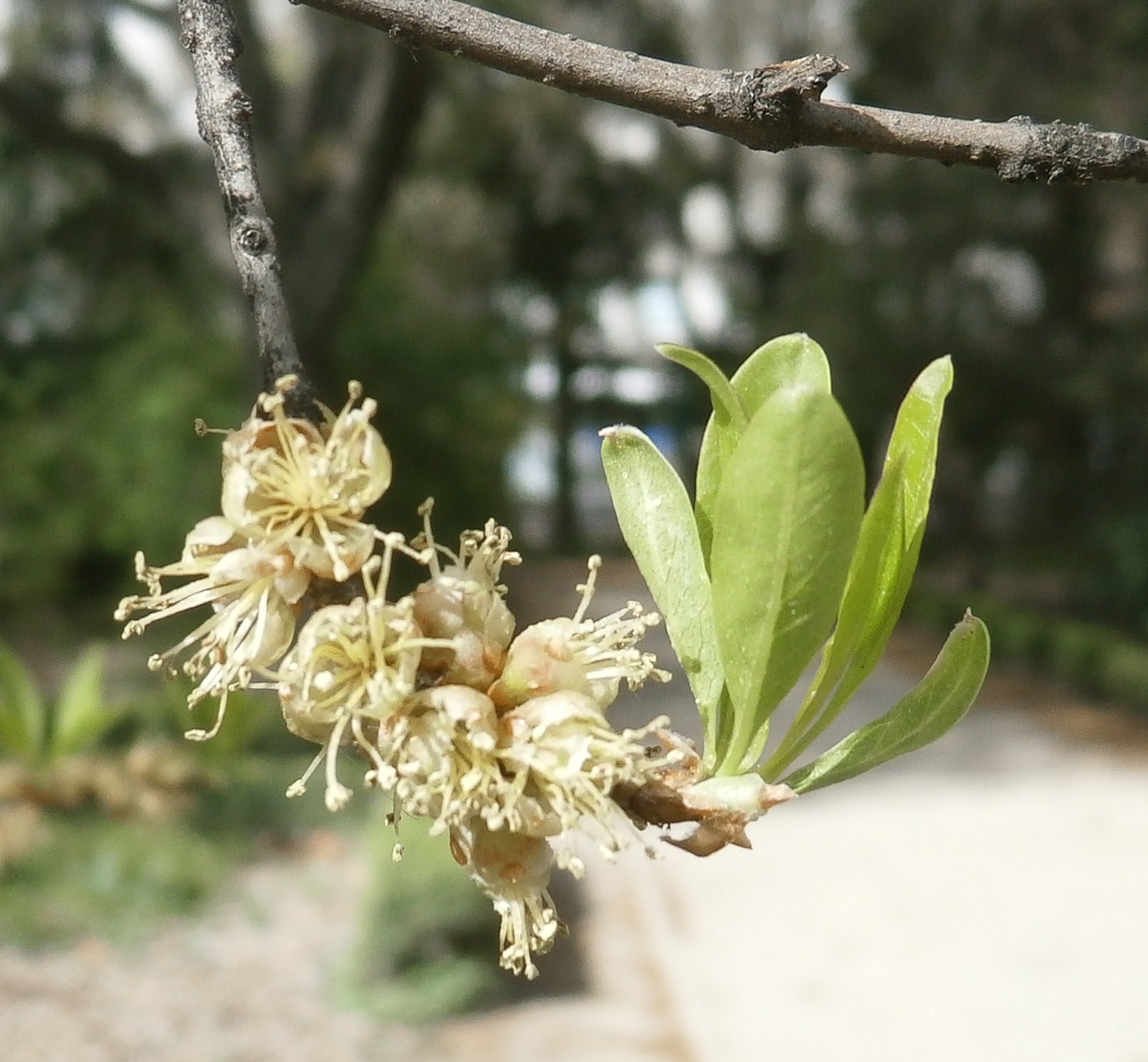
Leaves are small, simple, and opposite — a characteristic shared across the olive family. Each leaf is oval to elliptic, ¾–1.5 inches (2–4 cm) long, with a blunt to slightly pointed tip and a smooth or finely toothed margin. The upper surface is bright green and smooth; the underside is slightly paler. Leaves are deciduous to semi-evergreen, typically falling after a hard frost but sometimes persisting through mild winters. In spring, fresh green leaves emerge early, often shortly after the flowers, creating the impression of a shrub that awakens before most of its neighbors.
Flowers & Fruit
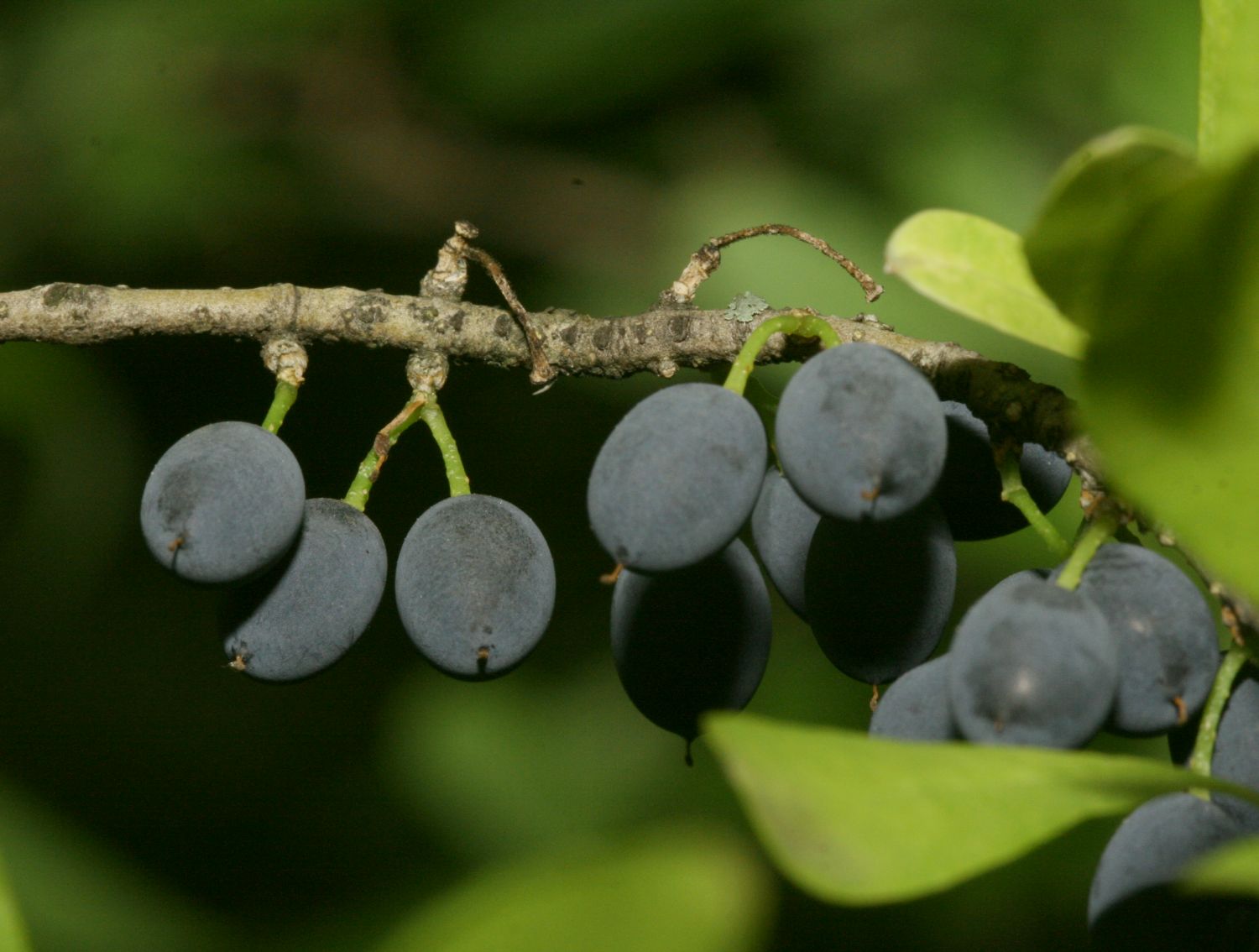
Flowers emerge in late February through April, often before the leaves fully expand. They are very small — only a few millimeters — appearing as tight yellow-green clusters directly on the stems and branches. The species is dioecious (separate male and female plants). Male plants produce dense, showy yellow clusters of anthers; female plants produce smaller, more inconspicuous flowers. The flowers are wind-pollinated. The fruit is a small drupe (olive-like berry) ¼–⅓ inch (6–8 mm) long, oval, and bright blue-black to dark purple when ripe. They develop in clusters of 3–8 along the branches, maturing in August through October. The berries are consumed by many species of birds and mammals but are too bitter and astringent for human consumption without processing.
Quick Facts
| Scientific Name | Forestiera neomexicana |
| Family | Oleaceae (Olive Family) |
| Plant Type | Deciduous to Semi-Evergreen Shrub / Small Tree |
| Mature Height | 12 ft |
| Sun Exposure | Full Sun |
| Water Needs | Low (Drought Tolerant) |
| Bloom Time | February – April (before leaves) |
| Flower Color | Yellow-green (inconspicuous) |
| USDA Hardiness Zones | 5–9 |
Native Range
Desert Olive is native to a broad swath of the American Southwest and Great Basin, extending from southern California east through Nevada, Utah, Colorado, Arizona, and New Mexico to western Texas, with scattered populations in adjacent Mexico. It is most abundant in Arizona and New Mexico, where it occurs across a wide range of elevations from about 2,000 to 7,000 feet, inhabiting canyon bottoms, rocky washes, desert scrub, and the lower edges of pinyon-juniper woodland.
Throughout its range, Desert Olive is associated with the Chihuahuan Desert, Sonoran Desert uplands, and Great Basin Desert vegetation types. It often grows in moist microhabitats within otherwise dry landscapes — the banks of intermittent streams, canyon bottoms that receive seasonal runoff, and rocky slopes where water concentrates briefly after rain. This preference for slightly moister microsites within a dry overall landscape reflects its moderate water needs compared to the most extreme desert plants.
Desert Olive is closely related to the Eastern Desert Olive (Forestiera acuminata), which extends from the central US to the Atlantic Coast. The New Mexico Privet is distinguished from its relatives by its range, its smaller leaves, and its specific habitat preferences. It is an important indicator species for the Rocky Mountain and Great Basin desert shrub communities and is frequently encountered in arroyo-bottom plant communities throughout the Chihuahuan Desert.
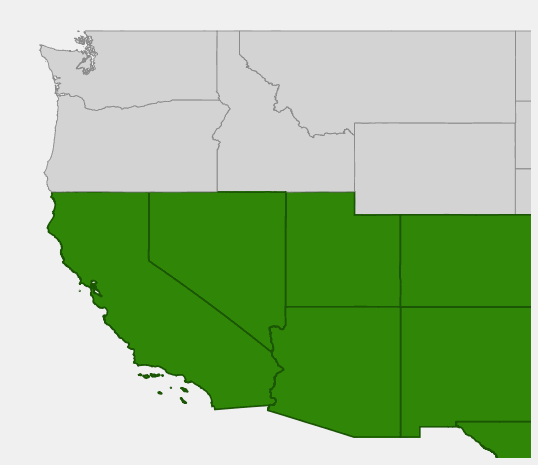
📋 Regional plant lists featuring Desert Olive: Arizona
Growing & Care Guide
Desert Olive is one of the easiest native shrubs to establish in the Southwest, tolerating a wide range of soil types, exposure levels, and moisture conditions. Its main requirements are full sun and well-drained to moderately drained soil — it does not tolerate waterlogged conditions but is otherwise highly adaptable.
Light
Desert Olive grows best in full sun, where it develops the densest growth, flowers most abundantly, and produces the most fruit for wildlife. It tolerates partial shade but will be more open and produce less fruit under reduced light. At lower desert elevations (below 3,000 feet), a location with some afternoon shade protection can reduce heat stress on young plants during the summer establishment period.
Soil & Water
Desert Olive tolerates a wide range of soils — sandy loam, clay, caliche, and alkaline soils — making it highly adaptable to diverse southwestern soil conditions. Once established, it is quite drought tolerant, surviving on natural rainfall throughout most of its native range. For the first year or two, water deeply every 2–3 weeks in summer, then reduce supplemental water to once monthly or less during extended dry periods. Avoid heavy clay or waterlogged situations.
Planting Tips
Because Desert Olive is dioecious, plant at least one male and one female plant near each other if fruit production for wildlife is your goal. Plant in fall or early spring, choosing a location with good air circulation. Desert Olive transplants easily from container stock and is available at most native plant nurseries in the Southwest.
Pruning & Maintenance
Desert Olive can be left to grow in its natural multi-stemmed shrub form, or trained into a small tree by removing lower stems over several years. Prune in late winter to shape or control size. It responds well to hard pruning if rejuvenation is needed. Dead-heading is not needed, as the berries provide important wildlife food. Desert Olive is largely pest- and disease-free in its adapted range.
Landscape Uses
- Wildlife habitat planting — berries attract dozens of bird species
- Informal hedge or screen — fast-growing and dense
- Arroyo and dry streambed planting
- Specimen small tree — can be trained with attractive multi-trunk form
- Riparian restoration along intermittent streams and washes
- Xeriscape anchor shrub
Wildlife & Ecological Value
For Birds
Desert Olive is among the most valuable native shrubs for fall-migrating songbirds in the Southwest. The blue-black berries are consumed by American Robins, Cedar Waxwings, Western Bluebirds, Yellow-rumped Warblers, Hermit Thrushes, and dozens of other species. In some locations, the berries are a critical food source for birds staging for southward migration in August through October. The dense thickets also provide roosting cover and nesting sites for year-round desert residents including Curve-billed Thrashers and Verdin.
For Mammals
The berries of Desert Olive are consumed by coyotes, ringtail cats, coatis, and various rodents. Deer and javelinas may browse the foliage during dry periods. The dense, thorny-looking thickets provide valuable escape cover for jackrabbits, cottontails, and small rodents throughout the year.
For Pollinators
Because Desert Olive is wind-pollinated, it does not offer significant nectar resources to pollinators. However, the early-blooming male plants with their abundant pollen may be visited by pollen-gathering native bees in late winter and early spring when few other pollen sources are available — making it a potentially valuable early-season resource in desert bee communities.
Ecosystem Role
Desert Olive often forms the dense shrub layer in canyon-bottom and arroyo communities, contributing to the structural complexity that supports high biodiversity in these water-influenced desert habitats. Its root system helps stabilize eroding streambanks and arroyo walls, and its leaf litter adds organic matter to nutrient-poor desert soils. The berries represent an important caloric resource for wildlife during the fall transition season.
Cultural & Historical Uses
Desert Olive has been used by Indigenous peoples of the Southwest for centuries. The Zuni people used various parts of the plant medicinally, and various Pueblo groups used the hard, heavy wood for small implements, bows, and fuel. The common name “privet” reflects the plant’s resemblance to the introduced garden privets (Ligustrum spp.) that it superficially resembles — both are members of the olive family with small, opposite leaves and dark berries, though Desert Olive is far superior in drought tolerance and wildlife value.
Desert Olive berries were occasionally used as a food source by Indigenous people, though the astringency of the raw fruit makes them unpalatable without preparation. The berries can be made edible through prolonged water-leaching to remove the bitter compounds — a common technique among Indigenous peoples for processing bitter plant foods. The resulting product was used in small quantities as a food flavoring or eaten in times of scarcity.
In modern landscaping, Desert Olive has gained considerable attention as a reliable, low-maintenance native shrub for wildlife gardens and xeriscape designs. It is widely available from native plant nurseries throughout the Southwest and is recommended by conservation organizations for habitat restoration projects, urban wildlife corridors, and sustainable landscaping on public lands. Its exceptional combination of drought tolerance, wildlife value, and ease of establishment make it a go-to species for restoration ecologists working in the Chihuahuan and Sonoran Desert regions.
Frequently Asked Questions
Do I need both a male and female plant to get berries?
Yes. Desert Olive is dioecious — individual plants are either male or female — and fruit is produced only on female plants when a male plant is nearby to provide pollen. Plant at least one of each sex within 50–100 feet of each other. Many native plant nurseries sell sexed plants, or you can plant several from seed and allow both sexes to establish.
Are Desert Olive berries edible for humans?
Raw, the berries are very bitter and astringent — not pleasant to eat. Indigenous peoples sometimes processed them through water-leaching to reduce bitterness, but they are not a commercial or commonly used food. They are best left on the plant for wildlife, which greatly benefits from the caloric resource they provide during fall migration.
How quickly does Desert Olive grow?
Desert Olive is a moderate to fast grower — typically adding 1–2 feet per year under good conditions. With adequate moisture during establishment and full sun, young plants can reach 5–6 feet within 3–4 years and begin producing berries within 2–3 years of planting.
Can Desert Olive be grown as a tree rather than a shrub?
Yes. By selectively removing lower stems over 2–3 years, you can train Desert Olive into an attractive multi-trunk small tree with an open, airy canopy. This tree form shows off the attractive gray bark and creates a more specimen-like landscape plant while retaining the wildlife value of the berries.
Is Desert Olive the same as Texas Privet?
Desert Olive (Forestiera neomexicana) and Texas Privet (Forestiera angustifolia) are related species in the same genus, but they are distinct plants with somewhat different ranges and leaf shapes. Texas Privet has narrower leaves and occurs primarily in Texas and Mexico, while Desert Olive has broader leaves and a wider range extending into Arizona, New Mexico, Colorado, and Utah.

Looking for a nursery that carries Desert Olive?
Browse our native plant nursery directory: Arizona