Brittlebrush (Encelia farinosa)
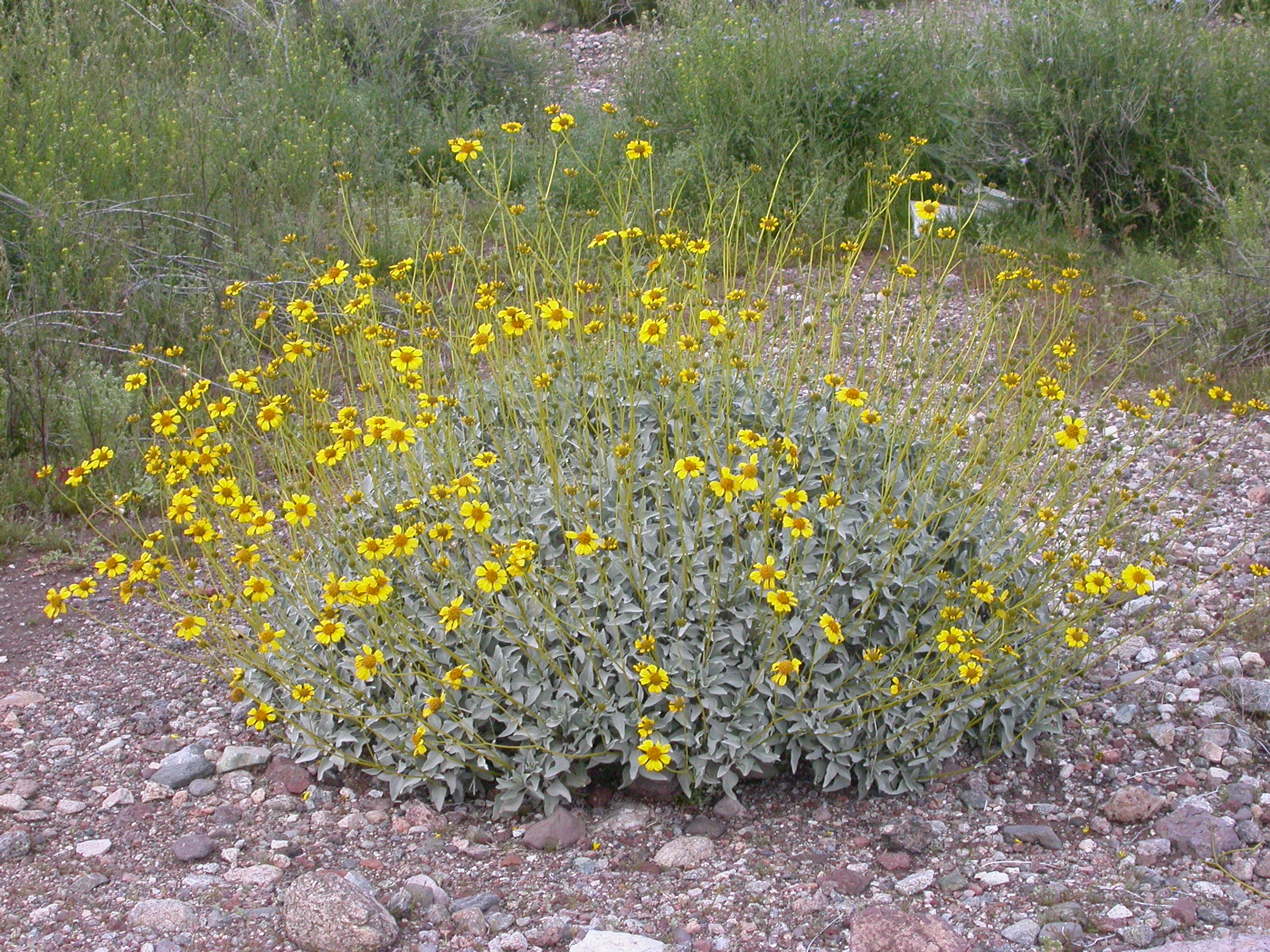
Encelia farinosa, commonly known as Brittlebrush or Incienso, is one of the most iconic and visually striking shrubs of the Sonoran Desert. Each spring, its rounded mounds of silver-gray foliage erupt into a breathtaking display of hundreds of bright yellow daisy-like flowers held on long, slender stems above the leaves — transforming entire hillsides into golden tapestries that are among the desert’s most celebrated wildflower events. The genus name honors Christopher Encel, a 16th-century botanist, while “farinosa” means “floury” or “mealy” — a reference to the dense coating of silvery-white hairs on the leaves.
Brittlebrush is a compact, rounded perennial shrub growing 2–3 feet tall, native to the rocky slopes, desert washes, and bajadas of the Sonoran Desert in Arizona and California, with populations extending into Nevada and Utah. Its silver-gray leaves are a marvel of desert adaptation — densely covered in reflective hairs that reduce water loss and reflect intense solar radiation, allowing the plant to thrive in some of the driest, hottest conditions on Earth. However, despite its extreme drought tolerance, Brittlebrush is notably vulnerable to overwatering, which can cause root rot and kill the plant quickly.
For desert gardeners and restoration ecologists, Brittlebrush is an invaluable native shrub. It is fast-growing, deer-resistant, fire-adapted, and extraordinary at stabilizing desert slopes and disturbed soils. Its prolific spring flowers feed native pollinators and support early-season bee populations. The plant’s resinous sap has a rich history of Indigenous and historical use — earning the Spanish common name “Incienso” (incense) for its fragrant resin, which was burned as incense in early California missions.
Identification
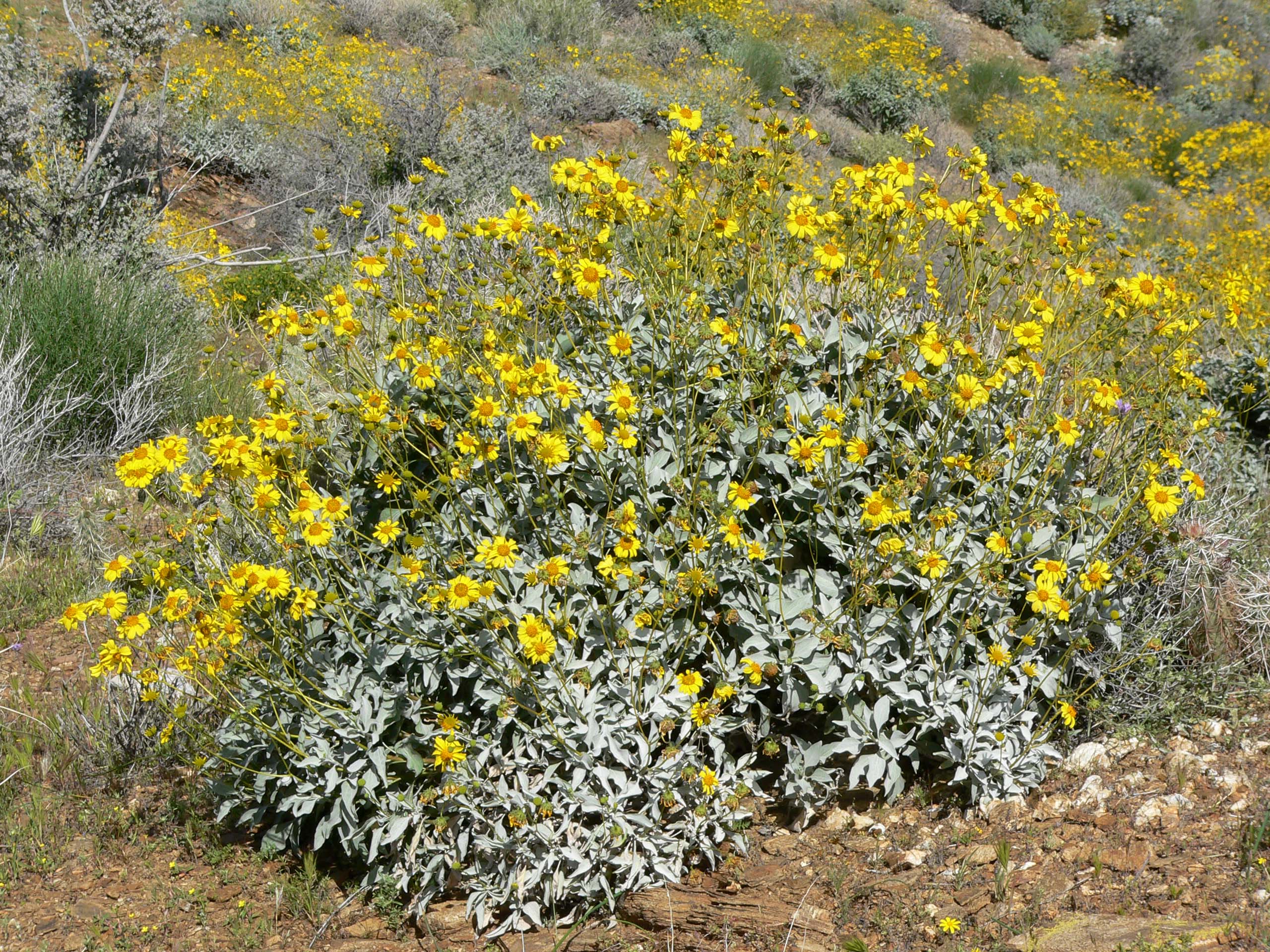
Brittlebrush is a rounded, densely branched perennial shrub that typically grows 2–3 feet tall and 3–5 feet wide. Its overall appearance is immediately distinctive: a mound of silvery-white foliage topped with a cloud of bright yellow flowers in spring. The stems are brittle and woody at the base, becoming softer toward the branch tips — giving the plant its common name.
Leaves
The leaves are the plant’s most recognizable feature out of bloom. They are oval to triangular, 1–3 inches long, and densely covered on both surfaces with fine, silvery-white hairs called trichomes. This dense pubescence gives the leaves a distinctly woolly or mealy silver-gray appearance that reflects sunlight and dramatically reduces water loss through transpiration. The leaves are somewhat sticky and fragrant when crushed, due to resinous compounds. During severe drought, the plant may drop most of its leaves to further reduce water stress — a remarkable drought-survival strategy.
Flowers & Seeds
The flowers appear from February through May, with peak bloom typically in March and April following winter rains. Each flower is a yellow ray-and-disk composite head (like a daisy) about 1–1.5 inches across, held on slender, unbranched stems (peduncles) 6–12 inches long that rise well above the foliage — creating a spectacular floating-flowers effect. The central disk florets are also yellow. After pollination, the seeds are small and flat, dispersed by wind. Brittlebrush typically begins flowering in its second or third year from seed.
Quick Facts
| Scientific Name | Encelia farinosa |
| Family | Asteraceae (Daisy / Sunflower Family) |
| Plant Type | Perennial Shrub |
| Mature Height | 3 ft |
| Sun Exposure | Full Sun |
| Water Needs | Low (Drought Tolerant) |
| Bloom Time | February – May |
| Flower Color | Bright Yellow |
| USDA Hardiness Zones | 8–11 |
Native Range
Brittlebrush is native to the Sonoran Desert and adjacent arid regions of the southwestern United States and northwestern Mexico. In the United States, its native range spans southern and central Arizona, the Colorado Desert and Mojave Desert regions of California, and small portions of Nevada and Utah. It is one of the most abundant and characteristic shrubs of the Sonoran Desert in Arizona, often dominating rocky hillsides and desert bajadas at elevations from near sea level to about 3,000 feet.
Within Arizona, Brittlebrush is found throughout the lower Sonoran life zone, particularly on the south- and west-facing slopes of desert mountain ranges, rocky alluvial fans, and the margins of desert washes. It grows with saguaro cactus, palo verde, ocotillo, and other signature Sonoran Desert plants. In California, it is most abundant in the Colorado Desert (Coachella Valley, Anza-Borrego, and the Imperial Valley region) and extends northward into the western Mojave Desert along dry, south-facing slopes.
The species extends well into Sonora and Baja California, Mexico, where it is a dominant shrub of the coastal and interior Sonoran Desert. The plant is fire-adapted and often one of the first species to reestablish after fire in its native range, rapidly colonizing burned areas and stabilizing soils. It lives for about 5–10 years on average, with plants dying after extended drought and re-establishing from seed.
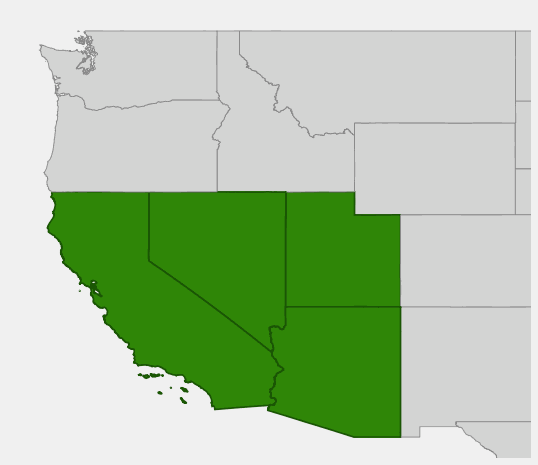
📋 Regional plant lists featuring Brittlebrush: Arizona
Growing & Care Guide
Brittlebrush is one of the easiest desert native shrubs to grow in its native range, rewarding gardeners with spectacular spring color for minimal care. The single most important rule: do NOT overwater. Excess moisture is the number one killer of Brittlebrush in cultivation.
Light
Full sun is essential. Brittlebrush evolved on intensely sun-exposed desert slopes and performs best with 8+ hours of direct sun per day. Even minimal shading will reduce flowering and weaken the plant. Choose the hottest, sunniest spot in your landscape — Brittlebrush thrives where other plants struggle.
Soil & Water
Well-drained, rocky or sandy soil is critical. Brittlebrush absolutely cannot tolerate wet feet or clay soils that retain moisture — this is the most common cause of plant death in cultivation. Plant in raised beds, on slopes, or in decomposed granite if your native soil drains poorly. Once established (after the first winter season), Brittlebrush needs almost no supplemental irrigation. Water deeply once every 3–4 weeks in summer if no monsoon rain falls. Do not water at all during cool-season dormancy (late fall to winter). Never use drip irrigation that keeps the soil continuously moist.
Planting Tips
Plant in fall (October–November) in Arizona for best establishment, or in early spring (February–March). Avoid planting during the hottest summer months. Plant slightly high to ensure excellent drainage around the crown. Space plants 4–5 feet apart to allow for their mature spread. Container-grown plants establish easily. Avoid adding compost or rich soil amendments — Brittlebrush grows best in lean, nutrient-poor desert soils.
Pruning & Maintenance
Pruning is optional but can help maintain a tidy shape. Cut back by one-third after flowering in spring to encourage compact growth and prolong plant life. Remove dead stems as needed. Brittlebrush is naturally short-lived (5–10 years) but readily reseeds, so allow some seed to drop to ensure natural replacement plants. The plant requires no fertilization — desert soils provide all the nutrients it needs.
Landscape Uses
- Desert slope planting — spectacular on rocky hillsides where it forms natural sweeps
- Xeriscape gardens — one of the best low-water native shrubs for Arizona landscapes
- Mass planting for spring color — few plants match its golden flower display
- Erosion control on disturbed desert slopes and disturbed roadsides
- Wildlife gardens — important early-season nectar source for native bees
- Restoration — used extensively in Sonoran Desert revegetation projects
Wildlife & Ecological Value
Brittlebrush provides critical ecological services in Sonoran Desert ecosystems, particularly as one of the earliest-blooming shrubs of the year.
For Birds
The seeds of Brittlebrush are consumed by desert sparrows, House Finches, Lesser Goldfinches, and other seed-eating birds. The dense, woody branching structure provides shelter and nesting sites for desert birds including Cactus Wrens, Curve-billed Thrashers, and Black-throated Sparrows. The early spring blooms attract insect pollinators that in turn provide food for insect-eating birds during the breeding season.
For Mammals
Brittlebrush is notably deer-resistant due to its aromatic resinous foliage, though jackrabbits and other small mammals may browse the stems. The dense mounds provide important shelter for desert lizards, snakes, small rodents, and toads. Ground squirrels and kangaroo rats store the seeds.
For Pollinators
Brittlebrush is one of the most valuable early-spring nectar and pollen sources in the Sonoran Desert. Its flowers are among the first to open each year, providing critical early-season resources for newly emerged queen bees, native bumblebees, digger bees, and the endangered Sonoran bumblebee. The prolific flowers also attract butterflies, particularly sulfurs and swallowtails, and a wide variety of beneficial flies and beetles.
Ecosystem Role
As a fire-adapted pioneer species, Brittlebrush plays an important role in desert ecosystem recovery and succession. Following fire, it is often among the first shrubs to reestablish, rapidly producing seeds that help stabilize soils and restore vegetation cover. Its resinous foliage burns readily, however, which means in areas with invasive annual grasses (buffelgrass), Brittlebrush populations may face increased fire frequency that exceeds their natural adaptation.
Cultural & Historical Uses
Brittlebrush has a rich history of human use, earning its Spanish common name “Incienso” from its widespread use as incense. The plant produces a fragrant, yellowish resin from its stems and leaves that was collected and burned as incense by the padres and Indigenous peoples of Baja California and Sonora. California Mission records document the use of Brittlebrush resin as incense in religious ceremonies — a practice that gave the plant a distinctly sacred significance in colonial-era California.
The Tohono O’odham, Seri, and Cahuilla peoples used Brittlebrush medicinally. The resin was heated and applied to relieve joint pain, toothaches, and chest congestion. The Seri people of Sonora chewed the resin as a gum and used it to waterproof pottery and baskets. The aromatic leaves were sometimes used to repel insects. Indigenous peoples also used the woody stems as fuel — the dry, resinous wood burns hot and fast, making it excellent tinder and kindling for fire-starting.
Modern ecological studies have focused on Brittlebrush’s remarkable drought-adaptation strategies, particularly the way it changes its leaf size, shape, and hair density in response to seasonal water availability. Desert ecologists have used Brittlebrush as a model organism for studying phenotypic plasticity — the ability of a single plant to change its physical characteristics in response to environmental conditions. Today, Brittlebrush is widely used in native plant landscaping, Sonoran Desert restoration projects, and highway revegetation throughout the Southwest.
Frequently Asked Questions
Why is my Brittlebrush dying?
The most common cause of Brittlebrush death in gardens is overwatering or poor drainage. This species evolved in extremely well-drained, rocky desert soils and cannot tolerate consistently moist conditions. Reduce watering immediately, ensure excellent soil drainage, and never plant in clay or heavy soils.
How fast does Brittlebrush grow?
Brittlebrush is a fast-growing shrub that can reach its full 2–3 foot height within 1–2 years from a container plant. From seed, it typically begins flowering in its second or third year. Plants grown in lean, dry desert conditions tend to be more compact and longer-lived than those in richer, moister soils.
Is Brittlebrush deer resistant?
Yes — the strongly aromatic, resinous foliage is generally avoided by deer, making Brittlebrush one of the better deer-resistant choices for Arizona desert gardens.
How long does Brittlebrush live?
Brittlebrush is naturally a short-lived shrub, typically living 5–10 years. Plants decline after extended drought or extreme heat. However, they readily reseed, so a planting will naturally replenish itself over time. Allowing some seeds to drop each year ensures continuous natural replacement.
Can Brittlebrush grow in a container?
Yes, but use a fast-draining cactus mix in a terracotta pot with excellent drainage holes. Be very careful not to overwater. Brittlebrush in containers tends to be shorter-lived than in-ground plants but provides excellent patio or balcony interest with its spectacular spring bloom.

Looking for a nursery that carries Brittlebrush?
Browse our native plant nursery directory: Arizona