
Broom Sedge (Andropogon virginicus)
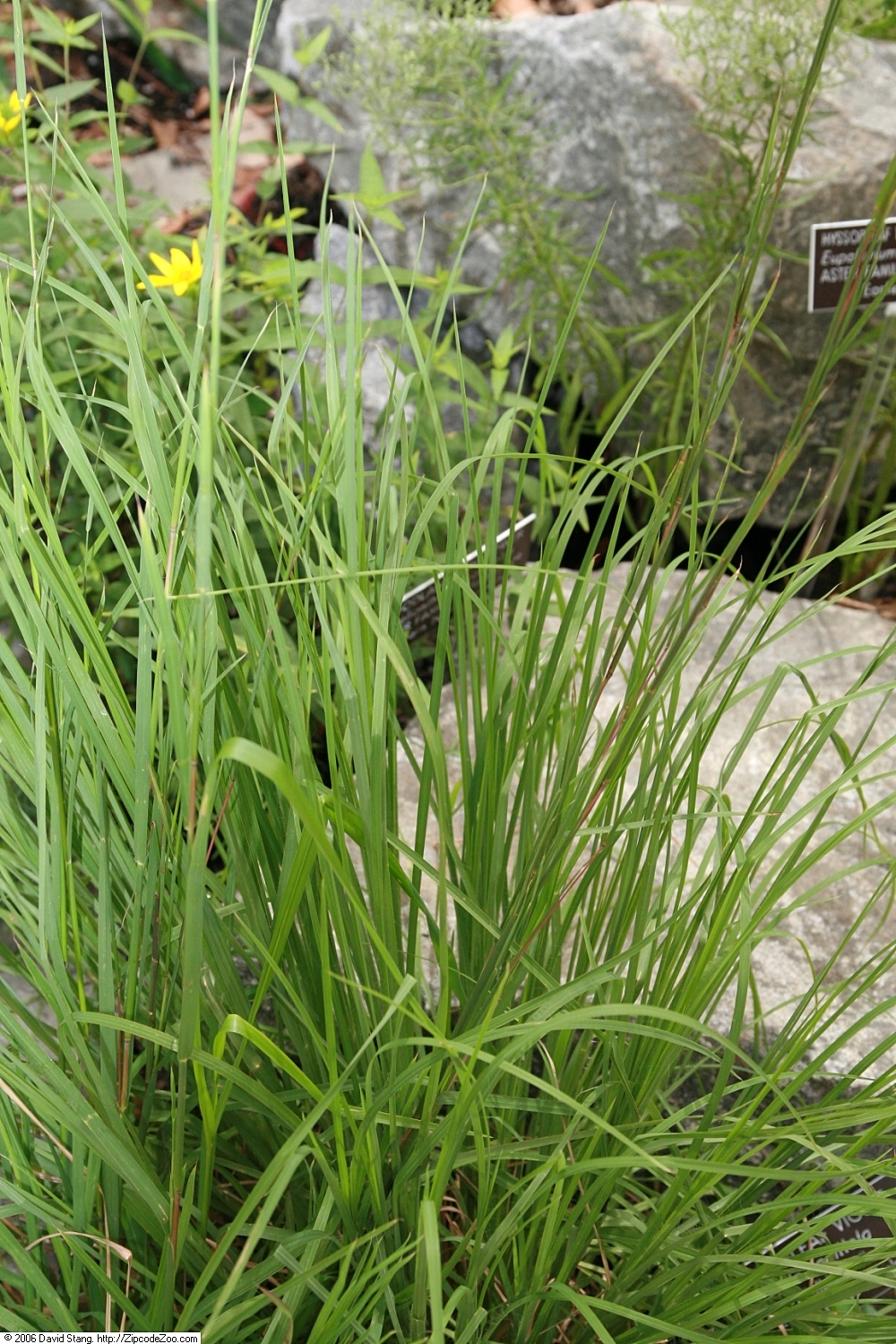
Andropogon virginicus, commonly known as Broom Sedge, Broomsedge Bluestem, or Yellowsedge Bluestem, is a warm-season native grass belonging to the Poaceae family. Despite its name, it is not a true sedge — it is a bluestem grass, part of the ecologically important Andropogon genus that forms the backbone of North American prairie and savanna ecosystems. In Hawaii, it has been introduced and naturalized and is recognized as an important pioneer species with documented soil-stabilization value in disturbed landscapes.
In its native range across eastern North America, Broom Sedge is one of the most widespread and ecologically significant warm-season grasses of old fields, meadows, roadsides, and dry to moderately moist open habitats. Its characteristic habit of forming dense, upright clumps that turn a warm, tawny gold-bronze in autumn — with feathery white, cotton-like seed plumes backlit by low autumn sun — makes it one of the most visually appealing native grasses of eastern North America. Its dried stalks and seed heads persist through winter, providing wildlife cover and seeds throughout the cold season.
In Hawaii, Broom Sedge (Andropogon virginicus) has established itself on several islands and is recognized as a useful pioneer plant for disturbed, degraded soils. While its role in Hawaiian ecosystems differs from its native range function, it demonstrates excellent soil-stabilizing properties, helping to anchor eroding slopes and disturbed ground until more permanent vegetation establishes. It is included in Hawaii’s regional plant lists as a functionally valuable grass for stabilization purposes.
Identification
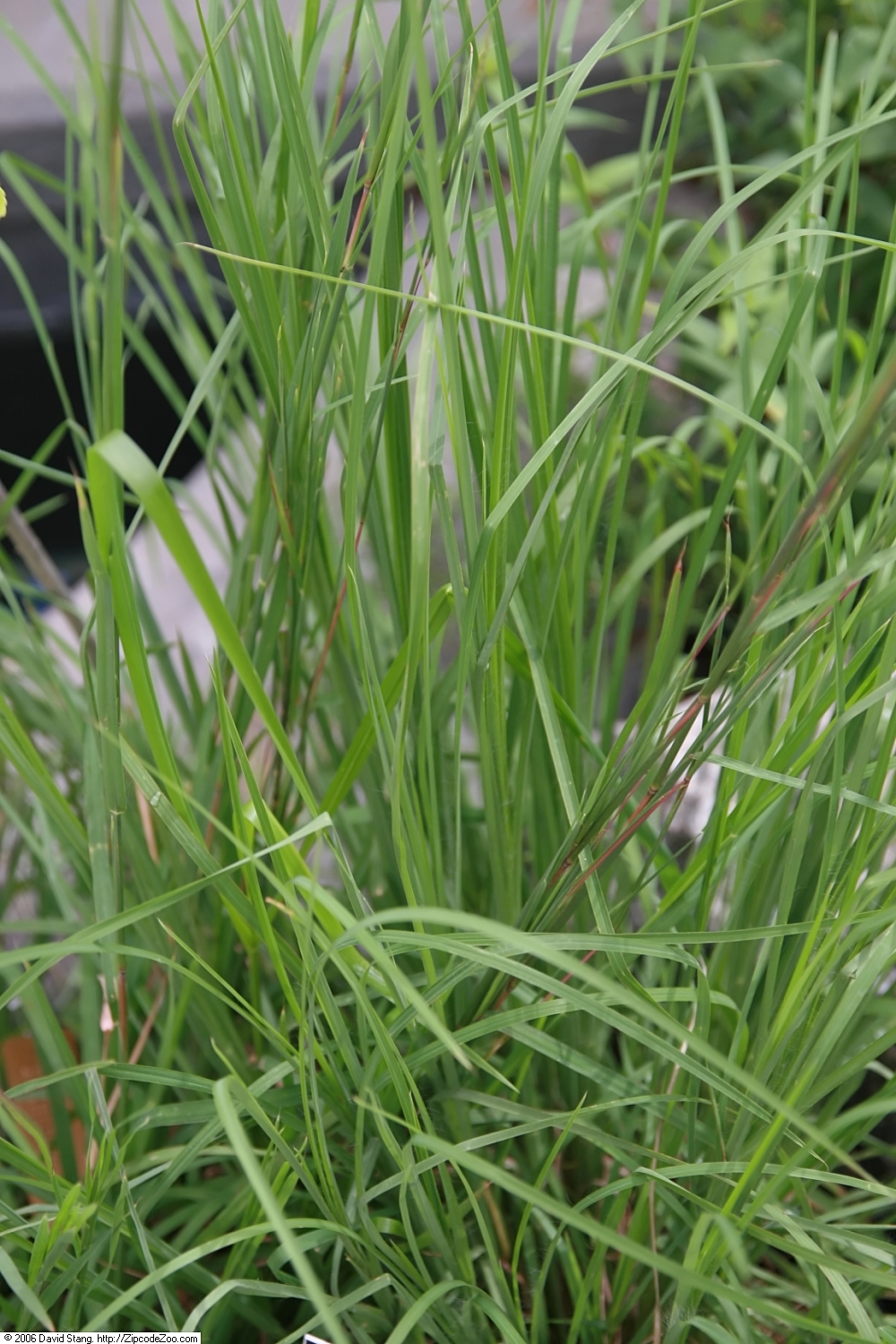
Broom Sedge forms upright, tightly clumped bunches of narrow, linear leaves that typically reach 2 to 4 feet in height. The overall growth form is distinctly upright and columnar during summer, becoming more open and arching as the seed stalks develop in fall. One of its most diagnostic features is the flattened, keeled leaf sheaths at the base and the delicate, silky-white to silver seed plumes that appear in late fall and persist through winter.
Leaves
The leaf blades are narrow — approximately ⅛ to ¼ inch (3–6 mm) wide — and up to 18 inches (45 cm) long, with a green to blue-green color during the growing season. The sheath (the base of the leaf that wraps around the stem) is distinctly flattened and slightly keeled, a useful identification feature. Leaf surfaces may be slightly hairy, particularly toward the base. In autumn, the foliage transitions through shades of orange, rust, and tawny gold before drying to a warm tan that persists through winter.
Stems & Seed Heads
Flowering stems are erect and branching, reaching 2 to 4 feet, topped with paired, spikelet-bearing racemes enclosed within boat-shaped, leaf-like bracts (spathes). Each individual spikelet has a twisted awn and is associated with long, silky white hairs that give the mature seed head its distinctive fluffy, cotton-like appearance. The seed heads are produced from late August through October and remain on the plant through winter. The combination of golden-tan foliage and silvery-white seed plumes makes Broom Sedge one of the most striking plants in the winter landscape.
Roots
The fibrous, deep root system is one of Broom Sedge’s most ecologically significant features. Roots penetrate 3 to 5 feet deep, binding soil, reducing erosion, and accessing moisture and nutrients from subsoil layers. This deep root architecture is what makes Broom Sedge such an effective pioneer and soil stabilizer on disturbed, compacted, or eroded sites.
Quick Facts
| Scientific Name | Andropogon virginicus |
| Family | Poaceae (Grass family) |
| Plant Type | Native Warm-Season Bunch Grass; Pioneer Species |
| Mature Height | 2–4 ft |
| Sun Exposure | Full Sun |
| Water Needs | Low to Moderate (pioneer soil-stabilizing plant) |
| Bloom Time | Late Summer – Fall (August–October) |
| Flower Color | Silvery-white seed plumes; tawny-gold foliage |
| Fall Color | Copper, orange, and tawny gold |
| USDA Hardiness Zones | 5–9 (native range); naturalized in Hawaii |
Native Range
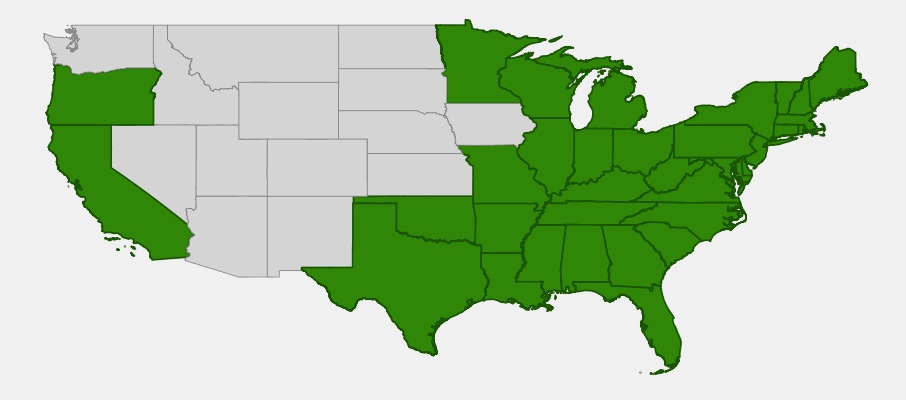
Broom Sedge (Andropogon virginicus) is native to the eastern United States, ranging from southern Maine south to Florida and west to Kansas, Nebraska, and Texas. It is one of the most adaptable and widely distributed warm-season grasses in North America, occurring in virtually every state east of the Rocky Mountains. Its tolerance of poor soils, drought, and disturbance has allowed it to colonize old fields, roadsides, forest clearings, pine savannas, and degraded lands across its native range.
In addition to its native eastern US distribution, Andropogon virginicus has been introduced to the western United States, Hawaii, Central America, South America, Asia, and parts of Australia, where it is generally considered naturalized. In Hawaii, it has established on several islands and is recognized as a naturalized grass that plays a functional role in stabilizing disturbed soils — a role it fills in its native range as well. In some Pacific Island contexts, it is considered invasive, but its soil stabilization value in open disturbed areas is recognized in regional plant management literature.
In its native eastern US range, Broom Sedge is a characteristic plant of old-field succession — one of the first plants to colonize abandoned agricultural fields, burned areas, and disturbed open ground. Over time, as woody shrubs and trees invade the site, Broom Sedge is gradually replaced by taller plants, making it a transitional but ecologically important species in landscape succession. Its deep root system contributes substantially to soil organic matter and structure as it decays.
📋 Regional plant lists featuring Broom Sedge: Hawaii
Growing & Care Guide
Broom Sedge is an exceptionally easy and low-maintenance grass to grow, requiring minimal inputs once established. Its value lies in its toughness, drought tolerance, and ability to thrive on poor soils where other plants struggle.
Light
Broom Sedge requires full sun. It will not thrive in shade and becomes open and floppy in partial shade conditions. For best color, seed production, and structural performance, site it where it receives at least 6 hours of direct sun daily. In full sun, plants develop the characteristic dense, upright bunches and vivid autumn coloration that make Broom Sedge such an attractive grass.
Soil & Water
One of Broom Sedge’s greatest strengths is its tolerance of poor, dry, compacted, or infertile soils — conditions that most ornamental plants cannot tolerate. It thrives in sandy loams, clay soils, rocky soils, and even heavy clays with adequate drainage. Established plants are highly drought tolerant and require no supplemental irrigation once their root system is developed. Avoid over-fertilizing, as rich soils can cause floppy, rank growth — Broom Sedge naturally performs best on lean substrates.
Planting Tips
Plant in spring for warm-season establishment. Container-grown plants establish readily; direct seeding in fall can be effective on prepared soil surfaces. Space plants 18 to 24 inches apart for a natural meadow effect, or 12 inches for a denser groundcover planting. Broom Sedge is excellent for stabilizing slopes, bare banks, and roadsides. It is also effective as a component of native meadow plantings mixed with goldenrods, asters, and other prairie species.
Pruning & Maintenance
Cut plants back to 4–6 inches in late winter to early spring (before new growth begins) to prevent a buildup of dead material and encourage vigorous new growth. Leave plants standing through fall and winter to provide wildlife habitat, enjoy the ornamental seed heads and winter foliage, and let seeds disperse naturally. Broom Sedge self-seeds readily — manage seedlings as needed in garden settings. It is highly fire-adapted and can be managed by controlled burning in appropriate settings.
Landscape Uses
- Slope stabilization — one of the best native plants for controlling erosion on disturbed slopes
- Native meadow and prairie plantings as a warm-season grass component
- Old-field restoration on degraded agricultural lands
- Roadside revegetation and cut-slope stabilization
- Rain gardens and bioswales — tolerates temporary flooding and dry periods
- Wildlife gardens — excellent winter cover and food source
- Ornamental grass planting for autumn color and winter texture
Wildlife & Ecological Value
Broom Sedge is one of the most ecologically valuable grassland plants in eastern North America, providing critical food and cover for a wide range of wildlife species.
For Birds
The seeds of Broom Sedge are consumed by a wide array of seed-eating birds, including Sparrows (Song, Field, Grasshopper), Juncos, Buntings, Goldfinches, and Towhees. The dense clumps provide essential nesting habitat for ground-nesting grassland birds, including Meadowlarks, Dickcissels, and various sparrow species. During winter, the standing dead stems and persistent seed heads provide food and shelter when other resources are scarce.
For Mammals
White-tailed deer, cottontail rabbits, and field mice utilize Broom Sedge habitat for cover. The dense clumps provide insulation and concealment for small mammals in winter. Meadow voles (Microtus pennsylvanicus) favor areas with dense Broom Sedge cover for runway systems and nesting sites, and their presence in turn supports predators such as Red-tailed Hawks, American Kestrels, and Red Foxes.
For Pollinators
Like most wind-pollinated grasses, Broom Sedge does not produce nectar rewards for pollinators. However, native grasses collectively support diverse grassland habitats where many native bee species nest in the ground and find floral resources in the companion forb community that typically develops alongside Broom Sedge in old-field settings.
Ecosystem Role
Broom Sedge is a keystone old-field grass in eastern North America. As a pioneer plant, it rapidly colonizes disturbed areas, prevents soil erosion, and begins the process of organic matter accumulation that eventually supports more diverse plant communities. Its deep root system adds organic carbon to the soil, improves water infiltration, and supports mycorrhizal networks. In the fire-influenced pine savannas of the Southeast, Broom Sedge is a dominant grass species that carries low-intensity fires across the landscape, maintaining the open, grassy structure that diverse communities of native plants and animals require.
Cultural & Historical Uses
Broom Sedge has a practical history closely tied to traditional agricultural communities in the eastern United States. The dried stems were bundled and used to make brooms — hence the common name “Broom Sedge” — a practice that was common on farms and homesteads throughout the 18th and 19th centuries before the advent of manufactured brooms. The dried stems were also used as bedding material for livestock and for thatching temporary structures.
Native American tribes of the eastern United States made use of various Andropogon grasses for basket weaving, cordage, and thatching. The dried stalks were particularly valued for their flexibility and durability. The fluffy seed heads were used as insulation material in bedding and garments in some traditions. Folk herbalists also utilized preparations from bluestem grasses, primarily for fevers and minor ailments, though the medicinal use of Broom Sedge specifically is not well-documented.
In modern ecological restoration and land management, Broom Sedge is increasingly recognized for its valuable role as a pioneer species in habitat restoration. Its use in erosion control, mine reclamation, and old-field restoration has been documented across its native range. In Hawaii, its recognition as a soil-stabilizing pioneer reflects this broader understanding of its ecological function. Today, seed of Broom Sedge is commercially available from native plant seed suppliers and used extensively in prairie restoration, native meadow, and erosion control plantings throughout its range.
Frequently Asked Questions
Is Broom Sedge a grass or a sedge?
Despite its common name, Broom Sedge is actually a grass (family Poaceae), not a true sedge (family Cyperaceae). The common name derives from the traditional use of its dried stems for making brooms. The scientific name Andropogon virginicus places it firmly in the grass family, in the same genus as Little Bluestem (Andropogon gerardii).
Does Broom Sedge become invasive?
In its native eastern US range, Broom Sedge is a valuable pioneer grass. However, outside its native range (including in Hawaii and parts of the Pacific), it can spread aggressively in disturbed areas and may compete with native vegetation. In Hawaii, it is considered naturalized and is recognized for its soil-stabilization value, though it should be used thoughtfully in areas adjacent to intact native Hawaiian plant communities.
How do I tell Broom Sedge apart from Little Bluestem?
Broom Sedge (Andropogon virginicus) and Little Bluestem (Schizachyrium scoparium) are similar grasses often found together. Key differences: Broom Sedge has distinctly flattened, keeled leaf sheaths and smaller, more compact seed heads enclosed within prominent boat-shaped bracts (spathes). Little Bluestem has rounder sheaths and more exposed, feathery seed heads, and often turns a distinctive orange-red color in fall.
Is Broom Sedge good for erosion control?
Yes — Broom Sedge is one of the best native plants for erosion control on disturbed slopes and bare sites. Its deep, fibrous root system (extending 3–5 feet deep) binds soil effectively, and its tolerance of poor soils allows it to establish quickly where other plants struggle. It is regularly used in roadside revegetation, mine reclamation, and slope stabilization projects.
Can I burn Broom Sedge in my garden?
Controlled burning of Broom Sedge in late winter (February–March) is an effective management tool that clears old stems, reduces thatch buildup, and stimulates vigorous new growth. However, controlled burns must be conducted safely with appropriate local permits, firebreaks, and conditions. For most residential gardens, cutting back to 4–6 inches in late winter is a safer and equally effective management approach.

Looking for a nursery that carries Broom Sedge?
Browse our native plant nursery directory: Hawaii