Buffalograss (Bouteloua dactyloides)
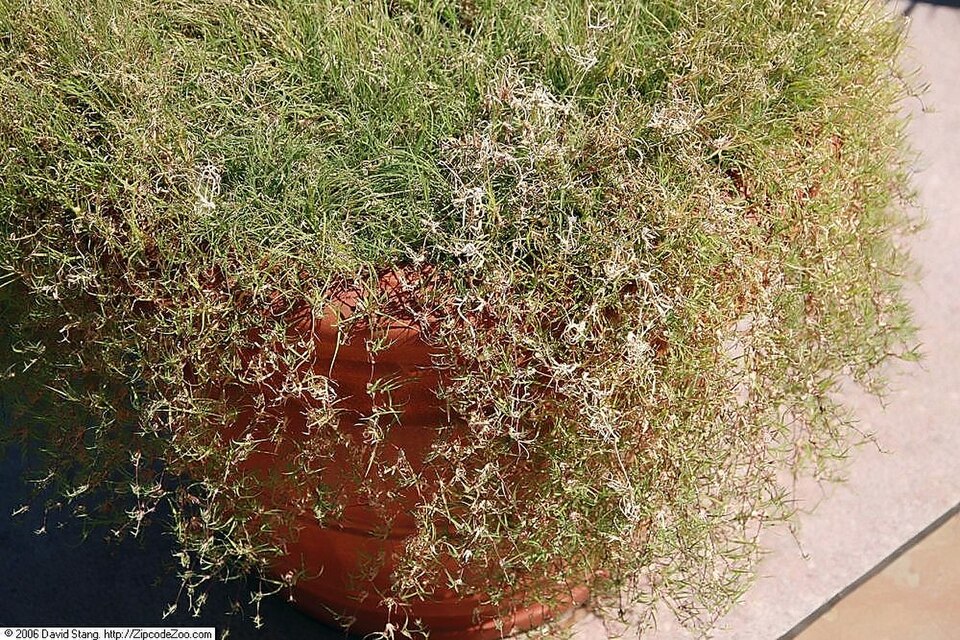
Bouteloua dactyloides (syn. Buchloe dactyloides), commonly known as Buffalograss, is the iconic native turf grass of the North American Great Plains — the very grass that once carpeted millions of acres of the central continent and helped sustain the enormous bison herds that shaped the landscape and cultures of the region for thousands of years. A warm-season, sod-forming grass, Buffalograss produces a dense, fine-textured, blue-green turf that rarely exceeds 4 to 8 inches in height and requires dramatically less water, fertilizer, and mowing than conventional lawn grasses, making it one of the most ecologically and practically valuable native grasses for gardens and landscapes in Montana, Wyoming, and the broader Great Plains region.
Buffalograss earned its evocative name by being one of the primary food sources of the American bison (buffalo), which once roamed in herds of tens of millions across the Great Plains. The grass’s remarkable nutritional density, its availability year-round (including through winter as a dried standing forage), and its ability to regenerate quickly after intensive grazing made it the biological foundation of the shortgrass prairie ecosystem. Indigenous nations across the plains harvested the seeds for food, used the dried grass for thatching and insulation, and recognized the presence of Buffalograss as a reliable indicator of bison country and healthy land.
Today, Buffalograss is prized as a low-maintenance, drought-tolerant alternative to conventional bluegrass and fescue lawns, especially in the dry interior regions of the western United States. It is the only grass native to North America that is widely used as a turf grass, and its ecological and practical virtues — extreme drought tolerance, low nitrogen requirements, short stature, and deep root system — make it an ideal choice for sustainable lawns, parks, roadsides, and native plantings across the Great Plains and Rocky Mountain foothills. Its creeping stolons and rhizomes form a tight sod that outcompetes weeds once established and holds soil against both wind and water erosion.
Identification
Buffalograss is a low-growing, warm-season perennial grass that spreads primarily by stolons (above-ground runners) and rhizomes (below-ground runners), forming a dense, continuous sod. It is dioecious — individual plants are either male or female, a characteristic unique among common North American turf grasses. The fine-textured, slightly curling leaves and very low stature (4 to 8 inches) make it readily recognizable in shortgrass prairie settings. The blue-green summer color and warm tan winter dormancy color are characteristic.
Leaves & Stems
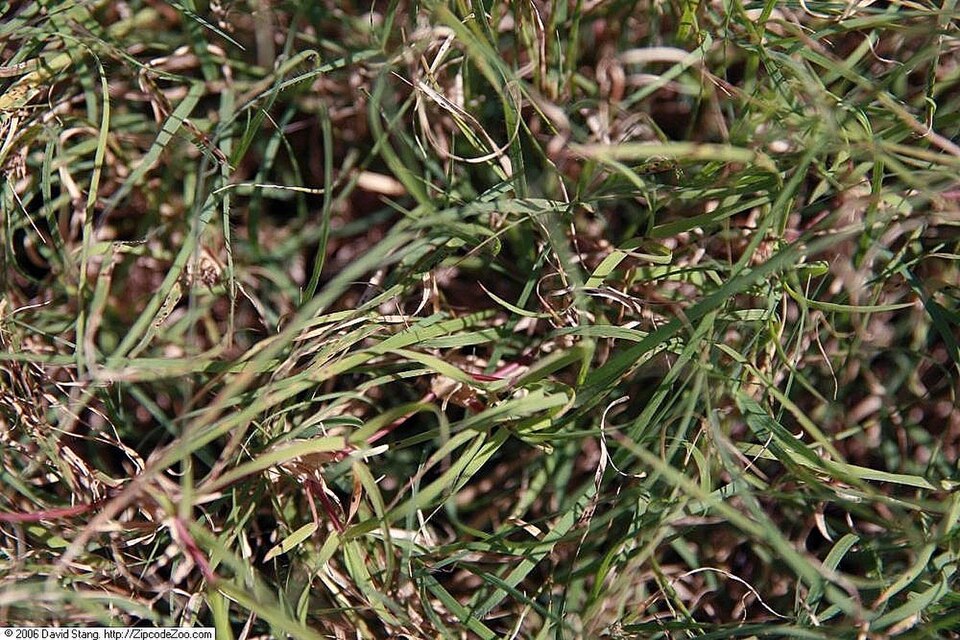
The leaves are narrow, only 1 to 3 mm wide, with a distinctive curling or slightly wavy habit that gives the turf a soft, fine texture. Leaves are gray-green to blue-green in summer, fading to a warm tan-buff color in fall and remaining as attractive dried foliage through winter. The leaf surface is covered with soft, scattered hairs. Internodes are very short on female plants, giving them a compact rosette-like appearance. Stolons — the horizontally running stems — root at nodes and can extend up to 6 feet from the parent plant, creating the characteristic tight sod. The leaf blades may fold or roll inward during dry conditions, a drought adaptation that reduces water loss.
Flowers & Seeds
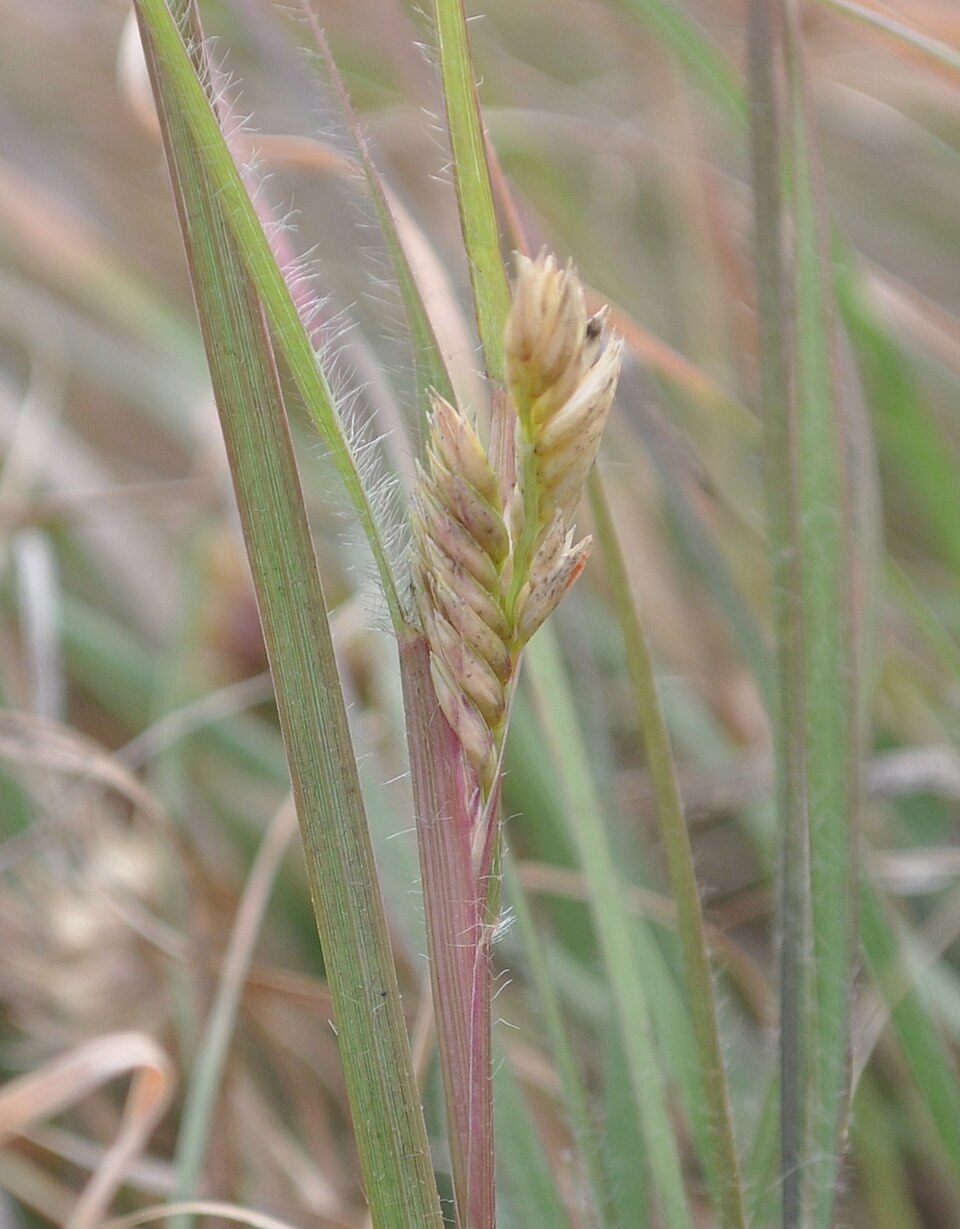
Buffalograss is dioecious: male and female flowers are borne on separate plants. Male plants are taller and produce flag-like seed heads on erect stems 3 to 8 inches tall, with 2 to 3 flag-shaped spikelets containing pollen. Female plants are shorter and more compact, producing inconspicuous bur-like seed heads that remain partially hidden within the foliage, containing 1 to 5 hard, enclosed seeds (burs). Flowering occurs from May through September. The seeds are dispersed by wind, water, and by adhering to animal fur and footwear. Seeds require scarification or cold stratification to overcome dormancy and germinate.
Quick Facts
| Scientific Name | Bouteloua dactyloides (syn. Buchloe dactyloides) |
| Family | Poaceae (Grass) |
| Plant Type | Warm-Season Perennial Turf / Groundcover Grass |
| Mature Height | 4–8 in (sod-forming groundcover) |
| Sun Exposure | Full Sun |
| Water Needs | Low (Drought Tolerant) |
| Bloom Time | May – September |
| Foliage Color | Blue-green (summer); tan-buff (winter dormancy) |
| USDA Hardiness Zones | 3–9 |
Native Range
Buffalograss is native to the Great Plains of North America, ranging from Montana and southern Canada south through the central plains to Texas, New Mexico, and into northern Mexico. Its native range corresponds closely with the historical extent of the shortgrass prairie ecosystem — the drier, rain-shadow grasslands east of the Rocky Mountains that receive 10 to 20 inches of annual precipitation. It is most common in the central and southern Great Plains but extends into the northern plains of Montana and Wyoming, particularly on dry, south-facing slopes and clay flats in the mixed-grass and shortgrass prairie zones.
Within this range, Buffalograss dominates sites with heavy clay soils that crack in dry weather and become waterlogged after rain — conditions that exclude many other grasses but suit Buffalograss perfectly. It thrives in hot, dry summers and cold winters, surviving the extreme temperature swings of continental climates. The species is most abundant between 1,500 and 5,500 feet elevation in the central states but occurs at higher elevations in Wyoming, Colorado, and New Mexico. Its deep root system — reaching 5 or more feet — allows it to access soil moisture well below the surface during drought periods.
Historically, Buffalograss and Blue Grama (Bouteloua gracilis) together comprised the dominant vegetation of the vast shortgrass prairies of the central plains — an ecosystem that covered an estimated 170 million acres and supported the largest terrestrial grazing herds in North American history. The widespread conversion of shortgrass prairie to cropland, especially the dramatic plowing of the late 19th and early 20th centuries, dramatically reduced Buffalograss’s distribution. Today, the species is most common along highway rights-of-way, in native pastures, and on rangeland that escaped conversion to cropland.
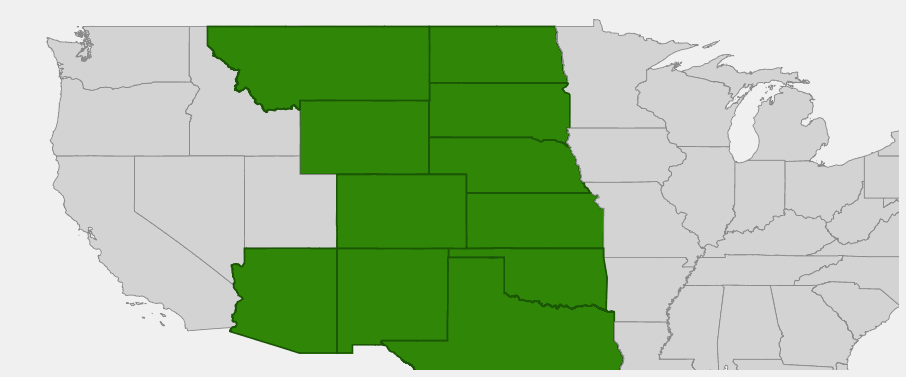
📋 Regional plant lists featuring Buffalograss: Montana & Wyoming
Growing & Care Guide
Buffalograss is one of the most sustainable and low-maintenance turf grasses available for gardens and lawns in the arid and semi-arid western United States. Once established, it needs remarkably little input — no irrigation beyond natural rainfall in most of its range, no fertilizer, and mowing only once or twice a season if at all. The challenge is the establishment phase, which requires patience and weed management during the first one to two seasons.
Light
Buffalograss requires full sun — a minimum of 6 to 8 hours of direct sunlight daily — to form a dense, weed-competitive turf. In shade, it thins out rapidly and is quickly overwhelmed by weedy grasses and broadleaf plants. It is not suitable for shaded areas under trees, north-facing slopes, or the shadow of buildings. For best results, plant in open, sunny exposures where it receives unobstructed sun throughout the growing season.
Soil & Water
Contrary to what many might expect, Buffalograss actually performs best in clay or clay-loam soils — the heavy soils that challenge most lawn grasses. It evolved in the clay-rich soils of the Great Plains and uses the moisture held in those dense soils between rain events. Sandy soils drain too quickly and require more supplemental irrigation. Once established, Buffalograss requires only 10 to 15 inches of annual precipitation — far less than bluegrass (requiring 25+ inches) or fescue lawns. During establishment (first 1–2 years), water weekly to encourage deep root development. After that, irrigation can be greatly reduced or eliminated in most Montana and Wyoming locations.
Planting Tips
Buffalograss can be established from pretreated seed, plugs, or sod. Seeding is most economical but requires the most patience. Plant pretreated (scarified or cold-stratified) seed in late spring after soil warms above 60°F. Standard seed rate is 1 to 2 pounds of pure live seed per 1,000 square feet. Keep the seedbed consistently moist until germination (2 to 4 weeks). Plugs and sod establish faster, producing a dense turf within one season. For best weed competition during establishment, avoid nitrogen fertilization in the first season, as excess nitrogen strongly favors weeds over Buffalograss. Allow the grass to grow to 4 to 6 inches before mowing for the first time to encourage deep root establishment.
Pruning & Maintenance
One of Buffalograss’s greatest virtues is minimal mowing. For a natural, low meadow look, it can be left unmowed entirely, reaching its natural height of 4 to 8 inches. For a more conventional lawn appearance, mow once in late spring and once in midsummer with blades set at 3 to 4 inches — never below 2 inches. Buffalograss requires no fertilization in most native soils. Occasional overseeding of thin or bare areas in late spring helps maintain density. Weed control in the first two years is essential; after establishment, a healthy Buffalograss sod is highly competitive against most weeds under low-fertility, low-moisture conditions.
Landscape Uses
- Low-maintenance native turf lawn — an ideal replacement for bluegrass in dry climates
- Prairie restoration — key component of shortgrass prairie seed mixes
- Erosion control — dense sod holds slopes and embankments against both water and wind erosion
- Roadside and highway plantings — widely used in Great Plains highway revegetation programs
- Parks and public spaces — cultivated varieties provide durable, low-water turf for public areas
Wildlife & Ecological Value
As the dominant grass of the shortgrass prairie, Buffalograss is foundational to the ecology of one of North America’s most threatened and biodiverse grassland ecosystems. It provides critical habitat structure, food resources, and nesting substrate for an extraordinary community of prairie wildlife.
For Mammals
Beyond its historic role as the primary forage grass for the American Bison — which once numbered 30 to 60 million on the Great Plains — Buffalograss is grazed by pronghorn antelope, mule deer, elk, and black-tailed prairie dogs. Prairie dogs, in turn, clip Buffalograss short to maintain clear sightlines and enhance their foraging opportunities, creating a mutualistic relationship of mutual benefit. The “towns” grazed by prairie dogs have some of the densest Buffalograss growth, as the grazing stimulates tillering and the prairie dog digging aerates the soil. Burrowing owls, swift foxes, and black-footed ferrets all depend on prairie dog colonies and the Buffalograss habitat they maintain.
For Birds
The seeds of Buffalograss provide food for horned larks, lark buntings, McCown’s and Chestnut-collared longspurs, Western meadowlarks, and various sparrow species — all characteristic birds of the shortgrass prairie. The short, open structure of Buffalograss turf is the preferred nesting habitat for Mountain Plovers, a federally threatened species that nests only in very short, open grassland. Killdeer also nest in Buffalograss areas, using the open sight-lines to detect approaching predators. The dense sod provides cover for ground-nesting birds and their eggs.
Ecosystem Role
Buffalograss is a foundational ecosystem engineer of the shortgrass prairie. Its deep roots — reaching 5 or more feet into the soil — build soil organic matter, sequester carbon, and improve soil structure and water infiltration over decades. As a warm-season grass, it complements cool-season native grasses, filling the summer growing niche and providing year-round cover and food for prairie wildlife. The dense sod prevents wind and water erosion and filters agricultural runoff, protecting water quality in the streams and ponds of the Great Plains. Without Buffalograss and similar native grasses, the soil health of the Great Plains would be far more vulnerable to the droughts, winds, and floods that characterize the region’s climate.
Cultural & Historical Uses
Buffalograss was one of the most important plants in the material and subsistence cultures of Plains Indian peoples. The seeds were harvested by several nations, including the Lakota, Cheyenne, and Arapaho, and ground into a meal that was mixed with rendered fat and dried meat to make pemmican — a high-calorie, shelf-stable travel food that was fundamental to the nomadic life of Plains peoples. The dried grass was used for stuffing mattresses, pillows, and saddle pads, and for insulating tipis against the bitter cold of Plains winters. Bundles of dried Buffalograss were used in ceremonial and spiritual contexts, and the deep, rich green of Buffalograss in spring was one of the most eagerly anticipated seasonal events in the annual cycle of life on the Great Plains.
European-American settlers quickly recognized the extraordinary utility of Buffalograss sod. The dense, matted root system of Buffalograss created the “sod” that early Plains settlers cut into rectangular bricks to build their famous “soddy” houses — the sod houses that defined frontier prairie architecture across Montana, Wyoming, Nebraska, Kansas, and the Dakotas in the mid-to-late 19th century. Buffalograss sod was the primary building material because it held together without mortar or conventional framing, provided excellent thermal insulation, and was nearly fireproof. Thousands of sod houses were built across the Great Plains, and some survive to this day as historic landmarks.
In the 20th century, Buffalograss found a new role as a sustainable, water-efficient lawn grass alternative. Research programs at Kansas State University, the University of Nebraska, and other institutions developed improved cultivars (including the popular ‘Prairie’, ‘609’, ‘Cody’, and ‘Bowie’ varieties) with enhanced density, uniformity, and cold-hardiness. Today, Buffalograss turf is widely used in low-water-use landscaping programs throughout the western United States, and it has been designated the official state grass of Nebraska. Its use in place of water-intensive Kentucky Bluegrass lawns saves millions of gallons of irrigation water annually across the Great Plains.
Frequently Asked Questions
Why does Buffalograss turn tan in fall and winter?
Buffalograss is a warm-season grass that goes dormant in response to cold temperatures and shorter day lengths in fall. As dormancy begins, the chlorophyll breaks down and the foliage fades to a warm tan-buff color. This is completely normal — the grass remains alive under the soil through winter and greens up again in late spring when soil temperatures warm above 60°F.
Can Buffalograss replace my bluegrass lawn in Wyoming or Montana?
Yes, it can — particularly in sunny areas with clay or loamy soils. Buffalograss will use far less water, require no fertilization, and need mowing only once or twice a season compared to 10 to 20 times for bluegrass. However, it won’t green up as early in spring, stays tan through winter, and requires careful weed management during establishment. It’s best suited for low-maintenance functional turf rather than manicured formal lawns.
How do I control weeds in my Buffalograss lawn during establishment?
During establishment (first 1–2 years), weeds are the biggest challenge. Hand-weeding and spot treatment with selective herbicides are the most practical approaches. Avoid pre-emergent herbicides in the first season as they can inhibit Buffalograss establishment. Once a dense Buffalograss sod is established, its competitive advantage under low-fertility, low-moisture conditions makes it highly resistant to most weed invasion.
Does Buffalograss need fertilizer?
Rarely, if ever. Fertilizing Buffalograss is often counterproductive — in high-fertility soils, cool-season weeds and invasive grasses outcompete it. The grass evolved in nutrient-poor, unamended soils and is perfectly adapted to grow without fertilizer inputs. If soil tests show extreme deficiency, a very light application of slow-release organic fertilizer in late spring (when the grass is actively growing) is acceptable.
What is the difference between Buffalograss and Blue Grama grass?
Both are native shortgrass prairie grasses with similar drought tolerance and ecological value. Buffalograss (Bouteloua dactyloides) spreads by stolons and rhizomes to form a dense sod — ideal for turf applications. Blue Grama (Bouteloua gracilis) is a bunchgrass growing in distinct clumps — better suited for naturalistic prairie plantings and seed mixes. Both are excellent native grasses, and they commonly grow together in natural shortgrass prairie communities across Montana and Wyoming.