Cassine Holly (Ilex cassine)
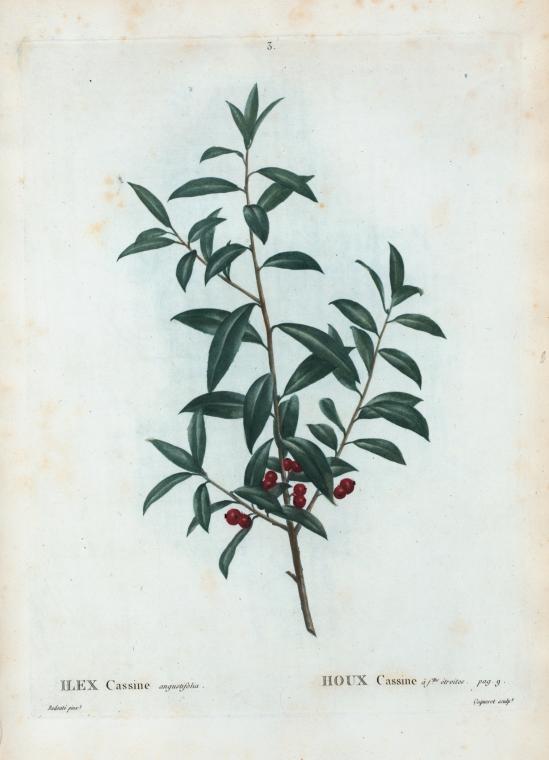
Ilex cassine, commonly known as Cassine Holly or Dahoon Holly, is one of the most ornamentally striking and ecologically generous of the southeastern native hollies. Unlike its upland relative American Holly (Ilex opaca), Cassine Holly is a wetland specialist — a graceful evergreen shrub or small tree that thrives in saturated soils, pocosins, bay swamps, and the edges of coastal ponds from Virginia to Texas. In fall and winter, the branches become laden with abundant clusters of reddish-orange to scarlet drupes that persist well into winter, creating a stunning spectacle against the dark green foliage and drawing flocks of fruit-eating birds for weeks on end.
Growing naturally along the Atlantic and Gulf coastal plains, Cassine Holly is an understory tree that rarely exceeds 30 feet in height and often grows as a large, multi-stemmed shrub in the wild. Its narrow, elliptical leaves are dark and glossy above — far less spiny than American Holly — giving it a refined, elegant appearance in the landscape. The plant is dioecious, meaning male and female flowers are borne on separate plants; for reliable fruit production, at least one male plant is needed near female plants. In cultivation, Cassine Holly is an outstanding choice for wet or seasonally flooded areas, rain gardens, streamside plantings, and coastal landscapes where its tolerance for wet feet and salt spray is unmatched among hollies.
The species was historically known by the name “cassine” or “cas’sine” from Algonquian or related Indigenous languages of the southeastern coast. It is closely related to Dahoon (Ilex cassine var. myrtifolia), which some botanists treat as a separate species. Cassine Holly is one of the few hollies that thrives in nearly flooded conditions, making it an invaluable tool for native plant gardeners working with challenging, wet landscapes throughout the southeastern United States.
Identification
Cassine Holly is an evergreen small tree or large shrub typically reaching 15 to 30 feet tall, sometimes taller in ideal conditions. In the wild, it often grows as a multi-stemmed clump in dense wetland thickets; in cultivation it can be trained into a single-trunked tree. Young plants have smooth, grayish-brown bark that develops faint furrows and a slightly rougher texture with age. The overall form is upright to irregularly spreading, with slender branches that droop slightly at the tips when loaded with fruit.
Bark & Stems
The bark is thin and smooth when young, grayish-brown to light gray, with small lenticels visible on the surface. Older trunks develop shallow, irregular furrows. Twigs are slender, pubescent (finely hairy) when young, turning glabrous and gray-brown with age. The inner bark has a faintly greenish tint when freshly cut. Unlike many trees, Cassine Holly’s stems do not bear the stiff spines sometimes found on young American Holly foliage.
Leaves
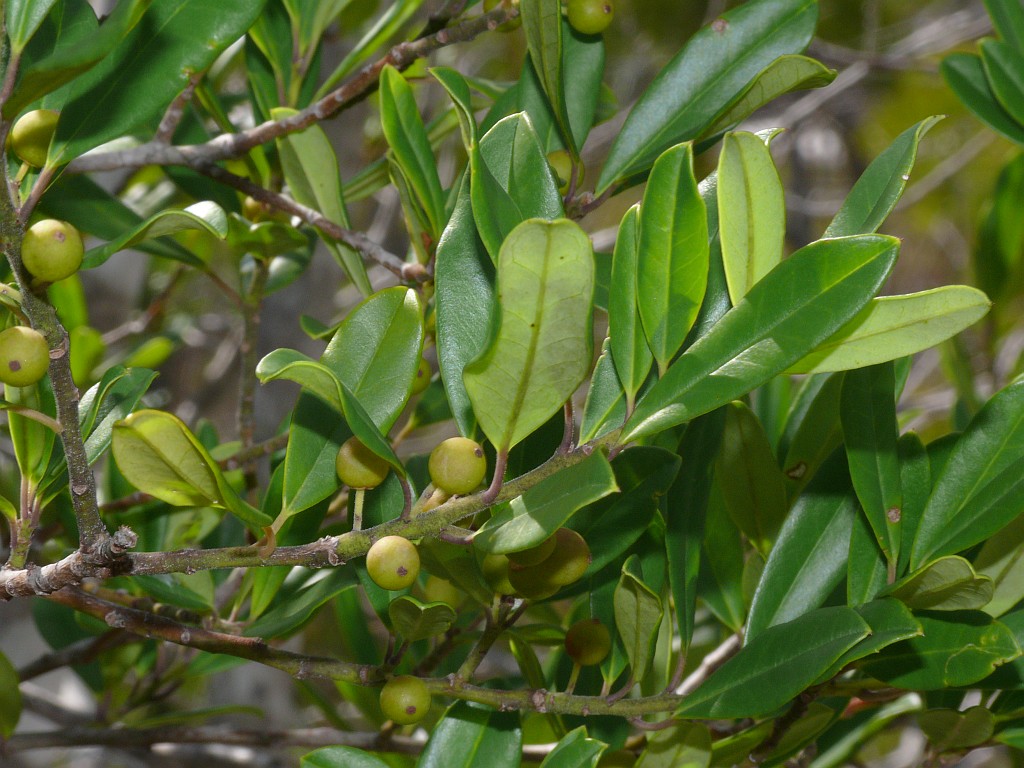
The leaves are simple, alternate, and persistent — remaining on the tree year-round. Each leaf is narrowly elliptic to oblong, 2 to 5 inches (5–13 cm) long and ¾ to 1½ inches (2–4 cm) wide. The leaf margins are minutely serrate to nearly entire (far less spiny than American Holly), and the texture is firm and leathery. The upper surface is dark, glossy green; the underside is lighter green and may be finely hairy along the midvein. The leaf tip is pointed to rounded, and the base is wedge-shaped. In coastal populations, leaves tend to be narrower and more elongate than in inland ones.
Flowers & Fruit
The small white flowers are produced in clusters (cymes) from the leaf axils from March through May. Individual flowers are only about ¼ inch (6 mm) across, with 4 to 5 white petals, and are fragrant enough to attract numerous native bees, wasps, and small butterflies. Because the plant is dioecious — male and female flowers on separate individual plants — both sexes must be planted in proximity for fruit production. Male flowers are more numerous per cluster; female flowers develop the characteristic round drupes.
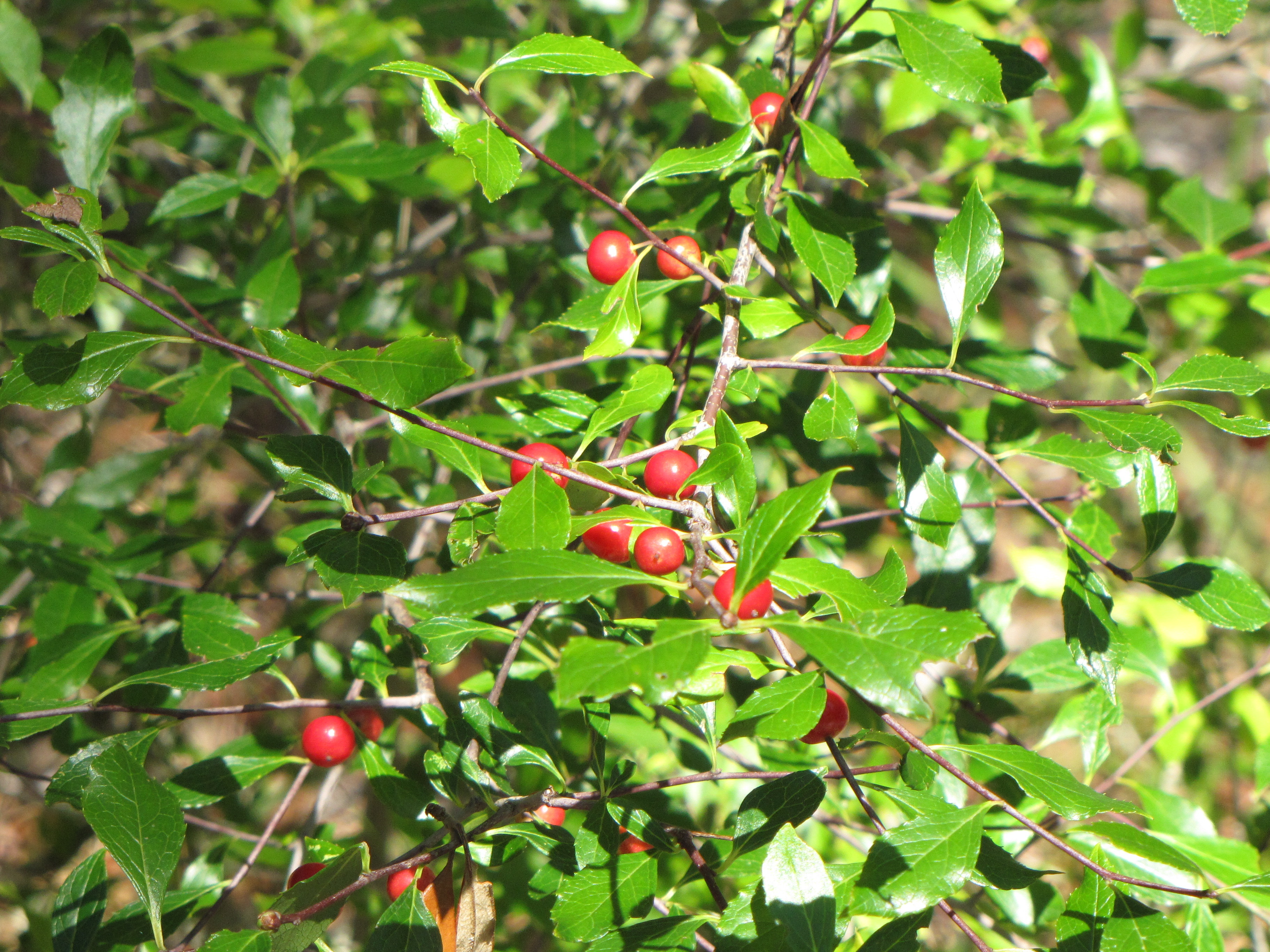
The fruit is a round to slightly ovoid drupe, about ¼ inch (6–8 mm) in diameter, ripening from green to vivid reddish-orange or scarlet in September through November. The drupes are borne in dense clusters along the branches and persist into winter or early spring if not consumed by birds. Each drupe contains 4 (sometimes 3–5) smooth, ribbed nutlets. The fruit provides critical winter nutrition for migratory and resident birds throughout the southeastern coastal plain.
Quick Facts
| Scientific Name | Ilex cassine |
| Family | Aquifoliaceae (Holly) |
| Plant Type | Evergreen Shrub / Small Tree |
| Mature Height | 30 ft |
| Sun Exposure | Full Sun to Part Shade |
| Water Needs | Moderate to High |
| Bloom Time | March – May |
| Flower Color | White |
| USDA Hardiness Zones | 7–10 |
Native Range
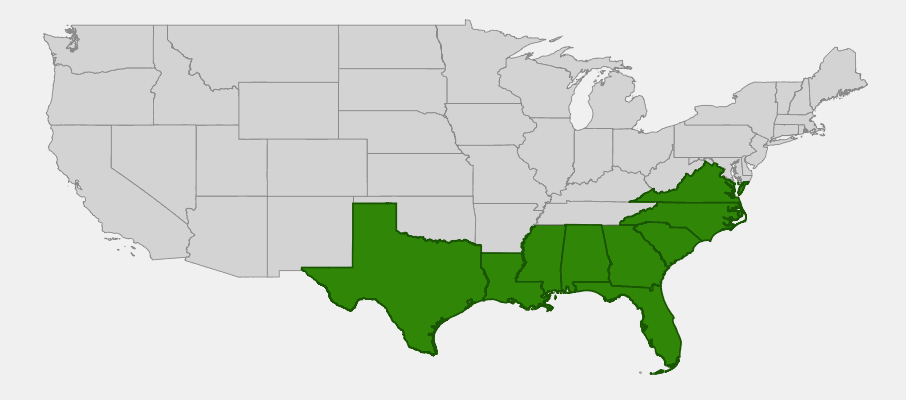
Cassine Holly is native to the Atlantic and Gulf coastal plains of the southeastern United States, ranging from southeastern Virginia south through the Carolinas, Georgia, and all of Florida, then west along the Gulf Coast through Alabama, Mississippi, Louisiana, and into coastal Texas. It is most abundant in the poorly drained flatwoods, bay swamps, pocosins, and pond margins of the Outer Coastal Plain and is rarely found far from the influence of year-round or seasonally high water tables.
Throughout its range, Cassine Holly is strongly associated with the wetland plant communities of the southeastern coastal plain — the dense pocosins of North and South Carolina, the blackwater bay forests of Georgia and Florida, and the cypress-gum swamps of the Gulf states. It is particularly abundant in Florida, where it occurs in nearly every county and commonly forms dense thickets along the margins of blackwater rivers, cypress domes, and coastal hammocks. In Texas, it is restricted to the Gulf Coast and Pineywoods regions.
Like many coastal plain endemics, Cassine Holly’s range has contracted somewhat due to wetland drainage and coastal development, but it remains common where suitable wet habitats persist. Its tolerance for brackish soils and salt spray gives it a competitive advantage in coastal scrub and salt-influenced habitats where other hollies cannot survive. It is often one of the first shrubs to colonize the edges of newly formed wetland retention basins and restored coastal marshes, demonstrating its ecological resilience.
📋 Regional plant lists featuring Cassine Holly: Alabama, Georgia & Mississippi
Growing & Care Guide
Cassine Holly is one of the most adaptable and low-maintenance native shrubs for wet southeastern landscapes. Once established, it requires minimal intervention and rewards the gardener with year-round evergreen beauty and exceptional wildlife value.
Light
Cassine Holly grows best in full sun to part shade. In full sun, it develops the densest branching and heaviest fruit production — important if you want maximum wildlife attraction. In part shade, the plant grows more openly but still fruits reliably as long as sufficient light reaches the canopy. Deep shade significantly reduces fruiting and can cause sparse, leggy growth. This plant is well suited to the dappled light of open woodland edges, where it naturally occurs along the margins of cypress swamps and bay forests.
Soil & Water
This species is specifically adapted to wet, poorly drained soils and is one of the best choices for wet spots in the native garden. It tolerates standing water for extended periods — even several weeks of flooding — and also performs reasonably well in average moisture conditions once established. The ideal soil is acidic (pH 4.5–6.5), peaty, or sandy with organic matter. Cassine Holly does not thrive in alkaline or highly compacted clay soils, and it dislikes excessively dry upland conditions. It naturally occurs in saturated, oxygen-poor soils that would kill most other trees — a remarkable adaptation to its coastal plain wetland habitat.
Planting Tips
Plant Cassine Holly in fall or early spring. To ensure fruit production, plant at least one male plant within 50–100 feet of female plants. Nurseries sometimes sell sexed plants; if not, plant 3–5 together and at least one will likely be male. Space plants 8–12 feet apart for a naturalistic screen or thicket planting. For rain gardens and bioswales, Cassine Holly can be planted at the margins and even in the bottom of basins that flood seasonally. Mulching with pine bark or leaf litter will help maintain soil acidity and moisture retention.
Pruning & Maintenance
Cassine Holly is naturally dense and well-shaped and needs very little pruning. Remove dead or crossing branches in late winter if desired. To maintain a tree form, gradually remove lower branches over several seasons to reveal the trunk. The plant can be lightly sheared to maintain a more formal shape, though this will reduce fruiting. Cassine Holly is generally free of serious pest and disease issues, though it can occasionally be affected by holly leafminer and scale insects — issues that are usually cosmetic and do not require intervention in healthy plants.
Landscape Uses
Cassine Holly excels in a wide range of wet-site landscape applications:
- Rain gardens and bioswales — tolerates extended periods of standing water
- Stormwater management areas — one of the best native shrubs for wet retention basins
- Streamside and pond-edge plantings — stabilizes banks and provides winter fruit
- Coastal landscapes — tolerates salt spray and brackish soil conditions
- Wildlife gardens — prolific fruit attracts dozens of bird species through winter
- Screening and hedgerow — evergreen, dense, and effective as a visual barrier
- Restoration plantings — excellent for restoring coastal wetland margins
Wildlife & Ecological Value
Cassine Holly is one of the premier fruit-bearing shrubs of the southeastern coastal plain. Its abundant, persistent reddish-orange drupes provide critical nutrition during fall and winter, when few other food sources are available. The plant supports a rich web of wildlife interactions across multiple seasons.
For Birds
The fruit of Cassine Holly is consumed by an impressive array of bird species, including American Robin, Hermit Thrush, Cedar Waxwing, Northern Mockingbird, Gray Catbird, Yellow-rumped Warbler, Eastern Bluebird, Swainson’s Thrush, and numerous sparrow species. The berries are particularly important for wintering and migrating songbirds along the Atlantic and Gulf Coast flyways, where Cassine Holly thickets can become magnets for mixed flocks of fruit-eating birds during fall migration. Neotropical migrants stopping over in coastal scrub and hammock habitats depend heavily on holly berries to fuel their journeys. In addition to the fruit, the dense branching structure provides excellent protective cover and nesting sites for Carolina Wrens, Yellow Warblers, and other shrub-nesting species.
For Mammals
Raccoons, opossums, Eastern Gray Squirrels, and White-tailed Deer consume the fruit of Cassine Holly. Deer browse the foliage, particularly in winter when other food is scarce. In Florida, Cassine Holly thickets provide important refuge and foraging habitat for many small mammals in coastal scrub and flatwood communities. Black Bears in the Southeast also consume holly berries as part of their fall fat-building hyperphagia.
For Pollinators
The small white flowers of Cassine Holly bloom in spring and provide nectar and pollen for a variety of native bees, including solitary bees in the genera Andrena, Halictus, and Lasioglossum. Honeybees also visit the flowers. Holly flowers are not showy but are fragrant, attracting a range of beneficial insects including small wasps and flies that serve as secondary pollinators. The spring flowering period coincides with the peak activity of many early-season native bee species.
Ecosystem Role
As one of the dominant shrubs of southeastern pocosins and bay swamps, Cassine Holly plays a fundamental structural role in these ecosystems. It provides year-round canopy cover in otherwise open wetland systems, creates mid-story habitat complexity, and its dense thickets serve as thermal refugia for wildlife in winter. The plant’s fruit subsidizes bird and mammal populations through the nutritionally sparse winter months, and its seeds — dispersed by birds — help spread the species across the coastal landscape. Cassine Holly is also important for erosion control at wetland edges, where its dense root systems help stabilize saturated soils along streambanks and pond margins.
Cultural & Historical Uses
Cassine Holly has a long history of human use along the southeastern coastal plain. Indigenous peoples of the region, including various Algonquian-speaking nations of the Virginia and Carolina coasts, used the plant’s leaves and branches as material for decorative and ceremonial purposes. The berries, while mildly toxic to humans (containing ilicin and theobromine-like compounds that can cause nausea and vomiting if consumed in quantity), were not used as a primary food source, though small amounts may have been consumed medicinally in some traditions.
The most historically significant use of plants in the genus Ilex in the southeastern region involves a close relative, Ilex vomitoria (Yaupon Holly), whose leaves contain caffeine and were widely used by southeastern Indigenous peoples to brew the “Black Drink” — a ritualized caffeinated beverage consumed in purification ceremonies. While Cassine Holly was not the primary species used for this purpose, it grew alongside Yaupon Holly in many coastal habitats and was sometimes confused with it by early European botanists. The name “cassine” itself entered the scientific literature partly through this complex historical tangle of southeastern holly species.
European colonizers and botanists of the 17th and 18th centuries were deeply interested in the southeastern hollies, and Cassine Holly was among the first North American ornamental plants introduced to European gardens. Its striking winter fruit display made it attractive to English and Dutch gardeners who admired its aesthetic qualities. The plant was grown in the Chelsea Physic Garden in London and other botanical gardens by the early 18th century. Today, Cassine Holly is valued primarily as an ornamental and ecological plant in native landscaping, rain garden design, and coastal restoration projects. Its wood, though small in diameter, is dense and fine-grained and has been used locally for small woodworking projects, but it has never been commercially significant as a timber species.
In contemporary horticulture, Cassine Holly has seen a resurgence of interest as native plant gardening has grown in popularity across the Southeast. It is increasingly used in stormwater management projects, coastal restoration, and wildlife habitat plantings, where its combination of wet-site tolerance, evergreen beauty, and exceptional fruit production makes it one of the most practical and appealing native shrubs available.
Frequently Asked Questions
Is Cassine Holly the same as Dahoon Holly?
These names are often used interchangeably, but botanists sometimes treat them as distinct varieties. True Cassine Holly (Ilex cassine) typically has broader, less spiny leaves, while Dahoon Holly (I. cassine var. myrtifolia or I. myrtifolia) has narrower, more myrtle-like leaves. Both grow in similar wetland habitats and are equally valuable in the landscape. Most nurseries sell plants simply as ‘Cassine Holly’ or ‘Dahoon Holly’ without distinguishing between the two.
Do I need both male and female plants to get berries?
Yes — Cassine Holly is dioecious, meaning male and female flowers are borne on separate plants. Only female plants produce fruit. For reliable berry production, plant at least one male plant within 50–100 feet of your female plants. Some nurseries sell named female cultivars with a nearby male pollinator, which takes the guesswork out of selection. If you buy plants of unknown sex, planting 3 or more together usually ensures at least one male.
Can Cassine Holly grow in standing water?
Yes — it is one of the best native shrubs for consistently wet and seasonally flooded areas. In its natural habitat it grows in pocosins and bay swamps that are waterlogged for much of the year. It tolerates several weeks of standing water without significant stress, making it an excellent choice for rain gardens, retention basins, and pond margins. However, it also performs well in average-moisture garden soils once established.
Are Cassine Holly berries poisonous?
Yes — the berries are mildly toxic to humans and should not be eaten. They contain ilicin and other compounds that can cause nausea, vomiting, and diarrhea if consumed in quantity. However, the berries are completely safe and highly nutritious for birds, which can metabolize the compounds without harm. Keep the berries away from small children and pets.
How fast does Cassine Holly grow?
Cassine Holly has a moderate growth rate, typically adding 1–2 feet per year under good conditions — consistent moisture, adequate sun, and acidic soil. Growth is fastest during the warm, wet months of spring and early summer. In ideal wetland conditions, young plants can grow faster; in drier upland sites, growth slows. The plant reaches its mature height of 15–30 feet over 10–20 years depending on conditions.

Looking for a nursery that carries Cassine Holly?
Browse our native plant nursery directory: Alabama · Georgia · Mississippi