Common Milkweed (Asclepias syriaca)
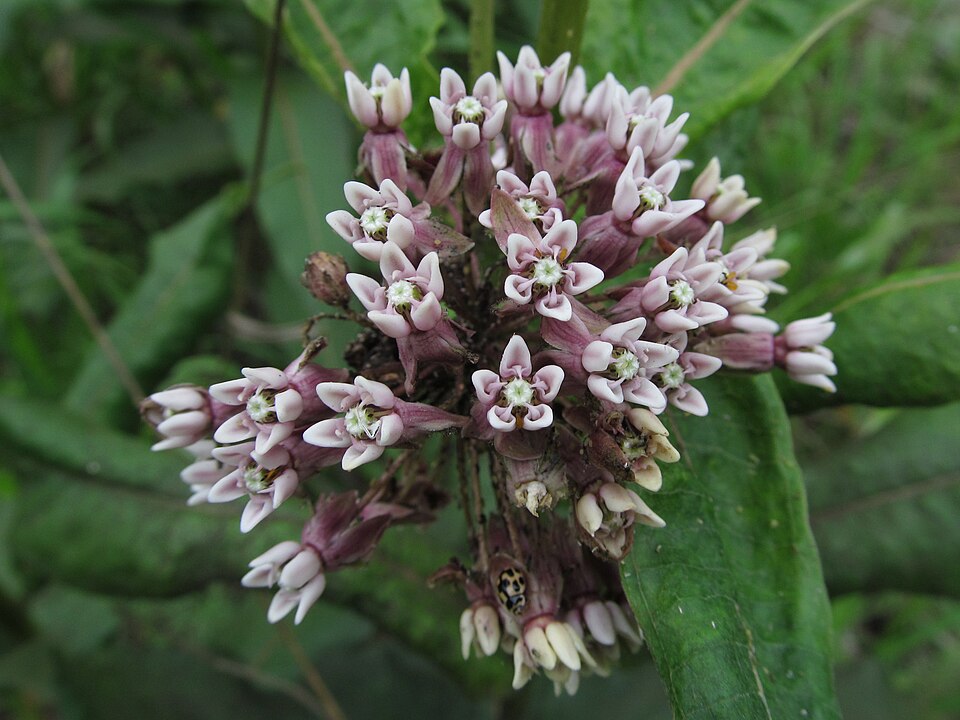
Asclepias syriaca, commonly known as Common Milkweed, is arguably the most ecologically important native wildflower in North America’s eastern and central regions. A member of the Apocynaceae family (formerly Asclepiadaceae), this native perennial herb produces large, spherical clusters of remarkably fragrant pink-to-mauve flowers that bloom from June through August, filling the summer air with a heady, sweet perfume rivaling that of any garden flower. Far beyond its beauty and fragrance, however, Common Milkweed holds irreplaceable importance as the sole larval food source for the iconic Monarch butterfly (Danaus plexippus), whose catastrophic population decline over the past two decades is directly linked to the widespread loss of milkweed across the American landscape.
Growing 2 to 4 feet tall from a deep, spreading rhizome system, Common Milkweed colonizes disturbed areas, roadsides, old fields, and prairie remnants throughout its range, often forming large, spreading colonies. Its broad, oval leaves and sturdy stems are filled with the thick white latex (milky sap) that gives the plant and the entire genus its common name. This sap contains toxic cardiac glycosides that Monarch caterpillars sequester into their tissues, making both caterpillar and adult butterfly unpalatable to predators — one of the most elegant and well-studied examples of co-evolution in North American ecology. Without milkweed, there are no Monarchs.
Beyond its role as Monarch host plant, Common Milkweed serves as a critical nectar plant for scores of native bee species, wasps, beetles, flies, and butterflies. Its large seed pods, which split open in autumn to release hundreds of silky-plumed seeds carried by wind, are themselves an engineering marvel. The plant is a linchpin of the eastern tallgrass prairie and open-land ecosystems, and restoring it to gardens, farms, and roadsides is one of the highest-impact conservation actions an Indiana or Ohio landowner can take.
Identification
Common Milkweed is a robust, erect perennial herb reaching 2 to 4 feet (sometimes up to 5 feet) tall. The plant has a distinctive overall appearance: stout reddish-green stems, large opposite leaves, and spherical clusters of pink flowers. When any part of the plant is broken, the white milky latex oozes freely — a definitive identification feature.
Leaves
The leaves are large, simple, opposite (or occasionally whorled), and arranged in pairs along the stem. Each leaf is broadly oval to oblong, 4–8 inches (10–20 cm) long and 2–4 inches (5–10 cm) wide, with a short petiole. Leaf surfaces are smooth and somewhat waxy above, paler and softly hairy (pubescent) beneath, with a prominent pale midrib. The leaf margins are entire (untoothed). In autumn, leaves turn yellow before dropping. Young leaves emerging from the rhizomes in spring are reddish-tinged and quite tender.
Flowers & Fruit
The flowers are extraordinary in structure — complex and highly specialized for insect pollination in a system unique to the milkweed family. Individual flowers are tiny but numerous, arranged in large, rounded to slightly drooping umbel clusters (cymes) at the stem tips and upper leaf axils. Each spherical cluster may contain 20–130 individual flowers. The five petals are reflexed (bent backward), typically pink to pinkish-mauve in color; above them rise five pink hooded structures (hoods) enclosing a central column. The flowers emit an intensely sweet fragrance, particularly noticeable in warm afternoon sun, which is detectable from many feet away.
Following pollination, only a fraction of flowers produce fruit — large, warty seed pods (follicles) 3–5 inches long with a rough, bumpy surface. The pods are green through summer, turning tan and woody by fall. When ripe, they split along one seam to release numerous flat, brown seeds, each attached to a long, silky white plume (coma) that carries the seed aloft on the wind. A single pod may contain 200+ seeds.
Stems & Root System
Stems are stout, smooth to finely hairy, and typically unbranched or sparingly branched, erect and sturdy. The root system consists of a deep, fleshy taproot and spreading horizontal rhizomes that enable the plant to form large colonies. This underground rhizome network makes the plant both persistent and somewhat difficult to eradicate once established — a feature that is beneficial in naturalized settings but requires consideration in small formal gardens.
Quick Facts
| Scientific Name | Asclepias syriaca |
| Family | Apocynaceae (Dogbane / Milkweed) |
| Plant Type | Native perennial wildflower / Monarch butterfly host plant |
| Mature Height | 2–4 ft |
| Sun Exposure | Full Sun to Part Shade |
| Water Needs | Moderate |
| Bloom Time | June – August |
| Flower Color | Pink to pinkish-mauve |
| Fragrance | Intensely sweet (one of the most fragrant native wildflowers) |
| Wildlife Value | Essential Monarch host; major pollinator nectar plant |
| USDA Hardiness Zones | 3–9 |
Native Range
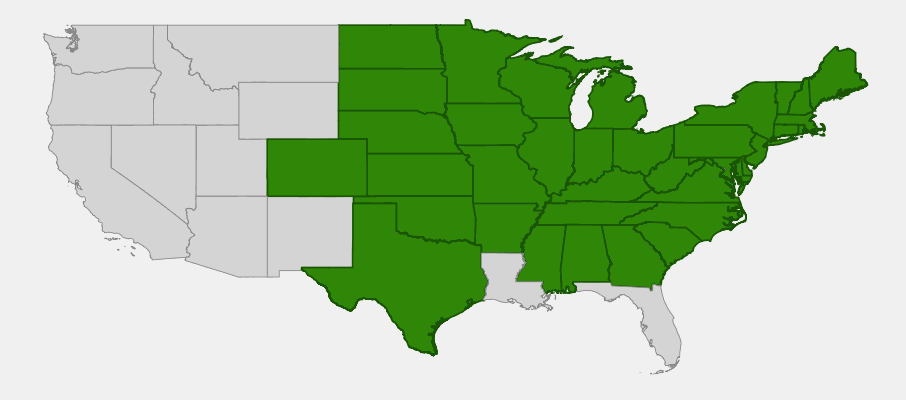
Common Milkweed is native to a broad range encompassing most of the eastern and central United States, extending from the Atlantic coast westward to the Great Plains states of Kansas, Nebraska, and South Dakota, and from southern Canada south to the Gulf Coast. The species reaches peak abundance in the tallgrass prairie region — the Midwest states of Indiana, Ohio, Illinois, Iowa, Missouri, and Wisconsin — where it historically thrived in prairies, savannas, and open woodlands before widespread agricultural conversion reduced its populations.
In Indiana and Ohio, Common Milkweed was once abundant in every county, growing in prairies, pastures, roadsides, fencerows, and old fields. Agricultural herbicide use — particularly the adoption of herbicide-tolerant GMO crops beginning in the late 1990s — dramatically reduced milkweed populations across the Corn Belt, contributing to the 90% decline in Monarch butterfly populations documented since 1990. Restoring milkweed to gardens, farm margins, and managed meadows in Indiana and Ohio is a critical conservation priority.
The species thrives in a wide range of habitats within its range: tallgrass prairie, old fields and pastures, roadsides, power line rights-of-way, woodland edges, and disturbed ground. It is most productive in full sun with average to moist, loamy soil, but adapts to a wide range of conditions from sandy dry soils to heavier clay. In natural settings, it forms large, spreading colonies from its rhizome system.
📋 Regional plant lists featuring Common Milkweed: Indiana & Ohio
Growing & Care Guide
Common Milkweed is one of the most rewarding native plants to grow for both beauty and wildlife value, though it requires some planning given its spreading habit. Once established, it is essentially permanent and self-sustaining.
Light
Common Milkweed performs best in full sun — it produces its most abundant flowers, strongest stems, and most attractive foliage in at least 6 hours of direct sunlight daily. It will tolerate part shade (3–6 hours of sun), but in shadier conditions plants tend to be taller, leggier, and produce fewer flowers. For Monarch butterfly purposes — both for caterpillar habitat and adult nectaring — a sunny, open location is strongly preferred.
Soil & Water
Common Milkweed grows in a remarkably wide range of soil types: sandy, loamy, or clay soils of average fertility are all acceptable. It prefers well-drained to moderately moist soils and should not be planted in areas with poor drainage or chronic wetness. Its deep root system makes it drought-tolerant once established, though young plants benefit from regular watering in their first year. Avoid overly rich, heavily amended soils, which produce excessive vegetative growth at the expense of flowers.
Planting Tips
Common Milkweed is notoriously difficult to transplant due to its deep taproot — container-grown plants established early in the season (before the taproot deepens) transplant best. Direct seeding is often more reliable: sow seeds in fall (the seeds require cold stratification to germinate) or stratify seeds in moist peat in the refrigerator for 30 days before spring sowing. Space plants or groups 18–24 inches apart and be prepared for the colony to slowly expand over the years. The plant emerges quite late in spring — don’t give up if nothing appears until late May or even June. It can take 2–3 years to reach flowering size from seed.
Managing Spread
Common Milkweed spreads by underground rhizomes and can form large colonies over time. In a meadow or naturalized garden, this is desirable — larger milkweed patches support more Monarchs. In smaller gardens, control spreading by cutting off rhizomes at the colony edge each spring with a sharp spade, or by growing the plant in a large buried container to restrict root spread. Removing seed pods before they open can reduce self-seeding.
Landscape Uses
- Monarch Waystation gardens — register your milkweed planting at journey north to support migration
- Meadow and prairie plantings — essential foundation species for any Midwest native meadow
- Pollinator gardens — unmatched for total wildlife value in the summer landscape
- Farm buffer strips and fencerows — excellent for restoring Monarch habitat on agricultural land
- Roadside restoration — highly adaptable to highway and roadside plantings
Wildlife & Ecological Value
Common Milkweed provides more concentrated wildlife value per square foot than almost any other plant in the eastern North American flora. It is a keystone species in the truest sense — its presence or absence cascades through entire communities of dependent organisms.
For Monarch Butterflies
Asclepias syriaca is the primary host plant of the Monarch butterfly (Danaus plexippus) throughout the eastern migratory population’s breeding range. Female Monarchs lay their eggs exclusively on milkweed foliage; the caterpillars eat only milkweed leaves, sequestering the plants’ cardiac glycosides (toxic compounds) into their bodies as a chemical defense against predators. Without milkweed, Monarchs cannot reproduce. The eastern Monarch population — which overwinters in Mexico and breeds across the eastern US and Canada — has declined approximately 90% since 1990, largely due to loss of milkweed from herbicide use. Planting Common Milkweed in Indiana and Ohio is one of the most direct and impactful actions anyone can take for Monarch conservation.
For Pollinators
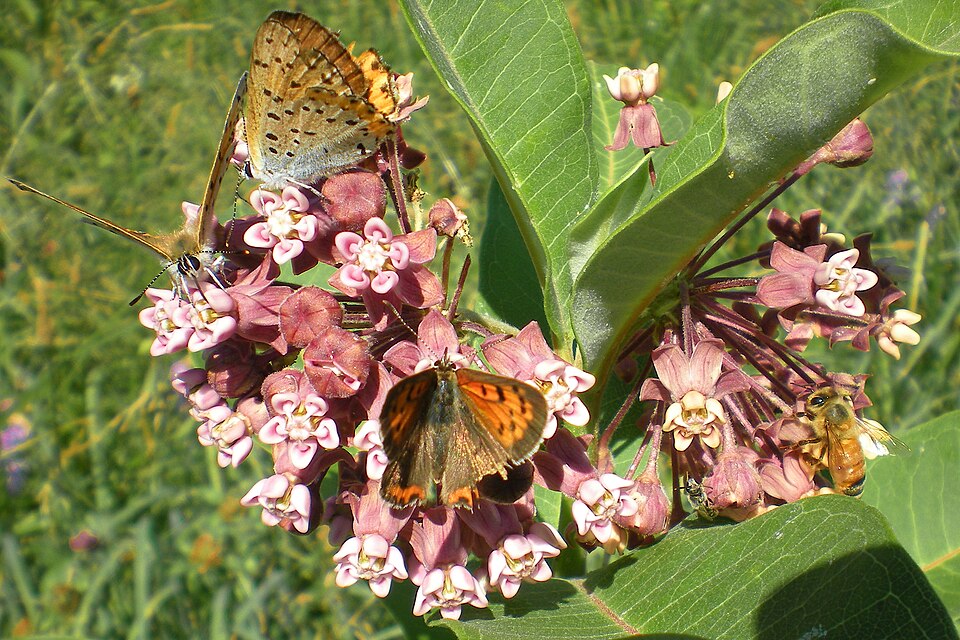
Common Milkweed flowers are a magnet for pollinators. Their concentrated nectar and complex flower structure require some insect strength and dexterity to access — selecting for larger, stronger bee species. Bumble bees (Bombus spp.) are primary pollinators. The flowers also attract numerous butterfly species beyond Monarchs — Eastern Tiger Swallowtails, Spicebush Swallowtails, Great Spangled Fritillaries, Red-spotted Purples, and many others nectar heavily on milkweed blooms. Native wasps, beetles, and flies round out the diverse visitor community. Honeybees also visit regularly.
For Birds
The silky seed fibers (coma) from milkweed pods are used by Baltimore Orioles, American Goldfinches, and other birds as nesting material — one of the finest natural fibers available to birds for weaving. The hollow dried stems are used by native cavity-nesting insects that in turn feed birds. Milkweed bugs and beetles that feed on the plant are eaten by various insectivorous birds.
Ecosystem Role
Common Milkweed is an ecological foundation species in the tallgrass prairie and open-land ecosystems of the Midwest. As a highly productive plant that forms dense colonies, it produces enormous quantities of plant biomass, nectar, pollen, and seeds that sustain food webs at multiple levels — from specialist milkweed insects to the birds that eat them, to the Monarchs that depend on it for survival. Its late-season seed dispersal by wind contributes to the colonization of disturbed and open habitats, and its deep rhizome system builds and stabilizes soil.
Cultural & Historical Uses
Common Milkweed has one of the most extensive ethnobotanical records of any eastern North American plant, having been used by dozens of Indigenous nations for food, medicine, fiber, and ceremony. The young shoots of Common Milkweed, emerging in spring, were boiled and eaten as a vegetable by the Iroquois, Potawatomi, Ojibwe, and many other nations — they are said to taste like asparagus when properly prepared. Young flower buds were boiled and eaten as a cooked vegetable, and the flowers themselves were used to make a sweet syrup by boiling them. The young unripe pods were cooked and eaten like okra.
Medicinally, Common Milkweed was used by numerous Indigenous nations for a wide range of purposes. The Iroquois used a root tea to treat kidney ailments and as a contraceptive. The Ojibwe used root preparations to treat swellings and rheumatism. The Potawatomi used the plant in treatments for warts. The milky latex was applied topically to warts and skin conditions by various groups. Early European settlers learned milkweed’s edible properties from Indigenous peoples and incorporated it into their own foodways, and it was occasionally listed in early American materia medica (medical reference texts) as a diuretic and mild expectorant.
During World War II, Common Milkweed had a brief moment of industrial importance: the silky seed fibers (coma) were harvested by the ton as a substitute for kapok, used as fill in life jackets and flight suits when Asian kapok supplies were cut off by the war. American schoolchildren participated in organized milkweed pod collection drives. The fibers proved excellent for this purpose — they are naturally hydrophobic and have good insulating properties. The USDA estimated that 1.5 to 2 pounds of milkweed floss could fill one life jacket. Today, milkweed fiber is experiencing a revival as a sustainable alternative to down insulation in sleeping bags and outdoor gear.
Frequently Asked Questions
Is Common Milkweed toxic to humans or pets?
Yes — all parts contain toxic cardiac glycosides and should not be eaten raw. However, the young shoots and flower buds are safely edible when properly cooked (boiled in multiple changes of water). Wear gloves when handling the milky sap, as it can cause skin irritation in sensitive individuals. Keep pets away from large quantities of the plant.
Will Common Milkweed take over my garden?
It can spread vigorously by underground rhizomes. In a formal garden, manage spreading by cutting the colony edge each spring with a spade. In a meadow or naturalized garden, the spreading habit is beneficial and provides more Monarch habitat. The plant does not self-seed as aggressively as some natives, since seed pods are often harvested by birds or the seeds fail to find suitable germination sites in established plantings.
When does Common Milkweed emerge in spring?
Very late — often not until late May or even mid-June in Indiana and Ohio. This is normal; don’t assume the plant has died. Mark the location to avoid accidentally digging it up. The late emergence is an adaptation to frost risk in its northern range.
How long before Common Milkweed flowers from seed?
Typically 2–3 years from seed to first flowering. The plant spends its first year or two building up its root system. Container-grown plants from nurseries typically flower in their first or second year after transplanting.
Do I need to plant milkweed specifically for Monarchs?
Yes — Monarchs can only breed on milkweed. While tropical milkweed (A. curassavica) is available at many garden centers, native species like A. syriaca are strongly preferred because they die back naturally in winter, which aligns with the Monarch’s migration cycle. Non-native evergreen milkweed may interfere with migration behavior.