Cut-leaf Anemone (Anemone multifida)
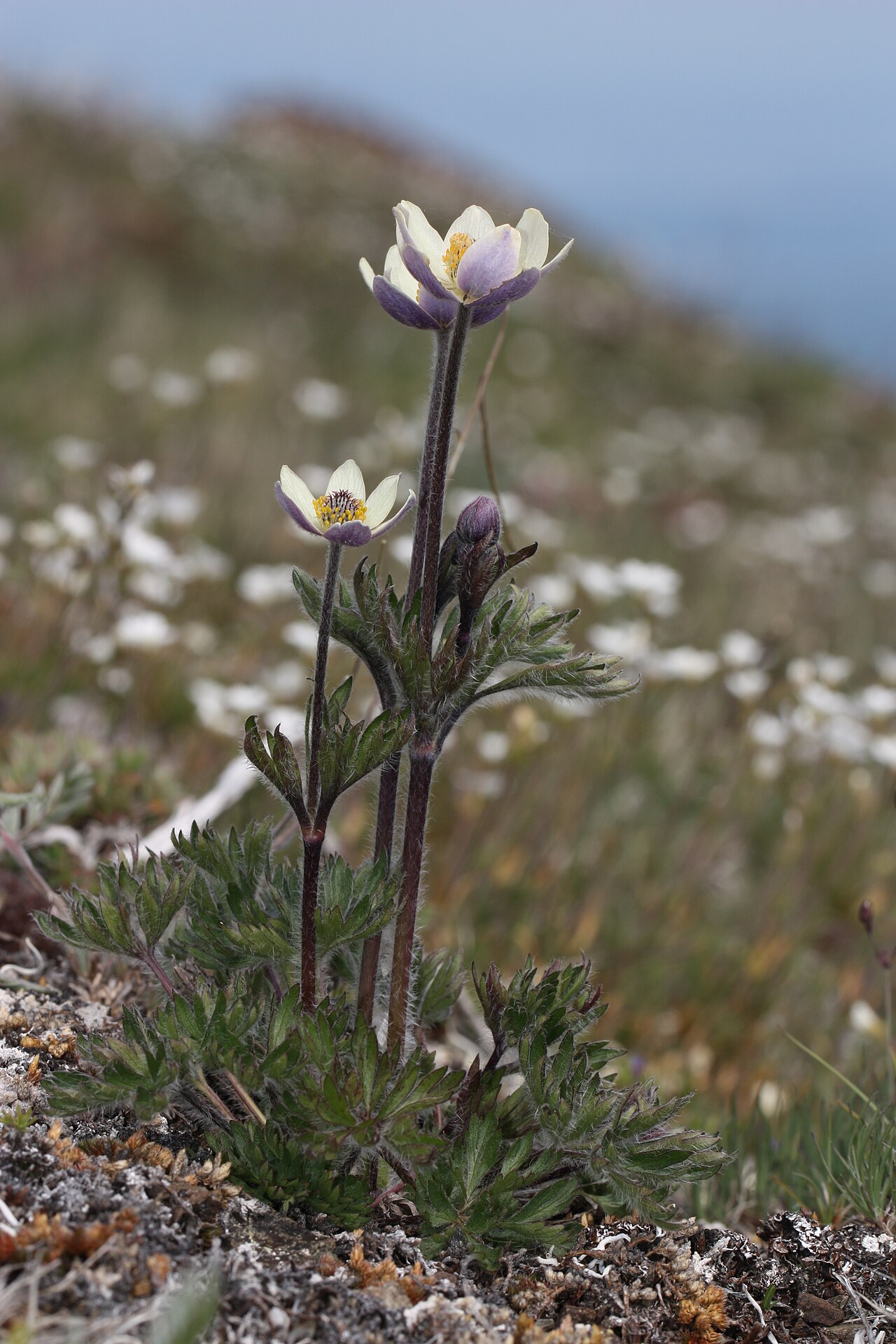
Anemone multifida, called Cut-leaf Anemone in Alaska’s regional plant lists and also known as cutleaf anemone, Pacific anemone, globe anemone, or (for its rusty-red form) red windflower, is a small, silky, fine-textured perennial of open ground across Alaska, northern Canada, and the western mountains. It belongs to the Ranunculaceae (buttercup family) and grows from a stout, branching caudex, sending up a tuft of much-divided leaves and wiry stems topped with flowers that can be cream, yellow-green, lilac, purple, pink, or brick-red depending on the plant in front of you.
That color variability is the plant’s signature. Across its range, cream-flowered plants occur alongside forms with purple-backed or reddish sepals. The flowers have no petals at all. What look like petals are petal-like sepals, and the woolly, ball-shaped seed heads that follow are just as ornamental as the blooms. For gardeners working with the harsh, quick, bright summers of the North, it is a low-input plant that thrives on the kind of dry, gravelly, sunny-to-lightly-shaded ground where fussier perennials struggle.
The Alaska regional list carries it as a dry-site, part-sun perennial of about 12 to 18 inches, with fine, light-green leaves and pink to maroon flowers. This guide covers how to recognize it (including how to tell it apart from the pasqueflowers that share its habitat and its old name), where it grows, how to establish it from seed, and what to expect from it in a northern garden. It also flags one point that gets glossed over in many plant profiles: like most buttercup relatives it is toxic, and the sap can irritate skin.
Identification
Cutleaf anemone is a tufted perennial, 4 to 28 inches (10-70 cm) tall in the wild. Shorter plants come from exposed, gravelly, high-elevation sites; the tallest are on richer, sheltered ground at low elevation. In a garden with average moisture and some shelter, expect the 12 to 18 inches given in the Alaska list. Plants develop from a woody, ascending-to-vertical caudex (a thickened, branching crown at the top of the root) from which the seasonal stems emerge.
Stems & Growth Form
Flowering stems are slender, wiry, and covered in soft, silky, whitish hairs, most noticeably on the flower stalks just below the blossoms. The plant forms a loose, clumping rosette of basal leaves with erect stems rising from it, and can gradually widen. Spread varies with provenance and growing conditions.
Leaves
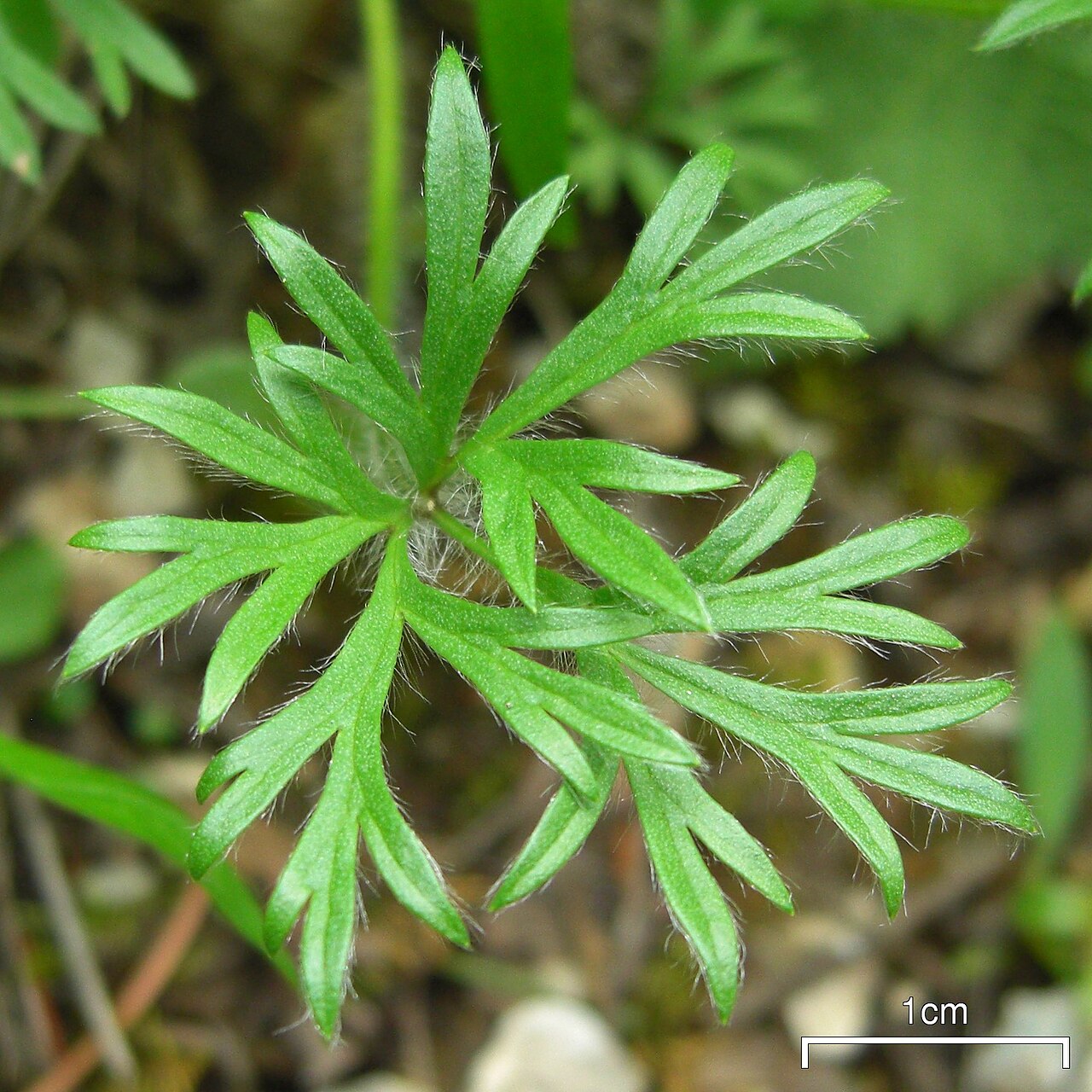
The basal leaves are what set this anemone apart. Each has a long petiole (about 2-6 inches) and a blade divided once or twice into three parts, then cut again into narrow, pointed segments only about 1/16 to 3/16 inch wide. The overall effect is feathery and slightly fern-like, with a light-green color that reads as soft in the garden. Both surfaces are covered with long, silky, whitish hairs, heavier on the undersides. A whorl of three to five much-reduced, similarly divided bracts sits just below the flower cluster, forming a small collar of leafy tissue that is also a good field character.
Flowers
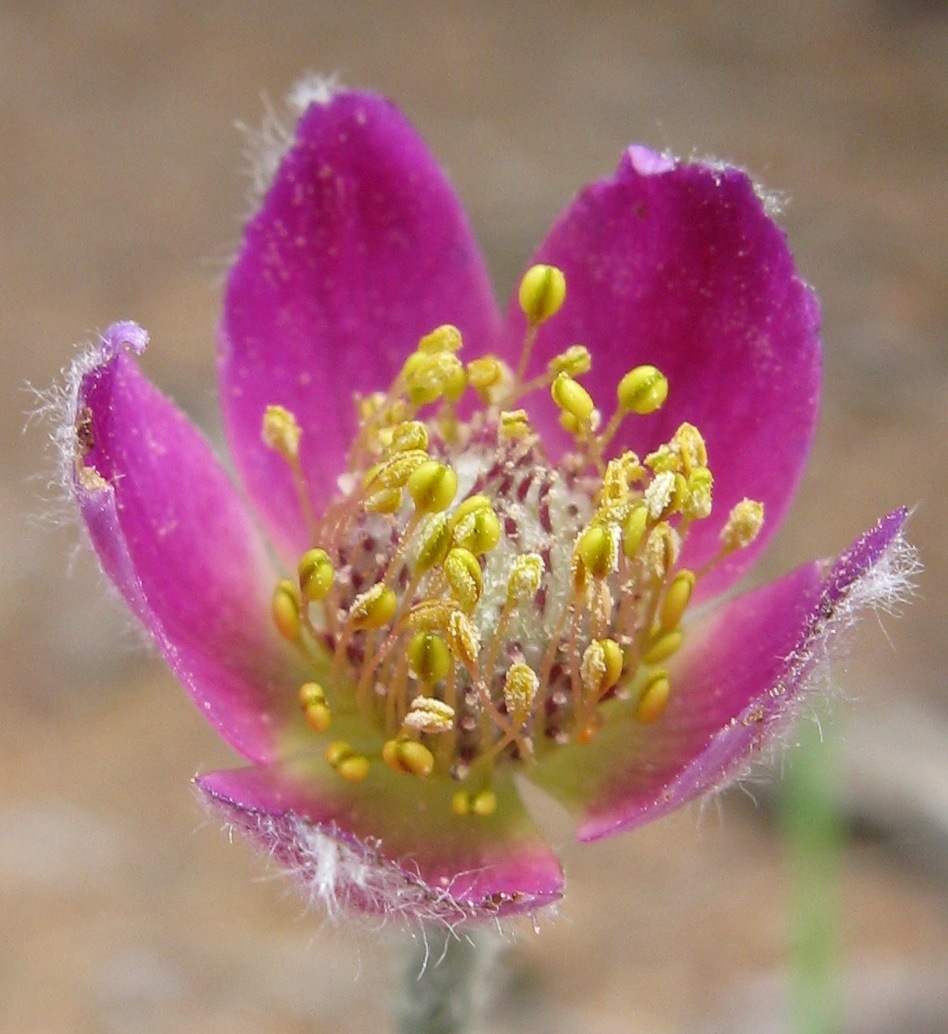
Flowers are borne singly or in loose clusters (cymes) of up to seven. Each one has 5 to 9 sepals (usually five), roughly 1/4 to 2/3 inch long, hairy on the outer surface, and no true petals. The color range recorded by Flora of North America runs from green to yellow, blue, purple, red, and occasionally white, and the two faces of a sepal can differ, for example white or yellow inside and red, blue, or purple outside. That is why photographs of the same species can look so unlike each other. In the center is a dome of 50 to 80 stamens around a woolly cluster of carpels. Blooming runs from spring into midsummer, depending on elevation and latitude; in most of Alaska expect it from about late May into July.
Fruit & Seeds
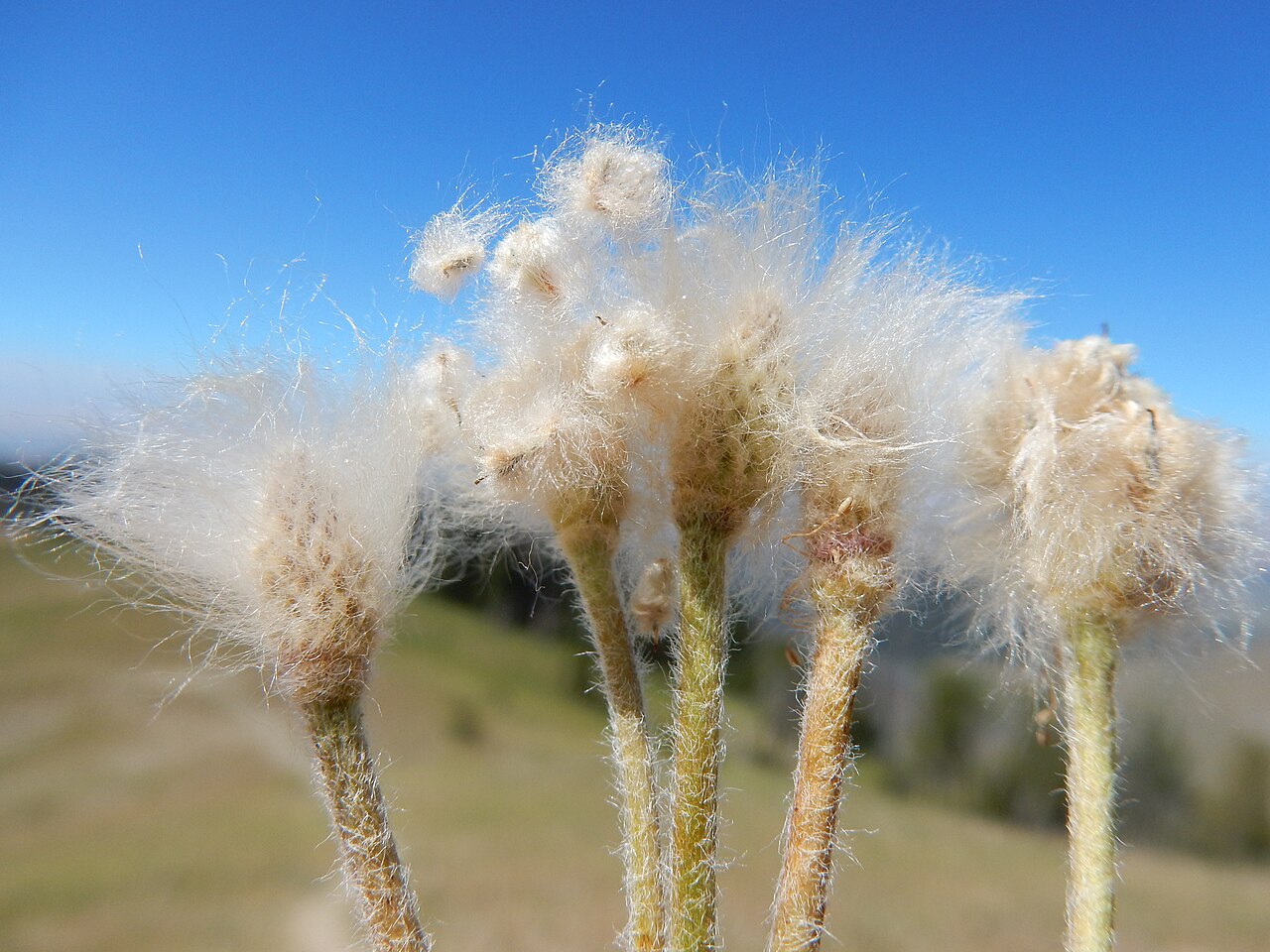
After pollination the flower head stretches out into a rounded to shaggy ball on a stalk 2 to 6 inches long. Each seed (an achene) is a few millimeters long, flattened, not winged, and wrapped in a dense coat of long, cottony hairs, with a slender beak 1 to 6 mm long that is straight in some varieties and strongly hooked in others. When the head dries, the woolly units break loose and drift on the wind. If you plan to grow it from seed, watch the heads as the wool fluffs out; collect just before the achenes start to leave.
Varieties and Look-alikes
Flora of North America recognizes four varieties. In Alaska the two you will meet are var. multifida, the taller form (about 12 to 28 inches) with several flowers per stem, silky bracts, and a straight beak; and var. saxicola, the shorter, rock-loving form (about 4 to 16 inches) with one to three flowers and often a reddish or purplish back to the sepals. The other two, var. tetonensis and var. stylosa, are restricted to the Rocky Mountain and Intermountain regions.
Two look-alikes cause confusion. First, prairie pasqueflower (Pulsatilla nuttalliana) has been treated under the name Anemone patens and even, wrongly, as “Anemone multifida (Pritz.) Zamels, non Poir.” A pasqueflower has larger, upright, silky blooms, a plume-like seed tail, and comes up in early spring before most of its leaves. Anemone multifida has small flowers on wiry stems, hairy stem leaves in a whorl beneath the flower cluster, and seeds with a short beak, not a long feathery plume. Second, the other northern anemones, such as Anemone parviflora (small white flowers, coarse, undivided leaf lobes) and Anemone narcissiflora (larger white umbels, described on regional floras), are easy to separate once you look at the leaves.
Quick Facts
| Scientific Name | Anemone multifida Poir. |
| Family | Ranunculaceae (Buttercup) |
| Plant Type | Herbaceous perennial (clumping, caudex-based) |
| Mature Height | 12-18 in (garden); 4-28 in in the wild |
| Mature Spread | A widening tuft; allow roughly 12 in, then adjust to local growth |
| Growth Rate | Slow to moderate |
| Sun Exposure | Part Sun (also full sun in cool climates) |
| Water Needs | Low (dry site plant); drought tolerant once established |
| Soil Type | Gravelly, sandy, or rocky; sharply drained; tolerates calcareous soil |
| Soil pH | Acidic to alkaline; often associated with calcareous habitats |
| Bloom Time | Late May – July in Alaska (April – August across its range) |
| Flower Color | Cream, yellow-green, lilac, purple, pink, or brick-red to maroon |
| Fall Color | None significant (foliage yellows and fades); woolly seed heads persist |
| Fruit | Round heads of woolly achenes |
| Deer Resistant | Not guaranteed; protect vulnerable new plants |
| USDA Hardiness Zones | Provenance-dependent; published cultivar ratings are not an Alaska-wide guarantee |
Native Range
Cutleaf anemone has one of the broadest ranges of any North American anemone. It grows across Alaska, Yukon, the Northwest Territories, and much of Canada from British Columbia east to Newfoundland, and south through the Rocky Mountains into New Mexico and Arizona. In the United States, Flora of North America records it in Alaska, California, Colorado, Idaho, Maine, Michigan, Minnesota, Montana, Nebraska, Nevada, New Mexico, New York, North Dakota, Oregon, South Dakota, Utah, Vermont, Washington, Wisconsin, Wyoming, with the varieties stylosa and tetonensis adding Arizona. A disjunct population, treated as the same species, occurs in the southern Andes of Chile and Argentina.
Within Alaska it is a plant of open, well-drained ground: grassland and steppe-like south-facing bluffs, shrubland, open forest, rock outcrops, gravel bars, and tundra meadows from lowlands to the subalpine zone. Range-wide, it has a marked preference for calcareous ledges, gravelly and rocky soils around lakes and streams, dunes, and thin, quick-draining ground. In Minnesota it even turns up in prairie, and it is an eastern rarity, where scattered populations along the Great Lakes and in northern New England are treated as conservation concerns.
The map below shows the U.S. states in which the species is native. The rare eastern and midwestern populations are far outnumbered by Alaskan and western ones, and the northern Rockies and boreal Canada form the heart of the range. It is a species of northern and mountain climates, and Alaska sits in the core of its range rather than at an edge.
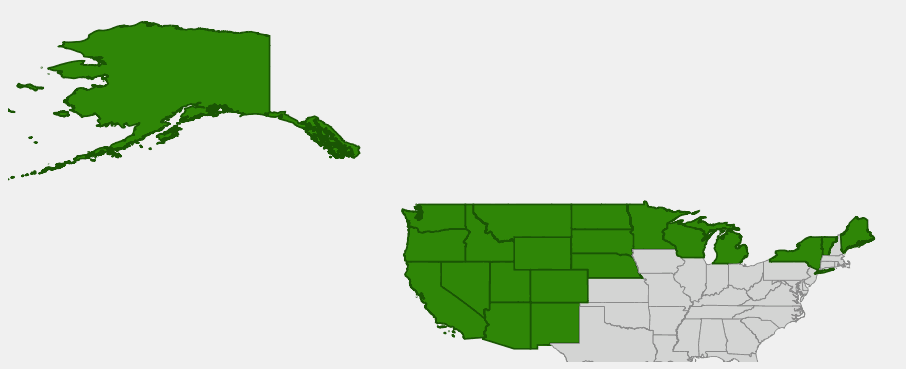
📋 Regional plant lists featuring Cut-leaf Anemone: Alaska
Growing & Care Guide
Treat cutleaf anemone as a rock-garden or dry-meadow plant and it is dependable. Give it a wet, heavy site and it is not. The plants are long-lived once they settle in, but they resent disturbance and they are slow to bulk up, so the aim is to choose the right spot the first time and then leave them alone.
Light
The Alaska list calls for part sun, and that fits: in most of Alaska, where summer light is long and the sun is low, plants perform well in full sun to light shade. In the coolest coastal gardens use the sunniest spot you have, since the plant flowers best in high light and becomes leggy in deep shade. In hot, dry, interior locations such as Fairbanks, a site with afternoon shade from a shrub or tree keeps the foliage fresh into July, and gives a somewhat longer bloom than a fully exposed spot.
Soil & Water
Drainage is the most important factor. In nature the plant occupies gravel, ledges, sand, and thin soils, and in the garden it wants the same: a sandy or gravelly, low-fertility mix with an inch or two of grit or fine crushed rock worked into the top of the bed. Neutral to alkaline pH is fine, and the plant is often found on limestone. It is rated dry on the Alaska list, but newly planted roots still need monitoring and water when the root ball dries; even established plants may need help in an unusually dry spell. Avoid standing water and compacted wet soil around the crown.
Planting Tips
Nursery-grown plants are hard to find, and most gardeners start from seed or from a small container plant from a native plant nursery. Set container plants out in spring or early fall so the roots can establish before freeze-up, keeping the crown at or just above soil level, and mulch with an inch of gravel rather than bark or compost. Space plants 8 to 12 inches apart for a small drift. Because the taproot-like caudex dislikes being cut or moved, plant in the final location and label it: the leaves die back in late summer in many years, and it is easy to dig up dormant plants by mistake.
Pruning & Maintenance
There is almost nothing to do. Leave the fluffy seed heads in place for winter interest and for self-seeding, or cut them off before the achenes disperse if you would rather not have seedlings. Clear away last year’s dead foliage in early spring. Do not routinely feed an established plant without evidence that the soil needs it. If seedlings appear in gravel paths or between stepping stones, they can be lifted while small and moved, but move established plants cautiously with as much root as possible.
Propagation
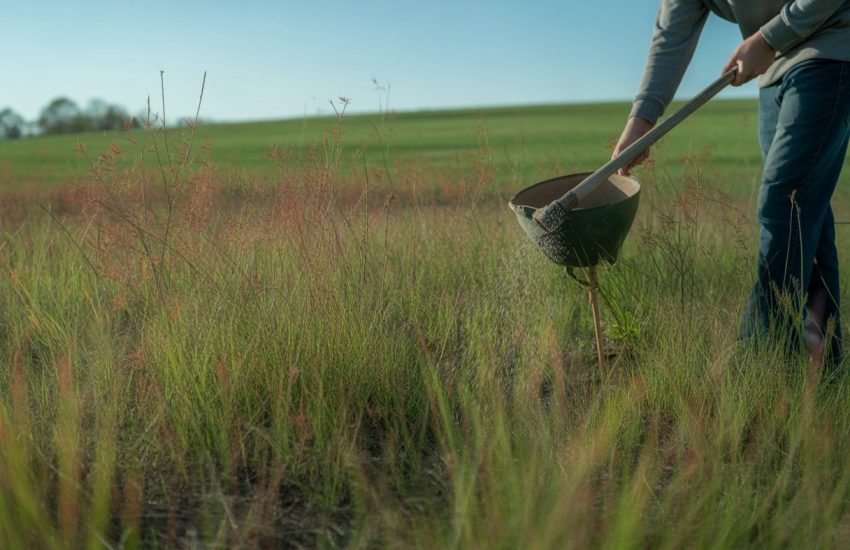
The dependable method is seed. Sow fresh seed in fall in a pot of gritty, well-drained mix (roughly equal parts coarse sand or fine gravel and peat-free compost), barely cover it, and leave it outdoors through winter in a cold frame or a sheltered spot so natural cold stratification can occur. Germination timing varies; grow on seedlings in their pots for the first year or two, then plant out. Use accurately identified seed with a recorded collection date. Plants can be divided only when large, and division sets them back, so it is a poor first choice. For restoration or nursery production, source seed from your own region: the color forms and varieties differ between Alaskan, Rocky Mountain, and Great Lakes populations.
Landscape Uses
- Rock gardens and scree beds, where the fine leaves contrast with cushion plants and dwarf shrubs
- Dry, sunny meadow plantings between bunchgrasses and other low, dry-site natives
- South-facing slopes and berms that shed water in spring
- Gravel gardens and stepping-stone paths where seedlings can wedge into cracks
- Restoration of open, disturbed, well-drained ground, using regionally sourced seed
- Cottage-style borders with excellent drainage alongside pasqueflowers, kinnikinnick, and low sedges
Handling
This is an ornamental buttercup-family plant, not a food crop. Avoid ingestion and wear gloves when handling fresh sap. Do not use it for home remedies or plant it as livestock forage.
Wildlife & Ecological Value
In a planting designed for northern biodiversity, this small perennial contributes flowers and fine-textured foliage rather than a large crop of berries or browse. Its ecological role is best understood as one component of an open native plant community, not as a substitute for the shrubs, grasses and sedges around it.
For Pollinators
The open flowers expose their stamens to visiting insects. Native Plant Trust lists bees among visitors to a cultivated selection. Plant several individuals near other regionally native flowers to offer a sequence of bloom; avoid insecticide applications to flowering plants. A photograph of one insect visit is not evidence that the species supports every butterfly or specialist bee in Alaska.
For Birds
No strong species-specific seed-food claim is established in the sources used here. The seed heads are ornamental and disperse hairy achenes, but this guide does not present the plant as a major bird food. For a bird-focused garden, combine suitable low forbs with locally native shrubs offering verified fruits and nesting structure.
For Mammals
This is not a forage recommendation. Do not infer deer or moose resistance merely from family-level chemistry: browsing depends on animals, season and site. Where browsing pressure is high, protect a new planting and observe local performance rather than expecting a small perennial to deter herbivores.
Ecosystem Role
Floras record it in open woodland, grassland, rocky ground and some moist prairie depressions. That breadth matters: the dry-site rating in our Alaska table is a garden starting point, not a claim that every wild population grows in identical soil. Retain existing native habitat and match new planting material to its source environment.
Cultural & Historical Uses
The names cutleaf anemone and cut-leaved windflower refer to its distinctive divided foliage. Older botanical literature also uses names such as Anemone globosa. The Flora of North America treatment brings several related names under a broad species concept, while modern conservation records may track individual varieties more narrowly. Keeping the scientific name and seed provenance together is more useful than relying on a common name alone.
This guide makes no medicinal-use recommendation and does not transfer practices associated with other anemones to this species. Traditional knowledge is community-specific; a general gardening page should not turn an old plant-use note into treatment advice. Grow it for observation and habitat-appropriate landscaping rather than ingestion.
Garden selections, including pink-flowered cultivars, demonstrate its ornamental appeal. A cultivar can be attractive without being the right material for restoration in Alaska. Ask a nursery whether its plants are cultivated selections or locally sourced seed-grown stock, and keep the distinction visible in planting records. Do not dig wild plants or collect seed without landowner permission and any required permits.
Frequently Asked Questions
Is cutleaf anemone the same as pasqueflower?
No. Pasqueflowers (Pulsatilla) are closely related and once were placed in Anemone, and some older references confuse the names, but they are separate plants. Pasqueflower blooms are larger and upright, with plume-like seed tails. Cutleaf anemone has small flowers in a wide range of colors, hairy bracts in a whorl beneath, and woolly seeds with short beaks.
Can I eat it or use it medicinally?
No. Treat it as an ornamental, avoid ingestion and fresh sap contact, and do not use this guide as a basis for home remedies.
How much sun and water does it need?
The Alaska list rates it for part sun and dry conditions. In practice it does well in full sun to light shade, on sharply drained, gravelly soil, and it seldom needs watering once established. Wet, heavy, or heavily amended soils are its main problem.
Why do the flowers on different plants look so different?
The species is genuinely variable, and sepal color runs from cream and yellow-green to lilac, purple, pink, and brick-red. The inside and outside of a sepal can be different colors, and the species includes several variable forms. If you want a particular color, ask a nursery for a named selection, recognizing that seed offspring may vary, or grow several forms together.
Can I grow it from seed?
Yes, and seed is the most reliable method. Sow fresh seed in fall in a gritty, well-drained mix, barely covered, and leave it outdoors over winter for natural cold stratification. Allow for variable germination timing, and allow one to two years in the pot before planting out, since older plants transplant poorly.

Looking for a nursery that carries Cut-leaf Anemone?
Browse our native plant nursery directory: Alaska
Sources & Further Reading
- Flora of North America: Anemone multifida — identification and infraspecific treatment.
- Kew Plants of the World Online — accepted name and native distribution.
- Native Plant Trust — cultivated selection, light, drainage and garden behavior; not a universal Alaska hardiness rating.
- Royal Horticultural Society — pink-flowered garden form and cultivation guidance.