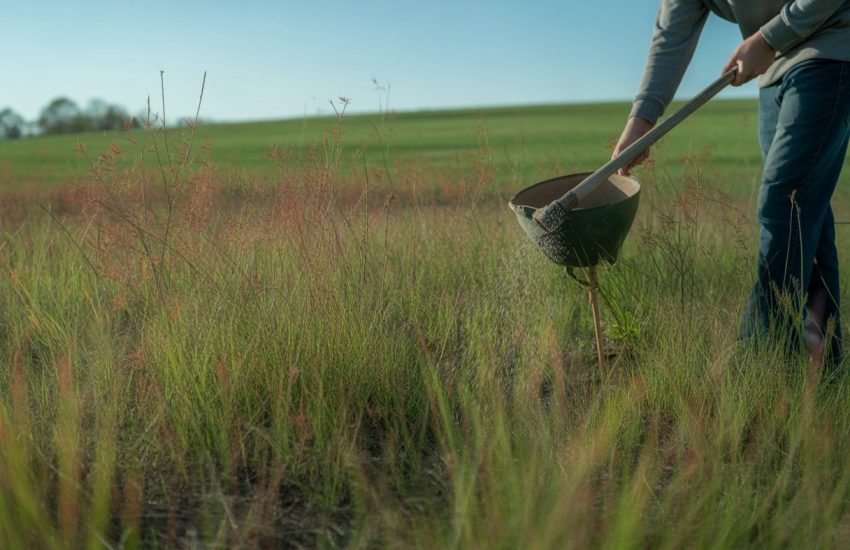
Pink Primrose (Oenothera speciosa)
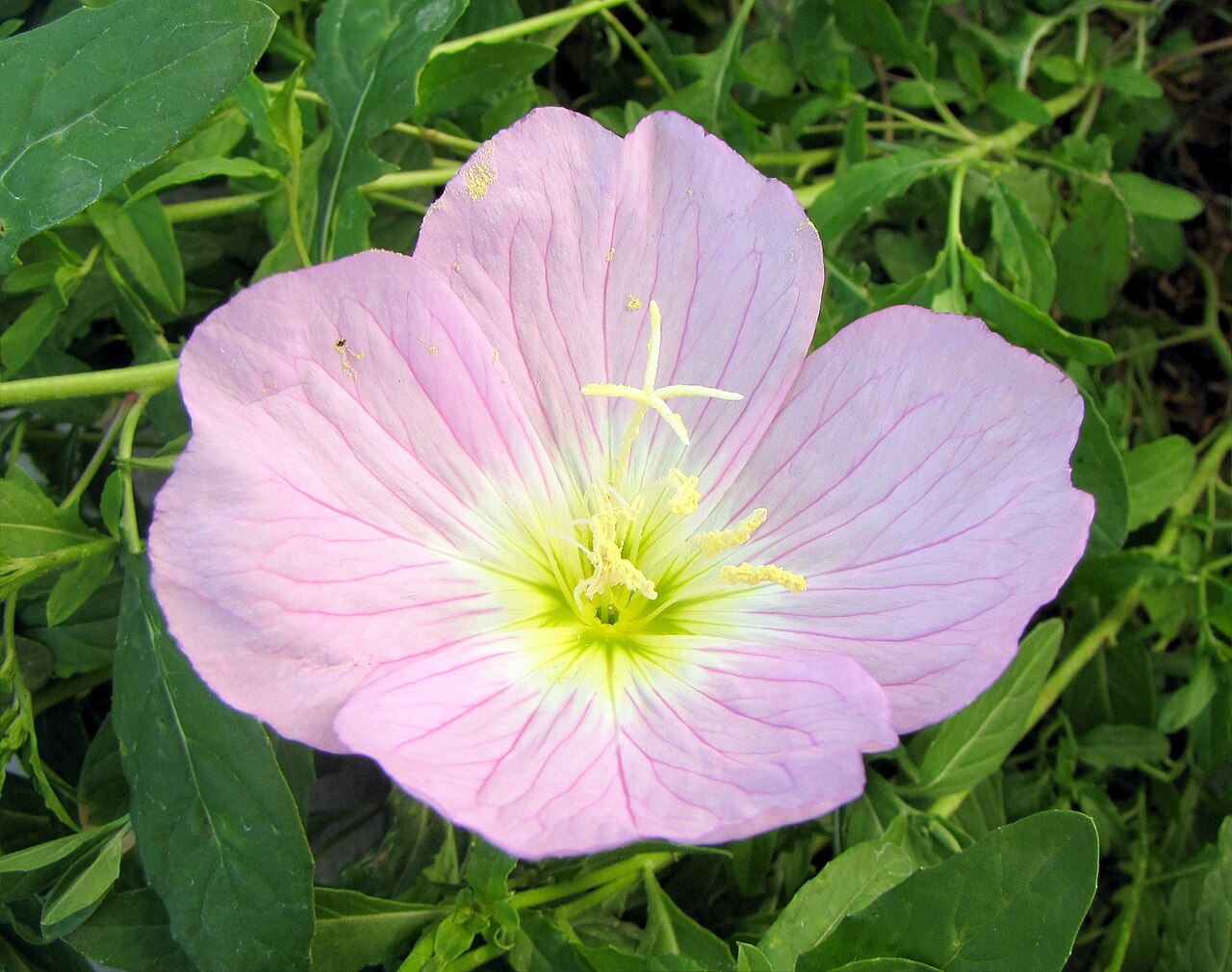
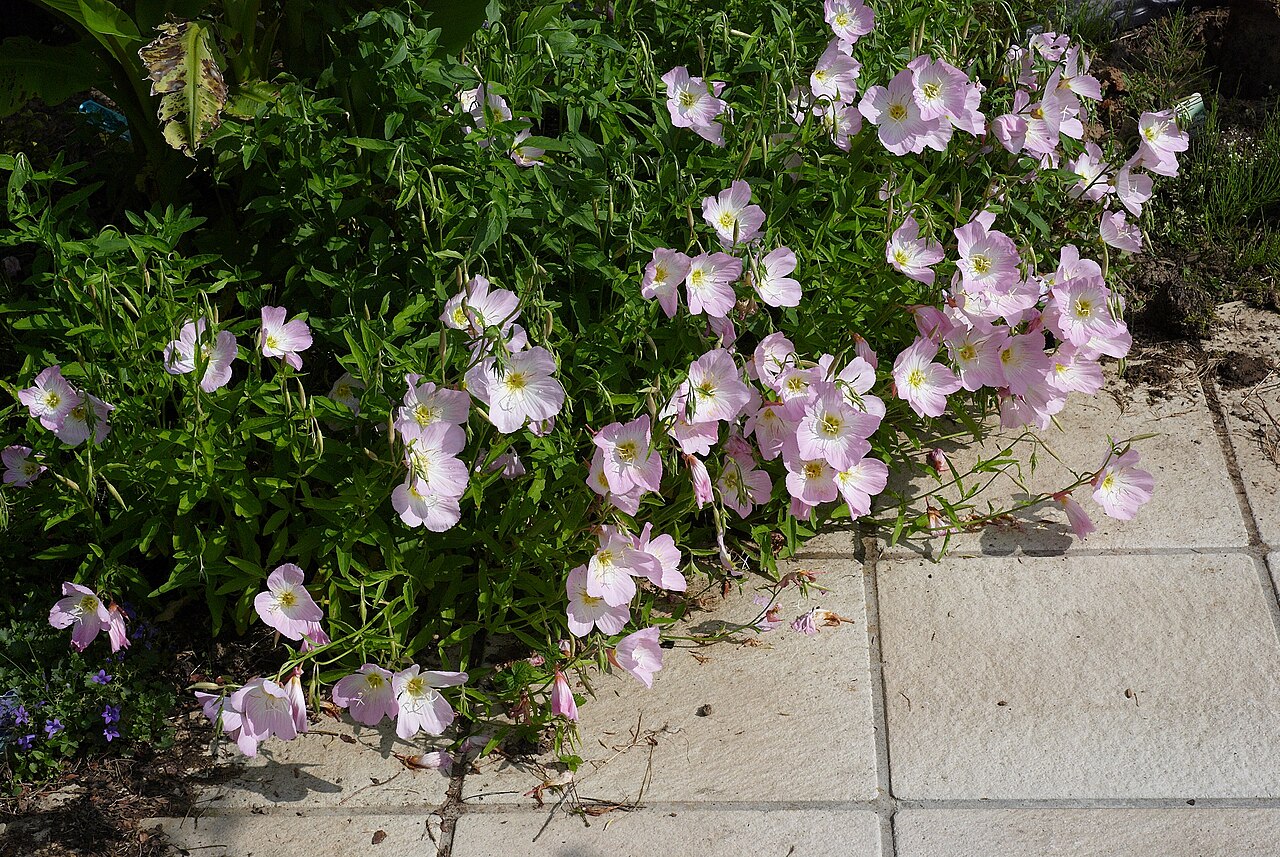
Pink primrose can make a beautiful sheet of pale flowers, but it is not a restrained little border plant. Oenothera speciosa spreads through underground growth and seed, sometimes moving well beyond the original planting. Its four-petaled flowers can be pink or nearly white, with stronger veins and a pale center. Showy evening primrose is another common name for the same species.
In the shared Iowa, Illinois, and Missouri regional list, nativity needs an explicit qualification. Kew lists Iowa and Missouri as native and Illinois as introduced. The table comment now states that distinction and warns about vigorous spread. A plant’s presence in a regional gardening list should not erase the difference between native occurrence and naturalization in a neighboring state.
Choose it only where its growth pattern fits the design. A naturalized sunny patch with room to expand is a different setting from a narrow perennial border full of small, slow-growing plants. The regional height of 12–20 inches describes the vertical display, not the eventual footprint of a colony. Plan the edges before planting, because managing spread later can become the main task.
Identification
Stems & Growth Form
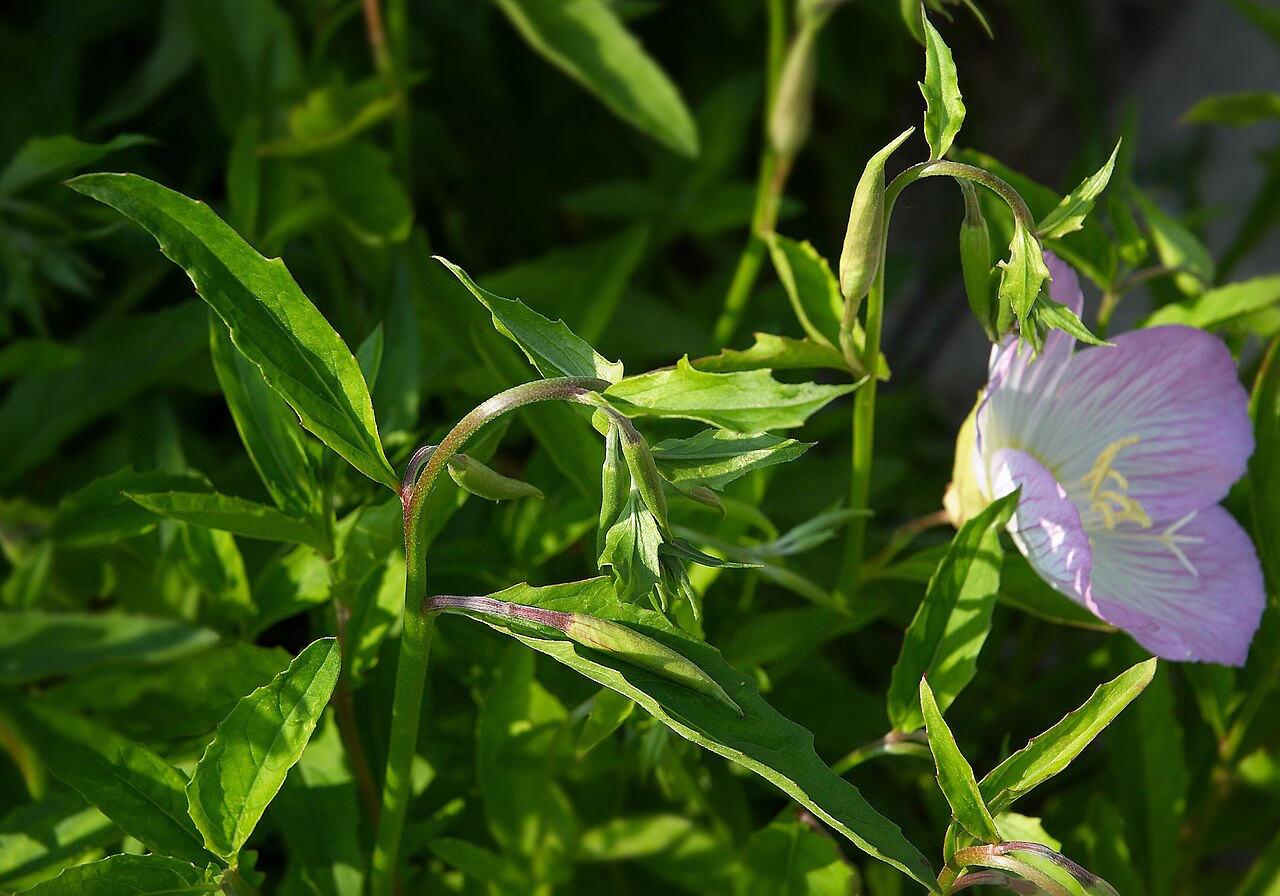
Stems rise or sprawl from an expanding underground system. A group may appear to consist of many separate plants while being connected belowground. That is why removing only the visible stem at the edge may not stop expansion. Observe the pattern over a season before assuming a newly planted pot will remain a compact mound.
Leaves
Leaves are alternate and generally narrow to lance-shaped, with margins that may be toothed, wavy, or more deeply divided. Hairiness and leaf outline can vary. Use flowers, stems, and growth pattern together for identification. The name primrose also applies to unrelated Primula species, so a common-name-only label is not enough to establish identity.
Flowers
Four broad petals form the open, cup-like blossom. Pink veins and a pale throat are conspicuous in many plants, while the overall color may vary from pink to white. Flower-opening time also differs among populations and regions, so the word evening should not be treated as a guarantee that every plant opens only at night. The photographs include the cultivated selection 'Siskiyou', identified in the captions rather than presented as a wild local ecotype.
Fruit & Seeds
Small dry capsules develop after flowering and contain numerous seeds. Seed is one route of spread, but it is not the only one. Removing spent flowers may reduce seed production while underground growth continues. Distinguish those two processes when choosing a management approach; deadheading alone does not create a nonspreading plant.
Quick Facts
| Scientific Name | Oenothera speciosa |
| Family | Onagraceae (evening primrose family) |
| Plant Type | Spreading herbaceous perennial |
| Mature Height | About 12–20 inches in the regional list |
| Mature Spread | Expanding colonies; not a fixed small clump |
| Growth Rate | Moderate to vigorous where conditions suit it |
| Sun Exposure | Full sun for best flowering |
| Water Needs | Dry to average; drought can trigger dormancy |
| Soil Type | Well-drained sandy, loamy, clay, or rocky soil |
| Soil pH | Tolerates neutral to alkaline conditions |
| Bloom Time | Late spring through summer; local pattern varies |
| Flower Color | Pink to white with contrasting veins and a pale yellow center |
| Fall Color | No dependable showy fall foliage |
| Fruit | Small dry capsules containing numerous seeds |
| Deer Resistant | Do not assume complete browsing resistance |
| USDA Hardiness Zones | 5–8 in NC State’s listing |
Native Range
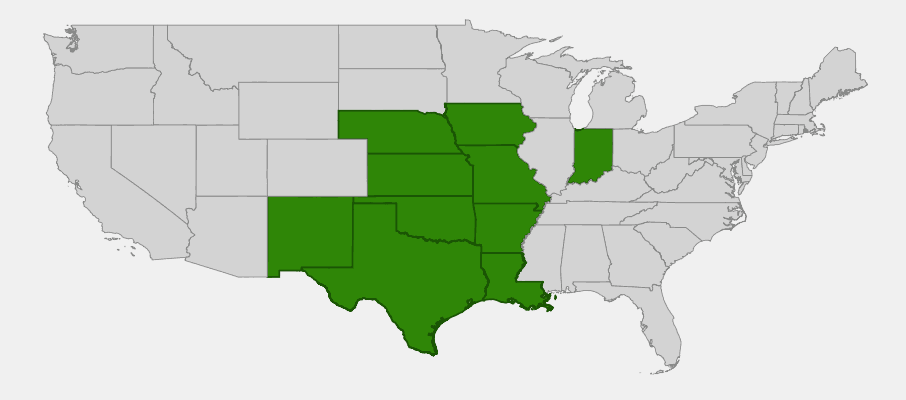
Kew’s native-state list includes Arkansas, Indiana, Iowa, Kansas, Louisiana, Missouri, Nebraska, New Mexico, Oklahoma, and Texas, with additional native distribution in Mexico. The map follows that native list. It deliberately does not shade every state where the species has been observed or cultivated.
Illinois is one of the places Kew lists as introduced. NC State likewise notes that the species has naturalized beyond its original range, and its broad occurrence list should not be mistaken for a native distribution map. Gardeners in Illinois who require strictly local native plants should choose an alternative confirmed by regional flora records.
Even within the native range, a spreading species can be a poor fit for a small garden. Nativity describes biogeographic history, not a promise of gentle behavior beside delicate plants. Match its open, sunny setting and competitive growth to a site where expansion can be monitored and managed without repeatedly disturbing the rest of the planting.
📋 Regional plant list: Iowa, Illinois & Missouri
Growing & Care Guide
Light
Use full sun for a good flower display. NC State notes that plants may persist in shade as groundcover with reduced flowering. That is not a reason to place it under a dense canopy when blossoms are the goal. Consider the mature size of neighboring shrubs and grasses so the planting does not become shaded after a few seasons.
Soil & Water
Good drainage is essential, while the species tolerates several soil textures. It can become dormant in severe summer dryness, so a seasonal loss of foliage should be evaluated alongside rainfall and root condition rather than immediately diagnosed as death. Establish new plants with appropriate watering, then manage them with compatible dry-to-average companions. Avoid rich, constantly irrigated conditions if vigorous spread is already a concern.
Planting Tips
Begin with a limited area that can be observed easily. Keep it away from small plants that would be difficult to disentangle if underground shoots move through them. A clear edge and access for maintenance are more useful than an optimistic assumption that a nursery pot will stay put. Check the label for cultivar information, since ornamental selections are not equivalent to local restoration material.
Pruning & Maintenance
Remove unwanted shoots promptly at the perimeter, while recognizing that underground parts may remain. Deadhead selectively if reducing seed production is important, but do not mistake that for control of the entire root system. Avoid spreading root fragments into other beds during soil movement. If the plant repeatedly exceeds the space available, changing the planting choice may be more sensible than committing to perpetual intensive control.
Propagation
Seed, division, and cuttings are listed by NC State as propagation routes. For a home gardener, the more important question may be whether more plants are actually wanted. Share accurately labeled material only with someone who understands the growth habit and local native status. Keep cultivar and species labels distinct, and do not distribute it as a universally appropriate native groundcover.
Managing Drought Dormancy
A dry summer can reduce the visible foliage while the underground system remains alive. Mark the planting boundary before dormancy so later digging does not unknowingly move roots elsewhere. Watering to maintain constant color is a design choice, not an ecological necessity. If seasonal gaps are unacceptable in the intended bed, choose a different plant rather than forcing this species onto a high-input schedule.
Monitoring a Colony
Record its boundary at planting and again after the growing season. This provides a more reliable assessment of spread than memory, especially in a mixed bed. Look for seedlings separately from connected shoots. Where the colony is welcome, allow a natural outline; where it approaches a sensitive neighboring planting, act while the new growth is still limited and accessible.
Landscape Uses
- A monitored naturalized patch within its confirmed native range where expansion is acceptable.
- Sunny, well-drained sites with robust companions rather than delicate small perennials.
- An educational example of why native range and garden behavior are separate questions.
- A visible seasonal flower patch with accessible boundaries for maintenance.
- Ornamental use of a named selection only when its identity and spreading habit are understood.
Wildlife & Ecological Value
For Pollinators
The flowers attract bees and butterflies, and NC State describes specialized bee associations within Oenothera. Preserve flower access and avoid routine insecticide treatment. A colony can provide many blossoms, but it should not be allowed to displace all the other native flowering plants that extend the garden’s season and diversity.
For Birds
Seeds may be used by birds according to NC State. Leaving some capsules can retain that resource, but balance it with the need to manage unwanted recruitment. This low perennial does not supply the same protective structure as woody plants. Include it, if appropriate, within a broader habitat design rather than treating one spreading flower as a complete wildlife garden.
For Mammals
NC State notes seed use by small mammals. Actual visitation depends on the surrounding habitat and should be observed rather than promised. Physical disturbance and browsing can still affect young plants. Protect establishment where necessary without assuming every sign of animal activity means the planting has failed.
Ecosystem Role
Within its native range, the species is part of an open-ground flora; outside that range it may be naturalized. In either setting, vigorous garden spread can reduce the space available to other plants. A useful habitat planting balances abundance with diversity. The goal is not to maximize a single species at the expense of the rest of the community.
Cultural & Historical Uses
Pink primrose and showy evening primrose describe its familiar ornamental appearance, while Oenothera speciosa identifies the actual species. It should not be confused with Missouri evening primrose, Oenothera macrocarpa, which has large yellow flowers and a different growth pattern.
Cultivation has carried the species beyond its native distribution. That history explains why broad occurrence maps and casual observations can give a misleading impression of nativity. A flower growing abundantly along a road is not automatically native to the state where it is seen.
In contemporary native gardening, it is a useful case study in making precise choices. Correct names, native-range evidence, cultivar labels, and realistic expectations of spread all matter. Select it for a site where those facts support the decision, not merely because the flowers are attractive in a nursery display.
Frequently Asked Questions
Is pink primrose native to Illinois?
Kew lists Illinois as introduced, while Iowa and Missouri are listed as native. For a strictly local-native Illinois planting, use regional botanical guidance to select another species.
Will it stay in a small clump?
Do not assume so. It spreads by underground growth and seed and can take over space among smaller perennials. Plan accessible boundaries and monitor expansion.
Will deadheading stop all spread?
No. It can reduce seed production, but underground shoots can continue to expand the colony.
Why does it disappear in a dry summer?
Severe dryness can trigger dormancy. Check the season and root condition before assuming the plant is dead, and avoid moving soil that may contain living underground parts.
Are the cultivar photographs local wild plants?
No. The captions identify 'Siskiyou' where that selection is shown. Those images illustrate cultivated appearance and growth, not local native provenance.
Sources & Further Reading
- NC State Extension: Oenothera speciosa
- Kew Plants of the World Online: Oenothera speciosa
- USDA PLANTS: Oenothera speciosa
Find Native Plants
Ask growers about nursery propagation and regional provenance. Browse our Iowa native plant nurseries, Missouri native plant nurseries directory for suppliers.