
Cut-leaf Coneflower (Rudbeckia laciniata)
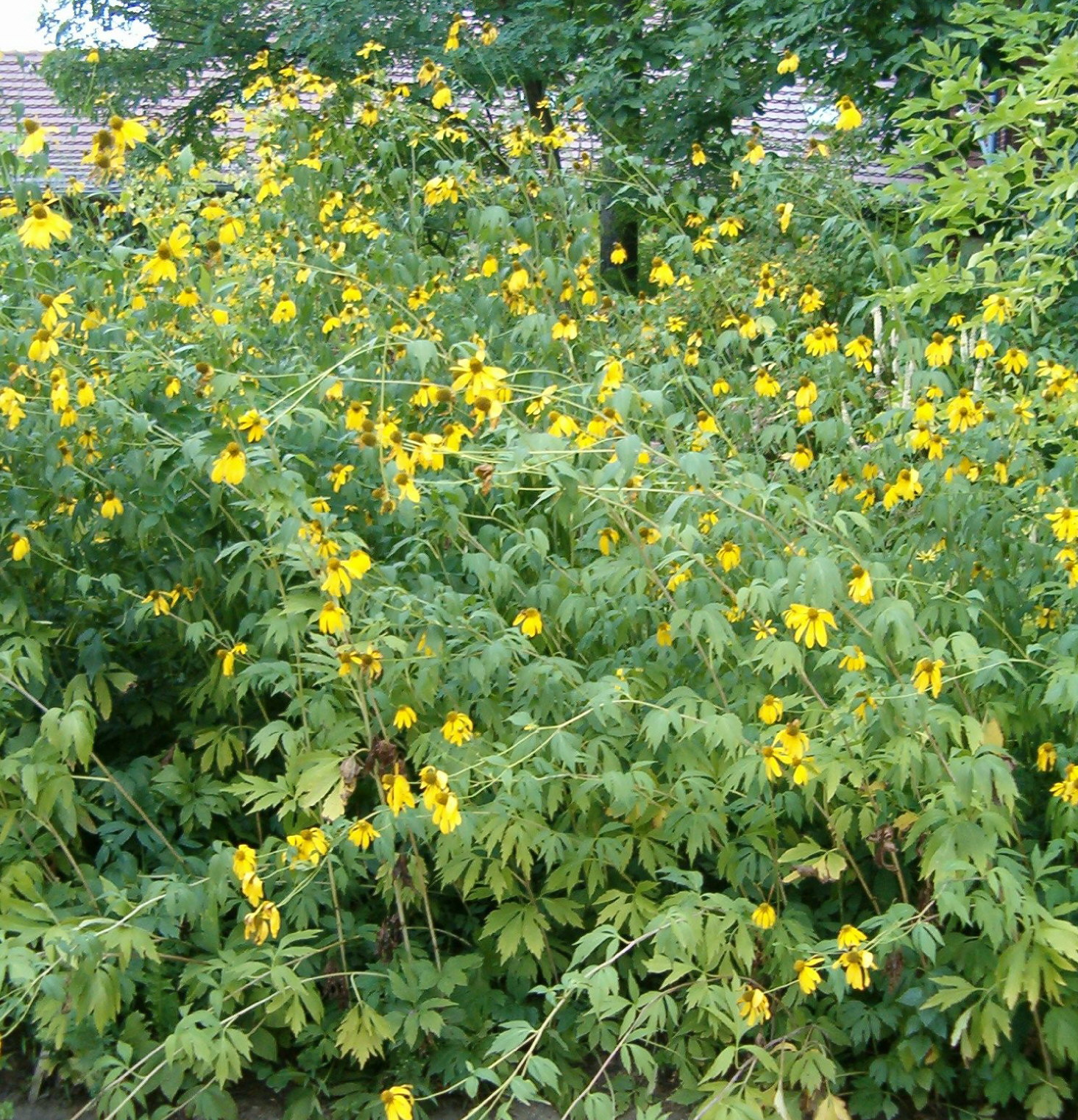
Rudbeckia laciniata, commonly known as Cut-leaf Coneflower, Tall Coneflower, or Green-headed Coneflower, is a bold, architectural native wildflower that commands attention wherever it grows. This tall perennial, reaching 3 to 10 feet in ideal conditions, produces an abundance of bright yellow daisy-like flowers from midsummer through fall, each with 6 to 12 gracefully drooping ray petals surrounding a distinctive greenish cone center — giving rise to the common name “Green-headed Coneflower.” A member of the Asteraceae (daisy) family, Rudbeckia laciniata is one of the tallest native wildflowers in North America and one of the most widely distributed, native from New England to British Columbia and south across much of the eastern and central United States.
The species name laciniata refers to the deeply cut, almost lacey appearance of the leaves — a distinctive feature that immediately separates Cut-leaf Coneflower from its cousin, the familiar Black-eyed Susan (Rudbeckia hirta). The large, pinnately lobed leaves emerge in spring and build impressive foliage that provides a lush, tropical look to the garden before the late-season blooming begins. Cut-leaf Coneflower thrives in moist to wet soils along stream banks, floodplain forests, and wet meadows, where it often forms imposing colonies that can fill an entire riparian corridor with color.
For native plant gardeners in New England and the greater northeast, Cut-leaf Coneflower is an indispensable plant for challenging moist or seasonally wet sites. Its extraordinary height makes it a spectacular back-of-border specimen, while its ecological value as a food source for goldfinches, other seed-eating birds, and a range of specialist native bees makes it an important component of any wildlife garden. The horticultural selection ‘Hortensia’ — a double-flowered form known as “Golden Glow” — was enormously popular in Victorian-era gardens across New England and can still be found naturalized around old homesteads throughout the region.
Identification
Cut-leaf Coneflower is a large, upright perennial herb that grows from a stout, branching rhizome. Stems are hollow, glaucous (blue-green, with a waxy bloom), smooth and hairless — a key feature distinguishing it from the hairy stems of other coneflowers. The plant can reach 10 feet (3 m) in rich, moist conditions, though 4 to 6 feet is more typical in garden settings. Stems branch profusely in the upper portion, producing many flower heads over a long season from July through October.
Leaves
The large, deeply divided leaves are the most distinctive identifying feature. Lower leaves can be 12 inches (30 cm) or more long, deeply pinnately lobed with 3 to 7 toothed segments, giving them a boldly cut, almost tropical appearance. The leaf surface is smooth and slightly glaucous on both sides. Upper leaves are progressively smaller and less divided. The combination of large, deeply cut leaves and smooth, hollow, glaucous stems makes Cut-leaf Coneflower easy to identify even before it flowers.
Flowers
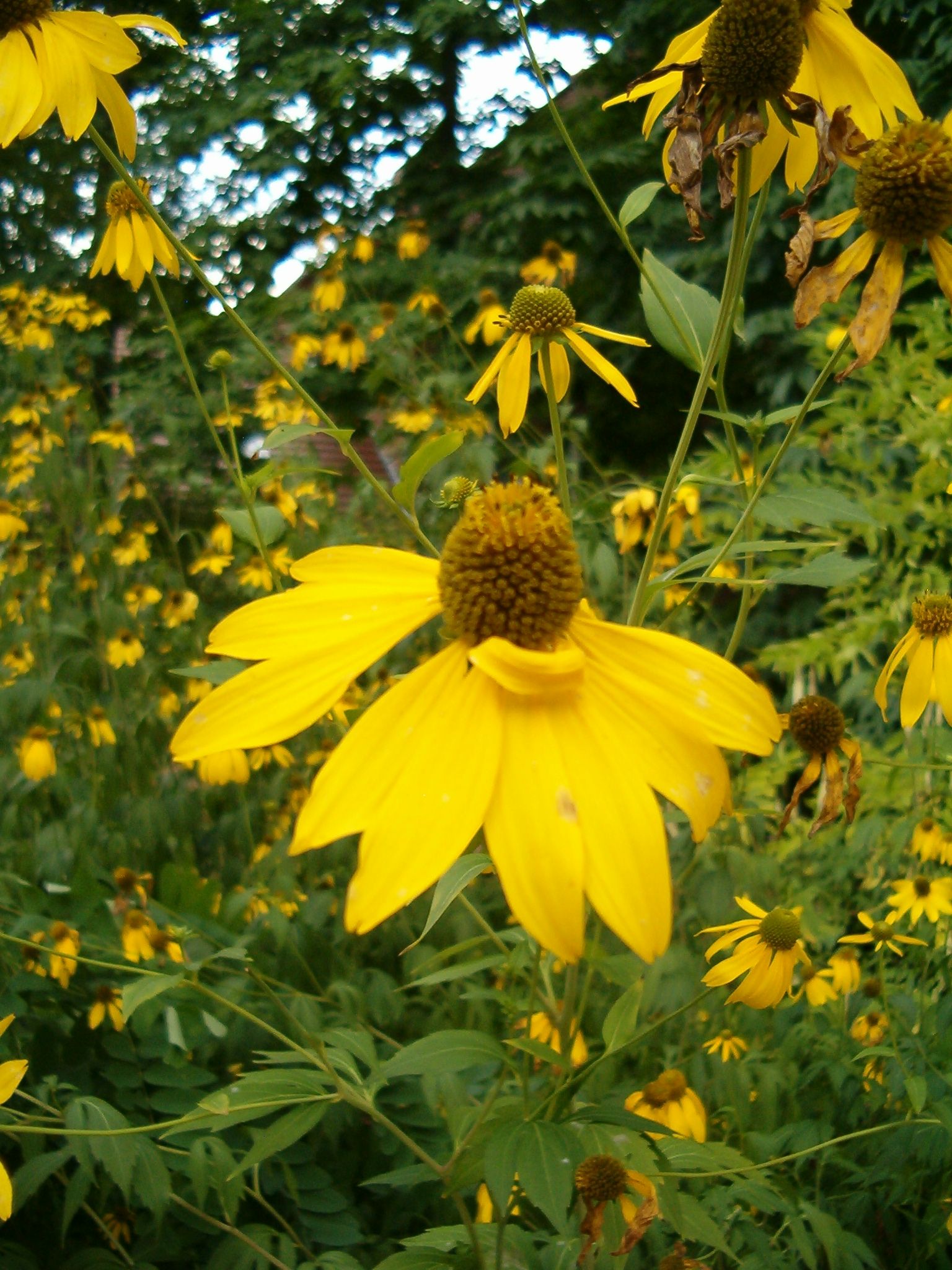
The flower heads are 2 to 3 inches (5–7 cm) across, with 6 to 12 (or more) drooping yellow ray petals surrounding a prominent, rounded to dome-shaped greenish center disk that turns brownish as it matures. The drooping rays are an immediately recognizable feature, giving each flower an elegant, slightly languid appearance quite different from the stiffly held petals of Black-eyed Susan. Multiple flower heads are produced on each branched stem, and a mature colony can produce hundreds of blooms over the long flowering season.
Fruit & Seeds
After pollination, the disk flowers mature into small, 4-angled achenes (seeds) with a short, irregular crown. The mature seed heads are attractive winter features, and the seeds are eagerly eaten by American Goldfinches, which often flock to Cut-leaf Coneflower colonies in September and October, hanging acrobatically from the seed heads.
Quick Facts
| Scientific Name | Rudbeckia laciniata |
| Family | Asteraceae (Daisy / Composite) |
| Plant Type | Perennial Herbaceous Wildflower |
| Mature Height | 3–10 ft (1–3 m) |
| Sun Exposure | Full Sun to Part Shade |
| Water Needs | Moderate to High |
| Bloom Time | July – October |
| Flower Color | Yellow rays with green center disk |
| Soil Type | Moist to wet; rich loam, clay loam, or alluvial soils |
| Soil pH | 5.5–7.0 |
| Deer Resistant | Moderately (less palatable due to bitter compounds) |
| USDA Hardiness Zones | 3–9 |
Native Range
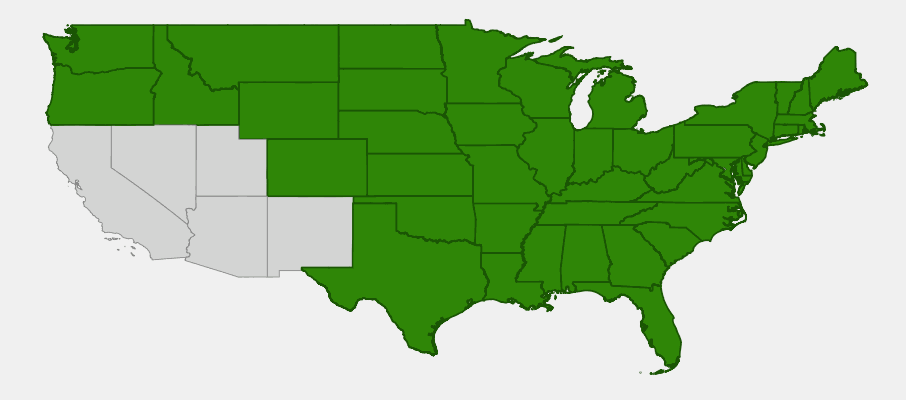
Cut-leaf Coneflower has one of the broadest native ranges of any eastern North American wildflower, extending from the Atlantic coast west across the continent to British Columbia and south from Manitoba and Quebec to Florida and Texas. This extraordinary range reflects the plant’s ecological flexibility — it thrives in diverse climates from cold northern forests to subtropical coastal plains, wherever moist, fertile soils and adequate moisture are available. It is native to virtually every state in the contiguous United States except for the driest portions of the arid Southwest.
In the northeastern United States — including New England — Cut-leaf Coneflower is most at home in riparian corridors: the moist soils of stream banks, flood plains, and wet meadow edges. It is a characteristic species of alluvial forest understories and edges throughout the Appalachians, growing alongside Ostrich Fern (Matteuccia struthiopteris), Tall Meadow-Rue (Thalictrum pubescens), and Joe-Pye Weed (Eutrochium spp.). In the Midwest, it can be found in wetter portions of prairies and savannas.
The species shows remarkable adaptability across its range: in the Pacific Northwest, it colonizes moist forest edges and stream corridors; in the Great Plains, it is restricted to riparian zones in an otherwise dry landscape; in New England, it’s a tall presence in floodplain forests and along brooks. This ecological plasticity has allowed Cut-leaf Coneflower to persist across a wide range of disturbance regimes, from post-agricultural fields to intact old-growth floodplain forests.
📋 Regional plant lists featuring Cut-leaf Coneflower: Southeastern U.S.
Growing & Care Guide
Cut-leaf Coneflower is a vigorous, long-lived perennial that thrives with minimal care once established in a site with adequate moisture. Its bold texture and great height make it best suited to larger garden spaces where its scale can be appreciated — and where it won’t shade out smaller plants. Given the right conditions, it can become a landscape anchor for many years, spreading slowly by rhizome into impressive colonies.
Light
Cut-leaf Coneflower grows in full sun to part shade. It produces the most flowers in full sun with consistent moisture, but is one of the few tall, showy wildflowers that tolerates and even thrives in part shade — making it invaluable for the challenging moist-shade niche along woodland edges and under high tree canopies. In dense shade, flowering is reduced but the foliage remains lush. In the south, afternoon shade helps prevent wilting during heat waves.
Soil & Water
This plant excels in moist to wet, rich soils — floodplain loam, clay loam, and alluvial soils are ideal. It will grow in average garden soil with regular irrigation, but truly thrives when moisture is consistently available. It tolerates periodic flooding and can grow at pond edges or rain garden margins. Soil pH of 5.5–7.0 is optimal. Unlike many native wildflowers, Cut-leaf Coneflower actually benefits from reasonably fertile soil — the rich alluvial soils of riverbanks where it naturally occurs support its impressive height and vigor.
Planting Tips
Plant in spring or fall, spacing plants 24–36 inches apart to allow for rhizome spread. Because of its height, site Cut-leaf Coneflower at the back of mixed borders, along fence lines, or in naturalistic mass plantings. It makes an excellent backdrop for shorter native wildflowers. Staking may be needed in exposed or windy locations; otherwise, in sheltered, partly shaded sites, the hollow stems are surprisingly strong. Cut-leaf Coneflower spreads by rhizome to form colonies over time — plan for this expansion in design, or divide clumps every 3–4 years to control spread.
Pruning & Maintenance
Cut-leaf Coneflower benefits from a “Chelsea chop” — cutting back by one-third to one-half in late May or early June — to reduce final height and encourage branching, producing more but smaller flower heads on shorter, sturdier stems. This is especially useful in windy or exposed locations. If height is not a concern, simply let it grow naturally. Cut back spent stems in late fall or early spring. Leave seed heads standing through winter to feed goldfinches and other seed-eating birds. Divide clumps every 3–4 years to maintain vigor and control spread.
Landscape Uses
This bold, tall wildflower shines in:
- Rain gardens and bioswales — excellent for wet, poorly drained areas
- Riparian plantings — naturalizing stream and pond banks
- Back-of-border accents — creates impressive summer-fall height
- Wildlife gardens — outstanding for birds, bees, and butterflies
- Tall meadow gardens — pairs beautifully with Joe-Pye Weed, Boneset, and Ironweed
- Screening — dense colonies create effective summer screens
- Shaded moist gardens — one of few tall bloomers for partly shaded wet sites
Wildlife & Ecological Value
Cut-leaf Coneflower is a wildlife magnet, particularly in the late summer and fall when it blooms and sets seed. Its long flowering period bridges the gap between midsummer and fall-blooming wildflowers, providing essential ecological services during a critical transition period.
For Birds
American Goldfinches are the most enthusiastic consumers of Cut-leaf Coneflower seeds, often forming flocks around mature colonies in September and October. The goldfinches perch acrobatically on the seed heads, extracting seeds with their specialized bills. Song Sparrows, House Finches, and Swamp Sparrows also eat the seeds. The tall stems provide perching structures for singing male birds during breeding season, and the dense colonies provide protective cover for ground-nesting birds.
For Pollinators
The open, accessible flower heads are a nectar and pollen bonanza for a wide range of pollinators. Native bumblebees (Bombus spp.) are frequent visitors, as are various sweat bees, mining bees, and hover flies. The disk florets in the center cone provide pollen that is accessible to insects with shorter mouthparts, while the open flat structure accommodates larger bees and butterflies. Monarch butterflies often nectar on Cut-leaf Coneflower during fall migration.
For Mammals
White-tailed deer occasionally browse the foliage, particularly in late spring when the emerging growth is tender. However, the plant’s bitter secondary compounds make it less palatable than many alternatives, and established colonies often remain largely undamaged. Small mammals including meadow voles and white-footed mice may collect seeds from fallen seed heads.
Ecosystem Role
In riparian ecosystems, Cut-leaf Coneflower plays a structural role in stabilizing streambanks with its robust rhizome system. Its dense colonies filter runoff and slow erosion. As a tall component of the herbaceous layer, it provides habitat structure for insects, spiders, and small vertebrates. The hollow stems, left standing through winter, serve as nesting sites for cavity-nesting native bees in spring.
Cultural & Historical Uses
Cut-leaf Coneflower has a long history of medicinal use among Indigenous peoples of eastern and central North America. The Cherokee used root preparations as a wash for swollen muscles and a tea for treating indigestion and fevers. The Ojibwe used decoctions of the plant as a burn remedy and for treating various skin conditions. Several Midwestern tribes used the plant in sweat lodge ceremonies, believing it had purifying properties. These uses reflect thousands of years of botanical knowledge developed through careful observation of plant chemistry and effects.
One of the most famous garden varieties of any native plant in American horticultural history is ‘Hortensia’ — the double-flowered form of Rudbeckia laciniata known as “Golden Glow.” Introduced into American horticulture in the 1890s, this showstopper quickly became one of the most planted perennials in Victorian and Edwardian gardens across New England and the Mid-Atlantic. Its massive globes of golden-yellow fully double flowers — looking more like pom-poms than coneflowers — adorned farmhouse gardens, village greens, and dooryard plantings throughout the region. Plants spread vigorously by rhizome and were freely shared among neighbors, becoming a beloved symbol of community and generosity in rural New England. Many old-growth colonies of ‘Hortensia’ can still be found naturalized around historic homesteads.
Today, the species is recognized as an outstanding native wildflower for moist, large-scale naturalistic plantings. It is increasingly used in bioengineered streambank restoration projects, where its strong root systems help stabilize eroding banks while providing wildlife habitat. The species is also planted in constructed wetlands, stormwater management gardens, and ecological restoration sites throughout its range, valued for its combination of rapid establishment, wildlife value, and landscape presence.
Frequently Asked Questions
How do I control Cut-leaf Coneflower from spreading too much?
Cut-leaf Coneflower spreads primarily by rhizome and can become aggressive in ideal conditions. Divide clumps every 3–4 years in spring or fall, removing and potting up or composting the excess divisions. Installing a root barrier 12–18 inches deep around plantings can also limit lateral spread. In containers, rhizome spread is naturally controlled.
Does Cut-leaf Coneflower need staking?
In exposed, sunny conditions, the tall stems can be prone to lodging (flopping). Staking with bamboo canes or a peony cage helps in windy locations. Alternatively, cutting stems back by one-third in late May reduces final height significantly while producing stockier, better-branched plants that rarely need staking.
Is Cut-leaf Coneflower the same as Black-eyed Susan?
No. While both are in the genus Rudbeckia, they are quite different plants. Cut-leaf Coneflower (R. laciniata) is much taller (3–10 ft vs. 1–3 ft), has smooth, deeply cut leaves, drooping yellow petals, and a greenish cone center. Black-eyed Susan (R. hirta) is shorter, rough-hairy, with undivided leaves and a dark brown/black cone. Their bloom times and habitat preferences also differ significantly.
What is “Golden Glow” and is it a native plant?
“Golden Glow” (cultivar ‘Hortensia’) is a double-flowered selection of the native Cut-leaf Coneflower that originated in American gardens in the 1890s. While it is derived from a native species, the double flowers produce little to no viable seed and have reduced value for pollinators compared to the wild type. The wild species is always preferable for ecological planting, though ‘Hortensia’ has historical and ornamental value.
Can Cut-leaf Coneflower grow in dry conditions?
Cut-leaf Coneflower strongly prefers moist to wet soils and will struggle in dry conditions, especially during hot summers. It can survive short dry spells once established, but for best performance, consistent moisture is essential. If your site is consistently dry, Black-eyed Susan (Rudbeckia hirta) or Orange Coneflower (Rudbeckia fulgida) are better choices.

Looking for a nursery that carries Cut-leaf Coneflower?
Browse our native plant nursery directory: Virginia · North Carolina · Georgia