
Desert Fivespot (Eremalche rotundifolia)
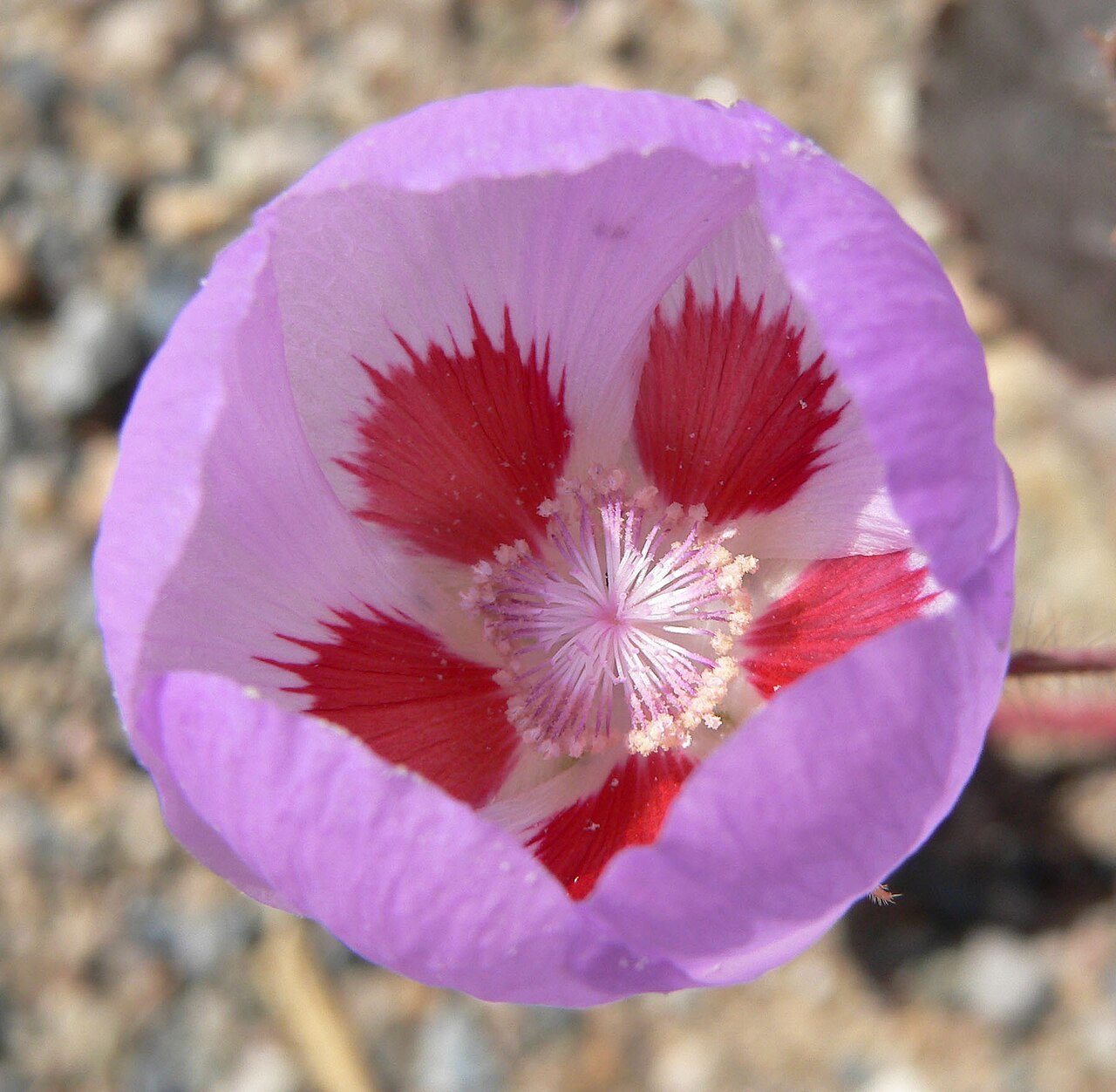
Eremalche rotundifolia, known as Desert Fivespot (also desert five-spot), is a spring annual of the mallow family (Malvaceae) that grows in the Mojave and Sonoran deserts of southeastern California, southern Nevada and western Arizona. It was formerly called Malvastrum rotundifolium. In wet years it is one of the most admired wildflowers of the desert, and it is a favorite during superblooms in places such as Death Valley, Joshua Tree and Anza-Borrego.
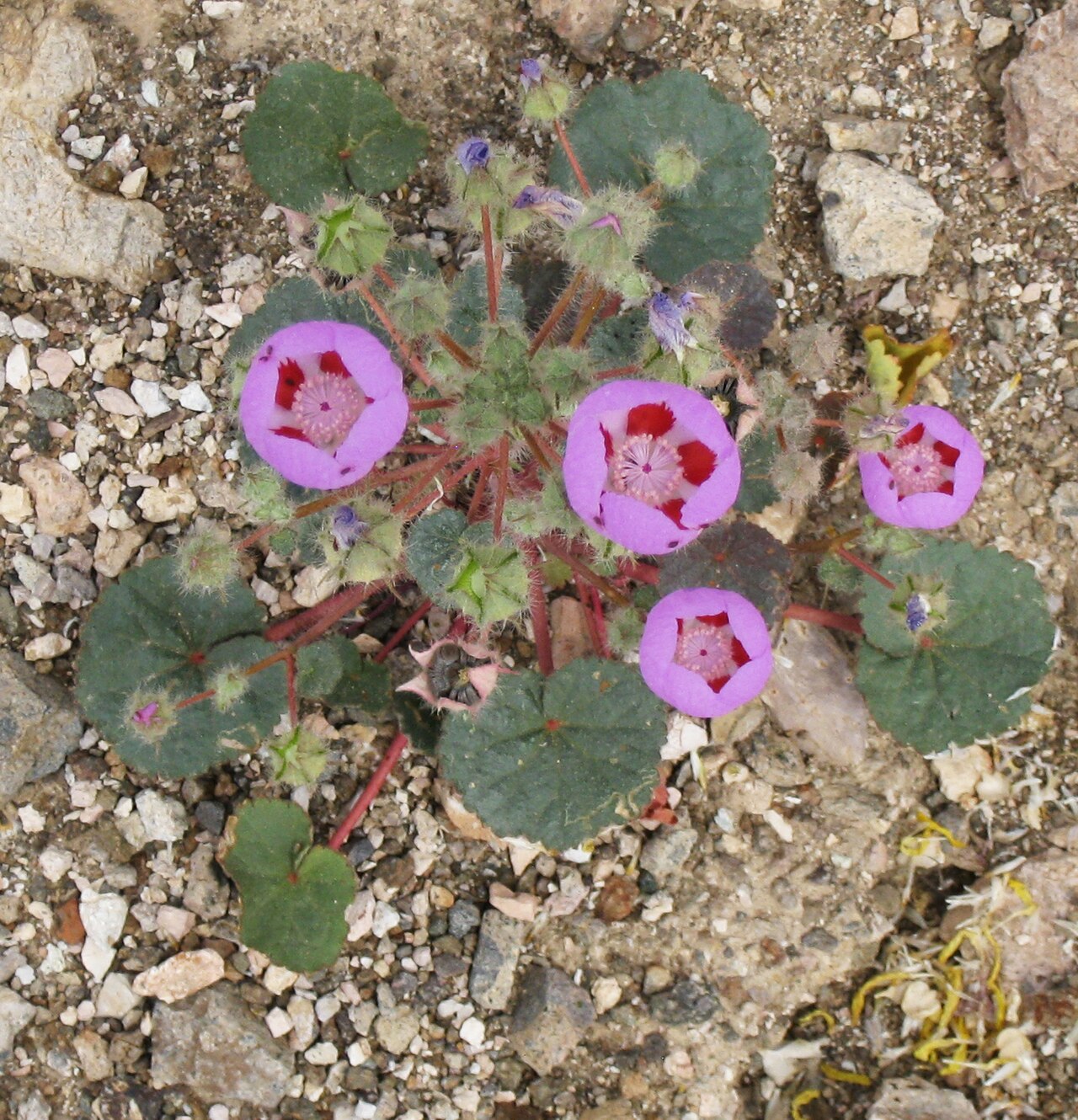
Each plant has an upright, hairy stem 4 to 24 inches tall with round, scalloped leaves on long stalks. Near the top are globe-shaped, lavender-pink flowers about an inch across. The petals curve inward to form a bowl, and inside each petal is a bright red spot at the base. When sunlight shines through the thin petals, the flowers seem to glow like small lanterns.
Desert fivespot germinates after good winter rains, flowers from about February to May, sets seed and dies as the desert heats up. Its seeds can wait in the soil through dry years. It is challenging to grow outside the desert, but it can be sown in desert gardens with very well-drained soil and winter rain.
Identification
Desert fivespot is unmistakable in flower: a lavender-pink, globe-shaped mallow flower with five red spots inside, on a small, hairy desert annual with round leaves.
Growth Habit
Plants have one main stem, or a few, that are upright and usually 4 to 24 inches tall, depending on rainfall. Stems are often reddish and covered with stiff, star-shaped and simple hairs. In dry years plants may be only a few inches tall with a single flower; in wet years they are taller and branched.
Leaves
The leaves are round to kidney-shaped, about 1/2 to 2 inches wide, with scalloped or shallowly toothed edges and long stalks. They are dark green, often with reddish veins or stalks, and slightly hairy. Most leaves are on the lower half of the plant.
Flowers
The flowers are about 3/4 to 1 1/4 inches across and grow on short stalks near the top of the plant. The five lavender-pink to rose-purple petals curve inward to form a globe or bowl. Each petal has a deep red spot near its base, so the inside of the flower shows five red spots around a pale center with a column of stamens. The flowers open in sun and partly close at night.
Fruit & Seeds
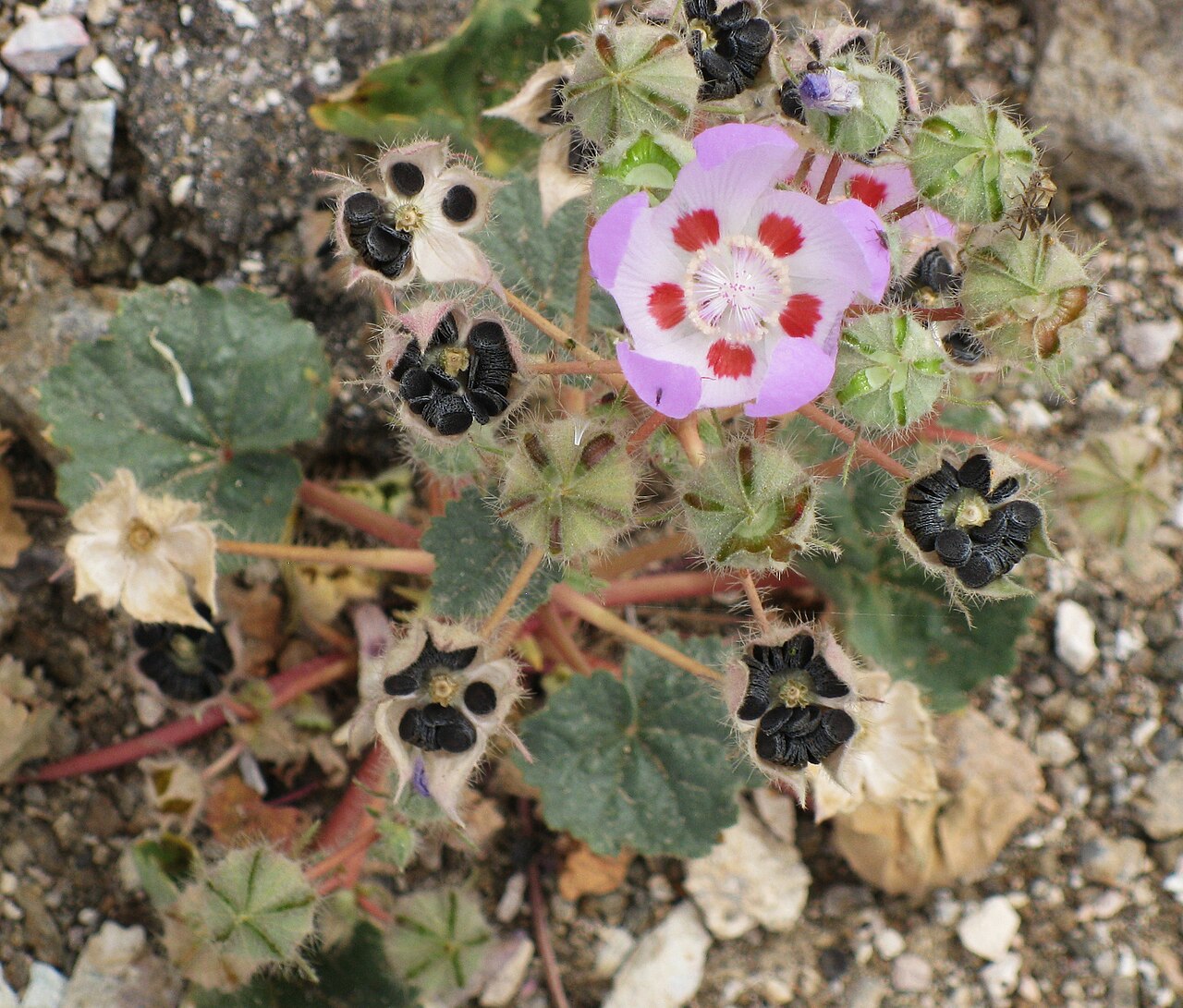
Like other mallows, the fruit is a flat, round ring of small segments (mericarps) arranged like the sections of a wheel or a cheese wheel. The segments turn dark as they ripen and break apart, each containing a seed.
Look-alikes
White mallow (Eremalche exilis) is a small, sprawling relative with tiny white to pale pink flowers. Desert globemallow (Sphaeralcea ambigua) is a perennial with orange (sometimes pink) saucer-shaped flowers and gray, lobed leaves. No other desert wildflower has the combination of a pink globe flower and five red interior spots.
Safety
Desert fivespot is not known to be toxic. Flowers in national parks and other protected areas must not be picked or collected; please enjoy and photograph them in place.
Quick Facts
| Scientific Name | Eremalche rotundifolia |
| Family | Malvaceae (mallow family) |
| Plant Type | Spring annual wildflower |
| Mature Height | 4–24 in |
| Mature Spread | 4–12 in |
| Growth Rate | Fast after winter rains |
| Sun Exposure | Full sun |
| Water Needs | Very low; winter rain only |
| Soil Type | Sandy or gravelly, well-drained desert soil |
| Soil pH | About 7.0–8.5 |
| Bloom Time | February–May |
| Flower Color | Lavender-pink with five red spots |
| Fall Color | None; dies by early summer |
| Fruit | Round, wheel-like ring of seed segments |
| Deer Resistant | Not usually browsed in its range |
| USDA Hardiness Zones | 8–10 (grows as a cool-season annual) |
Native Range
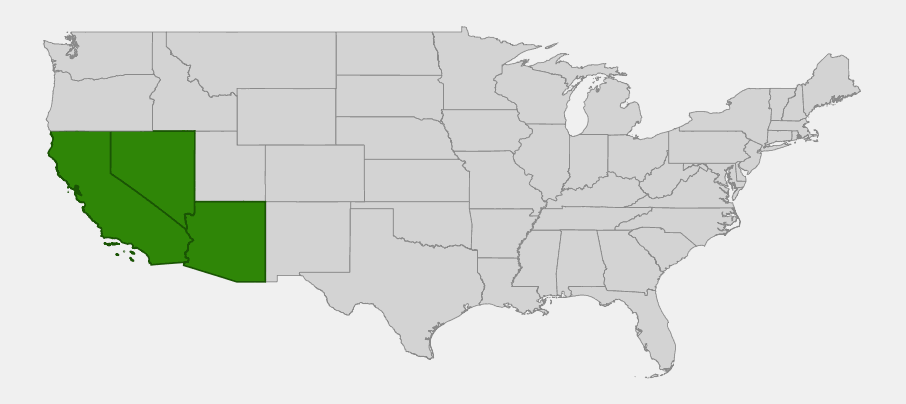
Desert fivespot is native to the deserts of the southwestern United States and northwestern Mexico. USDA PLANTS lists it as native in the lower 48 states and records it from three states: Arizona, California and Nevada. It also extends into northwestern Mexico.
In California it is found in the Mojave and Colorado (Sonoran) deserts, including Death Valley, Joshua Tree and Anza-Borrego. In Nevada it grows in the southern part of the state, and in Arizona it grows in the western deserts near the Colorado River. Its abundance changes greatly from year to year depending on winter rain: in dry years few plants appear, but after wet winters it can bloom by the thousands.
It grows on desert washes, gravelly alluvial fans, rocky slopes and sandy flats, usually in creosote bush scrub, at low elevations. It is often most common in washes and along road edges, where runoff collects.
📋 Regional plant lists featuring Desert Fivespot: Arizona & New Mexico · California & Nevada
Growing & Care Guide
Desert fivespot is a plant for desert gardens in its native region, where it can be grown from seed. It is rarely available as a plant, and it does not transplant well. Do not collect plants or seed in national parks or other protected areas; buy seed from native seed suppliers.
Light
Full sun is essential. It will not flower well in shade.
Soil & Water
Use very well-drained, sandy or gravelly soil, like that of a desert wash. In its range, winter rain is usually enough. In dry winters, a few deep waterings from late fall to early spring can help, but stop watering once flowering ends. Too much water or rich soil causes rot and weak growth.
Planting Tips
Sow seed directly in the garden in fall or early winter, just before the rainy season, and cover it lightly. Mix it with other desert annuals such as desert sunflower, desert dandelion, sand verbena and desert bluebells for a spring wildflower display between shrubs such as creosote bush and bursage.
Pruning & Maintenance
No pruning is needed. Leave plants in place after flowering so the seeds can ripen and fall to the soil for the next year. Keep the area free of non-native annual grasses and mustards, which compete strongly with native desert wildflowers.
Propagation
Grow it from seed only. Seeds of mallows often have hard coats; nicking the seed or soaking it in hot water before sowing can improve germination. In the wild, some seeds stay dormant in the soil for years, which spreads germination over several rainy seasons.
Landscape Uses
- Desert wildflower gardens: showy spring color in sandy or gravelly beds
- Pollinator plantings: early nectar and pollen for desert bees
- Wildflower viewing: a highlight of desert superblooms
- Habitat restoration: seeding disturbed desert washes and flats
- Education: a classic example of a desert annual that waits for rain
Wildlife & Ecological Value
Desert fivespot is part of the burst of life that follows good winter rains in the desert, when annual wildflowers, insects and animals all make the most of a short growing season.
For Pollinators
The bowl-shaped flowers are visited by native bees, including small solitary bees that specialize in mallow pollen, as well as beetles and other insects. Insects often shelter inside the cup-shaped flowers, and the red spots may help guide them to the center.
For Birds
Seed-eating birds such as sparrows and quail may eat the seeds after they fall from the ripe fruit.
For Mammals
Desert rodents such as kangaroo rats and pocket mice collect and store the seeds of desert annuals, including mallows.
Ecosystem Role
As a winter annual, desert fivespot builds up a seed bank in desert soils that lets it survive years of drought. In good years it is one of many annuals that briefly cover the desert floor, feeding insects and the animals that eat them. Invasive grasses and mustards that crowd out native annuals are a threat to these displays.
Cultural & Historical Uses
The genus name Eremalche comes from the Greek eremos, “desert” or “solitary,” and malache, “mallow,” so it means desert mallow. The species name rotundifolia means round-leaved. Asa Gray first described the plant as Malvastrum rotundifolium in the 19th century, and it was later moved to Eremalche.
Desert fivespot is one of the best-known wildflowers of Death Valley National Park. During widespread blooms after unusually wet winters, such as the 2016 superbloom, its flowers draw many visitors and photographers. Park rules prohibit picking or collecting wildflowers.
The plant was also painted by early wildflower artists. A watercolor by Mary Vaux Walcott is held in the Smithsonian American Art Museum, and it appeared in Margaret Armstrong’s Field Book of Western Wild Flowers (1915) under its older name.
Frequently Asked Questions
Why is it called desert fivespot?
Each of its five lavender-pink petals has a bright red spot at the base, so the inside of the flower shows five red spots.
When and where can I see it?
In spring, usually February to May, in the Mojave and Sonoran deserts of California, southern Nevada and western Arizona. It is most abundant after wet winters.
Is it an annual?
Yes. It sprouts after winter rain, flowers in spring and dies by early summer. Its seeds can remain dormant in the soil for years.
Can I grow desert fivespot?
In desert gardens, yes, from seed sown in fall in sandy or gravelly soil with full sun. It is difficult in humid or wet-summer climates.
Is it related to hibiscus?
Yes. It belongs to the mallow family, Malvaceae, which also includes hibiscus, hollyhocks and globemallows.

Looking for a nursery that carries Desert Fivespot?
Browse our native plant nursery directory: Arizona · California · Nevada