Downy Yellow Violet (Viola pubescens)
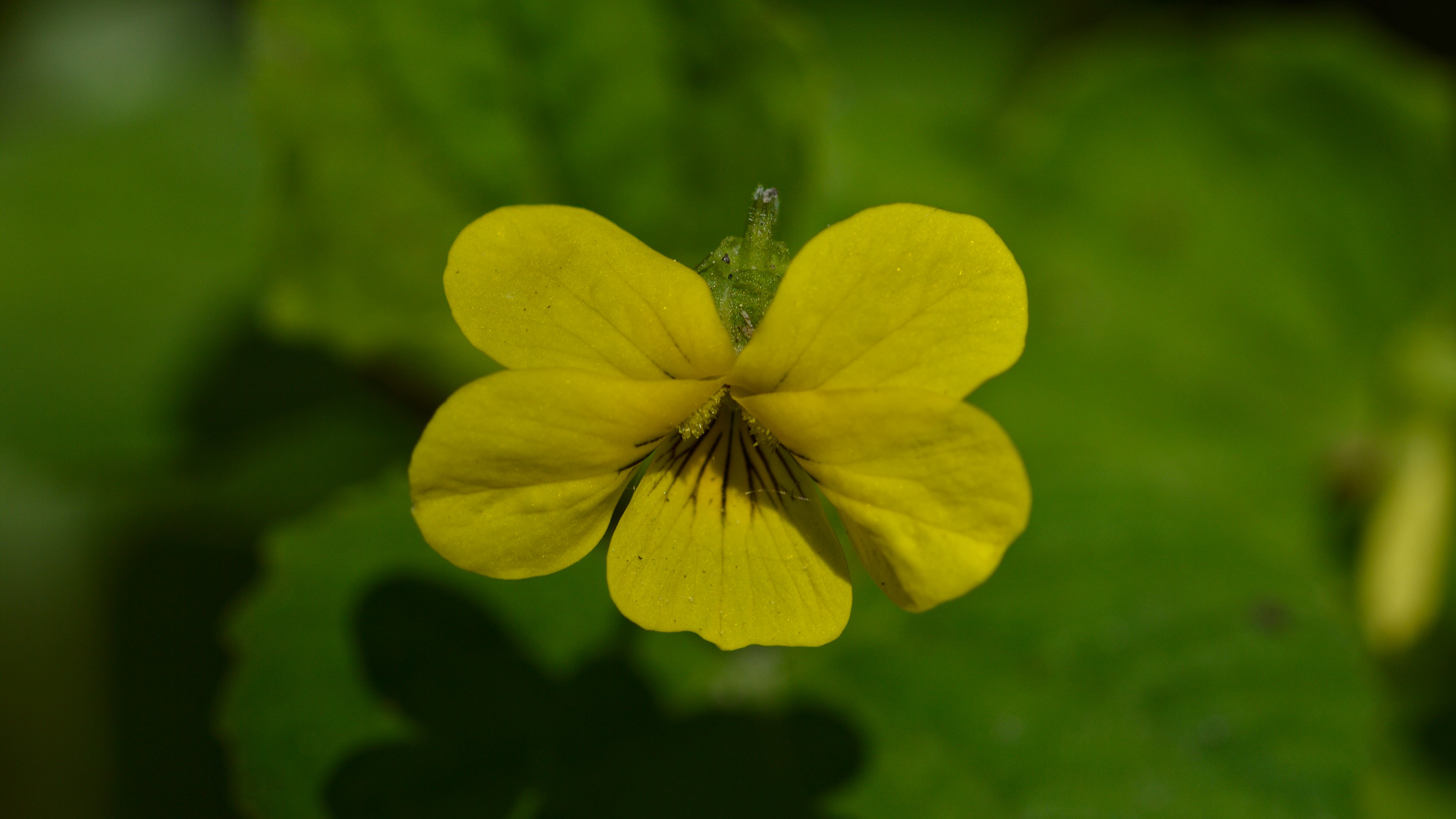
Viola pubescens, the Downy Yellow Violet, is one of the most widespread native violets of eastern North America’s deciduous forests. Unlike the familiar purple and blue violets of spring roadsides, this species produces cheerful bright yellow flowers above softly hairy (pubescent) foliage — an unusual combination that makes it instantly distinctive among the spring ephemeral wildflowers of the woodland floor. As a member of the Violaceae (violet) family, it shares the characteristic asymmetrical five-petaled flower of all violets, with the lower three petals bearing dark purple guide lines that direct pollinators toward the nectar-producing spur.
Downy Yellow Violet blooms in April and May, precisely when the forest canopy is still open and light floods the woodland floor. Its broad, heart-shaped leaves are covered in soft downy hairs — the feature that gives the species its common name — and remain as attractive, shade-tolerant foliage throughout the growing season long after the flowers have faded. The plant also produces cleistogamous flowers (self-pollinating flowers that never open) later in the season, ensuring seed production even when pollinators are scarce.
This understated woodland gem thrives in the dappled shade of mature deciduous forests alongside spring beauty, trout lily, trilliums, and other ephemerals. It is an excellent low-maintenance groundcover for shaded native plant gardens, where it will gradually spread by seed to form a natural carpet under trees. Its leaves are a documented host plant for the larvae of several native fritillary butterfly species, making it ecologically essential far beyond its modest appearance.
Identification
Downy Yellow Violet is a stemmed violet — unlike many violet species that produce only basal leaves and leafless flower stalks, this species produces leafy stems with both leaves and flowers arising from the same stem. Plants typically grow 6 to 14 inches tall. The key identification features are the combination of yellow flowers and softly hairy (pubescent) leaves and stems.
Leaves
Leaves are broadly heart-shaped (cordate) to ovate, 2–4 inches wide, with a rounded to pointed tip and shallowly scalloped margins. Both surfaces are covered with soft, downy hairs, giving the leaves a velvety texture. Basal leaves are present early in the season; stem leaves are similar but slightly smaller and arranged alternately on the flowering stems. Leaf color is medium green, and the foliage remains attractive well into fall, providing a reliable groundcover for shaded areas.
Flowers & Fruit
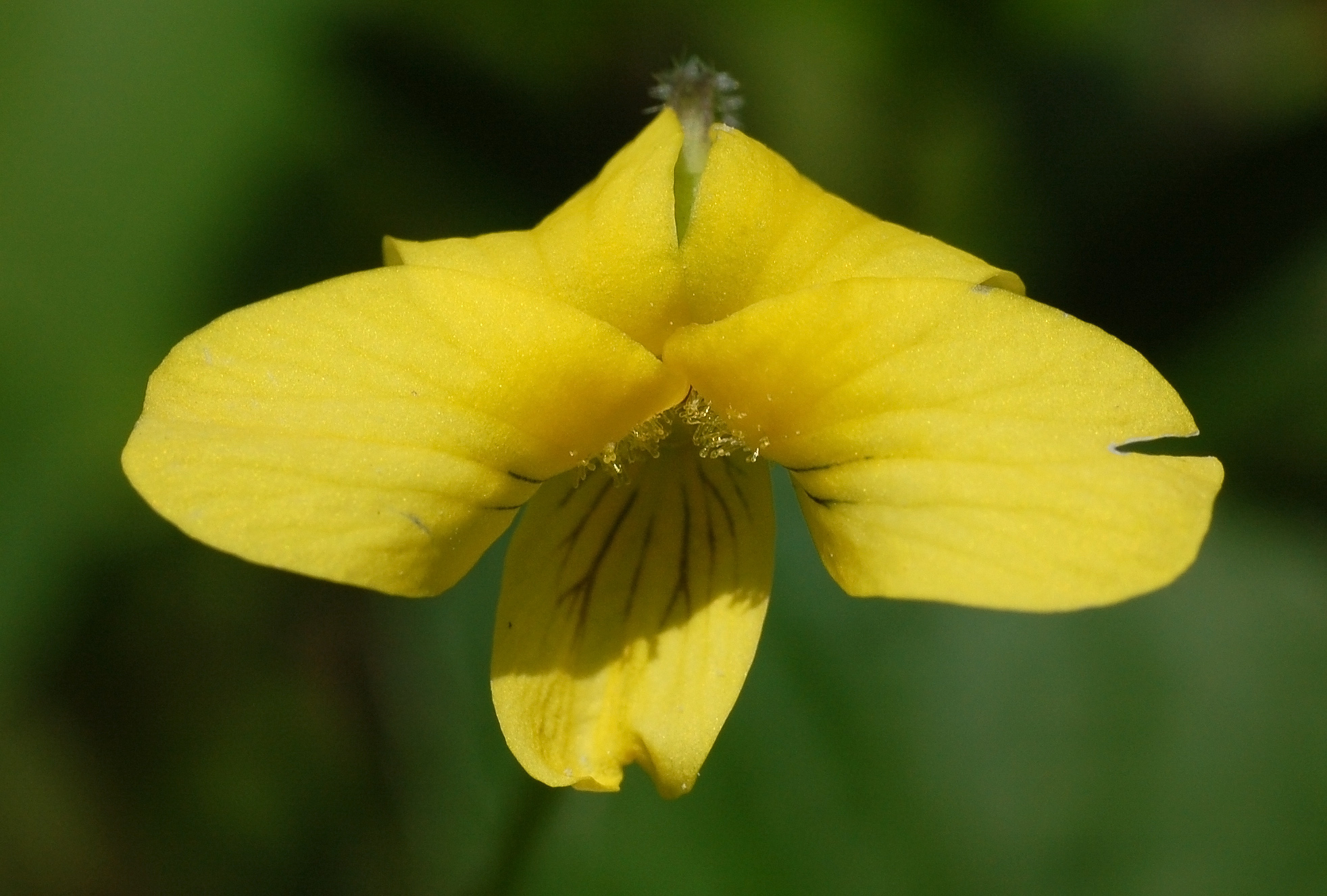
Flowers are bright yellow, typically ½ to ¾ inch across, with 5 asymmetric petals. The two lateral petals are bearded with small club-tipped hairs (a characteristic of many violet species), and the lower three petals bear dark brownish-purple veins (nectar guides) that lead pollinators to the small spur containing nectar. Flowers bloom from April through May. Later in the season, the plant produces cleistogamous (closed, self-pollinating) flowers at or near ground level that ensure seed set without pollinator visits. The seed capsules split into three sections when ripe, often ejecting seeds explosively several feet from the parent plant.
Quick Facts
| Scientific Name | Viola pubescens |
| Family | Violaceae (Violet Family) |
| Plant Type | Herbaceous Perennial Wildflower |
| Mature Height | 6–14 in |
| Sun Exposure | Part Shade to Full Shade |
| Water Needs | Moderate |
| Bloom Time | April – May |
| Flower Color | Bright yellow with purple nectar guides |
| Soil Type | Moist, well-drained; humus-rich woodland soil |
| Deer Resistant | Somewhat (rarely heavily browsed) |
| USDA Hardiness Zones | 3–8 |
Native Range
Downy Yellow Violet ranges across a vast area of eastern North America, from Nova Scotia and southern Quebec westward through Ontario to Manitoba, and south throughout the eastern and central United States. In the United States, it occurs from Maine and the Maritime states southward through the Appalachians to Georgia and Alabama, westward through the Midwest to Kansas, Nebraska, and South Dakota. It is among the most widely distributed native violet species in eastern North America.
The species is a characteristic plant of mature deciduous and mixed forests, particularly those dominated by oaks, maples, beeches, and hickories. It is most abundant in the understory of undisturbed second-growth and old-growth forests, where the leaf litter layer is deep and moisture is consistently moderate. It often grows alongside trilliums, trout lilies, wild ginger, bloodroot, and other woodland wildflowers in rich, mesic (moderately moist) forest sites.
Downy Yellow Violet tolerates a range of soil conditions and is one of the more adaptable native violets, found on slopes, flats, and even rocky woodland edges. It is shade-tolerant but grows best with some dappled light reaching the forest floor, making it particularly well suited to the partly open woodland understory rather than the densest, darkest parts of the forest interior. Populations are generally stable across the species’ range, though forest fragmentation and invasive plant competition (especially garlic mustard) threaten local populations in some areas.
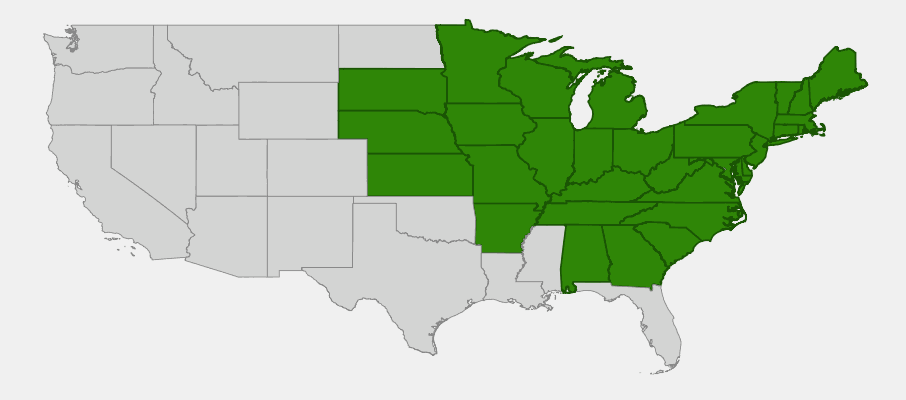
📋 Regional plant lists featuring Downy Yellow Violet: Southeastern U.S.
Growing & Care Guide
Downy Yellow Violet is among the easiest native wildflowers to establish and maintain in a woodland garden. Its adaptability to shade and modest water requirements make it ideal for the challenging conditions found under mature trees.
Light
This violet thrives in partial shade to full shade — conditions that mimic its natural habitat in deciduous forest understory. It performs best with 2 to 5 hours of dappled light daily, such as the shifting light beneath open-canopied trees. It tolerates deeper shade than most flowering perennials, making it useful in spots where few other plants will bloom. Avoid full sun, which causes leaf scorch and quickly desiccates the shallow root system.
Soil & Water
Downy Yellow Violet prefers moist, humus-rich soil with a slightly acidic to neutral pH (5.5–7.0). It grows naturally in the leaf litter layer of deciduous forests, so amending planting areas with compost and leaf mold creates ideal conditions. Water needs are moderate — the soil should remain consistently moist but not waterlogged. Established plants have reasonable drought tolerance in shaded conditions. Annual topdressing with fallen leaves mimics natural conditions and maintains soil moisture and fertility.
Planting Tips
Plant in fall or early spring. Container plants establish readily; bare-root plants can be planted while dormant in very early spring. Space plants 12–18 inches apart; they will self-seed and gradually fill gaps to form a natural groundcover. Downy Yellow Violet spreads both by seed (ejected ballistically from capsules) and by short rhizome growth, forming loose, natural-looking colonies over time. It is not aggressive and coexists well with other woodland wildflowers.
Pruning & Maintenance
Virtually no maintenance is required. Allow the foliage to die back naturally in fall. Do not rake away fallen leaves from the planting area, as the leaf layer provides essential moisture retention, winter insulation for the crown, and habitat for the pupating larvae of fritillary butterflies that host on violet leaves. Remove invasive plants — especially garlic mustard (Alliaria petiolata) — which compete aggressively with woodland wildflowers including violets.
Landscape Uses
- Shaded groundcover beneath mature deciduous trees
- Woodland garden companion to trilliums, ferns, and spring ephemerals
- Fritillary butterfly garden — essential larval host plant
- Naturalizing at woodland edges and path borders
- Rain garden understory in partially shaded, moist sites
- Native lawn alternative in lightly shaded areas
Wildlife & Ecological Value
Downy Yellow Violet plays a surprisingly large ecological role for such a modest plant. Its greatest importance lies in its relationship with fritillary butterflies, whose larvae depend on violet leaves as their sole food source.
For Birds
Seeds of Downy Yellow Violet are consumed by several ground-feeding birds, including Mourning Doves, Wild Turkey, Ruffed Grouse, and various sparrows. The plants also provide cover for ground-nesting birds in woodland settings, and the insects attracted to the flowers contribute to the overall invertebrate abundance that insectivorous birds depend on.
For Mammals
White-tailed deer occasionally browse the foliage, though violets are not typically a preferred deer food. Wild turkeys eat the seeds. Meadow voles and white-footed mice may consume the small rootstocks. The plants are generally not heavily impacted by mammal herbivory compared to many other woodland wildflowers.
For Pollinators
Early-flying queen bumblebees are the primary pollinators of Downy Yellow Violet, their long tongues able to reach the nectar spur. Mining bees (Andrena species) and mason bees also visit the flowers. The early spring bloom time — when most wildflowers have not yet opened — makes these violets a valuable early nectar source for emerging pollinators.
For Butterflies (Larval Host)
Downy Yellow Violet is a documented larval host plant for several native fritillary butterflies, including the Great Spangled Fritillary (Speyeria cybele), Aphrodite Fritillary (S. aphrodite), and Diana Fritillary (S. diana). The female butterflies lay eggs near violet plants in late summer; the newly hatched larvae overwinter and begin feeding on violet leaves the following spring. Without native violets, these spectacular butterflies cannot complete their life cycle — making Downy Yellow Violet an irreplaceable component of the woodland butterfly community.
Ecosystem Role
As a common element of the woodland floor community, Downy Yellow Violet contributes to the rich tapestry of spring wildflowers that characterizes healthy eastern deciduous forests. It provides floral resources during the critical early spring period, serves as the sole larval food source for multiple fritillary butterflies, and participates in the myrmecochory (seed dispersal by ants) network that characterizes many woodland wildflowers. The elaiosome (fatty appendage) attached to violet seeds is a preferred ant food, and ants carry the seeds to their nests, effectively planting the violets in new locations.
Cultural & Historical Uses
Violets, including yellow-flowered species, were widely known and utilized by Indigenous peoples throughout eastern North America. Various nations used violet leaves as food — the young leaves are mild-flavored, nutritious, and high in vitamins A and C. They were eaten raw in salads, cooked as pot greens, or used to thicken soups (the mucilaginous quality of cooked violet leaves serves as a natural thickener similar to okra). The Cherokee used yellow violets medicinally to treat headaches by inhaling crushed leaves.
European settlers incorporated violets into their home medicine chests as well. Violet leaf and flower preparations were used as demulcents (soothing agents for inflamed mucous membranes), and violet flower syrup was a traditional remedy for coughs, sore throats, and respiratory congestion. Violet flowers were crystallized in sugar as confections or used fresh in salads and as cake decorations — practices that continue today with edible flower enthusiasts.
The plant’s role as a fritillary butterfly host was not understood scientifically until modern ecological studies, but Indigenous observations of the connection between violets and the beautiful orange butterflies that lay eggs on them were surely made long before Western science documented the relationship. Today, Downy Yellow Violet is increasingly appreciated as a keystone plant in woodland butterfly conservation — its cultivation in home gardens directly supports declining fritillary populations.
Frequently Asked Questions
What makes Downy Yellow Violet different from other yellow violets?
The key feature is the soft, downy pubescence (tiny hairs) on the leaves and stems — hence “downy” in the common name. Some taxonomists recognize a related variety (V. pubescens var. scabriuscula) that is less hairy with fewer basal leaves, but most modern treatments include these under the species Viola pubescens. The combination of yellow flowers and hairy foliage distinguishes it from smooth yellow violet species.
Can Downy Yellow Violet spread aggressively?
No — it is well-behaved in garden settings. It self-seeds modestly and forms gradually expanding colonies, but it is not aggressive. If seedlings appear where you don’t want them, they are easy to remove by hand. Its gentle spreading nature is generally welcome in naturalistic woodland gardens.
Will fritillary butterflies use my garden Downy Yellow Violet?
Yes, if great spangled or aphrodite fritillaries are present in your area. Female fritillaries lay eggs near (but not always directly on) violet plants in late summer. The larvae that hatch in fall immediately go dormant and begin feeding on violet leaves the following spring. To support fritillaries, it is important to leave the leaf litter around violets undisturbed through fall and winter, as the tiny larvae overwinter in the leaf layer.
Are the leaves and flowers edible?
Yes — violet leaves and flowers are edible and have been used as food for thousands of years. Young leaves are mild and nutritious, suitable for salads or cooked greens. The flowers can be eaten fresh, crystallized, or used as a garnish. However, do not consume large quantities, and avoid plants that may have been sprayed with pesticides.
How do I establish Downy Yellow Violet from seed?
Violet seeds benefit from cold stratification. Collect seeds when the capsules just begin to split (before the seeds eject). Store seeds in a damp paper towel in the refrigerator for 60–90 days, then sow in moist seed-starting mix. Surface sow or barely cover with soil. Germination occurs in spring. Seedlings grow slowly their first year and may not bloom until their second or third year.

Looking for a nursery that carries Downy Yellow Violet?
Browse our native plant nursery directory: Virginia · North Carolina · Georgia