Dwarf Dogwood (Cornus canadensis)
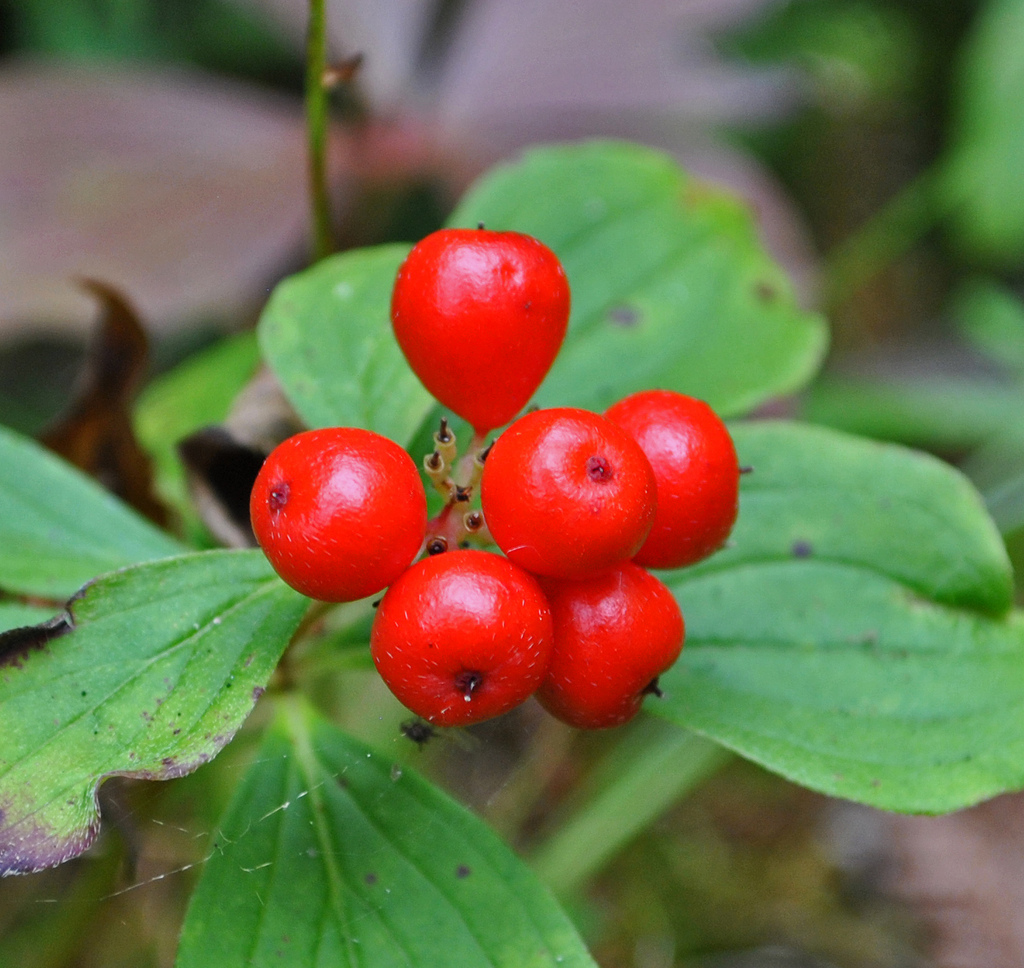
Cornus canadensis, commonly known as Dwarf Dogwood, is one of North America’s most distinctive woodland groundcovers. Also called Canadian Bunchberry, this diminutive member of the dogwood family creates carpets of glossy green leaves topped by elegant white flowers and brilliant red berries. Despite its small stature—rarely exceeding 8 inches tall—this remarkable plant produces one of the fastest mechanical actions in the plant kingdom, catapulting pollen at speeds that rival a bullet.
Quick Facts
| Scientific Name | Cornus canadensis |
| Plant Type | Herbaceous perennial groundcover |
| Height | 4-8 inches (10-20 cm) |
| Sun Exposure | Full Shade |
| Water Needs | High |
| Soil Type | Rich, organic, well-draining |
| Soil pH | Acidic (5.0-6.5) |
| Bloom Time | Late spring to midsummer (June-July) |
| Flower Color | White bracts, tiny greenish flowers |
| USDA Hardiness Zones | 2-7 |
Identification
Dwarf Dogwood is unmistakable once you know what to look for. This low-growing perennial spreads via slender underground rhizomes that run 1-3 inches deep, sending up unbranched stems topped with distinctive whorled leaves. The plant forms extensive colonies under the forest canopy, creating living carpets that can stretch for yards.
Leaves
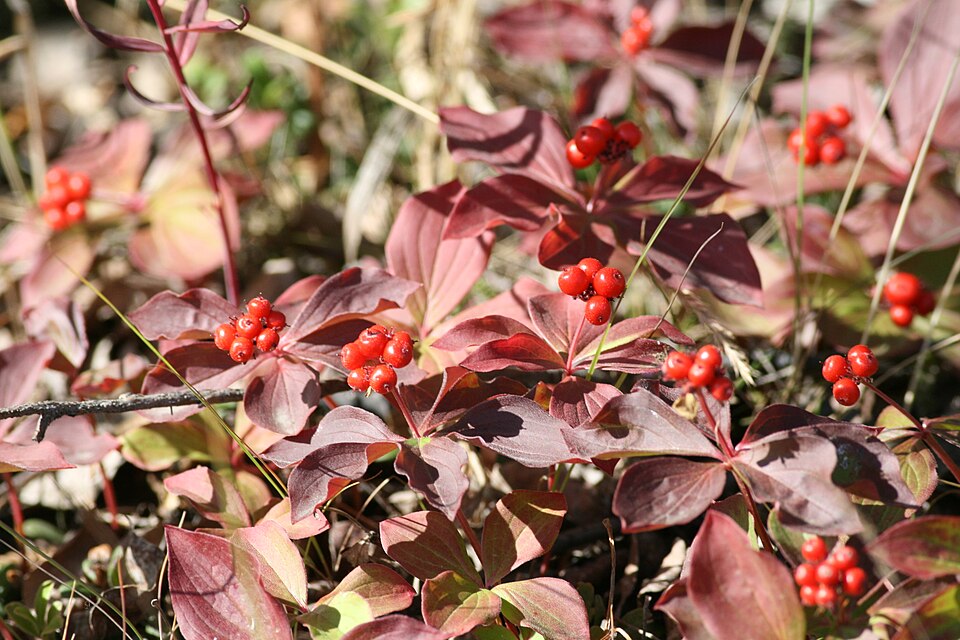
The glossy, dark green leaves are arranged in an apparent whorl of six at the stem tip, though technically they’re oppositely arranged with compressed internodes. Four of these leaves are larger (1.5-3 inches long), while two are smaller, developing from axillary buds. Each leaf is obovate with prominent parallel veins running from base to tip, creating a distinctive ribbed appearance. The leaves have entire margins and abruptly pointed tips. In autumn, they develop beautiful red tinting along the veins before turning completely crimson.
Flowers
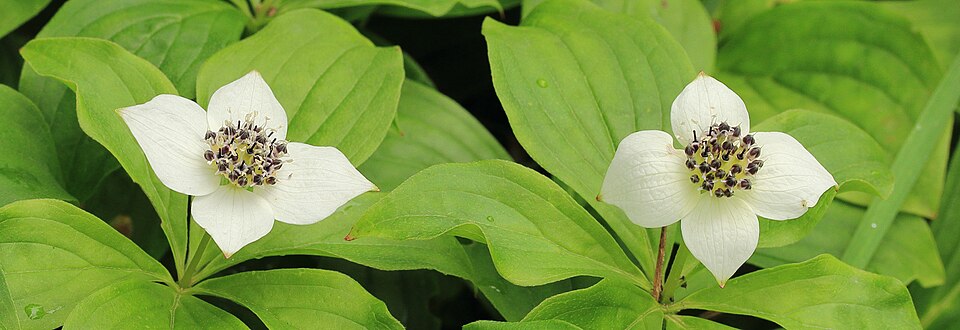
The “flowers” that catch your eye aren’t actually petals—they’re four large white bracts that surround a cluster of tiny, inconspicuous greenish flowers. These showy bracts are broadly ovate, ½ to 1 inch long, with seven parallel veins. The actual flowers are clustered in a compound terminal cyme at the center, each flower tiny but perfectly formed with yellowish anthers. The entire display creates a four-petaled appearance that’s both elegant and distinctive.
What makes these flowers truly remarkable is their explosive pollination mechanism. The stamens are held under tension beneath the petals, and when triggered by a visiting pollinator, they snap upward with incredible force—accelerating at 24,000 meters per second squared. This catapults pollen into the air in less than half a millisecond, making it one of the fastest movements in the plant kingdom.
Fruit
By late summer, clusters of brilliant red drupes replace the flowers. Each berry is about ¼ inch across, containing one or two hard seeds. While edible, the fruits have little flavor and the pulp doesn’t separate easily from the large, crunchy seeds. These bright berries are the plant’s main visual appeal in fall, often persisting into early autumn.
Native Range
Dwarf Dogwood has one of the most extensive native ranges of any North American wildflower. It spans the continent from coast to coast and extends well into the boreal regions of Canada and Alaska. In the western United States, you’ll find it from sea level to mountain elevations throughout the Pacific Northwest, extending into the Rocky Mountains and northern Great Plains.
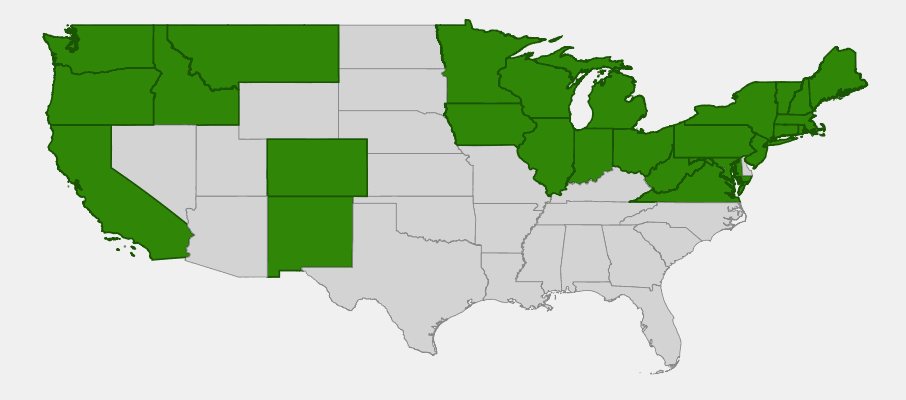
This remarkable distribution reflects the plant’s adaptation to cool, moist climates. In the west, it thrives in the understory of coniferous forests from the coastal fog belt to high mountain meadows. In the east, it’s equally at home in northern hardwood forests and boreal woodlands. The species also extends into eastern Asia, making it a true circumboreal plant.
📋 Regional plant lists featuring Dwarf Dogwood: Western Oregon & Western Washington
📋 Regional plant lists featuring Dwarf Dogwood: Western Oregon & Western Washington
Growing & Care Guide
Dwarf Dogwood can be a rewarding addition to woodland gardens, but it requires specific conditions to thrive. This is not a plant for sunny borders or dry soils—it demands the cool, moist environment of its native forest habitat.
Light Requirements
This is fundamentally a shade plant, evolved for life under the forest canopy. It performs best in partial to full shade, tolerating only morning sun in cooler climates. In its native range, it typically receives filtered light through the tree canopy, with perhaps 10-30% of full sun reaching the forest floor. Direct afternoon sun, especially in warmer climates, will quickly stress and kill the plant.
Soil Preferences
The key to successful Dwarf Dogwood cultivation is understanding its soil needs. It requires acidic soil with a pH between 5.0-6.5, rich in organic matter and consistently moist but well-draining. The ideal growing medium mimics forest floor conditions: a deep layer of decomposing leaves, conifer needles, and organic debris over mineral soil.
In cultivation, amend heavy clay with organic matter and ensure excellent drainage to prevent root rot. Sandy soils need significant organic amendment to retain the consistent moisture this plant requires. A thick mulch layer of shredded leaves or conifer needles helps maintain soil conditions and suppress competing vegetation.
Water Needs
Consistent moisture is absolutely critical. The plant’s shallow rhizome system and natural habitat in regions with reliable precipitation mean it cannot tolerate drought stress. In garden settings, this typically means supplemental irrigation during dry periods, maintaining soil moisture similar to a wrung-out sponge.
However, “moist” doesn’t mean waterlogged. The soil should drain freely while retaining moisture in the organic layer. Poor drainage leads to rhizome rot, while drought stress causes the leaves to wilt and the plant to retreat underground.
Planting Tips
Dwarf Dogwood is challenging to establish from seed and typically propagated through division of rhizomes. If you can source plants, establish them in spring when soil moisture is naturally high. Plant at the same depth they were growing previously, ensuring the rhizomes are adequately covered but not buried deeply.
Space plants 12-18 inches apart if you want coverage within a few years, though individual plants will naturally spread to form colonies. Be patient—this is a slow-growing species that may take 2-3 years to become established.
Maintenance
Once established in suitable conditions, Dwarf Dogwood requires minimal care. The main maintenance involves preserving the organic mulch layer and ensuring consistent moisture. Avoid disturbing the shallow rhizome system with cultivation.
In fall, allow the beautiful autumn foliage to decompose in place, adding to the organic layer. Remove any competing weeds carefully to avoid damaging the shallow root system.
Wildlife & Ecological Value
Dwarf Dogwood plays important ecological roles throughout its vast range, supporting wildlife from insects to large mammals.
Pollinators
Despite—or perhaps because of—its explosive pollination mechanism, Dwarf Dogwood attracts numerous pollinators. Bumblebees are primary visitors, along with solitary bees, bee flies, and syrphid flies. The plant’s unique pollen-launching system ensures effective cross-pollination, as the explosive action typically coats visiting insects with pollen that they carry to the next flower.
The timing of bloom, from late spring to midsummer, provides nectar and pollen when many forest understory plants have finished flowering, making it a valuable late-season resource for woodland pollinators.
Birds
The bright red berries are the plant’s primary wildlife value, attracting numerous bird species during fall migration. Thrushes, vireos, and warblers consume the fruits, helping to disperse seeds across the landscape. The berries ripen just as many migratory songbirds are building fat reserves for their southern journey, making them an important food source.
Ground-feeding birds also benefit from fallen berries, and the dense colonies provide cover and nesting sites for small forest birds.
Mammals
Large herbivores find Dwarf Dogwood particularly valuable. In Alaska and northern regions, it’s an important forage plant for moose, mule deer, and black-tailed deer throughout the growing season. The leaves, stems, and berries are all consumed, providing both nutrition and moisture.
Small mammals, including chipmunks and squirrels, also harvest the berries for winter storage, further contributing to seed dispersal.
Ecosystem Role
As a dominant understory species in many northern forests, Dwarf Dogwood helps stabilize forest floor conditions. Its rhizomatous growth pattern helps prevent soil erosion, while its deciduous leaves contribute organic matter to forest soils.
The plant’s ability to form extensive colonies creates microhabitat conditions that support forest floor invertebrates, amphibians, and small reptiles. Its presence often indicates healthy, mature forest ecosystems with the cool, moist conditions many woodland species require.
Cultural and Historical Uses
Indigenous peoples throughout Dwarf Dogwood’s range have found uses for this distinctive plant. The Inuit and other northern peoples traditionally ate the berries, though they’re somewhat bland and require significant processing to be palatable. The berries were sometimes mixed with other fruits or used in puddings after cooking and straining to remove the large, hard seeds.
In traditional medicine systems, various parts of the plant were used for treating ailments, though specific uses varied among different cultural groups. The plant’s widespread distribution meant it was known to many Indigenous communities across North America.
Today, Dwarf Dogwood has found a place in specialized woodland gardens, where it’s valued for its unique flowers, attractive berries, and excellent fall color. However, its specific growing requirements limit its use to gardeners who can provide appropriate conditions.
Gardening Applications
In the right conditions, Dwarf Dogwood makes an exceptional groundcover for woodland gardens. Its low growth habit, seasonal interest, and ability to form natural colonies make it ideal for naturalizing under trees or in woodland settings.
Consider using it in:
- Shade gardens: Under established trees or in naturally shaded areas
- Woodland edges: Transitioning from forest to more open areas
- Native plant gardens: As part of authentic regional plant communities
- Rock gardens: In cool, moist areas of alpine or woodland rock gardens
- Erosion control: On shaded slopes where its rhizomatous habit helps stabilize soil
The key is matching its native habitat as closely as possible. If you can provide cool, moist, acidic soil in partial to full shade, Dwarf Dogwood will reward you with years of distinctive beauty and ecological value.
Frequently Asked Questions
Why won’t my Dwarf Dogwood bloom?
Flowering problems usually stem from insufficient chill hours, too much sun, or plants that are too young. Dwarf Dogwood requires a cold winter dormancy period and may not bloom until well-established (2-3 years). Excessive sunlight can also inhibit flowering as the plant focuses energy on survival rather than reproduction.
Can I grow Dwarf Dogwood in containers?
While possible, container cultivation is challenging due to the plant’s moisture requirements and rhizomatous growth habit. If attempting container growing, use a large, deep pot with acidic potting mix and ensure consistent moisture without waterlogging. Expect slower growth and potentially reduced flowering.
How do I propagate Dwarf Dogwood?
Division of established colonies in early spring is the most reliable method. Carefully dig sections of rhizome with attached shoots, ensuring each division has adequate root system. Seeds require cold stratification and have variable germination, making this method less practical for home gardeners.
Is Dwarf Dogwood deer resistant?
Ironically, while deer and other large herbivores consume Dwarf Dogwood in its native range, garden deer often avoid it, possibly due to its low growth habit or the different plant community context in cultivated settings. However, it shouldn’t be considered reliably deer-resistant.

Looking for a nursery that carries Dwarf Dogwood?
Browse our native plant nursery directory: Oregon · Washington