Dwarf Mountain Ash (Sorbus scopulina)
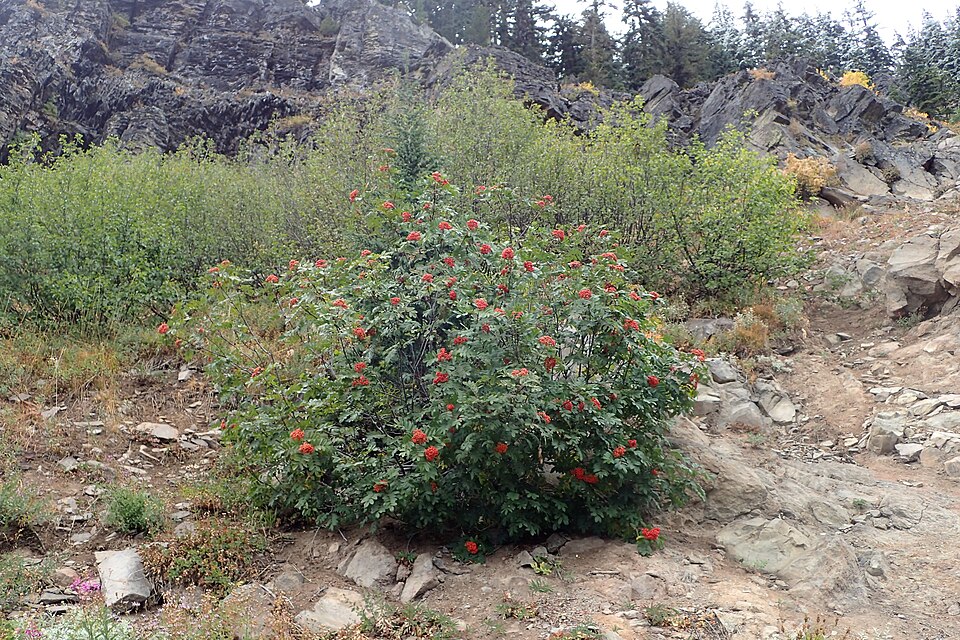
Sorbus scopulina, commonly known as Dwarf Mountain Ash or Greene’s Mountain Ash, is a beautiful native deciduous shrub of the Rocky Mountains, Cascades, and northern Sierra Nevada. This member of the rose family is named for its resemblance to the European Mountain Ash — the pinnately compound leaves, flat-topped white flower clusters, and brilliantly colored berry clusters are strikingly similar — though Sorbus scopulina is a true native of western North American mountain habitats, where it brightens subalpine slopes, rocky ridges, and open forest clearings with color from spring through fall.
Growing naturally in montane to subalpine habitats from Alaska south through the mountain states to Arizona and New Mexico, Dwarf Mountain Ash is perfectly adapted to cold winters, rocky soils, and the bright, open conditions of mountain clearings and forest edges. Despite its “dwarf” common name, it can reach 13 feet in height under favorable conditions, though it more commonly forms a compact, multi-stemmed shrub of 5 to 10 feet at higher elevations where it faces severe winter conditions. Its white flowers in spring, lush compound foliage in summer, spectacular berry clusters in late summer, and brilliant orange-red fall color make it one of the most ornamentally attractive native shrubs of the Mountain West.
Beyond its ornamental qualities, Dwarf Mountain Ash provides exceptional value for mountain wildlife. The berry clusters are an important fall food source for birds including American Robins, Varied Thrushes, Swainson’s Thrushes, and Bohemian Waxwings, as well as bears and other mammals fattening up before winter. In the garden, it is an excellent specimen plant for mountain-style landscapes, rock gardens, and native plant collections.
Identification
Dwarf Mountain Ash typically forms an upright to broadly spreading multi-stemmed shrub, reaching 5 to 13 feet (1.5–4 m) in height. The stems are smooth, reddish-brown to grayish, with prominent large, elongated, sticky buds covered in rusty hairs that are characteristic of the species. Young twigs are often reddish and somewhat hairy, becoming smooth and grayish with age.
Leaves
The leaves are pinnately compound, 4 to 9 inches (10–23 cm) long, with 11 to 15 (occasionally up to 17) leaflets arranged in pairs along a central rachis. Each leaflet is 1 to 2 inches (2.5–5 cm) long, lance-shaped with a sharply pointed tip and sharply toothed margins. The teeth are double and sharp, often curving toward the leaf tip. The upper surface is bright, shiny green; the underside is paler, sometimes hairy. Fall color is spectacular, ranging from orange to deep red.
Flowers
The flowers are small — about ¼ to ½ inch (6–12 mm) across — with 5 white petals and 15 to 20 stamens. They are borne in large, flat-topped compound corymbs measuring 2 to 5 inches (5–12 cm) across, containing 50 to 200 individual flowers. The clusters appear from late May through June, depending on elevation, and are fragrant with a sweet-musky scent. The flowers attract numerous pollinators including native bees, beetles, and flies.
Fruit
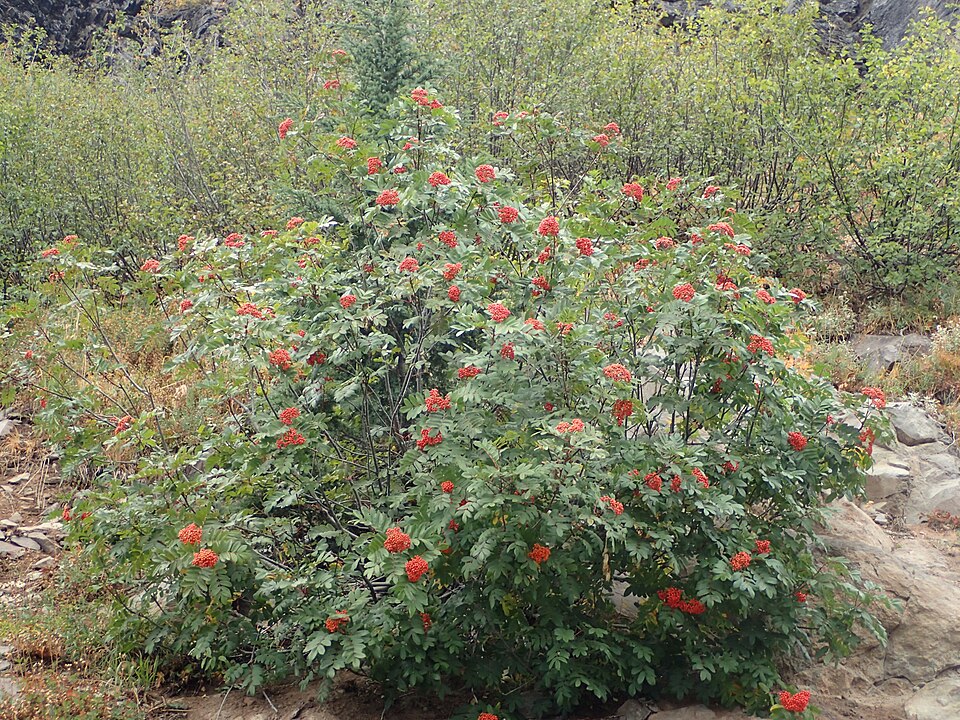
The fruit is a small, round pome (apple-like) measuring ¼ to ⅜ inch (6–10 mm) in diameter. The fruits ripen in late summer to early fall, turning from green to a brilliant orange-red or scarlet color. They hang in tight clusters on the plant, persisting well into fall and often through early winter if not consumed by wildlife. Each small fruit contains 2 to 4 seeds. The berries are slightly astringent when raw but become sweeter after frost.
Quick Facts
| Scientific Name | Sorbus scopulina |
| Family | Rosaceae (Rose Family) |
| Plant Type | Deciduous Shrub |
| Mature Height | 13 ft |
| Sun Exposure | Part Shade |
| Water Needs | Moderate |
| Bloom Time | May – June |
| Flower Color | White |
| USDA Hardiness Zones | 3–7 |
Native Range
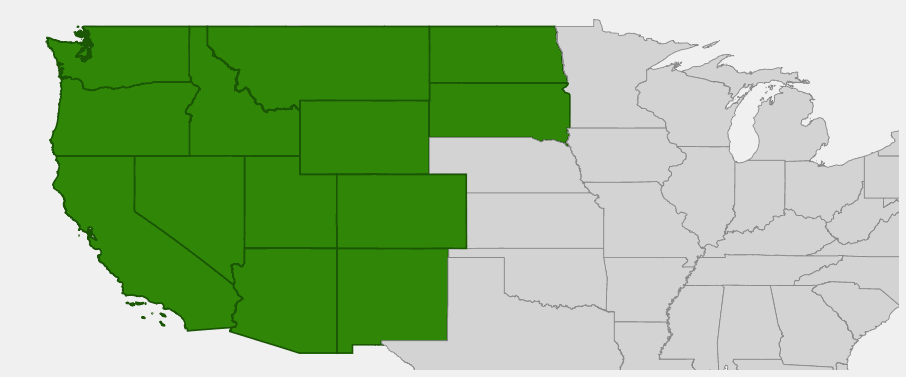
Dwarf Mountain Ash has an extensive native range covering much of the mountainous West from Alaska south through the Rocky Mountains and Cascades to Arizona and New Mexico, with scattered populations in the Black Hills of South Dakota. It is found primarily in subalpine and montane zones at elevations of 4,000 to 11,000 feet, reaching its greatest abundance in the northern Rocky Mountains and Cascades of Idaho, Montana, Oregon, and Washington.
In its natural habitat, Dwarf Mountain Ash typically grows in open forest clearings, subalpine meadow edges, rocky outcrops, talus slopes, and avalanche chutes where the canopy is open and light is plentiful. It often colonizes disturbed areas including old burns, roadsides, and forest edges. It grows in association with subalpine fir, Engelmann spruce, lodgepole pine, and quaking aspen, frequently forming dense thickets in avalanche paths and other areas where tree cover is periodically disturbed.
The species shows considerable ecological flexibility — it can grow on a variety of substrates from moist streamside soils to dry rocky slopes, and it tolerates both partial shade in forest understory settings and full exposure on open ridgelines. This adaptability across a wide range of mountain conditions contributes to its widespread distribution across western North America’s mountains.
📋 Regional plant lists featuring Dwarf Mountain Ash: Intermountain West
Growing & Care Guide
Dwarf Mountain Ash is best suited to cool mountain climates — it struggles in hot, humid lowland gardens but thrives in the cooler conditions of the Mountain West, the Pacific Northwest, and high-elevation gardens. Given the right conditions, it is a beautiful and low-maintenance landscape shrub.
Light
Dwarf Mountain Ash performs best in partial shade — it naturally grows in open forest situations with dappled light or open-sky conditions at high elevations. In lower-elevation gardens, afternoon shade helps protect it from excessive heat stress. Full morning sun with afternoon shade is ideal in most garden situations.
Soil & Water
This species prefers cool, moderately moist, well-drained soil. It is not drought-tolerant in hot lowland gardens but can handle drier conditions in cool mountain settings. Humus-rich, slightly acidic loam is ideal. Avoid waterlogged conditions. In the garden, mulching heavily with organic material helps moderate soil temperature and maintain the cool, moist root zone this species prefers.
Planting Tips
Plant in spring or fall in a cool, sheltered location with partial shade. This species is native to cool mountain conditions and will not thrive where summers are hot and humid. It is best suited to USDA zones 3–7. Allow adequate space — 8–12 feet between plants — for the shrub to develop its natural form. Do not fertilize heavily; this promotes lush growth that is more susceptible to fire blight.
Pruning & Maintenance
Dwarf Mountain Ash requires little pruning. Remove dead, damaged, or crossing branches in late winter. The shrub suckers moderately from the base; remove unwanted suckers to control spread. Like other members of the rose family, it can be susceptible to fire blight (Erwinia amylovora) in warm, humid conditions — prune out any infected wood immediately, disinfecting pruning tools between cuts with dilute bleach solution.
Landscape Uses
- Mountain and alpine gardens — a natural for high-elevation or north-facing landscapes
- Wildlife garden — berries are irresistible to fruit-eating birds
- Four-season specimen — flowers, berries, fall color, and winter structure
- Naturalized woodland edge — plant along forest margins in cool climates
- Screening plant — forms a tall, attractive informal hedge
- Mixed native shrub border with Serviceberry, Chokecherry, and Wild Currant
Wildlife & Ecological Value
Dwarf Mountain Ash is one of the highest-value berry-producing shrubs in mountain ecosystems, providing critical nutrition for wildlife during late summer and fall migration and fattening periods.
For Birds
The brilliant red-orange berries are consumed by American Robins, Varied Thrushes, Swainson’s Thrushes, Hermit Thrushes, Cedar Waxwings, Bohemian Waxwings, Pine Grosbeaks, and many other fruit-eating species. In mountain areas, Dwarf Mountain Ash is a magnet for fall migrants, who can strip a plant of berries in a matter of days. Ruffed Grouse and Blue Grouse eat the berries and also forage on buds and bark in winter.
For Mammals
Black bears actively seek out Dwarf Mountain Ash fruit in late summer when building fat reserves for hibernation. Mule deer and white-tailed deer browse the foliage and twigs, particularly in fall and winter. Elk feed heavily on the shrub. Small mammals including chipmunks, ground squirrels, and voles consume fallen berries. The dense shrub structure provides hiding and nesting cover for small mammals.
For Pollinators
The white flower clusters are visited by a wide variety of native bees, bumblebees, flies, and beetles in late spring and early summer. In mountain meadow habitats, Dwarf Mountain Ash is one of the most important early-season nectar sources after winter snowmelt, providing food at a time when few other shrubs are blooming at high elevations.
Ecosystem Role
In subalpine ecosystems, Dwarf Mountain Ash plays a significant role in habitat complexity, providing a fruiting shrub layer in otherwise predominantly coniferous forests. Its ability to colonize disturbed areas — avalanche chutes, old burns, roadsides — makes it an important early-successional species that provides wildlife habitat and stabilizes disturbed soil while forest canopy re-establishes. The leaves decompose rapidly, enriching mountain soils with organic matter.
Cultural & Historical Uses
Dwarf Mountain Ash berries were used as food by various Indigenous peoples throughout the Rocky Mountains and Pacific Northwest. The Blackfoot people used the berries as a food source, eating them fresh or dried. The Okanagan-Colville used the berries as food and also used the wood medicinally and ceremonially. Various groups used the bark and berries in preparations to treat stomach problems and other ailments.
The berries of Sorbus scopulina are edible but very tart when raw — they require processing (cooking with sweetener, or waiting for frost to convert starches to sugars) to be palatable. They are occasionally used to make jellies, preserves, and syrups similar to preparations made from the related European Rowan (Sorbus aucuparia). The berries contain significant levels of Vitamin C and were valued as a source of this nutrient in mountain communities.
The tough, hard wood of Dwarf Mountain Ash was used by Indigenous peoples for making tools, utensils, and small implements. The flexible young stems were used in basket-making in some traditions. The distinctive form of the plant — with its bright red berries — also gave it cultural significance in some traditions as a marker of high-elevation habitats and as a sign of the approaching fall season and time to prepare for winter.
Frequently Asked Questions
Is Dwarf Mountain Ash related to true ash trees?
No — despite the common name, Dwarf Mountain Ash is not related to ash trees (genus Fraxinus, family Oleaceae). It is a member of the rose family (Rosaceae) and is more closely related to apples, pears, and hawthorns. The “mountain ash” name comes from the superficial resemblance of its compound leaves to those of ash trees.
Can I grow Dwarf Mountain Ash at low elevations?
It can be grown at lower elevations in cool climates (Pacific Northwest, northern states) but struggles in hot, humid summer conditions. Gardeners in hot summer climates often find it difficult to grow successfully. USDA zones 3–6 with cool summers are most favorable.
Are the berries poisonous?
The raw berries are not poisonous but are very astringent and tart, containing parasorbic acid that can cause stomach upset if eaten in large quantities raw. Cooking the berries or allowing them to freeze destroys the parasorbic acid, making them safe and edible. They are excellent when made into jelly or syrup with added sweetener.
How do I attract more birds with Dwarf Mountain Ash?
Plant multiple shrubs in a group — a grove of 3 to 5 specimens creates a more visible fruit display that attracts migrating flocks. Plant near other berry-producing shrubs (chokecherry, serviceberry, wild currant) to create a multi-species fruiting garden that supports birds across the entire fall migration season.
What is the difference between Dwarf Mountain Ash and Sitka Mountain Ash?
Sorbus scopulina (Dwarf Mountain Ash / Greene’s Mountain Ash) can be distinguished from Sorbus sitchensis (Sitka Mountain Ash) by its leaflets, which have sharp, pointed teeth along the entire margin in scopulina, versus rounded leaflets with teeth mainly above the middle in sitchensis. S. scopulina also generally has more leaflets (11–17 vs. 7–11) and a wider range.