Great Basin Wildrye (Leymus cinereus)
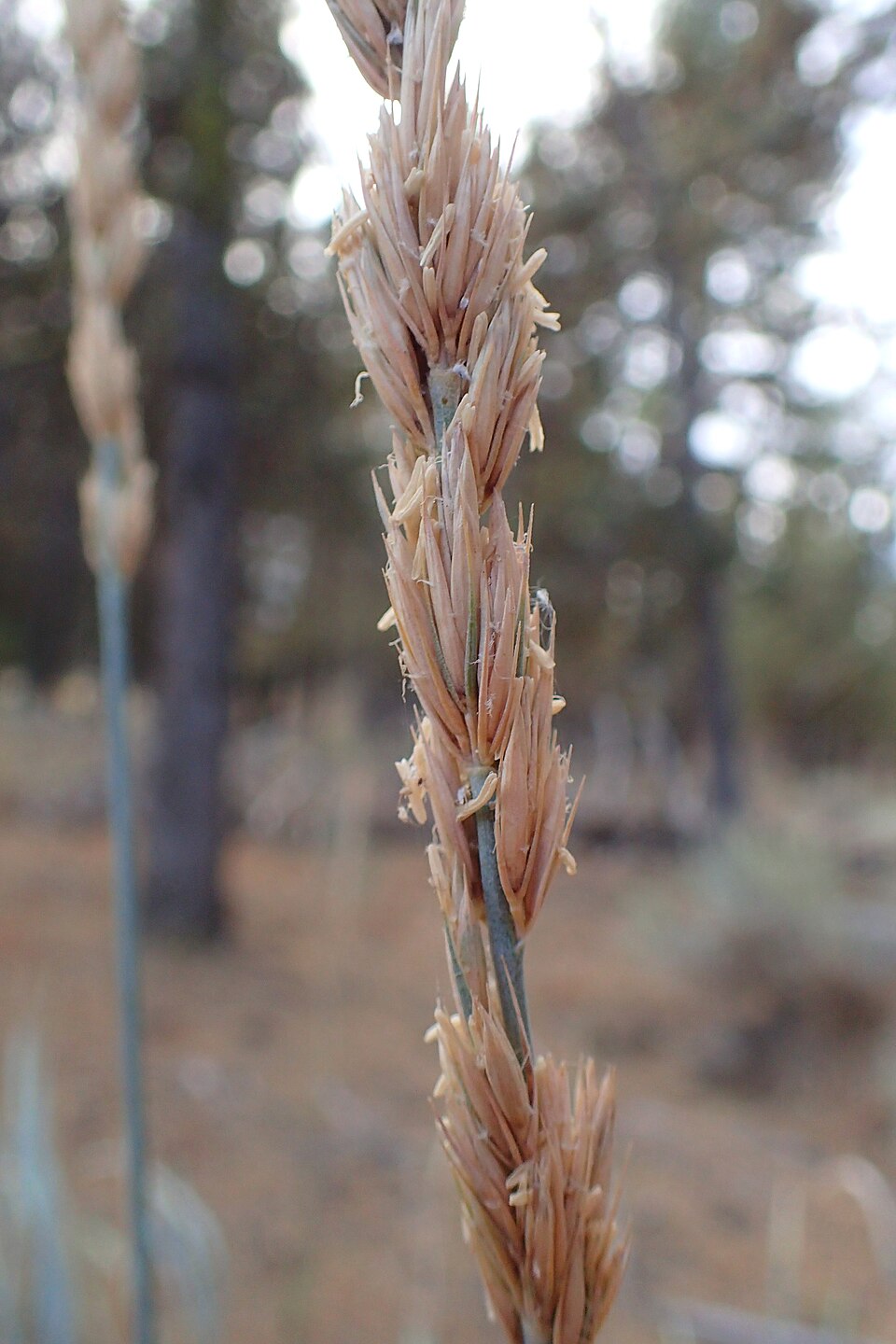
Leymus cinereus, commonly known as Great Basin Wildrye or Basin Wildrye, is one of the most impressive and ecologically significant native grasses of the American West. This robust, large-statured perennial bunchgrass forms dense clumps that can reach 4 to 6 feet (or taller) in height, with striking blue-green foliage and tall, wheat-like seed heads that wave in the wind. As its common name suggests, Great Basin Wildrye is a signature plant of the Great Basin Desert and adjacent Intermountain West, where it is one of the dominant grass species on deep, fertile valley soils.
Great Basin Wildrye is adapted to full sun and dry conditions, thriving in sagebrush-steppe, saltbush scrub, alkaline flats, dry meadows, and disturbed open areas across a vast range from the Pacific Coast states east through the Rocky Mountains and south to the Great Plains. It is remarkably drought-tolerant once established — its deep, extensive root system reaches far down into the soil to access moisture that is unavailable to shallower-rooted plants. At the same time, it can also tolerate periodic flooding and alkaline soils that exclude most other grasses, making it one of the most adaptable native grass species in western North America.
In restoration and erosion control work, Great Basin Wildrye is highly valued as a quickly-establishing, robust grass that provides immediate ground cover and wildlife habitat. It has been widely used in highway rights-of-way, mine reclamation, and degraded sagebrush steppe restoration across the West. In the landscape garden, it provides bold, textural presence — its tall clumps of blue-green blades provide structure, movement, and interest across three seasons.
Identification
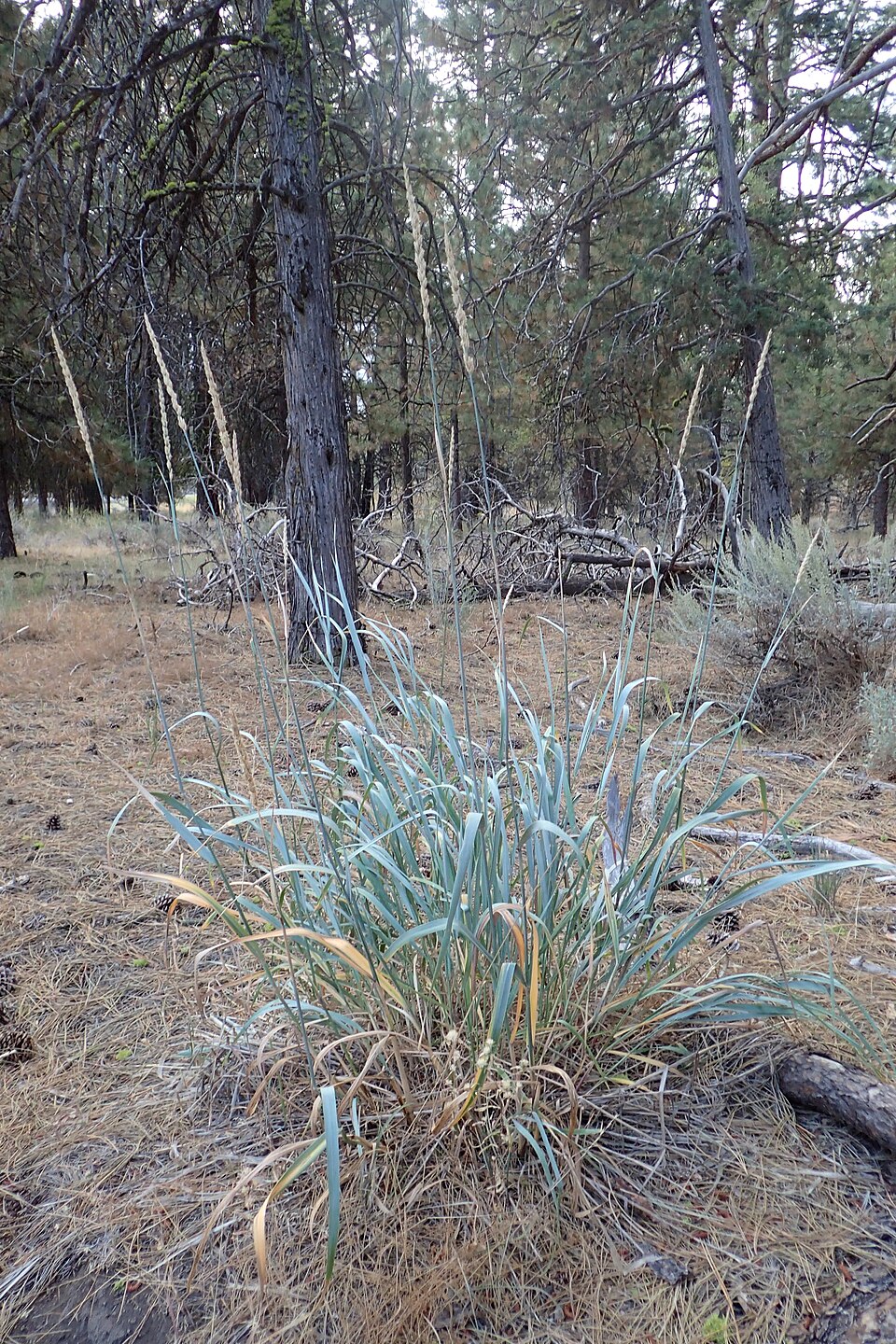
Great Basin Wildrye is a large, coarse perennial bunchgrass forming dense clumps 3 to 6 feet (occasionally taller) in height with a spread of 2 to 4 feet. New growth in spring is distinctive: stiffly upright blades of a striking blue-green (glaucous) color. It spreads slowly by rhizomes as well as producing seed, so clumps gradually expand but do not spread aggressively.
Leaves
The blades are flat and broad for a grass — ½ to ¾ inch (12–18 mm) wide — and stiffly erect. The surface is rough (scabrous) and distinctly blue-green (glaucous) due to a waxy coating, fading to tan in fall. Leaf margins are rough and can cut skin. The ligule (junction of blade and sheath) is membranous, about 1–3 mm long. The leaf base (sheath) wraps closely around the stem and may have short, stiff hairs (auricles) where it meets the blade.
Stems & Seed Heads
Flowering stems (culms) are tall and stout, reaching 4 to 8 feet (1.2–2.5 m) in height. The seed head is a dense, narrow spike resembling wheat or rye, 4 to 12 inches (10–30 cm) long, with multiple spikelets arranged closely along the central axis (rachis). Spikelets have long, rough awns giving the spike a bristly appearance. The seed heads mature from late June through August, turning tan-golden as they ripen. They are often used in dry flower arrangements.
Quick Facts
| Scientific Name | Leymus cinereus |
| Family | Poaceae (Grass Family) |
| Plant Type | Perennial Bunchgrass |
| Mature Height | 4–6 ft |
| Sun Exposure | Full Sun |
| Water Needs | Low (Drought Tolerant) |
| Bloom Time | June – August |
| Seed Head Color | Tan/Golden (seed heads) |
| USDA Hardiness Zones | 3–9 |
Native Range
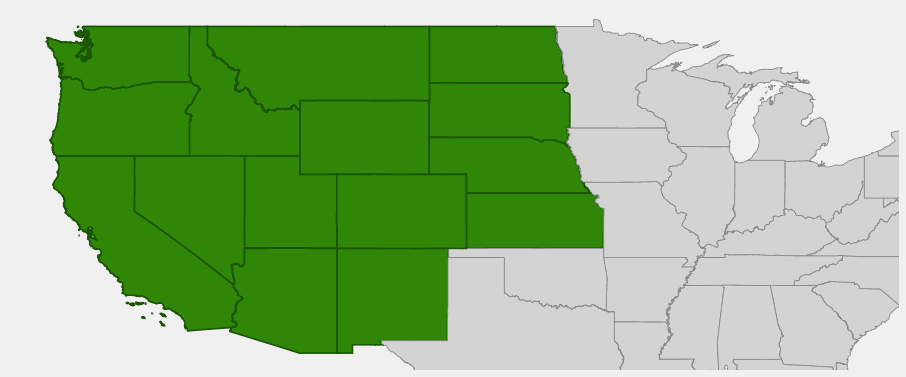
Great Basin Wildrye has one of the widest distributions of any native grass in the American West. Its range extends from eastern Washington and Oregon south through California, Nevada, and Utah, east through Idaho, Montana, Wyoming, Colorado, Arizona, and New Mexico, and onto the Great Plains in North Dakota, South Dakota, Nebraska, and Kansas. It grows from near sea level in coastal valley bottoms to over 9,000 feet elevation in mountain parks and meadows.
The species is most abundant and characteristic in the Great Basin region — the vast intermontane basin between the Sierra Nevada and Rocky Mountains — where it is a dominant grass on deep, fertile valley soils in association with big sagebrush (Artemisia tridentata), basin wild rye meadows, and alkaline grasslands. It is one of the few grasses that thrives in the saline and alkaline conditions common to Great Basin lake margins and playas.
In the northern Intermountain region and Rocky Mountain foothills, Great Basin Wildrye grows in association with big sagebrush, bluebunch wheatgrass (Pseudoroegneria spicata), rabbitbrush (Ericameria spp.), and other characteristic sagebrush-steppe species. It is a common component of riparian transitional zones, dry meadows, and disturbed open areas across its entire range.
📋 Regional plant lists featuring Great Basin Wildrye: Intermountain West
Growing & Care Guide
Great Basin Wildrye is one of the most adaptable and easy-to-grow native grasses for xeric western gardens. It establishes quickly, tolerates harsh conditions, and requires minimal care once established.
Light
Full sun is essential — Great Basin Wildrye is an obligate sun plant that declines in shade. Plant it where it receives at least 8 hours of direct sunlight daily for best performance and the characteristic upright, vigorous form. In partial shade, growth becomes lax and floppy.
Soil & Water
Great Basin Wildrye is exceptionally drought-tolerant and thrives in poor, dry, sandy, gravelly, or alkaline soils — conditions that challenge most plants. It does not require any supplemental fertilizer and actually performs better in lean soils. Once established (usually within one full growing season), it requires essentially no supplemental irrigation in most western climates. It will also tolerate moderately moist soils and even periodic flooding, making it one of the most flexible native grasses in terms of soil moisture. Avoid rich, heavily amended garden soils, which produce overly lush growth that flops over.
Planting Tips
Plant in spring or fall in well-draining soil. Container plants establish readily; direct seeding is also feasible in large-scale restoration plantings. Space plants 3–5 feet apart for a naturalistic look. Cut back any dead foliage before planting to reduce competition with new growth. The grass is slow to establish from seed in its first year but grows vigorously once the root system is established.
Pruning & Maintenance
Cut back to 6–8 inches in late winter before new growth begins. This removes the previous year’s tan seed stalks and dead leaf blades, stimulating fresh new growth. The spent seed heads are attractive through fall and early winter, providing structure and seed for wildlife, so allow them to stand until late winter. Division of large clumps every 5–7 years helps rejuvenate old plants and control size.
Landscape Uses
- Xeriscape anchor — bold structure and blue-green color with zero water once established
- Erosion control on dry slopes, highway cuts, and disturbed areas
- Sagebrush steppe garden — the signature grass of Great Basin native plant gardens
- Naturalizing in large open areas, meadows, and rangelands
- Wildlife habitat — seeds are eaten by birds; dense clumps provide cover
- Cut grass — seed heads are beautiful in dried arrangements
- Revegetation — one of the most effective grasses for mine reclamation and disturbed land restoration
Wildlife & Ecological Value
Great Basin Wildrye provides important habitat structure, food, and cover across the sagebrush steppe ecosystem, where the tall clumps stand out as the dominant structural feature of an otherwise relatively low-statured plant community.
For Birds
The abundant seeds are consumed by Sage Sparrows, Brewer’s Sparrows, Vesper Sparrows, and other seed-eating birds of the sagebrush steppe. The dense clumps provide nesting and foraging habitat for ground-nesting birds including Sage Grouse, Horned Larks, and Savannah Sparrows. Raptors — including Short-eared Owls, Northern Harriers, and Prairie Falcons — hunt over grasslands dominated by Great Basin Wildrye, targeting the small mammals that shelter within the clumps.
For Mammals
Pronghorn, mule deer, and elk graze Great Basin Wildrye, particularly the young, tender spring growth before the leaves become rough and tough. Jackrabbits and cottontails take cover in the dense clumps. Rodents including deer mice, voles, and kangaroo rats forage for spilled seeds around established clumps. The dense clumps also provide thermal refuge — shade in summer, wind protection in winter.
For Pollinators
Like most grasses, Great Basin Wildrye is wind-pollinated and not a significant nectar source. However, the tall seed heads provide perching and hunting habitat for predatory insects including dragonflies, robber flies, and jumping spiders that control pest insects in the surrounding landscape.
Ecosystem Role
Great Basin Wildrye plays a crucial stabilizing role in sagebrush-steppe and Great Basin desert ecosystems. Its deep, dense root system — which can penetrate 6 to 8 feet into the soil — holds fragile desert soils against wind and water erosion. In heavily grazed or burned areas, it is one of the fastest native perennials to reestablish, providing critical ground cover that prevents further erosion and establishment of invasive plants like cheatgrass (Bromus tectorum). It is a key component of sagebrush ecosystem restoration efforts throughout the West.
Cultural & Historical Uses
Indigenous peoples of the Great Basin region used Great Basin Wildrye as a significant food and material plant. The Paiute and Shoshone peoples collected the large seeds, which were parched and ground into flour or cooked as a gruel — an important caloric staple in the challenging arid environment of the Great Basin where food plants were often scarce. Seeds were collected using a seed beater into a large flat basket, then cleaned and processed on stone milling implements.
The tall, strong stems were used to make arrows in some traditions — the straight, stiff culms provided excellent arrow shafts of consistent length and strength. The dried leaves and stems were also used as building material for temporary shelters and as thatching material. The tough leaf blades were occasionally woven into baskets, mats, and other utilitarian objects, though the rough edges made them less preferred than smoother grasses for this purpose.
In modern rangeland management, Great Basin Wildrye is one of the most commonly planted native grasses for revegetation of disturbed and degraded western rangelands, highway rights-of-way, and mine reclamation sites. Several cultivars have been developed by the USDA Natural Resources Conservation Service (NRCS) specifically for revegetation purposes, including ‘Magnar’, ‘Trailhead’, and ‘Shoshone’. These selections were chosen for improved vigor, seed production, and establishment characteristics.
Frequently Asked Questions
How tall does Great Basin Wildrye get?
Great Basin Wildrye typically grows 4 to 6 feet tall in leaf, with flowering stems reaching 6 to 8 feet. In ideal conditions with deep, moist soil, exceptional specimens may reach 8 to 10 feet. In dry, poor soils, clumps typically stay shorter — 3 to 4 feet. It is one of the largest native bunchgrasses in the West.
Is Great Basin Wildrye the same as Basin Wildrye?
Yes — “Basin Wildrye” and “Great Basin Wildrye” both refer to Leymus cinereus. It was formerly placed in the genus Elymus (as Elymus cinereus), so you may see that older name in older references and some nursery catalogs.
Will Great Basin Wildrye spread and take over my garden?
It spreads slowly by short rhizomes and self-seeding, but it is not considered invasive or aggressively spreading. Clumps expand gradually over many years. If you want to prevent seed-based spread, cut down the seed stalks before they mature. Division of large clumps every 5–7 years helps control size and rejuvenate the planting.
Does Great Basin Wildrye need any fertilizer?
No — fertilizer is counterproductive. Great Basin Wildrye evolved in low-nutrient soils and performs best without added fertilizer. Fertilizing produces overly lush, weak growth that flops over and is more susceptible to disease. Let the native soil do its work.
Can Great Basin Wildrye grow in clay soil?
It can tolerate heavier clay soils better than many xeric grasses, but prefers well-draining loam or sandy soil. In heavy clay, ensure that standing water does not persist around the crown of the plant. Raised planting beds or incorporating gravel into clay soils can improve performance significantly.