Early Lowbush Blueberry (Vaccinium pallidum)
Early lowbush blueberry is a small native shrub with three distinct garden seasons: spring flowers, summer berries, and red-orange autumn foliage. Vaccinium pallidum is also known as hillside blueberry or Blue Ridge blueberry. In Delaware, New Jersey, and New York, it belongs in an acidic woodland-edge planting where a low, spreading shrub is more useful than a large highbush blueberry.
The regional table gives a height of 24 inches, full to partial sun, and average-to-dry soil. Garden plants may reach 2–3 feet, while wild plants vary considerably with exposure and soil. Underground rhizomes let a small group become a colony over time. Allow room for that expansion rather than placing the shrub in a narrow opening that will require constant digging around its roots.
Acidity is the first question to settle. This blueberry is not a good candidate for a naturally alkaline bed simply because a bag of fertilizer says it is suitable for berries. Test the soil and assess drainage before planting. Where the site is appropriate, the shrub can combine modest scale, attractive fall color, and wildlife resources without the visual weight of a tall hedge.
Identification
Bark & Stems
Slender woody stems emerge from a low spreading root and rhizome system. Young stems can appear green, yellowish, or reddish, with older growth becoming browner. A patch may consist of connected shoots rather than a collection of separate seedlings. That distinction matters when managing its perimeter: digging between stems can disturb more of the colony than expected.
Leaves
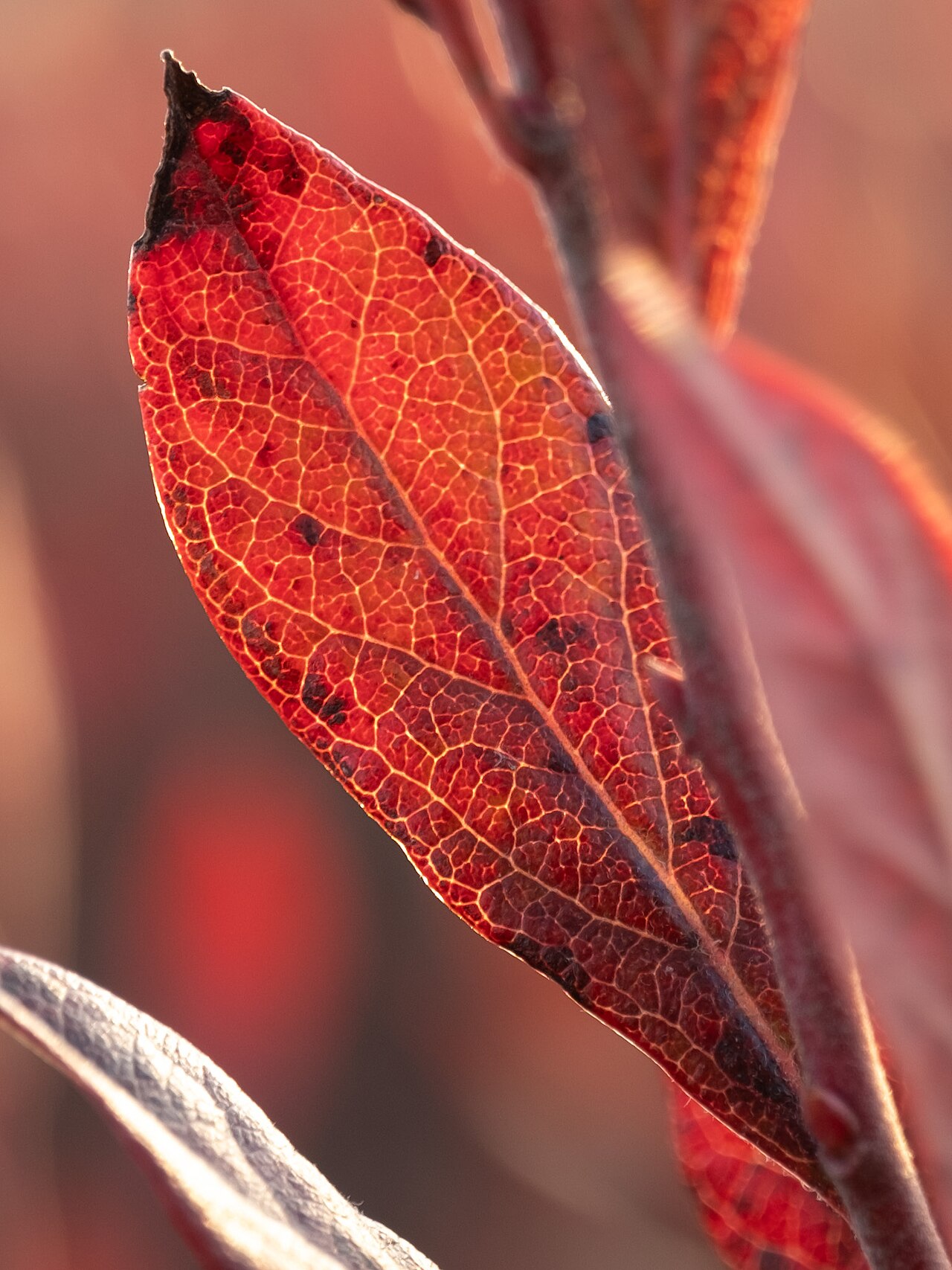
The leaves are simple and alternate, generally oval to somewhat broader toward the tip. The underside is often paler than the upper surface, a useful character but not a complete identification by itself. Leaf margins and hairiness can vary. In autumn, the foliage may turn orange to red or crimson, providing a low band of color beneath taller deciduous plants.
Flowers
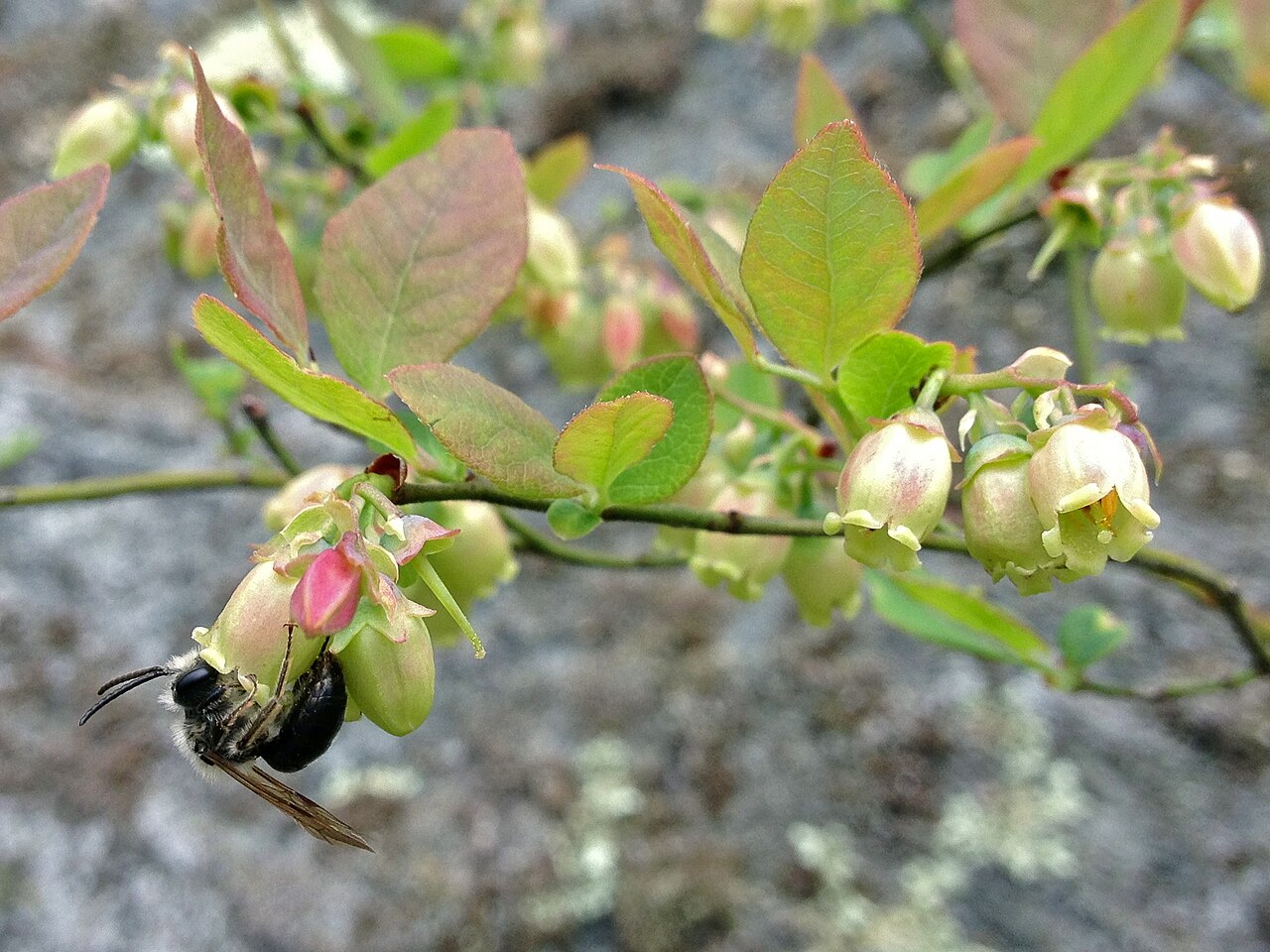
Small urn- or bell-shaped flowers hang in short clusters in spring. White and pinkish tones are typical. The narrow flower openings make a close view worthwhile, especially when bees are visiting. Bloom timing shifts geographically; a date recorded in the southern Appalachians should not be assumed to apply unchanged to a New York garden.
Fruit & Seeds
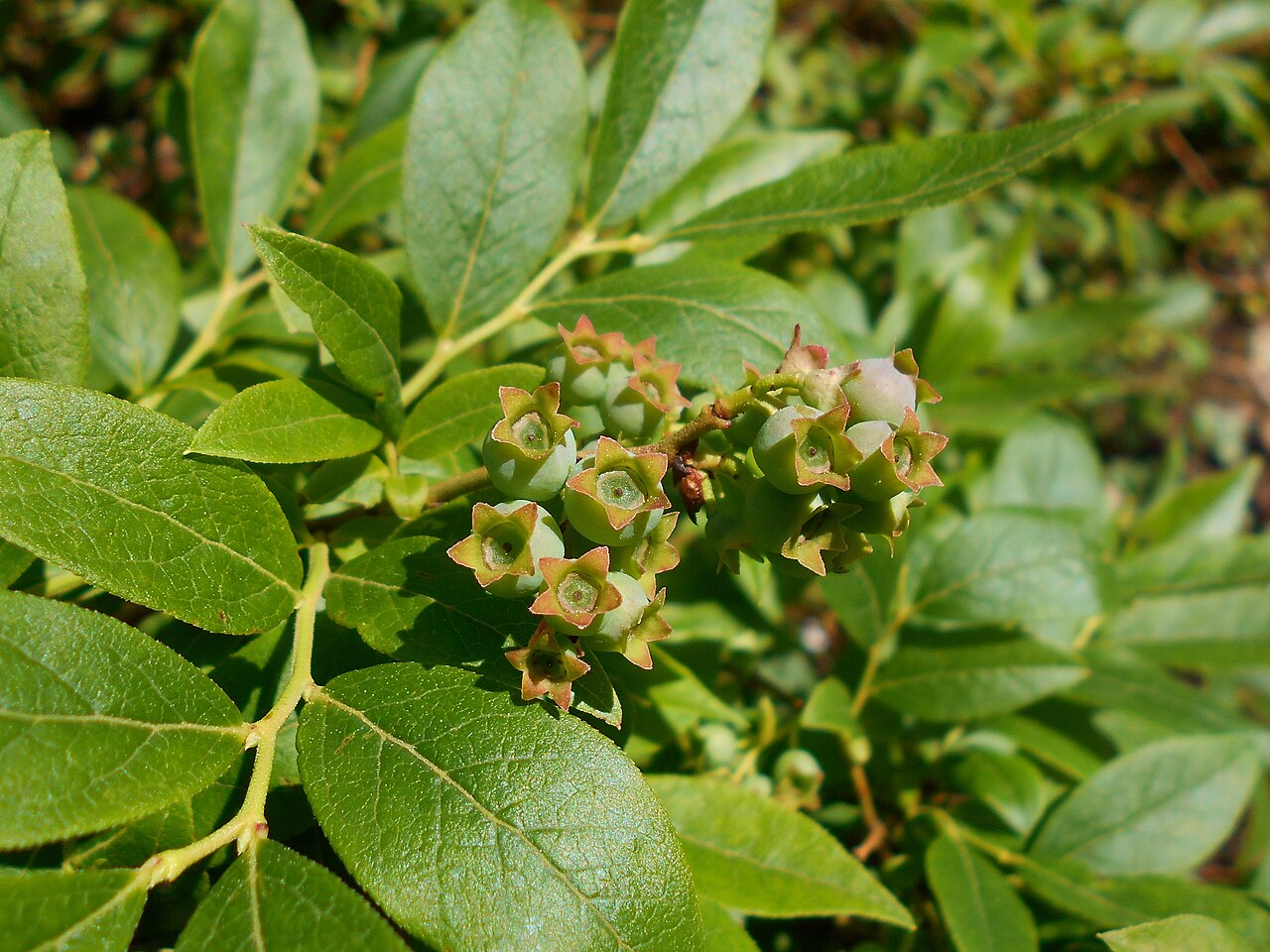
Small berries ripen from green toward blue or blue-black in summer. Their appearance and abundance vary among plants and sites. Fruit production is not guaranteed merely because a shrub flowers, and wildlife may remove berries promptly. Keep accurate labels: another plant sold as lowbush blueberry may be Vaccinium angustifolium, a distinct species, rather than this one.
Quick Facts
| Scientific Name | Vaccinium pallidum; synonym Vaccinium vacillans |
| Family | Ericaceae (heath family) |
| Plant Type | Deciduous, colony-forming low shrub |
| Mature Height | About 24 inches in the regional list; often 2–3 feet in gardens |
| Mature Spread | About 2–3 feet initially; colonies expand by rhizomes |
| Growth Rate | Moderate; dependent on site conditions |
| Sun Exposure | Full sun to partial shade |
| Water Needs | Average to dry after establishment; avoid prolonged saturation |
| Soil Type | Acidic, well-drained sandy, loamy, or suitable clay soil |
| Soil pH | Acidic; generally below pH 6 |
| Bloom Time | Spring, later in northern areas |
| Flower Color | White to pinkish bell-shaped flowers |
| Fall Color | Orange, red, and crimson |
| Fruit | Small blue to blue-black berries in summer |
| Deer Resistant | Not dependable; wildlife may browse it |
| USDA Hardiness Zones | 5–9 as listed by NC State; match local provenance |
Native Range
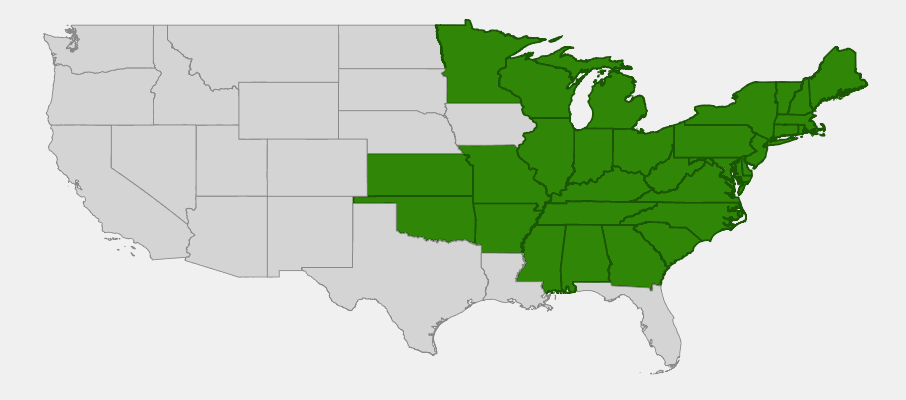
Vaccinium pallidum is native across much of eastern and central North America, including Delaware, New Jersey, and New York, with Ontario representing its Canadian range in the sources used here. The map follows the state distribution listed by NC State. Botanical summaries differ on a few peripheral states; for restoration, county-level records and a regional flora should take precedence over a generalized state map.
The Forest Service describes it in dry woods, rocky slopes, ridges, sandy ground, and barrens, and associates it with several oak and pine communities. These settings explain why the shrub is useful in an acidic woodland-edge garden. They do not imply that every shaded site is suitable: dense tree roots, compacted fill, or alkaline construction debris can make an apparently woodland-like garden a poor match.
In the Delaware–New Jersey–New York region, start with soil and provenance. An acidic upland bed with good drainage is a different opportunity from a wet depression or a limed lawn edge. Ask a grower whether stock is correctly identified and where it originated. The name lowbush blueberry alone is not precise enough for either botanical restoration or a species-specific garden plan.
📋 Regional plant list: Delaware, New Jersey & New York
Growing & Care Guide
Light
Use full sun to partial shade, as the regional list indicates. More open exposure generally gives the shrub room to develop flowers and fall color, while a woodland edge offers a natural setting. Evaluate both overhead shade and belowground competition before planting. Under a dense tree canopy, adding water does not remove competition from established roots or create the light needed for a strong display.
Soil & Water
Use acidic soil with drainage. A soil test is more useful than guessing from nearby plants or repeatedly adding acidifying products. Keep the root zone evenly supplied with establishment water, then adjust toward the site’s natural average-to-dry regime. Do not let the original container root ball become dry while the surrounding soil is wet. A modest layer of organic mulch can help protect shallow roots, but keep it away from the stem bases.
Planting Tips
Plant at the existing crown level and allow space for a spreading group. Remove competing weeds before installation so later cultivation does not repeatedly disturb shallow roots and rhizomes. In a woodland bed, work around existing tree roots rather than cutting large roots to force a planting hole into an unsuitable position. Start with several correctly identified plants if a visible patch is desired, and allow time for them to establish.
Pruning & Maintenance
Do not shear the shrub into a dense miniature hedge if flowers and berries are priorities. Remove dead or damaged wood selectively, and observe the colony before deciding how much renewal is necessary. Repeatedly cutting every shoot to a uniform height can simplify maintenance visually while sacrificing seasonal interest. At the edge of a patch, manage unwanted expansion deliberately rather than digging through the middle of established growth.
Propagation
The species can regenerate from seed and spread vegetatively by rhizomes, as described in the Forest Service review. For most home gardeners, propagated nursery stock is more predictable than attempting to establish a new bed from collected berries. Keep seed or vegetative material accurately labeled and follow a grower’s species-specific instructions. Do not dig wild colonies simply because they look abundant; their root systems are part of the woodland community.
Fruit Expectations
Treat fruit as a valued seasonal feature rather than a promised crop of grocery-store-sized berries. Planting more than one genetically distinct, appropriately identified specimen can support a more resilient planting, but no arrangement guarantees a heavy yield in every year. Observe bloom, visiting insects, weather, and berry disappearance separately. A plant that flowered well but appears fruitless may have fed wildlife before the gardener arrived.
Autumn & Winter Care
Enjoy the fall foliage and let leaf litter remain where it does not smother crowns or neighboring small plants. Mark young shrubs so dormant stems are not mistaken for weeds during winter cleanup. Avoid routine deep cultivation around the patch. In spring, inspect new growth before assuming that an uneven outline requires corrective pruning; a naturally spreading colony need not maintain a rigid geometric edge.
Landscape Uses
- Low native shrub groups in acidic Delaware, New Jersey, and New York gardens.
- Woodland edges where spring flowers and autumn foliage are visible from a path.
- A wildlife-oriented understory below appropriately spaced native trees.
- Naturalistic colonies in well-drained acidic ground with room to expand.
- Mixed heath-family plantings where all species share suitable soil and drainage.
Wildlife & Ecological Value
For Pollinators
Spring flowers supply a resource for visiting bees. NC State also identifies the shrub as a host for brown elfin butterflies and describes specialized bee associations within Vaccinium. Keep the planting free of routine insecticide treatment and let some imperfect foliage remain. A shrub can be useful to insects even when it is not in flower.
For Birds
The berries are a significant part of the plant’s wildlife value. Songbirds and other fruit-eating birds may take them quickly, so a short visible berry season is not necessarily disappointing performance. A low blueberry patch works best as part of a larger planting that also includes cover and perches without shading it completely.
For Mammals
Small mammals and other wildlife may eat the fruit, while browsing can affect stems and leaves. Do not assume that a native shrub is naturally protected from herbivores. Young plantings may need temporary protection where browsing pressure is high. If the primary goal is wildlife habitat, allow a portion of the fruit to remain available rather than designing the whole planting around exclusion.
Ecosystem Role
The rhizomatous growth creates a persistent low shrub layer in suitable woodland communities. Maintain that layer with restrained disturbance and compatible companions. Its ability to recover through underground structures in natural settings is not a recommendation for gardeners to burn or repeatedly cut a residential bed. Ordinary selective maintenance is enough for most garden situations.
Cultural & Historical Uses
Older botanical literature may use Vaccinium vacillans for this plant. Recording the synonym helps connect historical references with the currently used Vaccinium pallidum. It also prevents a search for the older name from being mistaken for a completely different species.
The plant’s several common names reflect its low stature and association with upland and Blue Ridge landscapes. They can overlap with names used for other blueberries. Accurate labels matter particularly because lowbush blueberry is often used without a scientific name in nursery listings.
In a contemporary native garden, the shrub’s value is broader than fruit production alone. Flowers, autumn color, low cover, and wildlife use all justify its place. Purchasing propagated stock and preserving existing wild colonies allow that garden role without treating natural woodland populations as a source of free transplants.
Frequently Asked Questions
Is this the same plant as Vaccinium angustifolium?
No. Both may be called lowbush blueberry, but they are distinct species. Use the scientific name Vaccinium pallidum when ordering this plant.
Is it native in Delaware, New Jersey, and New York?
Yes. All three states are included in the native range documented by the botanical sources used here. Check local records for restoration-scale projects.
Can it grow in alkaline soil?
Alkaline soil is a poor fit. Test the site first rather than relying on repeated fertilizer applications to overcome a fundamentally unsuitable root environment.
How much room does it need?
Expect a low shrub around 2–3 feet in many gardens, with gradual lateral expansion through rhizomes. The regional list’s 24-inch height is a representative size, not a strict limit.
Why are there few berries left to pick?
Yield varies with flowering, pollination, weather, and plant identity, and wildlife can remove ripe fruit quickly. Observe the whole sequence before assuming the shrub has failed.
Sources & Further Reading
- NC State Extension: Vaccinium pallidum
- US Forest Service: Blue Ridge blueberry species review
- Kew Plants of the World Online: Vaccinium pallidum
Find Native Plants
Ask growers about nursery propagation and regional provenance. Browse our Delaware native plant nurseries, New Jersey native plant nurseries directory for suppliers.