Early Saxifrage (Micranthes virginiensis)
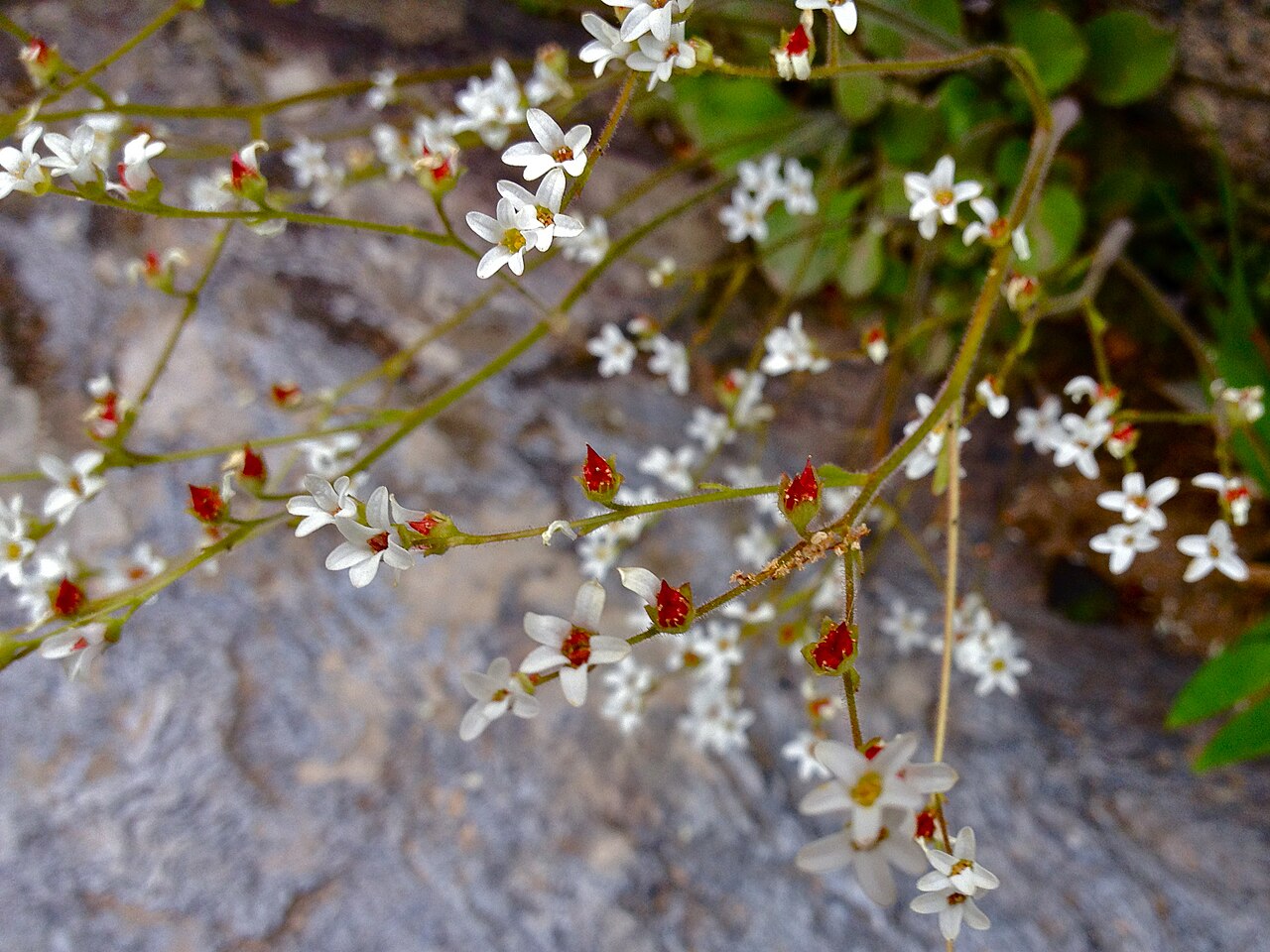
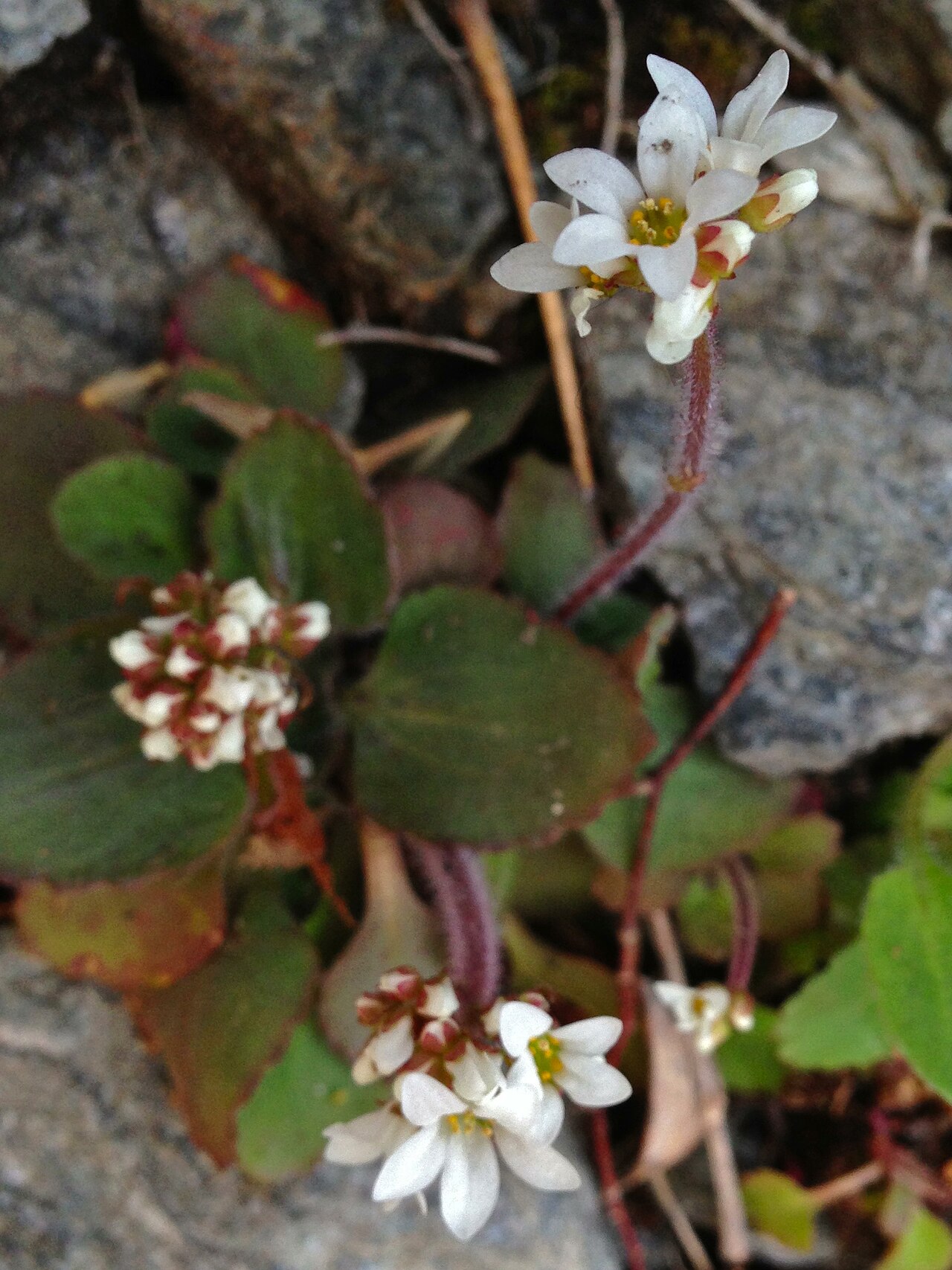
Early saxifrage (Micranthes virginiensis, formerly Saxifraga virginiensis) is a small native perennial with a talent for making a rocky spring landscape look alive. A low rosette of broad, toothed leaves sends up hairy stems that branch into clusters of white flowers. It is not a cushion-forming alpine saxifrage and should not be confused with the many imported hybrids sold for rock gardens.
For a Maryland, Virginia, or West Virginia garden, its best use is often a partly shaded rock pocket, a woodland path edge, or a small open ledge where taller plants cannot immediately overwhelm it. The leaves stay close to the ground while the flowering stems rise through spring. Put it where someone can kneel or pause to see the flowers; burying it at the back of a border wastes the plant’s scale and character.
The name change from Saxifraga to Micranthes reflects botanical classification, not a different garden plant. Labels bearing either name can refer to this species. Confirm the epithet virginiensis and the basal leaves rather than buying any plant called saxifrage. Nursery-propagated stock is preferable to wild collecting, especially because the thin soils and mosses around natural rock-outcrop populations are easily damaged.
Identification
Basal Rosette
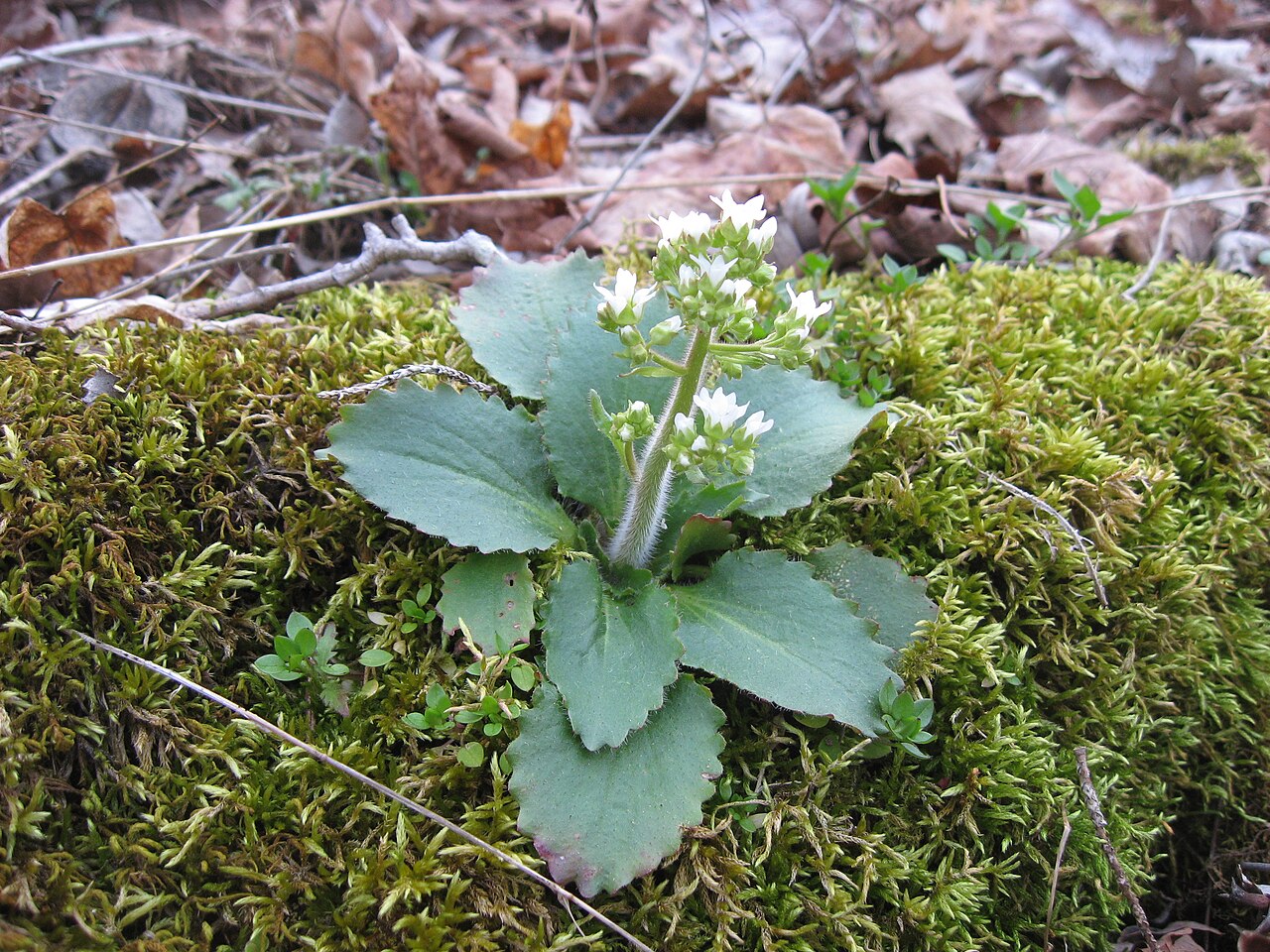
Leaves cluster at ground level in a rosette. They are oval to broadly elliptic, with rounded or coarse teeth along the edge, visible veins, and hairs, especially around the margins. A reddish or maroon tone may show underneath. The rosette is a useful identifying feature before flowering: this is not a plant with a tall leafy stem carrying many alternate leaves. Keep mulch from covering the center, where new leaves and flower stalks emerge.
Flowering Stems
Stems are densely hairy and can feel sticky. They begin short and lengthen as flowering progresses, so measurements taken early and late in the season can differ considerably. A practical height range is roughly 4–12 inches rather than a fixed number. The branching upper stem lifts the flower cluster above the low leaves. A tall spent stalk beside a short fresh rosette is therefore not evidence of two different species.
Flowers
The individual flowers are small, white, and five-petaled, with conspicuous yellow stamens. The petals are separate rather than fused into a tube. Several flowers together form a branching display, which can look much larger than any one bloom. This distinction matters when reading plant descriptions: a cluster measurement must not be mistaken for the diameter of a single flower. Spring bloom shifts with elevation and weather and may continue later in cooler locations.
Fruit and Similar Plants
After flowering, small dry capsules develop and eventually release tiny seeds. Retain a label or photographs of the basal leaves to recognize the plant after the showy stage has passed. Many unrelated woodland rosettes occur nearby, and some imported saxifrages can have white flowers too. Use the combination of broad toothed basal leaves, sticky hairy stalks, and branching white-flowered display, with a regional flora when identification is uncertain.
Quick Facts
| Scientific Name | Micranthes virginiensis (Michx.) Small |
| Synonym | Saxifraga virginiensis Michx. |
| Family | Saxifragaceae (saxifrage family) |
| Plant Type | Small rosette-forming herbaceous perennial |
| Mature Height | Flowering stems approximately 4–12 in, lengthening through bloom |
| Mature Spread | Small basal rosettes; allow about 6–12 in between garden plants |
| Growth Rate | Seasonal stem growth is rapid; colony establishment depends on site |
| Sun Exposure | Partial shade preferred; open rocky sites vary in exposure |
| Water Needs | Dry to average-moist, with good drainage |
| Soil Type | Thin, rocky, well-drained woodland or ledge soil |
| Soil pH | Use suitable local rocky soil; avoid imposing an unsupported universal pH range |
| Bloom Time | Spring, extending later in cool locations |
| Flower Color | White with yellow stamens |
| Fall Color | Not grown for a major autumn display |
| Fruit | Small dry capsules containing fine seeds |
| Deer Resistant | No dependable species-specific guarantee |
| USDA Hardiness Zones | 2–8, subject to local habitat and provenance |
Native Range
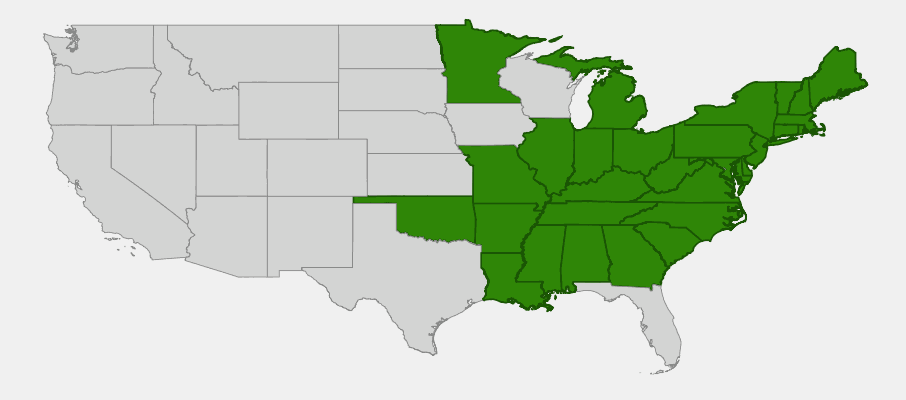
Early saxifrage is native to eastern and central North America. Its distribution includes eastern Canada and much of the eastern United States, with scattered occurrences farther west in suitable rocky habitats. Lady Bird Johnson Wildflower Center lists dry rocky slopes and outcrops as characteristic habitat, while extension references also describe wooded slopes, cliffs, and streambanks.
The state map uses the Wildflower Center distribution rather than copying an isolated inconsistent abbreviation from a garden database. A state-level outline cannot represent every local gap: the plant may be frequent on appropriate rock ledges and absent from the surrounding deep-soil landscape. County floras and natural-heritage records are the appropriate next step when choosing plants for a conservation project.
In the Mid-Atlantic, the strongest garden analogy is a small rocky woodland opening with drainage and seasonal moisture. The species can occupy places that become relatively dry after spring, but that does not mean it should be planted in a deep layer of hot gravel with no root access to soil. Preserve the contrast between a cool root crevice and an open flowering stem when designing a rock-garden setting.
📋 Regional plant list: Maryland, Virginia & West Virginia
Growing & Care Guide
Light
Partial shade is a reliable garden starting point, especially where deciduous trees provide spring light before the canopy fills in. A more open rocky site can work if roots remain protected and the plant does not bake in summer. Deep shade combined with heavy competition is less promising. Watch the actual growing-season light rather than choosing a site solely from a winter photograph of bare trees.
Soil and Water
Drainage is central. Use a pocket of rocky soil with enough moisture to support spring growth and a path for excess water to escape. Do not create a water-holding bowl between impermeable rocks. During establishment, water gently at soil level and check that the root plug is moist, not just the surrounding stone surface. Once rooted, the plant can tolerate relatively dry periods in a suitable setting. Repeated severe drying in a tiny exposed pot is different from drought tolerance in a natural crevice.
Planting Tips
Keep the rosette at its original level and avoid burying its center. A small nursery plant can be tucked into a prepared pocket beside a rock, with roots spread into soil rather than wedged into an empty crack. Set stones securely before planting so later adjustments do not crush roots. In a path-edge group, leave enough room to see the basal leaves. Several separated plants among stones often look more natural than a continuous carpet forced into an unsuitable bed.
Pruning and Maintenance
There is no need for routine shearing. Remove smothering debris carefully, keep weeds from occupying the rosette, and decide whether spent stems will be left for seed. If self-sowing is welcome, retain some capsules and open small patches of suitable soil nearby. Do not scrape away moss and litter wholesale: the objective is to keep this small plant visible and healthy, not to strip a woodland floor. Avoid heavy fertilizer, which is not a substitute for correcting shade or drainage.
Propagation
Seed is the principal propagation route described in extension references. The seed is small and should be handled with a suitable fine-seed technique, a stable moisture supply, and a species-specific nursery protocol. Do not assume that a general instruction for alpine Saxifraga applies to this eastern woodland taxon. Keep records of the parent identity and seed source. If growing a rare local provenance, work with a nursery or conservation program rather than collecting from an unassessed wild population.
Seasonal Design
Place the plant among companions that are restrained enough to leave its spring display exposed. A large spreading fern or broad-leaved perennial can hide it completely by the time a visitor arrives. A few small woodland plants with later interest can complement the rosette without occupying its crown. In a pot, combine the visual effect of stone with adequate soil volume and drainage; a decorative crevice only a few millimeters deep is not a viable root habitat.
Landscape Uses
- Create a small native rock-garden planting in partial shade.
- Use several rosettes along a woodland path where their spring flowers can be seen closely.
- Plant in well-drained pockets beside stable stones rather than in a saturated basin.
- Include in an educational planting that compares spring rosettes, flower stalks, and seed capsules.
Wildlife & Ecological Value
For Flower Visitors
The open flowers make their reproductive structures accessible to small visiting insects. Treat this as one component of a diverse spring garden rather than promising a particular rare pollinator. Avoid pesticide applications on flowering plants, and retain nearby native vegetation with a range of bloom times. A small plant can have ecological value even when its visitors are less conspicuous than the bumblebees on large summer flowers.
For Birds
This species is not a berry-producing shrub and should not be marketed as a major bird-food plant. Its value is part of the ground-layer community, including the small organisms associated with leaves, litter, and rocky soil. A garden that retains a mixture of plant heights and some undisturbed ground offers more than a display of isolated flowers in bare mulch.
For Mammals
Do not depend on early saxifrage as deer-proof. Small plants may be browsed or accidentally disturbed even if they are not a preferred food. Protect a new planting from repeated trampling and digging while roots establish. This guide does not recommend eating the leaves or using the plant medicinally; its ornamental value does not require harvesting it.
Ecosystem Role
Rock-outcrop plants occupy small, specialized soil pockets and contribute to the diversity of woodland edges. Those microsites can be fragile. Removing one plant may disturb much more than the visible rosette, including mosses and the thin soil that took a long time to accumulate. Propagated garden material lets people appreciate this habitat specialist without degrading its natural setting.
Cultural & Historical Uses
The traditional name Saxifraga combines words associated with rock and breaking, a reference that has followed many plants into the common name saxifrage. In the garden, the relevant observation is simply that these plants often grow in rocky places; they do not need a story about physically breaking solid stone to be interesting.
Molecular and morphological work has led botanists to recognize Micranthes separately from Saxifraga in modern classifications. Early saxifrage is consequently encountered under both Micranthes virginiensis and the older Saxifraga virginiensis. When consulting old field guides, nursery lists, or regional tables, retain that synonym connection so a name change does not become a mistaken duplicate species.
Its contemporary use is best grounded in local natural history: a spring walk reveals a small flowering rosette on a ledge, and a responsibly propagated plant can bring a similar detail to a garden. Avoid importing cultivation assumptions from unrelated saxifrages, and keep the botanical name with any seed or plants you share.
Frequently Asked Questions
Are Micranthes virginiensis and Saxifraga virginiensis different plants?
No. The latter is the older name for the species treated here. Modern references often place it in Micranthes. Keep both names in your records when comparing older regional lists.
Does each flower measure two inches across?
No. Individual flowers are small. A larger measurement can describe the branching cluster rather than a single flower. The small white petals and yellow stamens are best appreciated at close range.
Why are the stalks taller later in spring?
Flowering stems elongate through the season. A plant that begins flowering only a few inches above the rosette can finish with stems near a foot tall.
Can I put it in a sunny alpine trough?
Possibly, if the root zone stays suitably cool and the medium and climate fit, but a hot exposed trough is not the default recommendation. A partly shaded rocky woodland pocket is a safer analogy.
Should I dig a plant from a nearby cliff?
No. Use nursery-propagated stock or an authorized conservation source. The surrounding thin soil and plant community can be damaged even by removing one small rosette.
Sources & Further Reading
- NC State Extension: Micranthes virginiensis
- Lady Bird Johnson Wildflower Center: Saxifraga virginiensis
- USDA PLANTS: early saxifrage
Find Native Plants
Ask growers about nursery propagation and regional provenance. Browse our Maryland native plant nurseries, Virginia native plant nurseries, West Virginia native plant nurseries directory for suppliers.