Wild Stonecrop (Sedum ternatum)
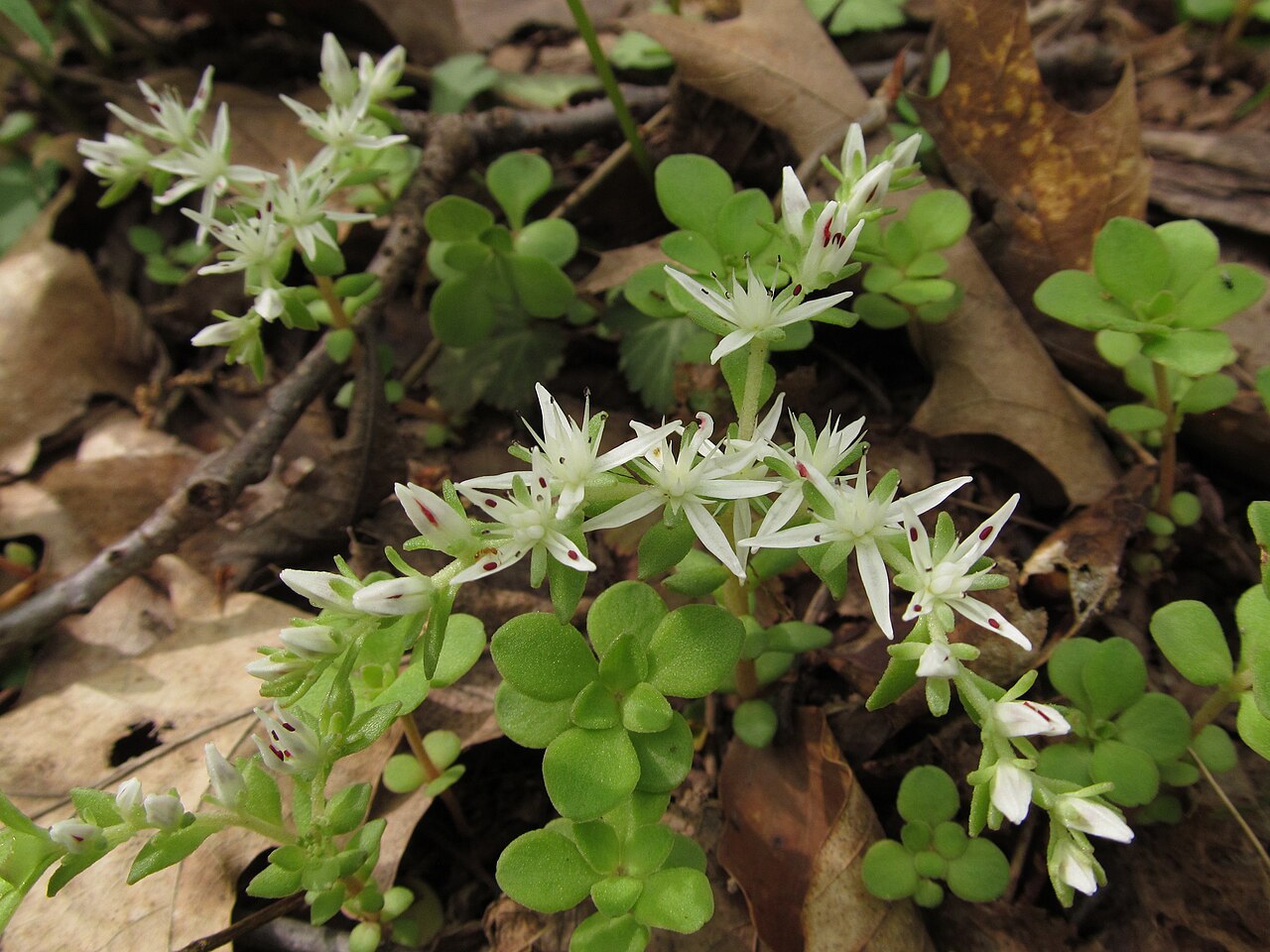
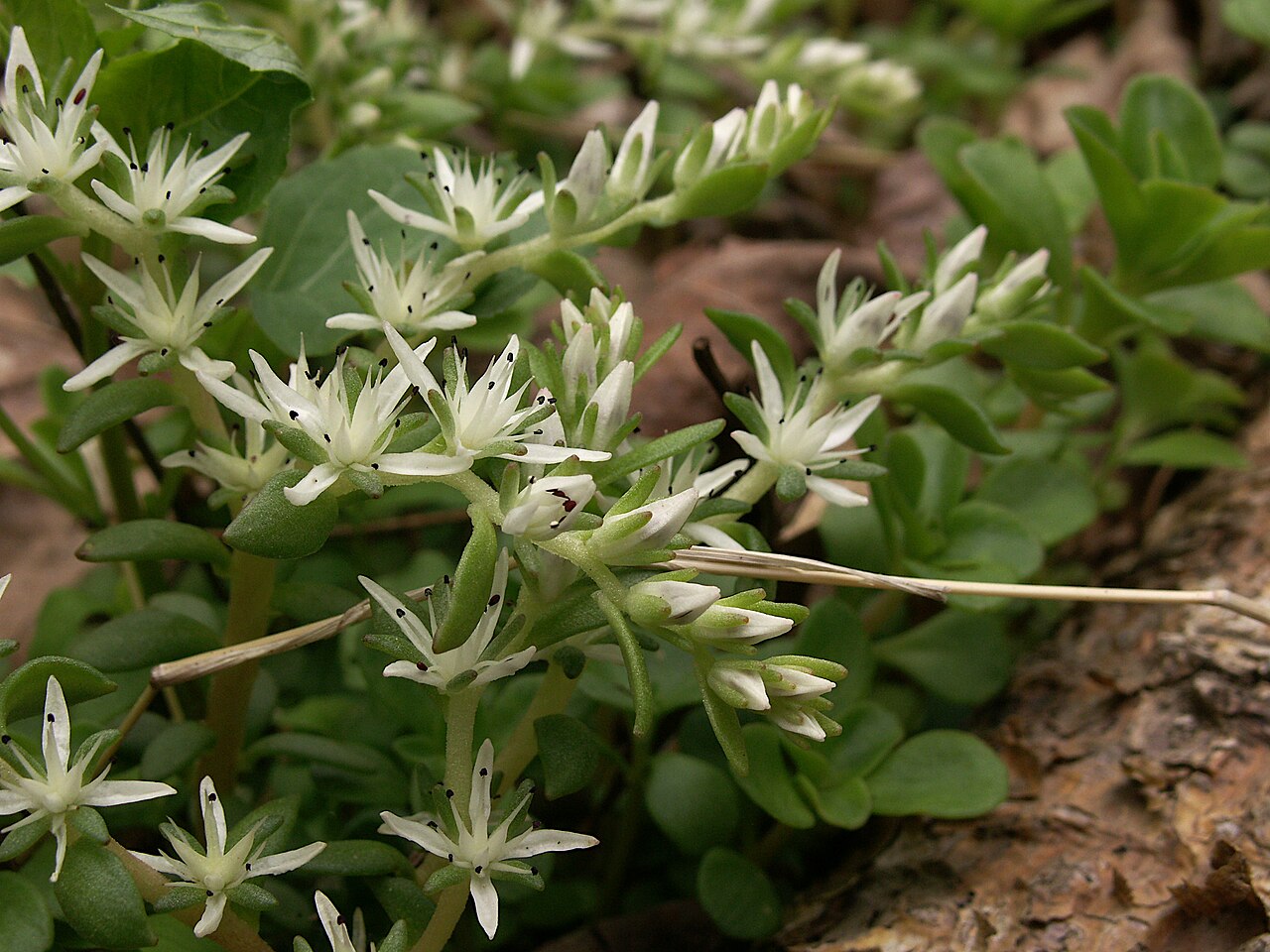
Wild stonecrop (Sedum ternatum) is the succulent for a woodland edge rather than a desert imitation. Low stems carry fleshy green leaves and, in spring, clusters of small white stars. It can settle into a shaded rock crevice, soften the edge of a path, or form a quiet patch beneath open deciduous trees. Its small scale rewards a close viewing position: a few inches of height are enough when flowers and leaf texture are within reach.
In Maryland, Virginia, and West Virginia, think of damp rocky woods and well-drained ledges when choosing a planting site. The regional table’s partial-shade to shade and average-moisture recommendations describe that woodland setting. Although its leaves store water and established plants can endure dry periods, wild stonecrop is not interchangeable with the sun-baked, yellow-flowered sedums used on hot roofs or traffic islands.
The common name woodland stonecrop helps distinguish this eastern native from many imported succulents sold simply as sedum. Ask for S. ternatum and inspect the leaves and white spring flowers. It is easy to propagate from garden stock, so there is no reason to pry plants from wild cliffs or streambanks. A small nursery-grown clump can provide material for several carefully placed patches over time.
Identification
Stems and Habit
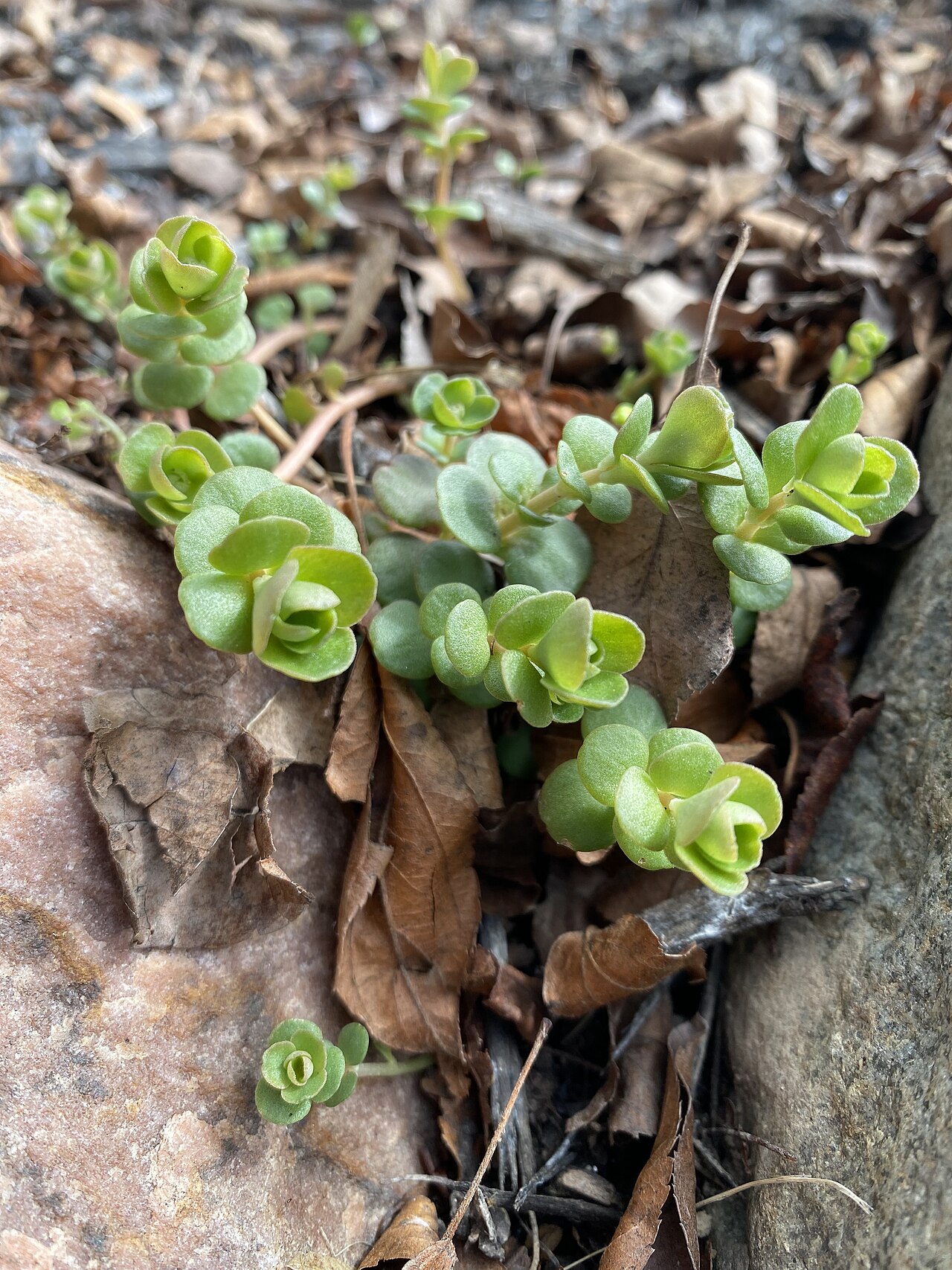
Stems creep over soil and rock surfaces, root where conditions suit them, and produce short upright flowering branches. The leafy mat generally stays around 3–6 inches tall; flower stems can rise somewhat above it. Growth is low and irregular rather than a perfectly level turf. Older connecting stems may die back, leaving rooted pieces that continue as separate plants. This is normal colony development, not necessarily a disease or a sign that the original clump has failed.
Leaves
Leaves are fleshy, smooth, and rounded to spoon-shaped, often arranged in conspicuous groups of three on nonflowering shoots. The name ternatum refers to this three-part arrangement. Flowering shoots carry smaller leaves. Leaf shape and spacing vary with light and moisture, but the plant should retain the soft, rounded appearance of a woodland succulent, not the thin needle leaves of many dryland stonecrops. Handle it gently: detached leaves can fall from a stem and sometimes root where they land.
Flowers
White star-shaped flowers open in branched clusters in spring, commonly April through June depending on locality. Four pointed petals are characteristic, with contrasting stamens adding detail at close range. Do not identify a sedum from flower color alone: use the low creeping habit and groups of fleshy leaves as well. The delicate display is easily hidden by a heavy mulch layer or by taller neighbors, so place the plant where spring growth is not immediately crowded out.
Fruit and Winter Appearance
After the flowers fade, small dry fruits release very fine seeds. The foliage can remain attractive after bloom and may persist through mild winters, but evergreen performance varies with exposure and climate. A weathered winter patch should be assessed for living rooted shoots before being replaced. Leave enough space around the mat to observe small new growth; vigorous weeds can look dominant long before they actually eliminate the succulent below.
Quick Facts
| Scientific Name | Sedum ternatum Michx. |
| Family | Crassulaceae (stonecrop family) |
| Plant Type | Low-growing woodland succulent perennial |
| Mature Height | Usually 3–6 in; flowering branches can be taller |
| Mature Spread | About 6–12 in initially, spreading into patches |
| Growth Rate | Moderate; rooted stem pieces expand a colony |
| Sun Exposure | Partial shade to shade; sun tolerated with suitable moisture |
| Water Needs | Average moisture with good drainage; some dry-period tolerance after establishment |
| Soil Type | Thin rocky or humus-rich woodland soil, well drained |
| Soil pH | Often associated with lime-rich, neutral to alkaline substrates |
| Bloom Time | Spring to early summer, generally April–June |
| Flower Color | White |
| Fall Color | Green foliage may persist; not a showy fall-color plant |
| Fruit | Small dry seed-bearing structures after flowering |
| Deer Resistant | Often listed as resistant, but not immune to browsing |
| USDA Hardiness Zones | 3–9, with local performance dependent on site |
Native Range
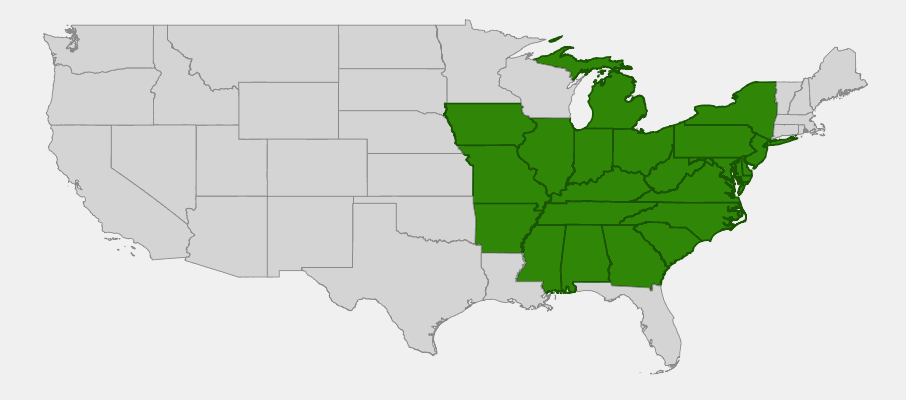
The main native range lies in the eastern United States, extending west toward Iowa and Arkansas and south through the Appalachian region. Damp rocky woods, wooded ravines, and limestone outcrops are recurring habitats. This is a small-scale ground-layer plant, not a species that requires an open meadow or a deep layer of cultivated topsoil.
Range sources do not always distinguish native occurrences from garden escapes in the Northeast. Lady Bird Johnson Wildflower Center explicitly describes populations farther north and east of the core range as escapes. The state map here therefore shows a conservative core U.S. native area rather than every state in which the plant has been reported. A green state is still not a claim that every county contains a native population; consult a state flora for local restoration work.
Within Maryland, Virginia, and West Virginia, use woodland and rock-garden conditions as the guide. A moist shaded crevice can support the plant while a nearby saturated hollow or exposed paved edge does not. Choosing a nursery source with regional stock helps keep the garden recommendation tied to actual local adaptation. Avoid spreading garden divisions into natural woods even when the species is native nearby.
📋 Regional plant list: Maryland, Virginia & West Virginia
Growing & Care Guide
Light
Partial shade is a dependable starting point. Morning light with afternoon protection can produce a compact patch without the stress of a hot exposed wall. Full shade is tolerated, but dense leaf litter and competition may be more limiting than light itself. If trying the plant in sun, keep an eye on moisture and reflected heat. A sunny rock garden in a cool setting is not equivalent to a shallow planter beside a south-facing driveway.
Soil and Water
Use a soil that retains modest moisture but drains freely. The plant often occupies thin, lime-influenced soils in nature; it does not need a deep, rich bed. Water new divisions until they root, then adjust irrigation to the actual site. Fleshy leaves offer some buffering against drought, not permission to let a newly planted root ball dry completely. Conversely, wet soil with no drainage can damage roots. Do not bury the stems under heavy compost in an attempt to make a small plant grow larger.
Planting Tips
Set rooted pieces at their existing depth, with leaves and the creeping stems near the surface. Spacing of roughly 6–12 inches allows patches to meet without forcing instant coverage. Press surrounding soil gently into contact with roots, water, and prevent loose mulch from sliding over the foliage. Between rocks, choose a pocket with enough soil to support roots and a way for excess water to escape. Keep the plant beside a path rather than directly in a regularly walked joint.
Pruning and Maintenance
This is not a plant that needs shearing. Lift windblown leaves or sticks that smother a small patch, while leaving a light woodland litter layer around it. Remove weeds early by hand so pulling them later does not uproot the stonecrop. If a mat reaches a walkway, trim a few rooted tips and use them elsewhere in the garden. A patch that thins in the center may be renewed with healthy rooted pieces rather than fertilized heavily.
Propagation
Stem cuttings and division are straightforward ways to preserve an identified garden plant. Take a healthy nonflowering piece, place it in a well-drained rooting medium, and keep it from drying severely while roots form. Rooted sections can be moved directly to another suitable spot. Leaves may also root, but stem pieces with an active tip are easier to handle. Seed is extremely fine; use a protected sowing setup and avoid burying it deeply or washing it out with a forceful watering stream.
Companions and Design
Pair wild stonecrop with plants that will not cover it completely by early summer. Small native sedges, modest ferns, and spring woodland flowers can work where their moisture needs agree. Avoid planting it immediately beneath a rapidly expanding large perennial and expecting the same low carpet to remain visible. In a container, use a broad shallow presentation with drainage and protection from excessive afternoon heat. Remember that roots in a pot face greater winter exposure than roots among ground-level stones.
Landscape Uses
- Edge a shaded woodland path with small patches that can be viewed close up.
- Fill well-drained crevices in a low rock wall away from foot traffic.
- Create a native succulent planting in a cool, partly shaded container.
- Use as a low accent among restrained woodland companions rather than as a universal lawn substitute.
Wildlife & Ecological Value
For Pollinators
The spring flowers offer resources to visiting insects, including bees and butterflies. Their small size is not a reason to dismiss them: a low patch can provide flowers in a space where larger plants would not fit. Keep the flowering stems accessible and avoid routine insecticide applications. Combining wild stonecrop with native plants that bloom before and after it gives a garden a more continuous sequence of resources.
For Birds
Wild stonecrop does not produce fleshy berries. Its contribution to birds is better understood as part of a diverse ground-layer habitat and insect-supporting garden rather than a major fruit crop. Leave surrounding vegetation and some natural litter where appropriate, and do not remove every spent flower simply to maintain a permanently tidy appearance.
For Mammals
Deer resistance is a tendency, not a guarantee. A small succulent patch may still be damaged by browsing or by animals moving through it. Protect newly rooted pieces if local wildlife repeatedly dislodges them. The sap may irritate skin in sensitive people, and eating large quantities can cause stomach upset; this ornamental guide does not recommend treating the plant as a salad crop.
Ecosystem Role
Low mats occupy pockets of soil between rocks and add a living layer beneath taller vegetation. They are useful for a small garden niche, but they do not stabilize a major eroding slope by themselves. Preserve existing native rock-outcrop communities rather than treating them as sources of free plants. Easy propagation from cultivated stock makes responsible use particularly practical with this species.
Cultural & Historical Uses
The name stonecrop reflects the long association of sedums with rocky growing places. In this species, those places are often wooded and moist rather than desert-dry. The Latin epithet ternatum draws attention to the leaves in threes, a more useful memory aid for identification than a generalized picture of a succulent.
Wild stonecrop has become a valued native alternative for small shaded rock gardens because it combines fleshy texture with a woodland growth pattern. Its garden use should not obscure the difference between species. A plant sold simply as creeping sedum may be an imported taxon with a different flower color, winter habit, and ecological role.
There is no need to attach an unverified medicinal story to appreciate this plant. Its practical history in a garden can be as simple as a labeled nursery division, a successful patch beside a stone step, and carefully identified cuttings shared with another gardener. Keep the scientific name with those divisions so the native species is not lost among look-alike succulent collections.
Frequently Asked Questions
Does wild stonecrop need full sun like other succulents?
No. Partial shade to shade is a normal setting for this woodland species. It can tolerate more sun where moisture and temperature are suitable, but a hot dry exposure is not the default recommendation.
Can I use it between stepping stones?
Place it beside stones or in joints that are not routinely stepped on. It is a low groundcover, not a durable walking surface. Repeated foot traffic can break the fleshy stems.
Why is the plant coming apart into little rooted pieces?
Older connecting stems can die back while rooted portions persist. That is part of its spreading habit. Check that the remaining pieces are healthy and rooted before assuming the colony is dying.
Is it native throughout New England?
No blanket claim is appropriate. Some northern and eastern records represent escapes from cultivation. Use a local flora or native-plant organization to check status before including it in a restoration planting.
How do I make a small patch larger?
Move a few healthy rooted pieces into nearby suitable pockets and water them while they establish. This is usually more reliable than heavy feeding or burying existing stems under compost.
Sources & Further Reading
- NC State Extension: Sedum ternatum
- Lady Bird Johnson Wildflower Center: wild stonecrop
- USDA PLANTS: Sedum ternatum
Find Native Plants
Ask growers about nursery propagation and regional provenance. Browse our Maryland native plant nurseries, Virginia native plant nurseries, West Virginia native plant nurseries directory for suppliers.