Eastern White Pine (Pinus strobus)
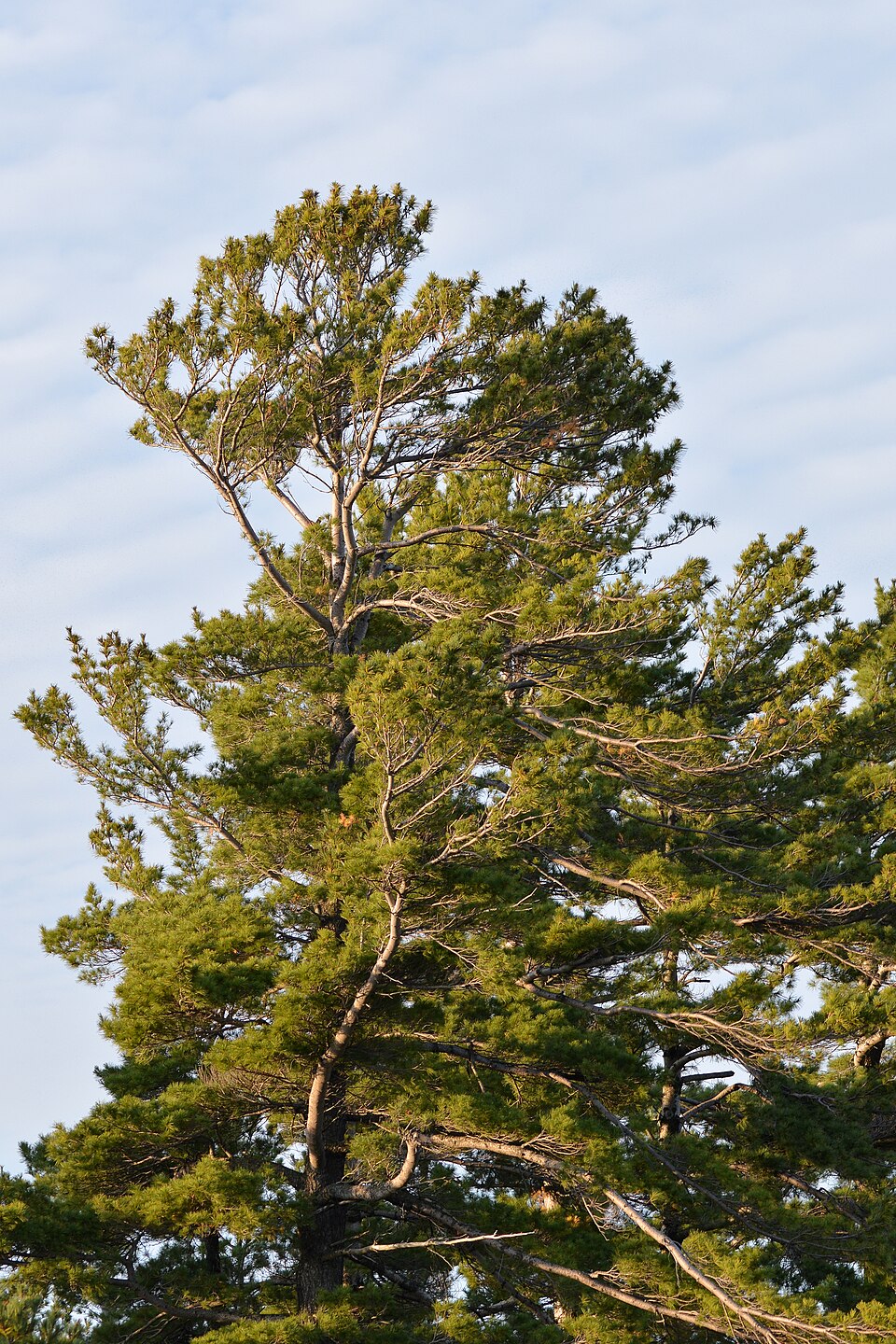
Pinus strobus, the Eastern White Pine, is the largest conifer native to eastern North America and one of the most iconic trees of the northeastern and upper midwestern landscape. Once forming vast primeval forests stretching from Newfoundland to the Great Lakes and south through the Appalachians, this majestic pine was so valuable to colonial Britain — its towering, straight trunks were prized as masts for the Royal Navy — that it became a symbol of American freedom. The broad, horizontally tiered canopy of mature White Pine is unmistakable in the forest, and its soft, bluish-green, five-needle bundles are distinctive at any scale.
Eastern White Pine grows rapidly to impressive heights of 50 to 80 feet under typical landscape conditions, though in forest settings it can reach 150 feet or more. The species is the ecological backbone of the northeastern pine barrens and mixed hardwood-conifer forests of Indiana, Ohio, and the broader Great Lakes region. Its evergreen canopy provides year-round cover for wildlife, its cones feed birds and mammals through winter, and its dense stands create the thermal microhabitats that allow many species to survive harsh midwestern winters.
For landscape use, Eastern White Pine is among the most useful large native conifers available to Indiana and Ohio gardeners. Its rapid growth (2 to 3 feet per year when young), adaptability to a range of soils, and tolerance of full sun make it an excellent choice for windbreaks, screens, and naturalized woodland plantings. The soft texture of the foliage, the graceful horizontal branching, and the year-round evergreen color give it an aesthetic quality that few other large conifers can match.
Identification
Eastern White Pine is easily recognized by its needles — long (3 to 5 inches), flexible, and bundled in groups of five, giving it a soft, feathery texture unlike any other native pine. In summer the foliage is bluish-green; in fall older needles turn yellow and drop, creating a temporary golden haze before the green of the current season’s growth reasserts itself. The tree’s overall form changes dramatically with age: young trees are strongly pyramidal with whorled branches; mature trees develop a broad, irregular, picturesque crown with flat-topped tiers of spreading branches.
Bark
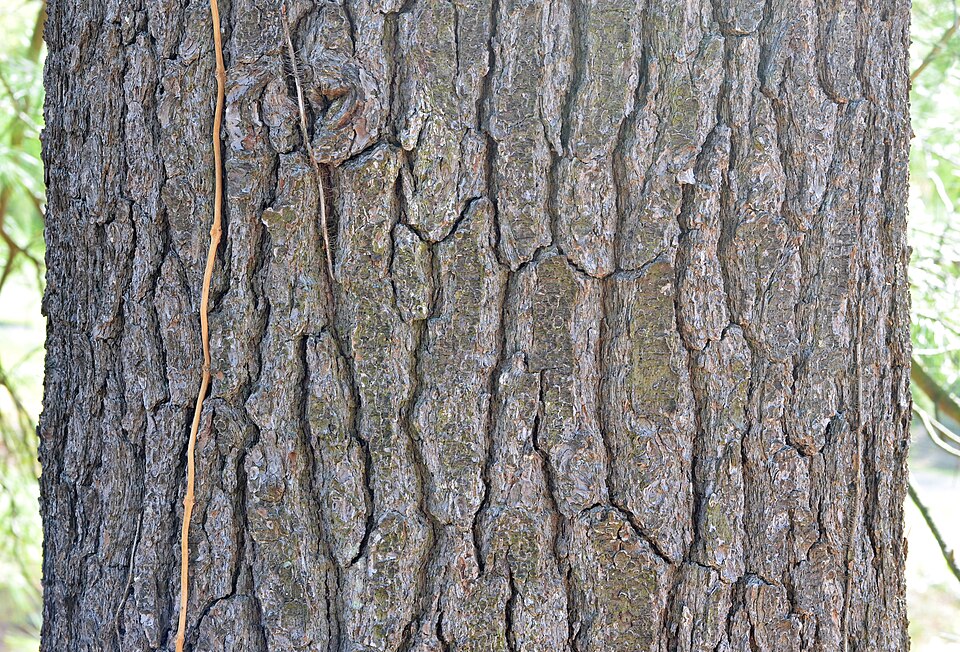
Young bark is smooth and greenish-gray, becoming darker and more deeply furrowed with age into long, irregular, rectangular plates separated by deep grooves. Old-growth specimens develop broad, thick, rounded ridges with a grayish or dark brown appearance. The bark is not as deeply furrowed as that of Pitch Pine or Ponderosa Pine — Eastern White Pine bark retains a comparatively smooth appearance on young trunks, developing texture gradually over decades.
Needles
The needles are the definitive field mark: bluish-green, soft (not stiff), 3 to 5 inches long, in bundles (fascicles) of exactly five. A simple mnemonic — WHITE has five letters, and White Pine has five needles — helps distinguish it from all other native eastern pines. The needles are flexible, with fine white lines (stomatal bands) running along each one, giving the bundles their characteristic bluish-green cast. Each bundle is enclosed at its base in a deciduous sheath that falls off in the first summer. Needles persist for 1 to 2 years before dropping.
Cones & Seeds
Eastern White Pine produces elongated, cylindrical cones 4 to 8 inches long — the longest of any native eastern pine. The cones are slender, slightly curved, with thin scales that lack the spines found on most other pine species. They mature in late summer and fall of their second year, opening to release the winged seeds. The seeds are an important food source for many animals, including Red Squirrel, White-breasted Nuthatch, Crossbill, and numerous other birds and small mammals.
Quick Facts
| Scientific Name | Pinus strobus |
| Family | Pinaceae (Pine) |
| Plant Type | Evergreen Conifer |
| Mature Height | 50–80 ft |
| Sun Exposure | Full Sun |
| Water Needs | Moderate |
| Needle Color | Bluish-green (evergreen) |
| Needles per Bundle | 5 (diagnostic) |
| Cone Length | 4–8 in (longest of eastern pines) |
| Growth Rate | Fast (2–3 ft/yr when young) |
| Deer Resistant | Somewhat (deer browse seedlings) |
| USDA Hardiness Zones | 3–8 |
Native Range
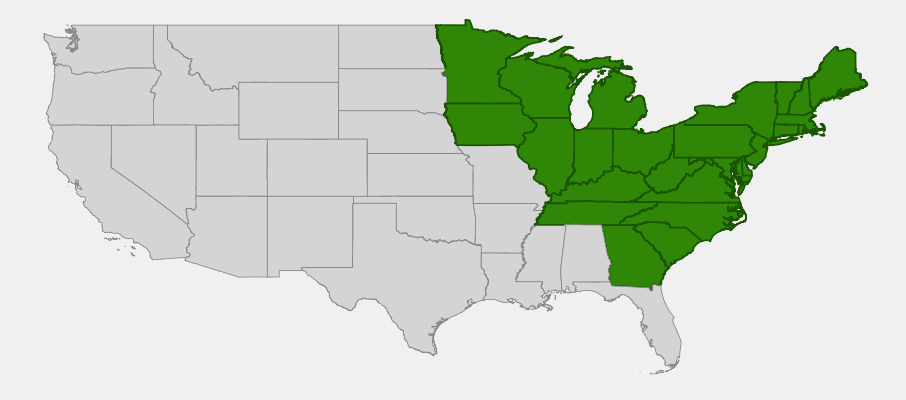
Eastern White Pine is native to an enormous area of eastern North America, from Newfoundland and Nova Scotia south through New England and the Mid-Atlantic states, west through the Great Lakes region (Indiana and Ohio included), and south along the Appalachians to Georgia and Alabama. Its range is essentially coextensive with the mixed deciduous-coniferous forest zone of eastern North America — a vast biome shaped in large part by the presence of this dominant species.
In Indiana and Ohio, Eastern White Pine occurs naturally in the northern and eastern portions of both states — areas with sandier, more acidic soils associated with glacial outwash and lake-effect climates. It is found naturally on well-drained sandy soils, rocky slopes, lake shores, and bog edges. In these native habitats it grows alongside Red Maple, Bigtooth Aspen, Paper Birch, and various oaks. In the more agrarian and clay-dominated regions of central Indiana and Ohio, it is less common naturally but has been extensively planted in plantations, windbreaks, and Christmas tree farms.
Historically, Eastern White Pine forests blanketed vast areas of the northeastern and Great Lakes region. The clearing of these forests during the 19th century for lumber — White Pine was the most commercially valuable timber species in North America for most of that century — fundamentally transformed the landscape of the region. Today, second-growth White Pine forests are common throughout the northern parts of Indiana and Ohio, and the species is recovering steadily where conditions are appropriate.
📋 Regional plant lists featuring Eastern White Pine: Indiana & Ohio
Growing & Care Guide
Eastern White Pine is a remarkably adaptable and fast-growing conifer that establishes readily in most Indiana and Ohio landscapes. Its primary requirements are full sun, well-drained soil, and adequate space — it grows large, and planting too close to structures or power lines creates problems that are difficult to remedy once the tree matures.
Light
Eastern White Pine requires full sun for best growth and health. While young trees can tolerate light shade, mature trees in shaded conditions lose their lower branches and develop thin, open crowns. For use as a screen, windbreak, or specimen tree, choose a site with at least 6 to 8 hours of direct sun daily. The tree also performs better with some protection from extreme west-facing exposure in continental midwestern climates, where winter desiccation of the needles can be a recurring problem.
Soil & Water
Eastern White Pine grows best in well-drained, slightly acidic soils — sandy loams, loamy sands, and glacial outwash soils are ideal. It tolerates a modest range of soil pH but is sensitive to high pH (alkaline) soils, which can cause needle chlorosis (yellowing). It does not tolerate prolonged wet feet — avoid planting in clay soils with poor drainage. Water needs are moderate; established trees are relatively drought-tolerant but benefit from deep watering during extended dry spells. Air pollution tolerance is moderate — trees near heavy traffic may show needle browning.
Planting Tips
Plant in spring or early fall from container or balled-and-burlapped stock. Avoid planting in highly compacted or alkaline soils without significant amendment. Space trees at least 20 to 25 feet apart for naturalistic plantings; for dense screens, 15-foot spacing can work if you are willing to accept some competition. Mulch the root zone with 3 to 4 inches of wood chips or pine bark to maintain moisture, reduce competition from grass, and slightly acidify the soil over time. Protect young trees from deer browse — White Pine seedlings and saplings are highly palatable to deer.
Pruning & Maintenance
Eastern White Pine requires minimal pruning under normal conditions. Remove dead or broken branches as needed. If you wish to control height or density, prune back the “candles” (new growth tips) in late spring before the needles fully extend — this is the classic technique for shaping pines without cutting into old, needle-free wood. Avoid cutting back into old wood (beyond current-year growth), as pines generally do not regenerate new growth from leafless wood. The most common problems are white pine blister rust, pine blister rust, white pine weevil (which kills the leader), and needle cast diseases — all manageable with proper site selection and, if necessary, targeted treatments.
Landscape Uses
- Privacy screen and windbreak — fast growth and evergreen density make it superb
- Specimen tree on large properties where its eventual size can be accommodated
- Naturalized woodland planting on sandy or well-drained slopes
- Wildlife planting — dense cover and seed production support numerous species
- Christmas tree farming — a traditional commercial crop in Indiana and Ohio
- Restoration planting on degraded sandy soils and former agricultural fields
Wildlife & Ecological Value
Eastern White Pine is a foundational ecological species whose value to wildlife cannot be overstated. Its dense evergreen canopy, abundant seed production, and structural longevity make it one of the most important native conifers for wildlife in the eastern United States.
For Birds
The seeds are consumed by Red Crossbill, White-winged Crossbill, White-breasted Nuthatch, Red-breasted Nuthatch, Pine Siskin, Purple Finch, and many other seed-eating birds. The dense canopy provides essential winter roosting and thermal cover for species including Northern Saw-whet Owl, Long-eared Owl, and Sharp-shinned Hawk. Bald Eagles and Osprey frequently nest in the crowns of tall, emergent White Pines near water. Red-breasted Nuthatch and Brown Creeper use the furrowed bark as foraging habitat. Dozens of songbird species use White Pine stands for nesting, foraging, and migration staging.
For Mammals
Red Squirrel is perhaps the most important consumer of White Pine seeds in the northeast — it harvests and caches cones by the hundreds, and its forgotten caches lead to natural reforestation. Gray Squirrel, Eastern Chipmunk, and Pine Vole also consume seeds. Porcupine is notorious for debarking White Pine during winter food scarcity. Black Bear uses dense White Pine stands for denning. White-tailed deer and snowshoe hare browse young trees, and many small mammals use dense stands for thermal refuge in winter.
For Pollinators
As a wind-pollinated conifer, Eastern White Pine does not provide nectar. However, its dense shade creates a cool, moist microhabitat beneath the canopy that supports shade-tolerant wildflowers (trilliums, hepaticas, Canada Mayflower) that are important pollinator resources. The litter layer beneath old White Pines hosts a rich invertebrate community that supports ground-nesting bees and many other beneficial insects.
Ecosystem Role
Eastern White Pine is a keystone species that structures entire forest ecosystems. Its persistent canopy creates distinctive understory conditions — cool, acidic, nutrient-poor — that favor specialized communities of plants, fungi, and invertebrates. Its deep root system helps stabilize soils on slopes and sandy sites, reducing erosion. As a dominant canopy tree, it intercepts precipitation, moderates temperature, and creates the structural complexity (standing snags, fallen logs, thick duff layer) that supports the full biodiversity of the eastern forest ecosystem.
Cultural & Historical Uses
Few trees have shaped North American history as profoundly as Eastern White Pine. Its straight-grained, lightweight, and easily worked wood made it the most commercially valuable timber in colonial North America. The British Royal Navy designated the tallest, straightest trees as “Mast Pines” — marked with a broad arrow and reserved for the Crown — and the resentment this policy generated among New England colonists contributed meaningfully to the tensions that led to the American Revolution. A stylized White Pine was depicted on the first flag raised by American revolutionaries, and the species remains the state tree of both Maine and Michigan.
Indigenous peoples throughout the Northeast and Great Lakes region used Eastern White Pine extensively. The Iroquois, Ojibwe, Potawatomi, and many other nations used pine pitch as a waterproofing agent for canoes and containers, as an antiseptic wound treatment, and as a fire-starting aid. The inner bark (cambium layer) was eaten as emergency food in hard winters and used medicinally. Pine needle tea, rich in vitamin C, was used to treat scurvy — a life-saving knowledge that European explorers were slow to accept. Pine tar, distilled from the wood, was a valuable commodity for rope treatment, wood preservation, and medicine.
The lumber era of the 19th century saw catastrophic over-harvesting of White Pine forests across the Great Lakes states. Michigan, Wisconsin, Minnesota, Indiana, and Ohio all had vast White Pine stands that were cleared in a matter of decades for lumber used in building the rapidly expanding cities and farms of the Midwest. The ghost of these forests — enormous stumps still visible in some northern Indiana and Ohio wetlands — stands as testimony to what was lost. The recovery of White Pine forests, now well underway where soil conditions allow, is one of the more ecologically hopeful stories of 20th and 21st century American conservation.
Frequently Asked Questions
How big will Eastern White Pine get in my yard?
In a typical landscape setting, Eastern White Pine will reach 50 to 80 feet tall with a spread of 20 to 40 feet over 50 years. Under ideal conditions (full sun, good soil, adequate moisture), growth can be faster. Be sure you have adequate space — this is a large tree that does not respond well to heavy pruning or restriction.
Why are my White Pine’s needles turning yellow and dropping?
Natural needle drop: White Pine sheds its second-year needles every fall, which turns the inner portions of the crown yellow before the needles drop. This is completely normal and not a sign of disease. However, if new growth (current-year needles) is yellowing, this could indicate nutrient deficiency (especially iron chlorosis on alkaline soils), salt damage, air pollution stress, or white pine blister rust. Consult an arborist if yellowing appears in new growth.
Can I plant Eastern White Pine near my house?
With caution. The tree grows large and its branches can become brittle with age. Maintain at least 30 to 40 feet of clearance from structures. Never plant under power lines. White Pine roots are generally not invasive toward foundations, but the tree’s eventual size and potential for branch failure near structures make careful placement critical.
Does Eastern White Pine work as a deer-resistant plant?
Not particularly. White Pine seedlings and young trees are very palatable to deer, and heavy browsing can kill young plants or cause persistent multi-stemmed growth from browsed leaders. Protect young trees with tree tubes or wire cages until they reach 5 to 6 feet in height. Once established and beyond browsing height, deer impacts are minimal.
How do I identify Eastern White Pine vs. other pines?
Eastern White Pine is the only eastern pine with exactly five needles per bundle. “WHITE” = 5 letters = 5 needles per fascicle. All other eastern pines (Pitch Pine, Jack Pine, Shortleaf, Loblolly, Virginia Pine) have two or three needles per bundle. The long, slender, unarmed cones (4–8 inches, no spines) are also diagnostic.