Firecracker Flower (Dichelostemma ida-maia)
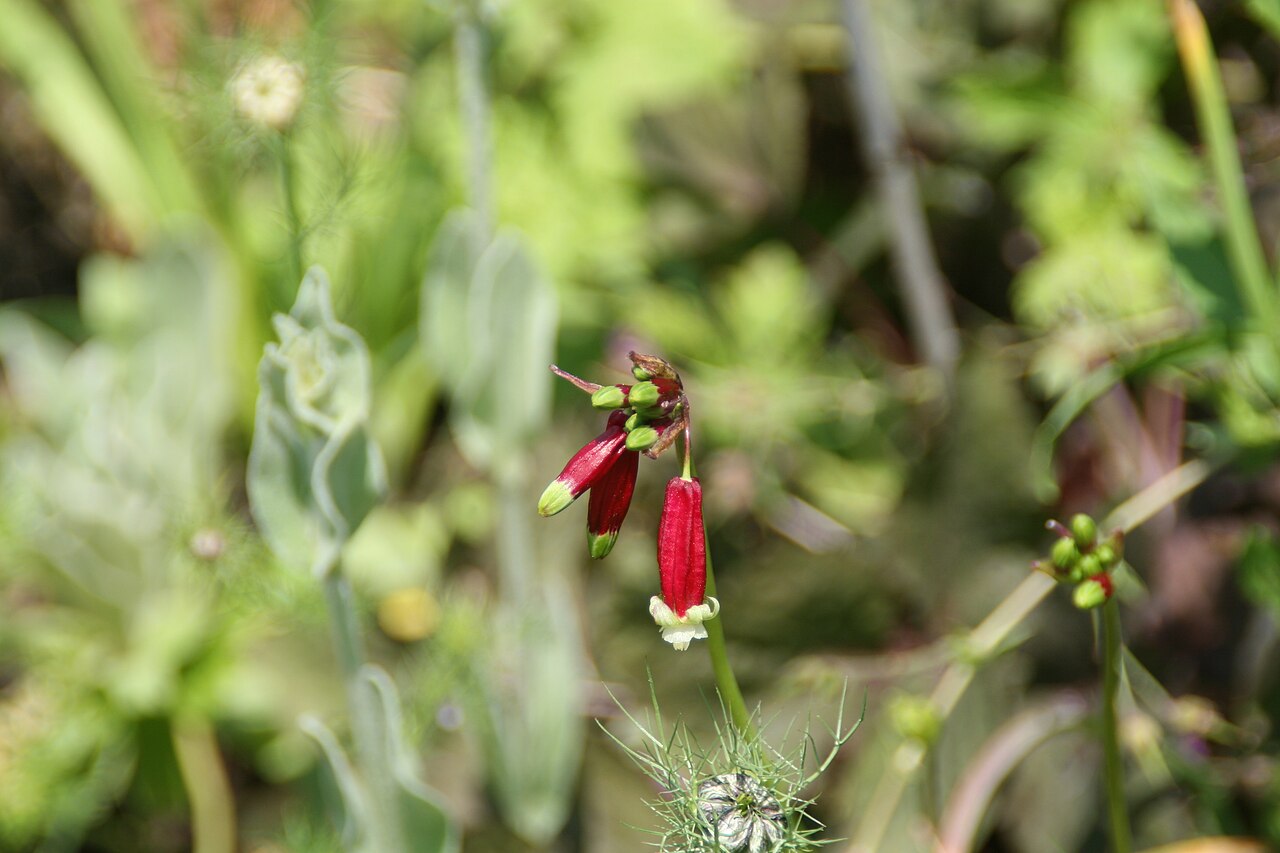
Dichelostemma ida-maia, commonly called firecracker flower (also firecracker brodiaea or Ida May’s snakelily), is a bulb-forming perennial native to the mountains of northwestern California and southwestern Oregon. It belongs to the brodiaea tribe within the asparagus family (Asparagaceae, subfamily Brodiaeoideae), a group of western American “lilies” that grow from underground corms and vanish entirely between bloom cycles. The species carries the name of Ida May Burke, who is said to have first shown the plant to a 19th-century bulb collector near the Klamath River.
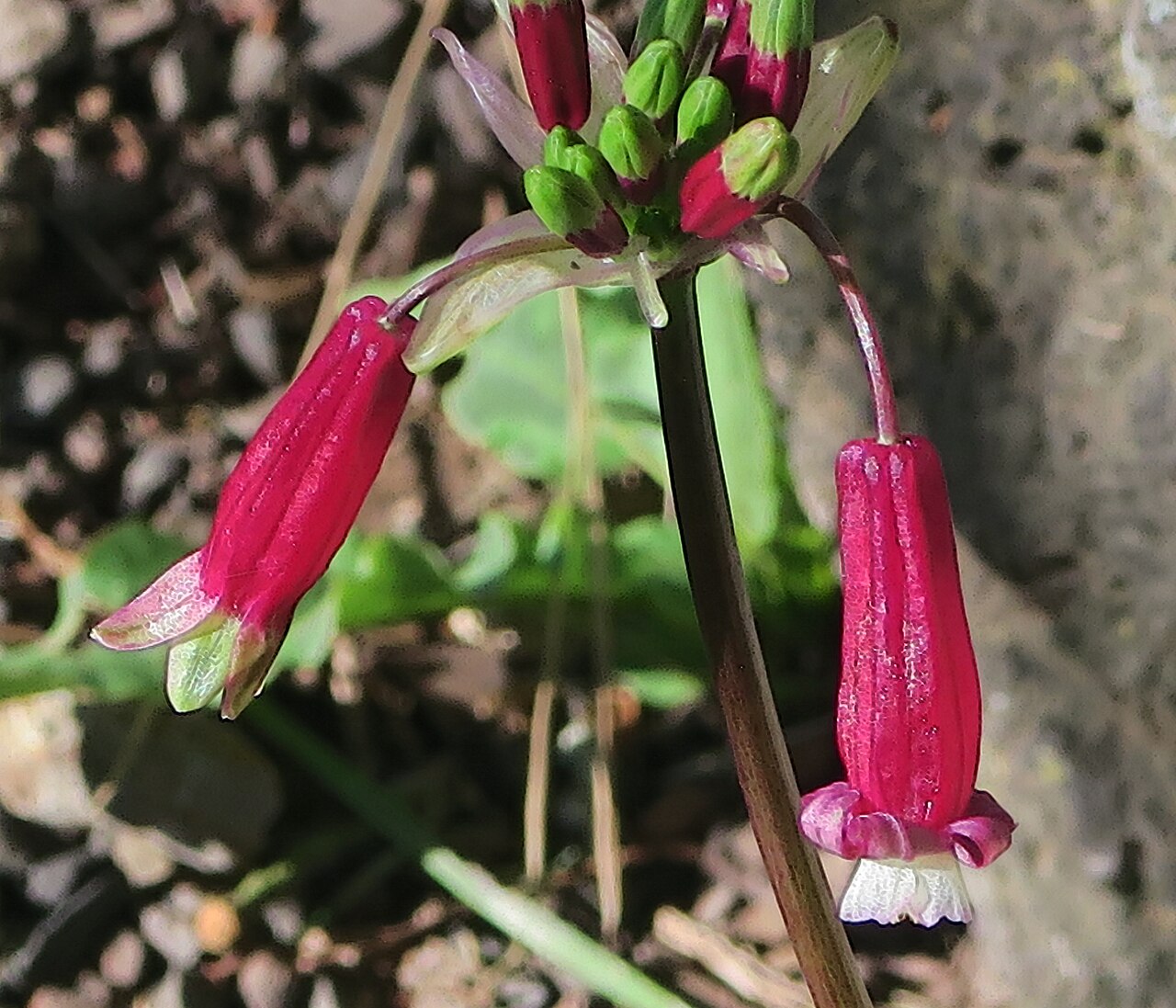
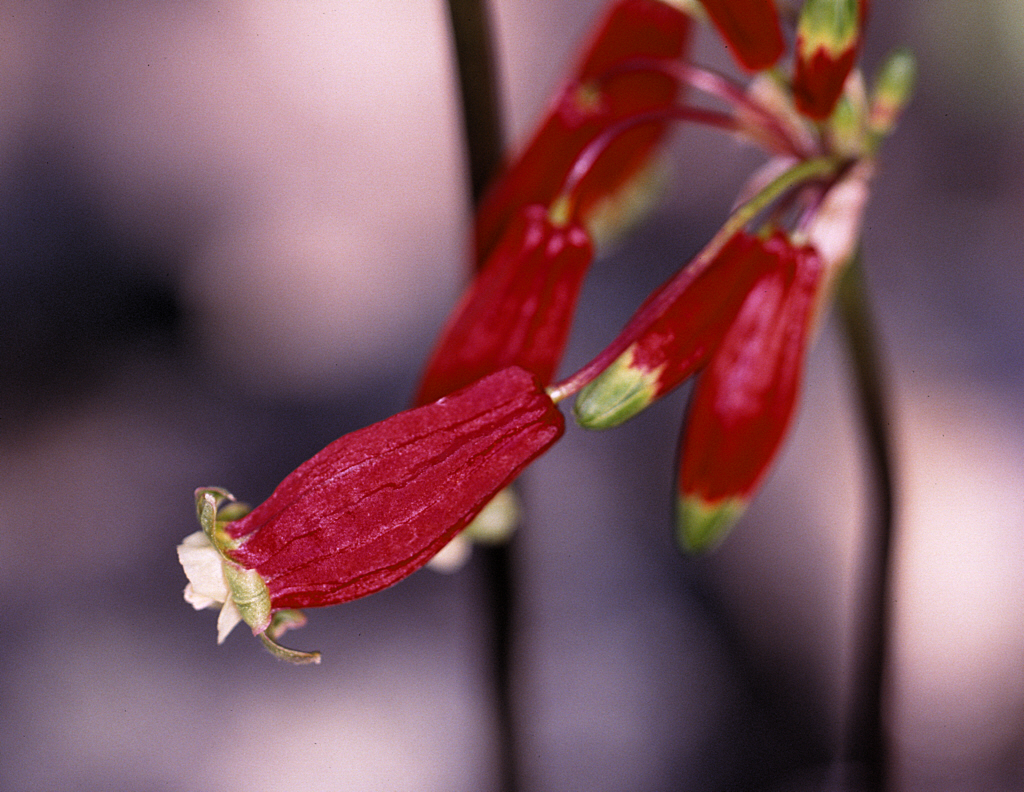
What sets firecracker flower apart from its brodiaea relatives is its flower shape: instead of an open, star-like bloom, each flower hangs as a narrow crimson tube that flares open at the very tip into six small cream-to-pale-green lobes, like a tiny exploding firework on a wire. A dozen or more of these dangle from thin, arching pedicels at the top of a single wiry stalk 1 to 3 feet tall, rising leafless above the surrounding grass and brush.
In the garden, firecracker flower is prized by anyone trying to attract hummingbirds, since the tubular red flowers are built almost exclusively for them. It wants exactly what it gets in the wild — a dry summer dormancy and a wet winter-to-spring growing season — which makes it an easy, low-water bulb for California and southern Oregon gardens, but a poor match for a regularly irrigated lawn bed.
Identification
Firecracker flower grows from a small, fibrous-coated corm buried a few inches underground. It sends up a few narrow, grass-like basal leaves in late winter that typically wither before or during bloom, followed by a single slender, naked flowering stalk.
Leaves
The leaves are linear and grass-like, 6 to 16 inches long and less than half an inch wide, arising directly from the corm. They are soft and somewhat fleshy, and because they emerge early and dry up by flowering time, the plant is often seen blooming with no obvious foliage at all — a trait shared with many California geophytes adapted to a long dry summer.
Flowers
The flowering stalk (scape) stands 12 to 36 inches tall and carries an umbel of 3 to 12 (sometimes more) pendant flowers at its tip, each on its own slender, curved pedicel. Each flower is a narrow tube about ¾ to 1¼ inches long, deep crimson-red for most of its length, abruptly flaring at the mouth into six short, spreading, cream-to-pale-greenish-yellow lobes. The contrast of hot red tube and pale flared tip is the plant’s signature “firecracker” look. Bloom runs from late April through June, peaking in May at lower elevations and later at higher ones.
Fruit & Seeds
After pollination, each flower matures into a small three-chambered capsule holding several shiny black, angular seeds. The stalk and capsules dry in place through summer, and the whole above-ground plant eventually disappears, with the corm surviving the dry season underground.
Quick Facts
| Scientific Name | Dichelostemma ida-maia |
| Family | Asparagaceae (subfamily Brodiaeoideae) |
| Plant Type | Perennial bulb (corm), deciduous/summer-dormant |
| Mature Height | 12–36 in flowering stalk |
| Mature Spread | 6–12 in (clump of leaves at base) |
| Growth Rate | Slow to moderate (bulb offsets) |
| Sun Exposure | Full sun to part shade |
| Water Needs | Low; needs dry summer dormancy |
| Soil Type | Well-drained loam, gravel or clay-loam |
| Soil pH | 6.0–7.5 |
| Bloom Time | Late April – June |
| Flower Color | Crimson-red tube, cream to pale-green lobes |
| Fall Color | None (dormant, no foliage present) |
| Fruit | Small three-chambered capsule, black seeds |
| Deer Resistant | Yes |
| USDA Hardiness Zones | 7–10 |
Native Range
Firecracker flower occupies a narrow band of the Klamath-Siskiyou region, from the mountains of southwestern Oregon (Douglas, Jackson and Josephine counties) south through Del Norte, Siskiyou, Humboldt and Trinity counties in northwestern California. Within this range it is locally common but is found nowhere else in the wild; gardeners elsewhere in the West grow it from nursery-propagated bulbs rather than wild stock.
It grows in open conifer and oak woodlands, brushy chaparral openings, and grassy forest edges, typically on well-drained slopes from near sea level up to about 5,000 feet. It is often found alongside manzanita, ceanothus, and scattered Douglas-fir or Oregon white oak, in the dappled light at the edge of denser forest rather than in deep shade or in open grassland.
Because its range is so restricted, firecracker flower is not listed in the USDA PLANTS database for any state outside California and Oregon, and it should not be planted as a “California native” substitute in regions to the south or east where it never historically grew — in those gardens it is best treated as an ornamental bulb from the Pacific Northwest rather than a true native.
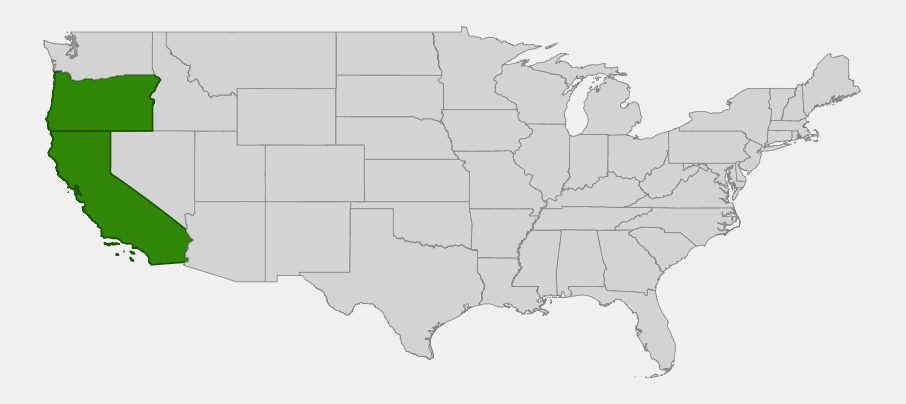
📋 Regional plant lists featuring Firecracker Flower: California & Nevada · Western Oregon & Western Washington
Growing & Care Guide
Firecracker flower is an easy, trouble-free bulb once you accept its dry-summer, wet-winter rhythm. It fails only when it is kept too wet after bloom, so the biggest rule of thumb is: water through spring, then let it bake.
Light
Full sun produces the most flowers, but in hot interior gardens light afternoon shade or the dappled shade of oaks (mimicking its native woodland-edge habitat) extends bloom and prevents the thin stalks from scorching. Avoid deep, continuous shade, which weakens flowering.
Soil & Water
Plant in well-drained soil — gritty loam, decomposed granite or clay-loam that doesn’t stay soggy. Water through the winter and spring growing season, then withhold summer water entirely once the leaves yellow; corms rot quickly in irrigated beds that stay moist through summer. This makes firecracker flower an excellent choice to tuck among other summer-dry native bulbs and bunchgrasses rather than in a lawn or a regularly watered perennial border.
Planting Tips
Plant dormant corms 3 to 4 inches deep in fall, spacing them 3 to 5 inches apart for a natural-looking cluster. Corms are small and should be handled gently; they multiply slowly by offsets, so a planting increases in density over years rather than spreading aggressively. Firecracker flower looks best planted in loose drifts among bunchgrasses or low shrubs rather than in straight rows.
Pruning & Maintenance
Let the foliage and flowering stalks die back naturally and dry in place; this is how the corm stores energy for next year. Deadhead spent flower stalks for tidiness if desired, but leave the basal leaves alone until they are fully brown. No fertilizing is needed in reasonably fertile garden soil.
Propagation
The easiest method is dividing and replanting cormlets (small offset corms) that form around the base of mature corms, done during the summer dormant period when the soil can be dug without disturbing active growth. Seed is also viable but slow, typically taking three to four years to reach flowering size.
Landscape Uses
- Hummingbird gardens — the tubular red flowers are a strong hummingbird draw
- Dry bulb meadows interplanted with native bunchgrasses
- Woodland-edge borders beneath oaks or conifers with light shade
- Rock gardens and gravel beds with sharp drainage
- Cut flowers — the stems hold up well in arrangements
- Containers grown dry in summer and watered in winter-spring
Wildlife & Ecological Value
Firecracker flower plays a focused but important role for one group of pollinators above all others, while its corms and seeds support a modest supporting cast of other wildlife.
For Pollinators
The narrow red tubes with a tiny flared opening are a textbook hummingbird flower: the shape excludes most bees and other insects while rewarding birds that can reach past the long tube to the nectar at its base. Anna’s and Rufous hummingbirds are the primary visitors and the main pollinators across its range.
Birds
Hummingbirds, especially migrating Rufous Hummingbirds passing through the Klamath-Siskiyou region in spring, rely on firecracker flower and other tubular natives as an early-season nectar source timed to their northward migration.
Mammals
Like many brodiaea-relatives, the underground corms were historically dug and eaten by small mammals and, as discussed below, by Indigenous peoples; deer and rabbits largely leave the foliage and flowers alone, making it one of the more reliably deer-resistant native bulbs.
Ecosystem Role
As a geophyte that disappears completely each summer, firecracker flower occupies a seasonal niche in Klamath-Siskiyou woodlands — using spring moisture and light before the tree and shrub canopy fully leafs out, then retreating underground to avoid summer drought stress entirely.
Cultural & Historical Uses
Firecracker flower belongs to a group of brodiaea-type corms that were an important food source for Indigenous peoples of northern California and southern Oregon, including Karuk, Yurok and Shasta communities within its range, who dug and roasted or steamed the starchy corms of related species as a seasonal staple. Historical accounts of firecracker flower itself are sparser than for some of its more widespread relatives, but it would have been gathered alongside other brodiaea-type bulbs where it occurred.
The species gets its common and scientific name from Ida May Burke, who is credited with first bringing the plant to the attention of botanists and bulb growers in the late 1800s near the Klamath River in Siskiyou County. It was quickly taken up by bulb collectors in Europe for its unusual flower shape, and it remains in cultivation today largely through nursery-propagated stock rather than wild collection.
Modern use is almost entirely ornamental — as a hummingbird-garden bulb, a cut flower, and a specialty item for native-plant and bulb enthusiasts outside its native range, where it is grown as a curiosity from the Pacific Northwest rather than a regional native.
Frequently Asked Questions
Is firecracker flower the same as firecracker brodiaea?
Yes. Dichelostemma ida-maia is commonly called both firecracker flower and firecracker brodiaea; some older references still list it under its former name, Brodiaea ida-maia.
Why didn’t my firecracker flower bloom this year?
The most common cause is summer water. If the corms were kept moist through summer dormancy — from nearby lawn irrigation, for instance — they may rot or simply fail to initiate flowers the following spring. Make sure the planting dries out completely after the leaves yellow.
Can I grow firecracker flower outside California and Oregon?
Yes, as an ornamental bulb, as long as winters don’t dip much below USDA zone 7 and the site has sharp drainage and a dry summer rest. It will not be acting as a native plant outside the Klamath-Siskiyou region, but it adapts well to similar Mediterranean-climate gardens.
Do hummingbirds really prefer this flower?
Very much so — the long, narrow red tube with a small flared mouth is shaped almost exclusively for a hummingbird’s bill and tongue, and in its native range it is pollinated primarily by Anna’s and Rufous hummingbirds.
Is firecracker flower deer resistant?
Yes, it is considered reliably deer resistant, likely due to its narrow grass-like leaves and the fact that little foliage is present during the main grazing season.

Looking for a nursery that carries Firecracker Flower?
Browse our native plant nursery directory: California · Oregon