Flannel Bush (Fremontodendron californicum)
Fremontodendron californicum, commonly called Flannel Bush or California Flannelbush, is a tough, drought-defying evergreen shrub native to the dry chaparral slopes and foothill canyons of California and central Arizona. Named for the American explorer John C. Frémont, who first collected it in the 1840s, this member of the mallow family (Malvaceae) is best known for its spectacular three-month display of large, waxy, golden-yellow flowers that cover the plant from late spring into summer, and for the dense coat of stiff, star-shaped hairs that covers every leaf, stem, and seed capsule.
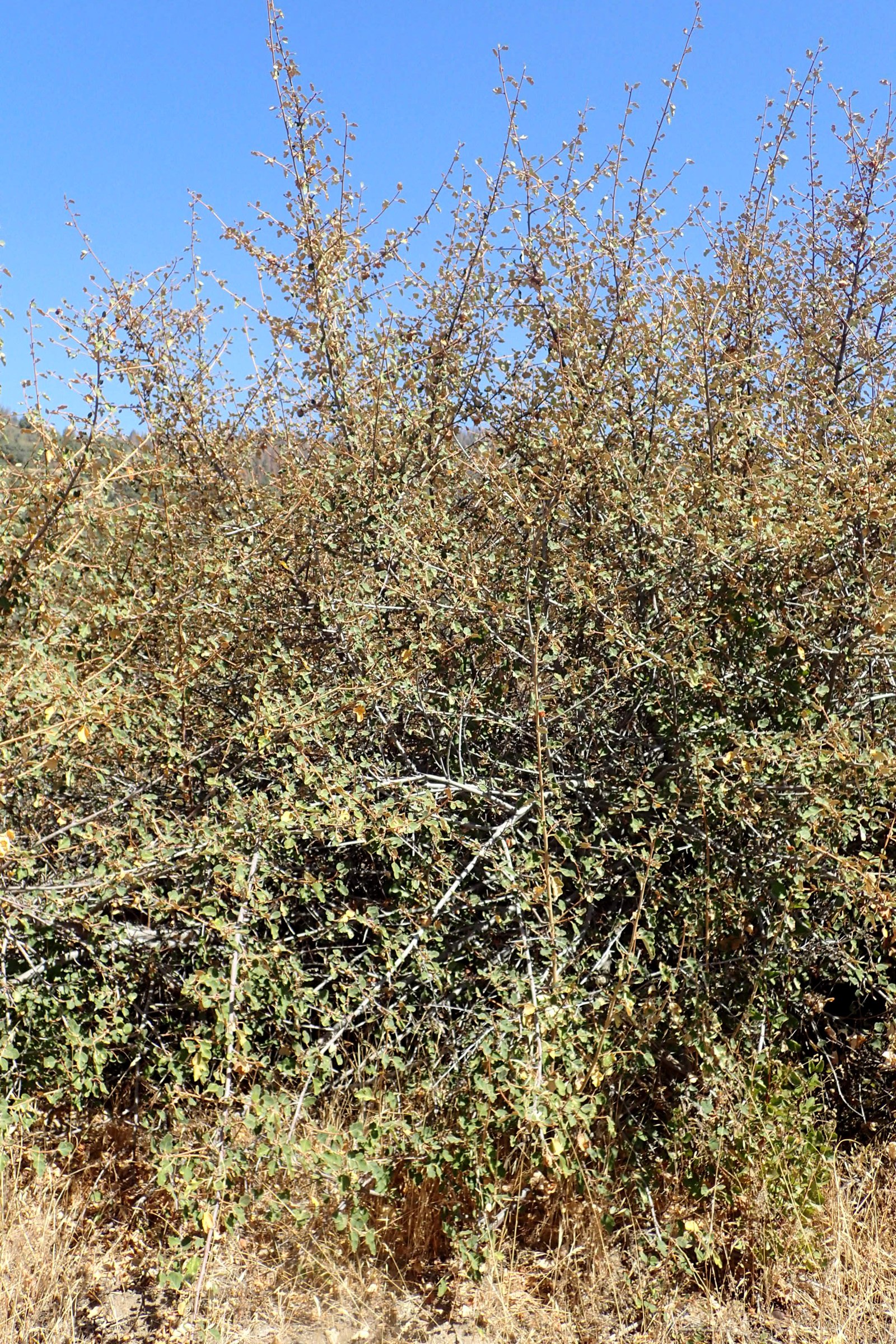
In the wild, flannel bush grows on rocky, nutrient-poor slopes in chaparral and dry oak woodland, often on serpentine or granitic soils where few other shrubs can compete. It is especially common in the foothills ringing California’s Central Valley, in the Sierra Nevada foothills, the Coast Ranges, and scattered sites in the Transverse and Peninsular Ranges, with outlying populations in the mountains of central Arizona. Plants typically reach 6 to 20 feet tall with an equal or greater spread, forming a dense, irregular mound of dark green, felted foliage that looks almost evergreen-gray from a distance.
For gardeners in California and the low desert Southwest who want a genuinely low-water native with months of bloom, flannel bush is hard to beat. It thrives on neglect: once established it needs no supplemental irrigation, resents rich soil and regular watering, and rewards a lean, well-drained site with an extraordinary flush of color. The one essential caution is the plant’s namesake fuzz — the fine hairs covering leaves, stems, and especially the seed capsules are a significant skin and eye irritant, so it should be sited and handled with that in mind.
Identification
Flannel bush is an evergreen to semi-evergreen shrub or small tree, usually multi-stemmed and rounded to irregular in form, growing 6 to 20 feet tall (occasionally taller in favorable sites) with a similar or wider spread. The whole plant, especially new growth, is covered in a dense felt of branched, star-shaped (stellate) hairs that give the foliage a grayish, flannel-like texture.
Bark & Stems
Young stems are stout, brown, and densely hairy, becoming smoother and grayish-brown with age. Older trunks develop a shreddy, fibrous bark. Branching tends to be irregular and somewhat open, giving older specimens a picturesque, gnarled look rather than a tidy rounded form.
Leaves
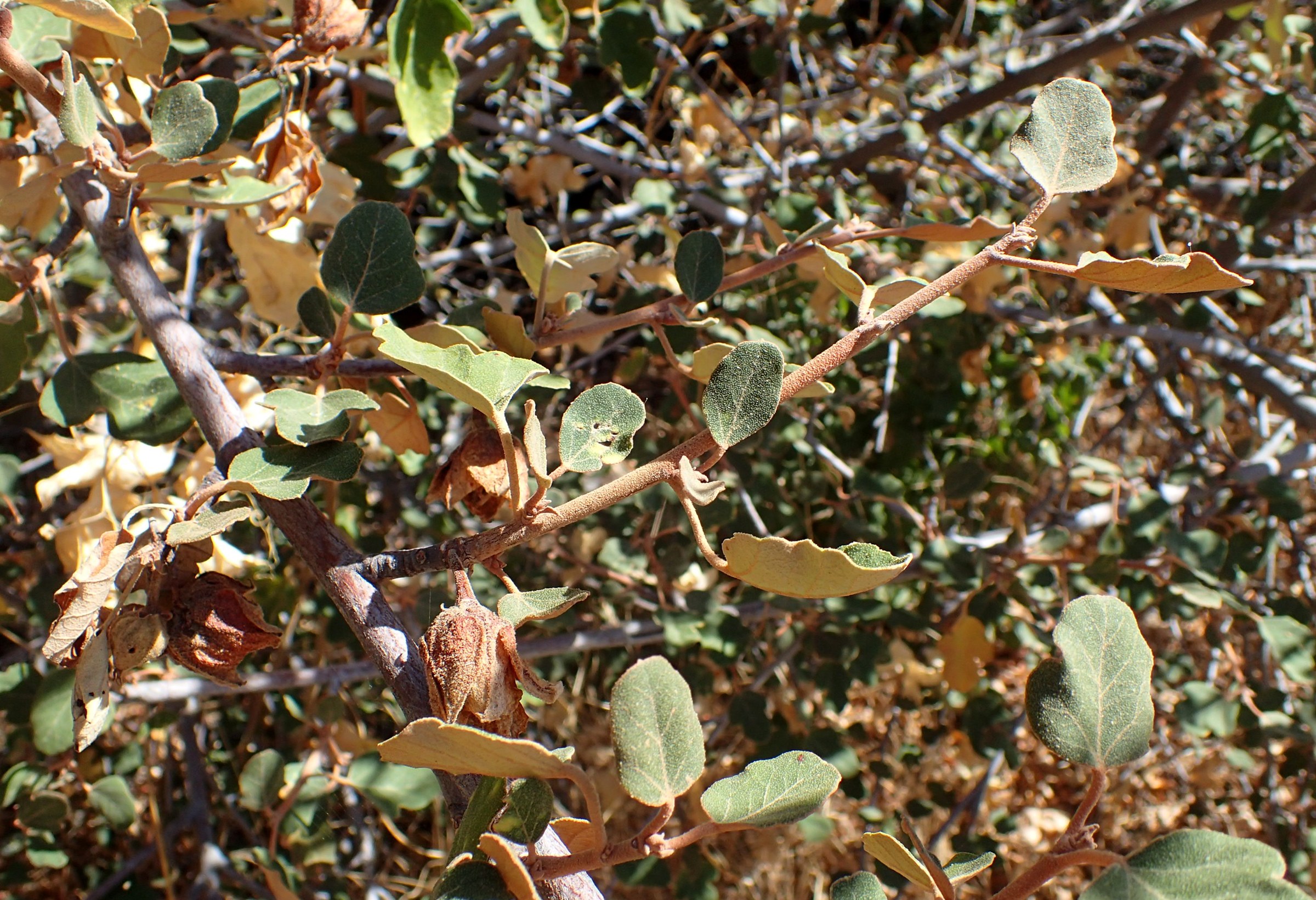
The leaves are simple, alternate, and leathery, typically 1 to 3 inches long, with a rounded to heart-shaped base and 3 (occasionally 5) shallow, rounded lobes resembling a small maple leaf or a grape leaf. The upper surface is dark green and roughened by stellate hairs; the lower surface is densely gray-felted. Because the hairs are irritating to skin and eyes, leaves should never be rubbed against bare skin or the face.
Flowers
The flowers are the plant’s signature feature: large, saucer-shaped blooms 1.5 to 3 inches across, with five broad, overlapping, waxy-textured petal-like sepals (the plant lacks true petals) in a rich golden to lemon yellow, sometimes with an orange-red flush at the base. Flowers are borne singly at the branch tips and appear in heavy flushes from April through July, with scattered bloom continuing into fall in mild years. The buds, like the leaves, are coated in irritating hairs.
Fruit & Seeds
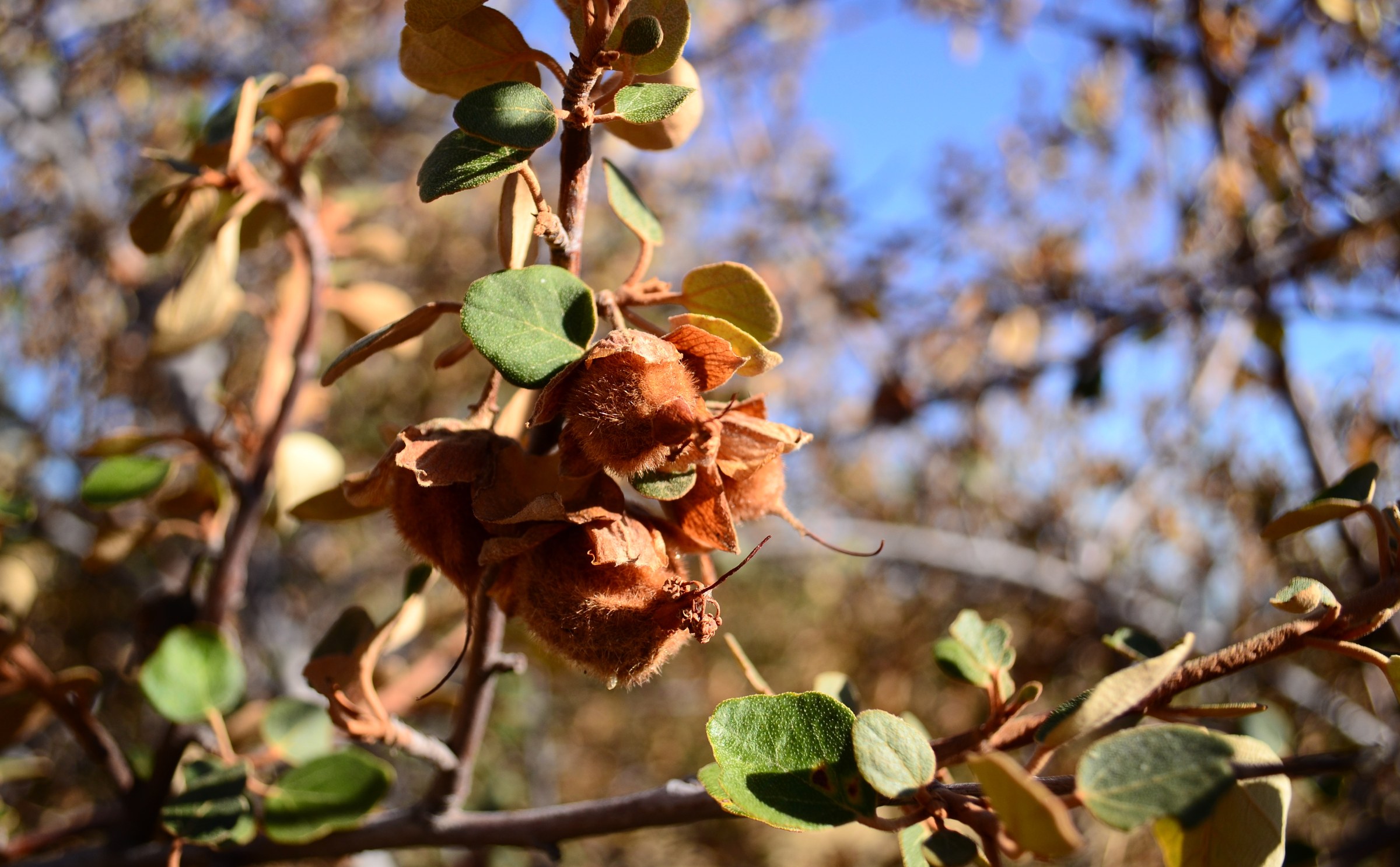
The fruit is an oval, woody capsule about 1 to 1.5 inches long, densely covered in stiff, bristly, brown hairs that are even more irritating than the leaf hairs. Capsules ripen from summer into fall, splitting open to release several hard, dark brown seeds. Dried capsules often persist on the shrub well into winter, giving even a leafless-looking plant a bristly, textured silhouette.
Quick Facts
| Scientific Name | Fremontodendron californicum |
| Family | Malvaceae (Mallow) |
| Plant Type | Evergreen shrub |
| Mature Height | 6–20 ft |
| Mature Spread | 6–15 ft |
| Growth Rate | Moderate to fast when young |
| Sun Exposure | Full sun |
| Water Needs | Very low once established; resents summer water |
| Soil Type | Lean, rocky, fast-draining; tolerates poor and serpentine soils |
| Soil pH | Adaptable; prefers neutral to slightly alkaline |
| Bloom Time | April – July, scattered into fall |
| Flower Color | Golden yellow |
| Fall Color | Evergreen (no significant fall color) |
| Fruit | Bristly brown capsule, irritating to skin |
| Deer Resistant | Yes |
| USDA Hardiness Zones | 8–10 |
Native Range
Flannel bush is native to California, where it occurs widely through the foothills of the Sierra Nevada, the inner and outer Coast Ranges, and the Transverse and Peninsular Ranges of Southern California, generally below about 6,000 feet elevation. It also reaches into the Mojave Desert’s transition zones and south into northern Baja California, Mexico (outside the scope of this U.S.-focused guide). A separate, naturally disjunct population occurs in central Arizona, concentrated in the Mazatzal and Superstition Mountains and the Mogollon Rim transition zone of Gila, Maricopa, Mohave, Pinal, and Yavapai counties.
Across this range, flannel bush is a classic chaparral species, growing on dry, rocky, often nutrient-poor slopes and canyon sides alongside chamise, manzanita, scrub oak, and California buckwheat. It is notably frequent on serpentine and other mineral-poor soils where competition from faster-growing shrubs is reduced, and it is a conspicuous colonizer of recently burned chaparral, since its seeds are stimulated to germinate by fire.
Despite being widely cultivated as an ornamental shrub well outside this range — including in parts of the Pacific Northwest, the Southeast, and even Europe — flannel bush is not native outside California and central Arizona, and plantings elsewhere should be understood as garden introductions rather than range extensions.
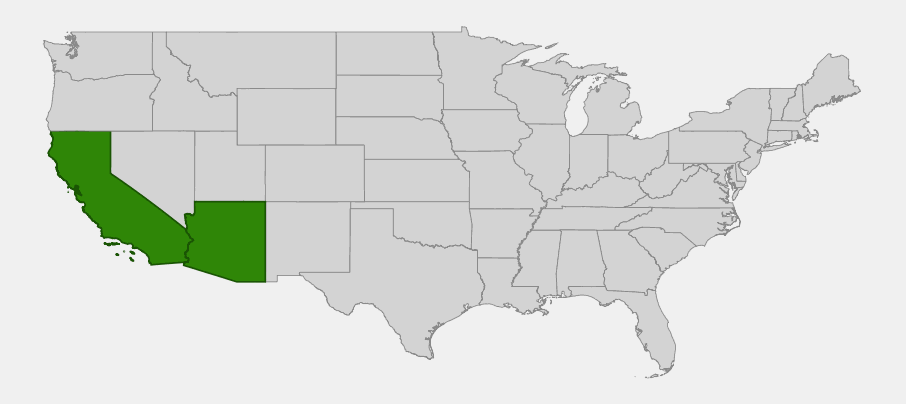
📋 Regional plant lists featuring Flannel Bush: Arizona & New Mexico
Growing & Care Guide
Flannel bush rewards gardeners who can resist the urge to pamper it. In its native chaparral it survives on winter rain alone and punishing summer drought, and garden plants that receive the same tough-love treatment are the longest-lived and healthiest.
Light
Give flannel bush full sun. It flowers most heavily and holds its naturally dense, compact form in open, sunny sites; in shade it grows leggy and sparse and blooms poorly.
Soil & Water
This is a plant for lean, fast-draining soil — rocky, gravelly, or decomposed granite are ideal, and even poor, unamended clay can work as long as drainage is sharp. The single most common way to kill a flannel bush is to give it rich garden soil and regular summer irrigation: both encourage root rot and shorten the plant’s life dramatically. Once established (after the first one to two years), established plants should receive little to no supplemental water during the dry season.
Planting Tips
Plant in fall or winter so winter rains can help the shrub establish before its first dry summer. Choose a permanent, open site, since flannel bush resents transplanting and root disturbance; use small container stock rather than large specimens for better long-term establishment. Avoid working compost or fertilizer into the planting hole — lean soil is a feature, not a problem to fix. Because of the irritating hairs on leaves and especially seed capsules, site plants away from paths, play areas, and spots where people brush against foliage, and wear gloves and eye protection when pruning or handling cut material.
Pruning & Maintenance
Minimal pruning is best. Remove dead or damaged wood in late summer after the main bloom flush, and avoid heavy shearing, which spoils the plant’s naturally graceful, irregular form and can stimulate the kind of dense regrowth that shades out future flowers. Flannel bush is relatively short-lived for a shrub — often 10 to 20 years — so treat a decline in vigor as natural rather than a sign of a care mistake.
Landscape Uses
Flannel bush earns its place in a range of low-water garden settings:
- Dry slopes and banks where its deep roots help stabilize soil
- Chaparral and foothill restoration plantings
- Xeriscape and Mediterranean-climate gardens as a flowering anchor shrub
- Wildlife and pollinator gardens for its long, heavy bloom
- Screening and informal hedges on sites too dry for most shrubs
- Fire-wise, drought-tolerant landscaping in defensible-space zones away from structures
Wildlife & Ecological Value
Flannel bush plays a meaningful role in chaparral ecosystems, both as cover and as a reliable nectar source during the dry season when few other shrubs are blooming.
For Pollinators
The large, open, pollen-rich flowers attract a wide range of native bees, including bumblebees and solitary bees, as well as honeybees and various beetles. Because flannel bush blooms heavily through the hottest, driest months of the year, it is an important nectar and pollen source when many spring-flowering chaparral plants have already finished.
For Birds
The dense, twiggy growth provides cover and nesting sites for chaparral birds such as wrentits, California towhees, and various sparrows. Hummingbirds visit the flowers opportunistically, and the persistent seed capsules can provide limited seed forage for seed-eating birds into winter.
For Mammals
Browsing mammals generally avoid flannel bush, likely due to the irritating hairs on leaves and stems, which is part of why the plant is considered reliably deer-resistant. This makes it useful as a browse-resistant anchor shrub in gardens near wildland edges.
Ecosystem Role
As a fire-following chaparral species, flannel bush is well adapted to the periodic burns that shape its native plant communities; its seeds germinate readily after fire, and young plants are often among the first shrubs to recolonize burned slopes. Its deep, extensive root system also helps stabilize steep, erosion-prone chaparral soils between fire cycles.
Cultural & Historical Uses
Flannel bush was named for John C. Frémont, the explorer and politician who collected the type specimen in California in the 1840s during one of his Western expeditions; the genus Fremontodendron and the related historic name Fremontia both commemorate him. The species epithet californicum simply reflects the plant’s California stronghold.
Indigenous peoples within the plant’s range made limited use of flannel bush, most notably using the fibrous inner bark for cordage and the mucilaginous sap medicinally in some traditional practices; because the plant’s hairs are a known irritant, direct contact and ingestion were approached with caution. These uses are a matter of historical record rather than a recommendation for modern use.
In the 20th century, flannel bush became one of the first California native shrubs to be deliberately bred for garden use. The widely sold hybrid Fremontodendron ‘California Glory’ — a cross between F. californicum and the rarer Mexican species F. mexicanum — was introduced by the Saratoga Horticultural Foundation in the 1950s and remains a garden-center staple; true wild-type F. californicum offers the straightforward, fully native alternative for restoration and native-plant gardens.
Frequently Asked Questions
Is flannel bush dangerous to touch?
The fine, star-shaped hairs covering the leaves, stems, and especially the seed capsules are a significant skin and eye irritant for most people, causing itching, rash, or redness similar to fiberglass exposure. Wear gloves and eye protection when pruning, and site the shrub away from paths and play areas.
Why is my flannel bush dying after a few years?
Flannel bush is naturally short-lived, often 10 to 20 years, and summer irrigation or rich, poorly drained soil can shorten that further by encouraging root and crown rot. If a plant declines after years of good bloom in a lean, dry site, it may simply be reaching the end of its natural lifespan.
Does flannel bush need water to get established?
Yes — water deeply but infrequently for the first one to two years to encourage deep rooting, then taper off sharply. Mature, well-sited plants should need little or no supplemental water, and continued summer irrigation is one of the most common causes of early decline.
Can flannel bush grow outside California and Arizona?
It is only native to California and central Arizona (and northern Baja California, Mexico), but it is cultivated well beyond that range in other dry-summer climates. Gardeners outside its native range should treat it as a drought-adapted ornamental rather than a native plant for ecological restoration.
Is flannel bush deer resistant?
Yes. The irritating hairs that make the plant uncomfortable for people to handle also discourage browsing by deer and other mammals, making it a reliable choice in areas with heavy deer pressure.

Looking for a nursery that carries Flannel Bush?
Browse our native plant nursery directory: California · Arizona