
Ironwood (Carpinus caroliniana)

Carpinus caroliniana, commonly known as American Hornbeam, Ironwood, or Musclewood, is a distinctive native understory tree that brings four-season beauty and exceptional wildlife value to southeastern landscapes. This member of the Betulaceae (birch) family is beloved for its unique smooth, fluted bark that resembles muscular arms, brilliant fall colors ranging from yellow to orange and scarlet, and adaptability to challenging growing conditions including shade and wet soils.
Typically growing 20 to 30 feet tall with a similar spread, Ironwood develops an attractive, irregular rounded crown with distinctive horizontal branching patterns. The tree earns its common names from both its incredibly hard, dense wood (Ironwood) and its characteristic bark that appears to show muscle definition beneath the smooth gray surface (Musclewood). The oval, serrated leaves provide excellent texture throughout the growing season before transforming into spectacular fall displays.
What makes Ironwood particularly valuable in southeastern gardens is its remarkable adaptability to difficult sites where many other trees struggle. It thrives in both wet and well-drained soils, tolerates deep shade, and provides excellent wildlife habitat while requiring minimal care once established. Its moderate size makes it perfect for smaller residential lots, and its tolerance for urban conditions makes it an excellent street tree choice where space is limited and growing conditions are challenging.
Identification
American Hornbeam is easily identified by its distinctive bark, which is unlike any other native tree. The smooth, light gray bark appears to be stretched over underlying muscles, creating flutes and ridges that give the trunk its characteristic “sinewy” appearance. This feature, combined with its serrated leaves and unique fruiting structures, makes the tree unmistakable.
Bark
The bark is perhaps Ironwood’s most distinctive and memorable feature. It remains smooth throughout the tree’s life, never developing the rough, plated, or furrowed texture typical of most mature trees. The light gray to blue-gray bark appears to be tightly stretched over an underlying structure, creating pronounced flutes, ridges, and muscle-like bulges that give the trunk and larger branches their distinctive appearance. This unique bark texture has earned the tree its “Musclewood” common name and makes it instantly recognizable even in winter.
Leaves
The leaves are simple, alternate, and oval to elliptical, typically 2 to 4 inches long and 1 to 2 inches wide. They have prominent parallel veins (pinnately veined) and sharply double-serrated margins that create a distinctly toothed edge. The upper surface is dark green and somewhat glossy, while the underside is paler green. Fall color is consistently outstanding, ranging from bright yellow through orange to deep red and scarlet, often with multiple colors appearing on the same tree simultaneously.
Flowers
Ironwood is monoecious, producing separate male and female flowers on the same tree in early spring before the leaves emerge. Male flowers appear as drooping catkins (similar to birch), while female flowers are small, inconspicuous, and appear at the tips of branches. The flowers are wind-pollinated and don’t produce showy displays, but they provide early-season pollen for beneficial insects.
Fruit
The fruit is perhaps the tree’s second most distinctive feature after its bark. Small nuts are borne in clusters, each attached to a three-lobed, leaf-like bract that looks somewhat like a miniature maple leaf. These papery bracts help the nuts disperse by wind and create an attractive drooping cluster effect in late summer and fall. The nuts are small but provide important food for wildlife.
Growth Form
American Hornbeam typically develops multiple trunks or a short main trunk that divides into several major stems, creating an irregular, rounded to vase-shaped crown. The branching pattern is distinctive, with many horizontal to slightly drooping branches that create an attractive winter silhouette. Trees grown in more open conditions tend to be broader and more spreading, while those in forest conditions are taller and more upright.

Quick Facts
| Scientific Name | Carpinus caroliniana |
| Family | Betulaceae (Birch) |
| Plant Type | Deciduous Tree |
| Mature Height | 20–30 ft |
| Sun Exposure | Part Shade to Full Shade |
| Water Needs | Moderate to High |
| Bloom Time | March – April |
| Flower Color | Inconspicuous (catkins) |
| USDA Hardiness Zones | 3–9 |
Native Range
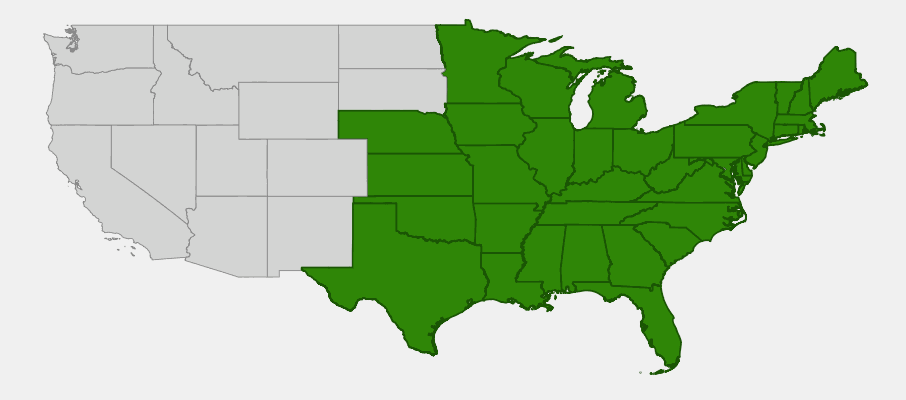
American Hornbeam has one of the broadest native distributions of any North American tree, extending from southeastern Canada south to northern Florida and west to eastern Texas and southeastern Minnesota. This impressive range demonstrates the species’ remarkable adaptability to various climatic conditions, soil types, and forest ecosystems throughout eastern North America.
In its native habitat, Ironwood typically grows as an understory tree in moist, rich soils along streams, in floodplains, and in mixed hardwood forests. It shows a particular affinity for areas with consistent moisture availability, though it adapts to a wide range of soil conditions from well-drained uplands to periodically flooded bottomlands. The species is most abundant in the eastern deciduous forests where it forms an important component of the understory layer.
Throughout its range, American Hornbeam demonstrates considerable ecological flexibility, growing alongside different associated species depending on local conditions. In the Southeast, it commonly occurs with other shade-tolerant trees such as American Beech, Eastern Redbud, and various oak species. Its ability to thrive in the understory while providing its own unique ecological services makes it a keystone species in many forest communities.
📋 Regional plant lists featuring Ironwood: North Carolina & South Carolina
Growing & Care Guide
American Hornbeam is one of the most adaptable and low-maintenance native trees available to gardeners. Its tolerance for shade, wet soils, and urban conditions, combined with its moderate size and exceptional beauty, make it an excellent choice for a wide variety of landscape situations.
Light
One of Ironwood’s greatest strengths is its exceptional shade tolerance. The tree performs well in everything from full shade to partial sun, making it ideal for understory plantings beneath larger trees or for sites where buildings create challenging light conditions. While it can tolerate full sun, it typically performs better with some protection from the hottest afternoon sun, especially in southern climates. Morning sun with afternoon shade is often ideal.
Soil & Water
American Hornbeam is remarkably adaptable to various soil conditions, thriving in everything from well-drained upland soils to periodically flooded bottomlands. It performs best in rich, moist, slightly acidic soils (pH 5.5-7.0) but adapts to clay, loam, or sandy soils as long as adequate moisture is available. The tree is quite tolerant of wet conditions and can handle periodic flooding, making it excellent for rain gardens and areas with drainage challenges. Once established, it has moderate drought tolerance but performs best with consistent moisture.
Planting Tips
Plant American Hornbeam in early spring or fall when temperatures are moderate. The tree transplants relatively easily, especially when young, but larger specimens may require more careful handling. Space trees 15-20 feet apart for naturalistic plantings or closer for hedgerow applications. Choose container-grown or balled-and-burlapped specimens from reputable nurseries, and water regularly during the first growing season to ensure proper establishment.
Pruning & Maintenance
Ironwood requires minimal pruning beyond removing dead, damaged, or crossing branches. The tree’s natural form is attractive and should be preserved whenever possible. If structural pruning is needed, do it during dormancy in late winter. Young trees may benefit from light pruning to encourage the development of a strong branch structure, but mature trees should be left largely undisturbed. The tree is naturally resistant to most pests and diseases and requires no regular treatments.
Landscape Uses
American Hornbeam’s moderate size and adaptability make it valuable for numerous landscape applications:
- Understory plantings beneath larger canopy trees
- Small residential lots where space is limited
- Urban landscapes and street tree applications
- Rain gardens and areas with drainage challenges
- Naturalized woodland gardens
- Privacy screens and hedgerows when planted in groups
- Stream bank stabilization and riparian restoration
- Four-season interest gardens – attractive in all seasons
- Wildlife habitat gardens
Wildlife & Ecological Value
American Hornbeam provides exceptional wildlife value throughout its range, supporting numerous species of birds, mammals, and insects while playing important ecological roles in forest ecosystems. Its position as an understory tree makes it particularly valuable for species that utilize multiple forest layers.
For Birds
The small nuts produced by American Hornbeam are consumed by numerous bird species, including Ruffed Grouse, Wild Turkey, Bobwhite Quail, Wood Ducks, and various songbirds such as cardinals, nuthatches, and woodpeckers. The tree’s dense branching structure provides excellent nesting sites for many woodland birds, while its position in the understory creates important habitat connectivity between ground level and the forest canopy. Many birds also consume the insects that live on and around hornbeam trees.
For Mammals
Squirrels, chipmunks, and other small mammals eagerly consume the nuts, often caching them for winter food supplies. White-tailed deer browse the foliage and young twigs, particularly during winter when other food sources are scarce. Beavers occasionally use the wood for dam construction, and the tree’s dense growth provides shelter and cover for various small mammals moving through forest understories.
For Pollinators
While American Hornbeam is primarily wind-pollinated, its early spring catkins provide pollen that is collected by various early-season beneficial insects. The tree also supports a variety of specialized insects, including several moth species whose caterpillars feed specifically on hornbeam foliage. These insects, in turn, support the birds and other predators that depend on them for food.
Ecosystem Role
As an understory tree, American Hornbeam plays a crucial role in forest structure and function. It helps create the multiple canopy layers that characterize healthy, mature forests, providing habitat complexity that supports diverse wildlife communities. The tree’s leaves decompose relatively quickly, contributing organic matter and nutrients to forest soils. Its tolerance for wet conditions makes it valuable for riparian forest health and stream bank stabilization, while its shade tolerance allows it to persist in mature forest understories where it provides long-term habitat stability.

Cultural & Historical Uses
American Hornbeam has a rich history of human use dating back thousands of years. Native American tribes throughout the tree’s range recognized the exceptional qualities of its incredibly hard, dense wood and used it for tools, weapons, and implements where strength and durability were essential. The Cherokee and other southeastern tribes used hornbeam wood for making bows, tool handles, mallets, and other items requiring extreme hardness.
The wood’s density and strength gave rise to the common name “Ironwood,” reflecting its almost metal-like hardness when properly seasoned. European colonists quickly adopted many of the Indigenous uses for hornbeam wood, using it for tool handles, wooden gears, ox yokes, and other applications where exceptionally strong wood was required. The wood was also prized for making wooden bowls, spoons, and other kitchen implements because it could be carved when green but became extremely hard and durable when dry.
In early American communities, hornbeam wood was particularly valued by wheelwrights and millwrights for making wooden machine parts, gears, and components that needed to withstand heavy wear. The wood’s fine grain and ability to take a smooth finish also made it useful for specialty items like wooden plane bodies and other precision woodworking tools. However, the tree’s relatively small size and slow growth limited its commercial timber potential compared to larger hardwood species.
The tree’s bark and other parts were used medicinally by various Native American tribes, though specific uses varied among different groups. Some tribes used preparations from the bark to treat various ailments, though modern research has not validated these traditional medicinal applications.
In contemporary times, American Hornbeam is increasingly valued for its landscape and ecological benefits rather than primarily for its wood. The tree’s outstanding ornamental qualities, including its unique bark, excellent fall color, and four-season interest, have made it a sought-after species for native plant gardens and sustainable landscaping. Its exceptional shade tolerance and adaptability to challenging growing conditions have also made it valuable for urban forestry applications, particularly in areas where larger trees cannot be successfully grown.
Frequently Asked Questions
Why is it called both American Hornbeam and Ironwood?
“American Hornbeam” is the most botanically accurate common name, distinguishing it from European hornbeam species. “Ironwood” refers to the wood’s exceptional hardness – it’s one of the hardest woods in North America. “Musclewood” comes from the distinctive fluted bark that resembles muscular arms.
Can American Hornbeam grow in deep shade?
Yes, this is one of the most shade-tolerant native trees. It naturally grows in forest understories and can thrive even in quite dense shade, though it may grow more slowly and have a more open form than trees in brighter conditions.
Is American Hornbeam a good street tree?
Yes, it can be an excellent street tree for narrow spaces or areas with overhead utilities. Its moderate size, tolerance for urban conditions, and beautiful form make it ideal where larger trees would be inappropriate. However, it needs adequate moisture and some protection from extreme conditions.
How fast does American Hornbeam grow?
American Hornbeam is a slow to moderate grower, typically adding 12-18 inches in height per year under good conditions. While not fast-growing, its longevity and low maintenance requirements make it a worthwhile long-term investment.
Does American Hornbeam have any pest or disease problems?
The tree is remarkably healthy and resistant to most pests and diseases. Occasionally, it may be affected by leaf spots or cankers in very stressed conditions, but serious problems are rare. Its natural resistance is one of its many attractive qualities.

Looking for a nursery that carries Ironwood?
Browse our native plant nursery directory: North Carolina · South Carolina