Jumping Cholla (Cylindropuntia fulgida)
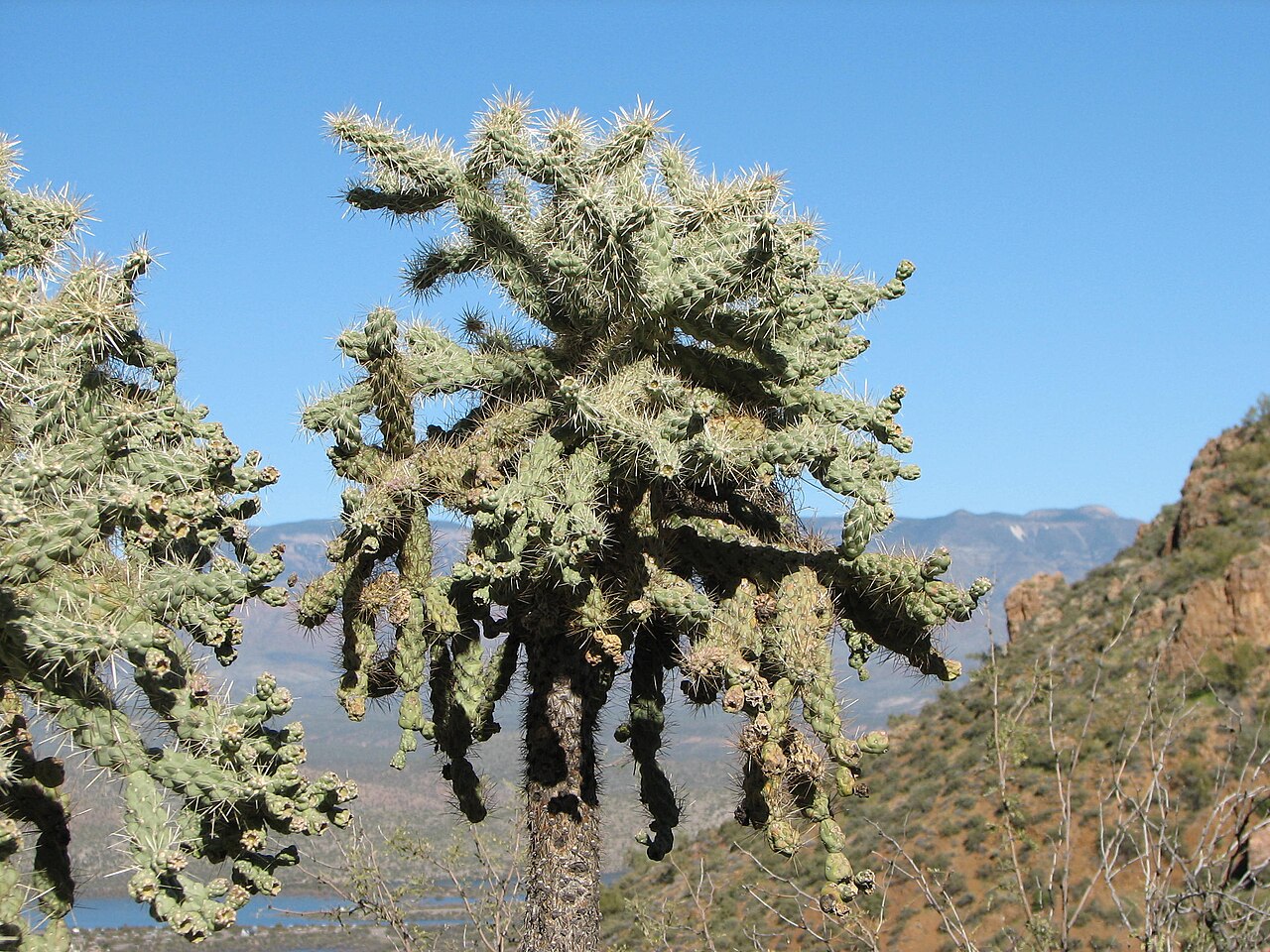
Cylindropuntia fulgida, commonly called Jumping Cholla or Chainfruit Cholla, is one of the signature cactus trees of the Sonoran Desert, instantly recognizable by the long, dangling chains of fruit that hang from its branches year after year. Despite the common name, the cactus does not actually “jump” — but its loosely attached, heavily barbed stem joints detach so readily at the slightest touch that it can feel that way to anyone who brushes against one. This is a true desert specialist, found growing wild only in Arizona within the United States, extending south into Sonora and Sinaloa, Mexico.
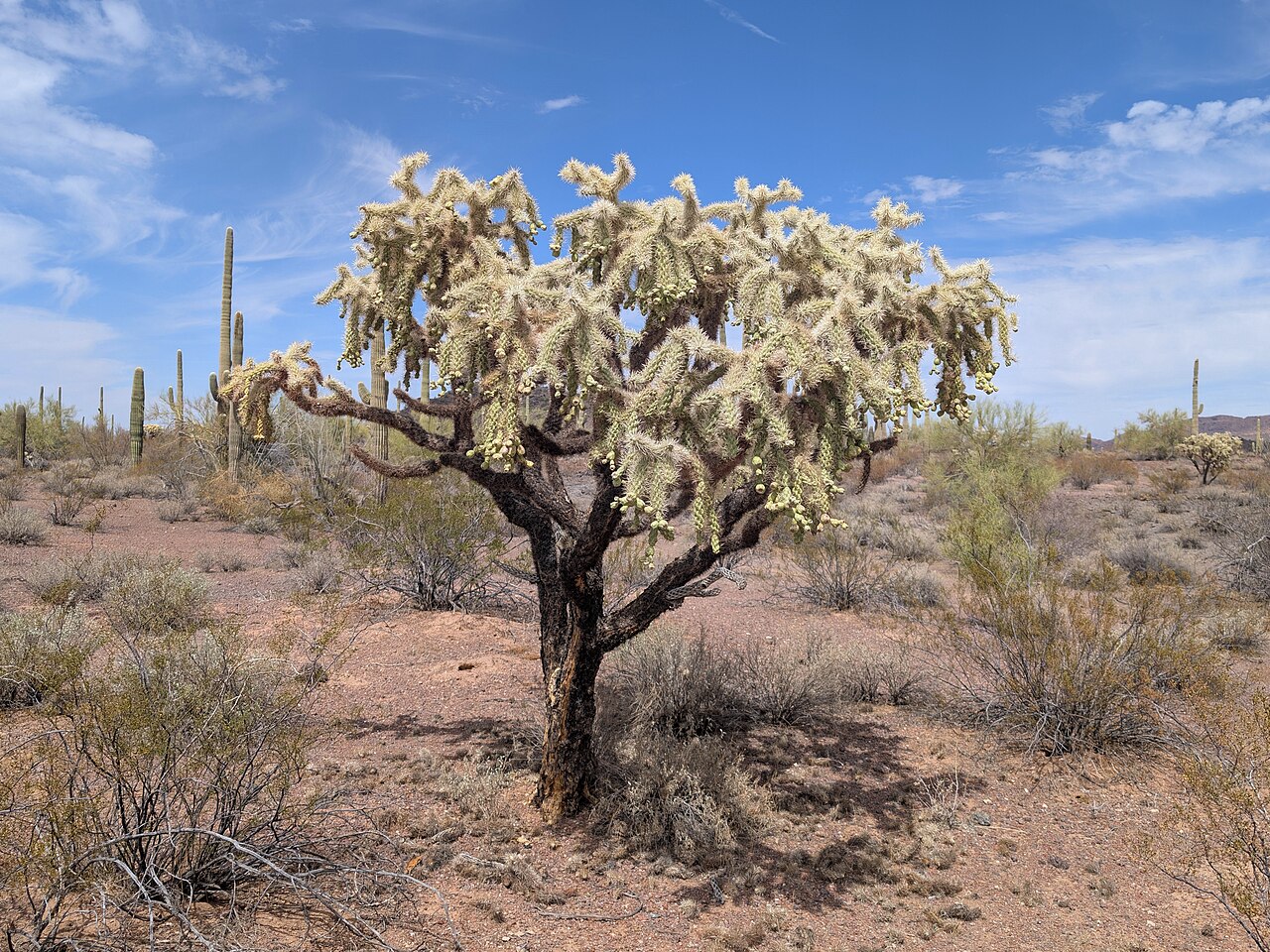
Mature plants develop a distinct tree-like form 3 to 10 feet tall, with a woody, bark-covered trunk supporting a dense, rounded crown of cylindrical, spine-covered branches. In late spring the crown is studded with small greenish-white to pale pink flowers, followed by chains of pear-shaped, spineless green fruits that persist on the plant for years, sometimes forming chains of a dozen or more fruits stacked end to end — the source of the “chainfruit” name.
Jumping cholla is a defining structural plant of the Sonoran Desert, providing dense, nearly impenetrable cover that shelters cactus wrens, pack rats, and other desert wildlife from predators and summer heat. It is not a plant for casual handling — the spines carry backward-facing barbs that catch painfully in skin and clothing — but for a true Arizona desert garden built to showcase the region’s iconic cactus forest character, it has no substitute.
Identification
Jumping cholla is a large, shrubby to tree-like cactus with a single woody trunk or several trunks arising near the base, typically reaching 3 to 10 feet tall (occasionally to 15 feet) with a rounded, densely branched crown often as wide as the plant is tall.
Stems & Spines
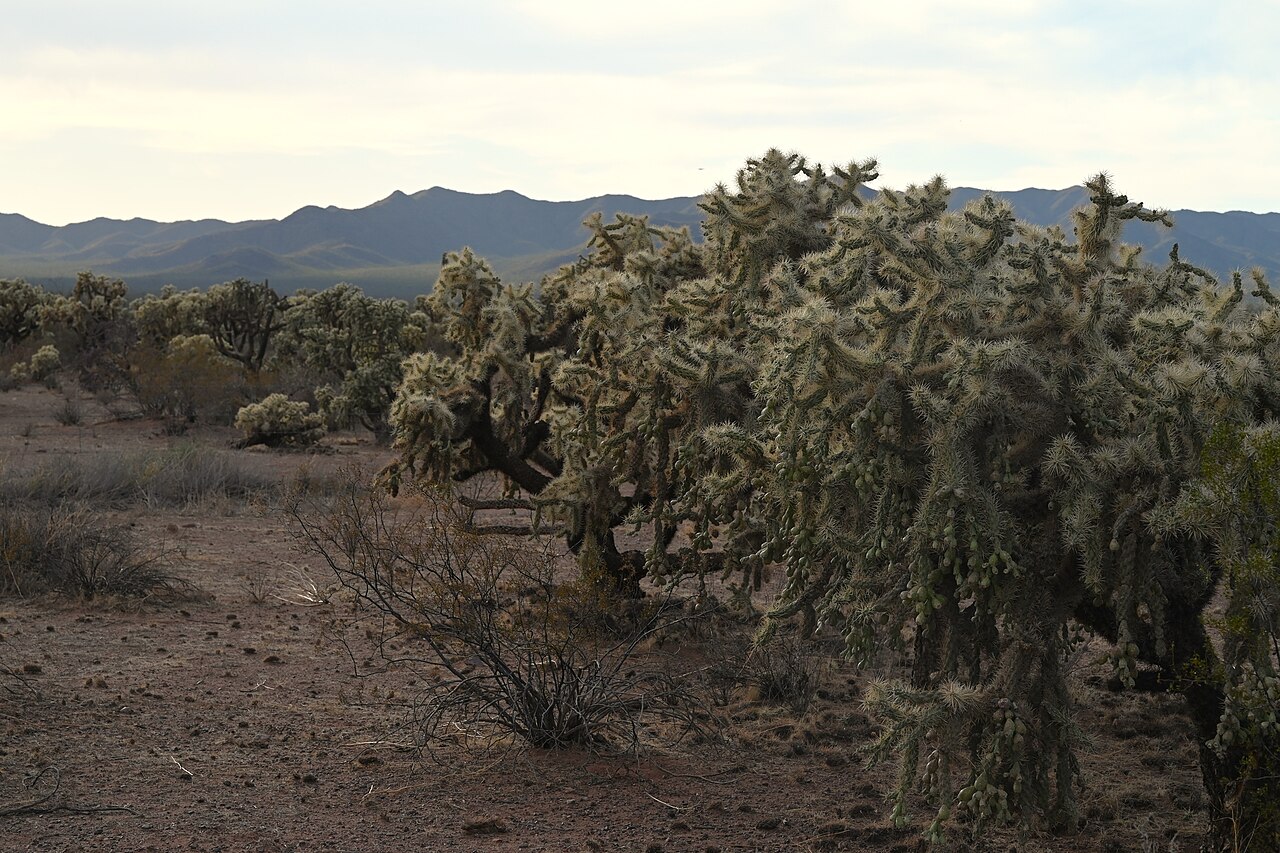
The stems are made up of cylindrical joints 4 to 12 inches long and roughly 1 to 1.5 inches thick, covered in low, tightly packed tubercles. Each tubercle bears a cluster of several pale yellow to straw-colored spines up to 1 inch long, sheathed in a loose, papery covering that gives the whole plant a silvery, almost fuzzy glow when backlit by the sun. The spines are heavily barbed, and the joints detach from the plant with remarkable ease — a defense and dispersal strategy, since detached joints readily root wherever they fall or catch on a passing animal.
Trunk & Bark
Older plants develop a true woody trunk at the base, covered in rough, dark gray to blackish bark that cracks and fissures with age, quite unlike the green, spiny joints above. This trunk can persist long after the plant dies, and bleached, hollow cholla “skeletons” — a lattice of woody tubes — are a familiar sight on the desert floor.
Flowers & Fruit
Flowers appear from April through June, opening in the late afternoon and lasting only a day or two. They are 1 to 1.5 inches across, with pale pink, lavender, or greenish-white petals surrounding a cluster of yellow stamens. Most populations produce little or no viable seed, and the fruit that follows is typically spineless, pear-shaped, green, and tuberculate, about 1 to 1.5 inches long. Because the fruit rarely drops and new flowers often form at the tip of the previous year’s fruit, the plant builds up the dangling chains of three, four, or more fruits that give chainfruit cholla its name.
Quick Facts
| Scientific Name | Cylindropuntia fulgida |
| Family | Cactaceae (Cactus) |
| Plant Type | Tree-like Cactus |
| Mature Height | 3–10 ft |
| Mature Spread | 3–8 ft |
| Growth Rate | Slow |
| Sun Exposure | Full Sun |
| Water Needs | Low |
| Soil Type | Rocky, gravelly, or sandy; very well-drained |
| Soil pH | 7.0–8.5 (neutral to alkaline) |
| Bloom Time | April – June |
| Flower Color | Pale pink, lavender, or greenish-white |
| Fall Color | None (evergreen stem succulent) |
| Fruit | Green, spineless, pear-shaped, persisting in hanging chains |
| Deer Resistant | Yes (dense barbed spines deter browsing) |
| USDA Hardiness Zones | 9–11 |
Native Range
Jumping cholla is native to the Sonoran Desert of south-central and southern Arizona, where it is a dominant, landscape-defining cactus across much of its range, including the Phoenix and Tucson basins, the Tonto Basin, and south toward the Mexican border around Organ Pipe Cactus National Monument. South of the border, it continues through Sonora and northern Sinaloa, Mexico. Although it is sometimes reported more broadly across the desert Southwest in older or popular sources, county-level distribution data confirm that wild, naturally occurring populations within the United States are concentrated in Arizona; plants found elsewhere are typically cultivated or escaped from cultivation rather than part of the native range.
Within Arizona, jumping cholla grows on rocky slopes, bajadas, and desert flats from roughly 1,000 to 4,000 feet in elevation, most often in the classic Sonoran Desert “cactus forest” alongside saguaro. It tolerates poor, rocky, caliche-rich soils that few other plants can use, and it is often one of the most abundant woody plants on a given site, sometimes forming dense stands locally called “cholla gardens” or “jumping cholla forests.”
Because detached stem joints root so readily, jumping cholla can spread clonally to form extensive stands from a relatively small number of original seedlings. This reproductive strategy, combined with its tolerance of heat, drought, and poor soils, makes it one of the most resilient and recognizable plants of the Arizona desert floor.
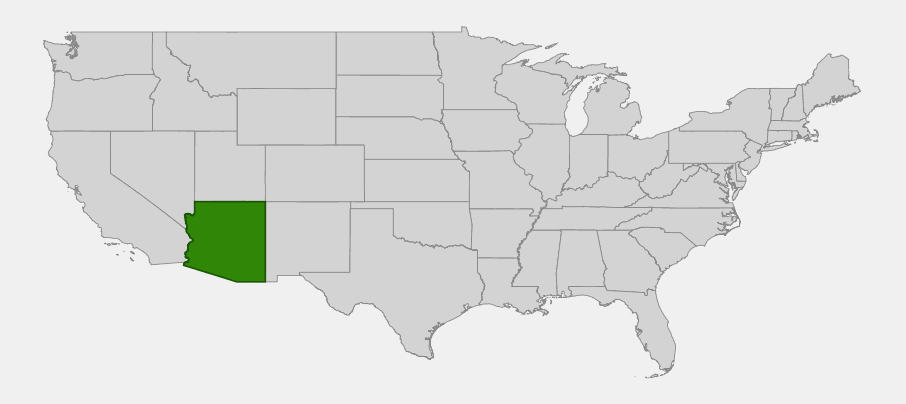
📋 Regional plant lists featuring Jumping Cholla: Arizona & New Mexico
Growing & Care Guide
Jumping cholla is built for the harshest conditions a low-desert garden can offer, but its barbed spines mean it needs a thoughtful spot — one where its architectural form can be admired without anyone brushing past it.
Light
Give jumping cholla full, all-day sun. It is a true desert plant and will not thrive in shade or even partial shade; strong, reflected heat off rock or pavement only improves its form and flowering.
Soil & Water
Plant it in rocky, gravelly, or sandy soil with excellent drainage — heavy clay or any soil that holds water around the roots will cause rot. Established plants need no supplemental irrigation in the low desert beyond natural rainfall; occasional deep watering during the first year or two after planting helps young specimens establish a strong root system, but once settled in, jumping cholla is as drought-tolerant as any plant in the Sonoran Desert flora.
Planting Tips
Because the barbed joints detach so readily, always handle jumping cholla with long-handled tongs, a rolled towel, or heavy leather gloves — never bare hands. Plant it well away from walkways, patios, play areas, and anywhere pets or children regularly pass. Container-grown plants from native nurseries establish more reliably than transplanted wild specimens, and because the species is a slow grower, buying a larger specimen will save years of waiting for a mature architectural form.
Pruning & Maintenance
Jumping cholla needs essentially no maintenance once established. Fallen or detached joints should be collected promptly with tongs, since they root easily and can start unwanted new plants; dispose of them in a way that prevents accidental contact. No fertilizer is needed, and no routine pruning is required beyond removing the occasional damaged branch.
Landscape Uses
Jumping cholla earns its place in a true desert garden through sheer architectural presence and wildlife value:
- Sonoran Desert theme gardens paired with saguaro, ocotillo, and palo verde
- Security barrier plantings along property edges, where its spines discourage foot traffic
- Wildlife habitat gardens — dense cover for cactus wrens and small mammals
- Xeriscape focal points requiring no irrigation once established
- Rock gardens and gravel-mulched desert plantings
Wildlife & Ecological Value
Few plants shape the structure of the Sonoran Desert floor as thoroughly as jumping cholla, and its dense, barbed growth makes it a cornerstone of shelter and nesting habitat for desert wildlife.
For Birds
Cactus wrens frequently build their bulky, football-shaped nests deep within the protective tangle of cholla joints, where the spines keep most predators away. Curve-billed thrashers, verdins, and various sparrows also use cholla thickets for nesting and roosting cover, and the plant’s structure provides shaded perches during the hottest parts of the day.
For Mammals
Pack rats (woodrats) often build their dens at the base of jumping cholla, incorporating fallen spiny joints into the structure as a defense against coyotes, foxes, and other predators. Javelina are known to eat cholla fruit and pads despite the spines, and various rodents shelter among the dense branches during the day.
For Pollinators
The spring flowers attract native bees, including cactus-specialist bees, along with occasional visits from honeybees. Though the bloom period is brief, it coincides with a critical early-season nectar and pollen source in the desert.
Ecosystem Role
As one of the most abundant woody plants across large stretches of the Sonoran Desert floor, jumping cholla adds vertical structure and near-impenetrable cover in a landscape where predator-avoidance habitat is scarce. Its vegetative spread by rooting joints allows it to colonize disturbed ground and stabilize soil on rocky slopes, while its dead, woody “skeletons” continue to provide habitat and nutrients to the desert floor long after the living plant has died.
Cultural & Historical Uses
Indigenous peoples of the Sonoran Desert, including the Tohono O’odham and Akimel O’odham, have long lived alongside jumping cholla and developed careful methods for using it despite its formidable spines. The unopened flower buds of various chollas, gathered in spring with tongs and traditionally roasted in pits to remove the spines, were an important seasonal food source rich in calcium and other nutrients, and this foraging tradition continues today among some desert communities using chollas generally found in the region.
The woody, lattice-like skeletons left behind after a cholla dies and its flesh decays have long been collected and used decoratively, and in some traditional contexts as material for small implements or walking sticks, once thoroughly dried and cleaned of spines.
In the broader desert Southwest, jumping cholla and its relatives are also recognized as a hazard to livestock and hikers, and ranchers in cholla country have long managed trails and grazing areas with this in mind. Today the plant is better known as an icon of the Sonoran Desert landscape, featured in desert botanical gardens and used by homeowners seeking an authentic, low-water native landscape.
Frequently Asked Questions
Why is it called “jumping” cholla if it doesn’t actually move?
The stem joints are so loosely attached and so easily triggered by the slightest brush of skin or clothing that they seem to leap onto anyone who gets too close. In reality, the joint simply detaches at a weak point and the recoil of your own movement pulls it toward you — but the effect feels exactly like the cactus jumped.
Is jumping cholla dangerous to pets?
Yes. The barbed spines readily embed in paws, noses, and skin and are painful and difficult to remove; use pliers or a comb, never bare fingers, and keep dogs away from cholla patches. Plant it well out of reach of pets and children in home landscapes.
Can I eat the fruit or buds of jumping cholla?
Unopened flower buds of various cholla species have a traditional history of use as food after careful spine removal and pit-roasting by Indigenous desert peoples, but this requires specialized preparation and is not something to attempt casually. The mature green fruit is not a food source and should be left on the plant.
How fast does jumping cholla grow, and how tall will it get?
It is a slow grower, typically reaching its mature height of 3 to 10 feet over many years. Because of this slow pace, gardeners who want an established-looking specimen often start with a larger container plant from a native nursery rather than a small cutting.
Will jumping cholla survive outside of Arizona’s low desert?
It is only reliably hardy in USDA zones 9–11 and needs the hot, dry, frost-light conditions of the Sonoran Desert lowlands. In colder, wetter, or more humid climates outside its native Arizona range it is best grown, if at all, as a protected container specimen rather than planted in the ground.

Looking for a nursery that carries Jumping Cholla?
Browse our native plant nursery directory: Arizona