
Labrador Tea (Ledum groenlandicum)
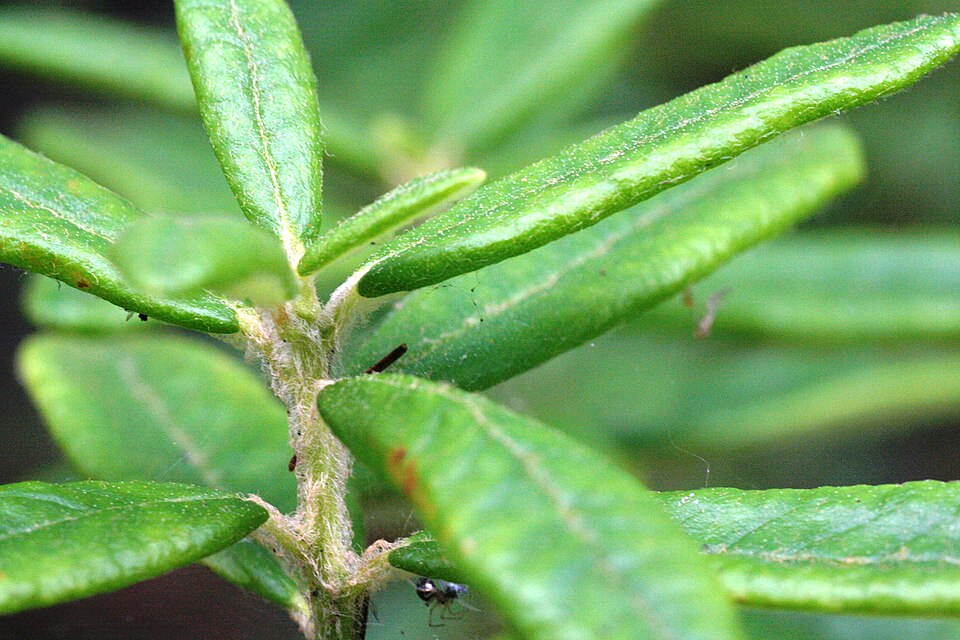
Ledum groenlandicum (now more accurately classified as Rhododendron groenlandicum), commonly known as Labrador Tea, is one of the most distinctive and ecologically specialized native shrubs of northeastern North America. This low-growing evergreen shrub — typically reaching 1 to 3 feet in height — is intimately associated with the boggy, peaty, acidic wetlands and cool moist forests of New England, eastern Canada, and the boreal zone across northern North America. Where it grows, it often forms dense, dominant colonies that create a characteristic understory layer with its leathery, aromatic, rust-woolly-backed leaves and clusters of showy white flowers.
The common name “Labrador Tea” reflects one of the plant’s most historically significant attributes: its leaves were extensively used as a tea substitute by Indigenous peoples and European settlers throughout the northern boreal region, particularly during periods when imported tea was unavailable. The distinctive flavor, derived from a suite of aromatic compounds including ledol and other sesquiterpenes in the leaf tissue, produces a fragrant, mildly medicinal brew with a characteristic northern forest scent that many find pleasant. The rust-colored woolly hairs on the leaf undersides — and their distinctive aroma when brushed — make Labrador Tea one of the most tactilely and aromatically memorable shrubs of the northern wilderness.
In New England gardens, Labrador Tea fills a very specific ecological niche: wet, acidic, nutrient-poor sites that challenge most other ornamentals. It is exceptional for naturalizing bog gardens, wet meadow edges, lakeshores, and seepage slopes where the soil is consistently moist to saturated. The task data notes that it “transplants well” — an advantage that makes it relatively easy to establish compared to other bog specialists. For gardeners committed to ecological authenticity and wildlife value in wet, acidic habitats, Labrador Tea is essentially irreplaceable.
Identification
Labrador Tea is a low to medium-height evergreen shrub growing 1 to 3 feet tall (occasionally to 4 feet in ideal conditions), with erect to spreading branches arising from a compact, rhizomatous base. The plant spreads slowly by underground rhizomes to form colonies. The overall appearance is compact and aromatic, dominated by the distinctive foliage.
Leaves
The leaves are the most diagnostic feature. They are simple, alternate, evergreen, and leathery — 1 to 2.5 inches long and 0.25 to 0.5 inches wide, with rolled-under margins (revolute). The upper surface is dark green, slightly wrinkled, and somewhat shiny. The underside is densely covered with rusty-brown to whitish woolly hairs (tomentum) — this woolly coating is immediately visible and tactilely distinctive. The leaves contain aromatic compounds that give crushed foliage a strong, resinous, slightly medicinal scent. Leaves persist for 2–3 years before dropping.
Flowers & Fruit
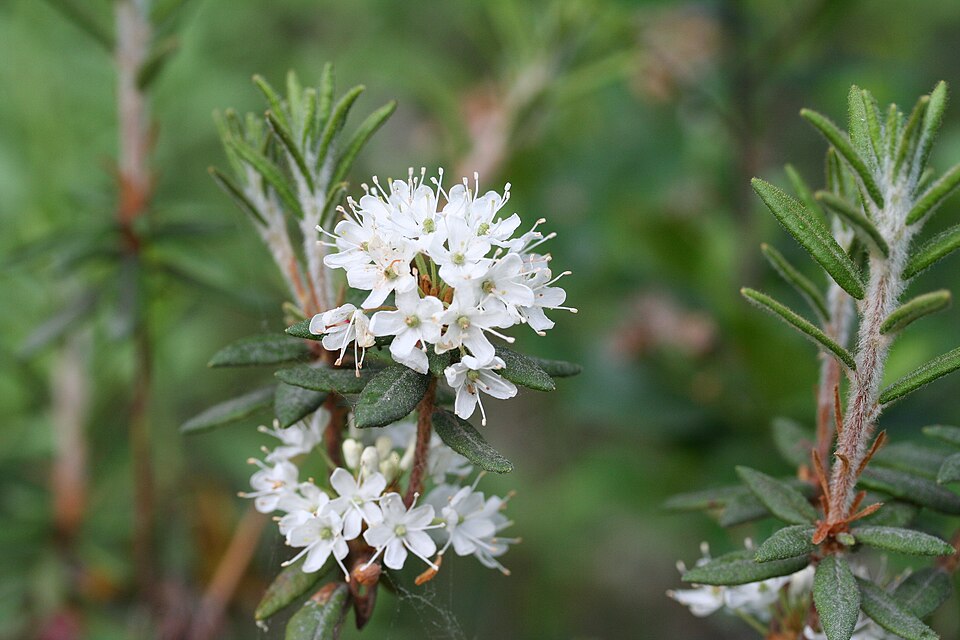
Flowers are borne in showy, dense, terminal umbel-like clusters (corymbs) at the ends of the previous year’s branches. Each individual flower is small (0.5 inches wide), with 5 white petals and 5–7 conspicuous stamens that extend beyond the petals, giving the flower head a delicate, starry appearance. Bloom period is May to June in New England. The overall flowering display is attractive and conspicuous against the dark foliage. Fruit is a small, dry, 5-parted capsule that releases numerous tiny seeds in late summer. The persistent flower stalks and capsules remain on the plant through winter.
Quick Facts
| Scientific Name | Ledum groenlandicum (syn. Rhododendron groenlandicum) |
| Family | Ericaceae (Heath) |
| Plant Type | Evergreen Shrub |
| Mature Height | 3 ft |
| Sun Exposure | Full Sun to Part Shade |
| Water Needs | Moderate to High |
| Bloom Time | May – June |
| Flower Color | White |
| USDA Hardiness Zones | 2–6 |
Native Range
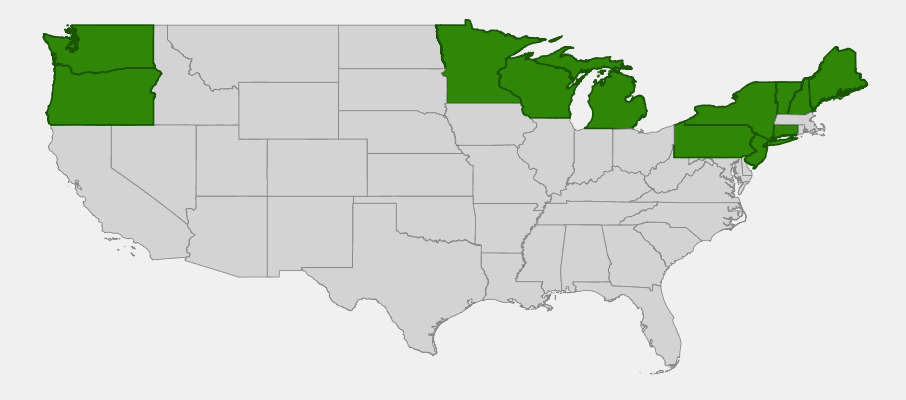
Labrador Tea is a boreal and sub-arctic species with an enormous circumpolar distribution. In North America, it extends from Greenland and Labrador westward across boreal Canada and Alaska, and southward into the Great Lakes states, the Pacific Northwest mountains, and New England. In the contiguous United States, it is native to Maine, Vermont, New Hampshire, New York, New Jersey, Pennsylvania, Michigan, Minnesota, Wisconsin, Oregon, and Washington — always associated with wet, acidic, and nutrient-poor habitats.
The ecological habitat of Labrador Tea is highly distinctive: open bogs and fens, sphagnum-dominated peatlands, lakeshores with peaty substrates, seepage slopes, and wet coniferous forests with poorly drained, acidic soils. It is an obligate acidophile, thriving only in soils with pH below 5.0, and is almost never found on mineral-rich or alkaline substrates. In bogs, it often grows in association with other ericaceous specialists: Bog Rosemary (Andromeda polifolia), Leatherleaf (Chamaedaphne calyculata), Bog Laurel (Kalmia polifolia), Sundews (Drosera spp.), and Pitcher Plants (Sarracenia purpurea).
Within New England, Labrador Tea is most abundant in Maine, where extensive peatland systems provide ideal habitat across a broad area. In Vermont and New Hampshire, it occurs in scattered bog complexes and seepage wetlands. The plant notes well that Labrador Tea “transplants well” — this is botanically unusual for a bog specialist and reflects the species’ robust root system and tolerance of disturbance, making it easier to establish in cultivated settings than many of its bog companions.
📋 Regional plant lists featuring Labrador Tea: New England
Growing & Care Guide
Labrador Tea is a specialist shrub with specific requirements, but within those parameters it is surprisingly resilient. Successfully growing it requires replicating its natural bog and wetland habitat — particularly the combination of high moisture, low pH, and high organic matter content.
Light
Labrador Tea grows in full sun to partial shade. In bog settings, it often grows in full sun where the open habitat provides maximum light. In forested wetlands, it tolerates considerable shade beneath a coniferous canopy. For garden cultivation, full sun to light shade with morning sun and afternoon protection produces the best results. Avoid deep shade, which reduces flowering and vigor.
Soil & Water
This is the critical factor for Labrador Tea: it demands consistently moist to wet, highly acidic (pH 4.0–5.5), nutrient-poor soil high in organic matter. The ideal growing medium is a mix of sphagnum peat, perlite, and acidic sand — similar to what you would use for carnivorous plants or other bog specialists. Regular garden soil, even if kept moist, will typically be too nutrient-rich and alkaline. Rain garden plantings, bog gardens, pond margins, and naturally peaty or boggy sites are perfect. Avoid fertilizing — nutrient enrichment will cause decline. Consistent moisture is essential; unlike most shrubs, Labrador Tea will tolerate standing water around its roots.
Planting Tips
Plant Labrador Tea in spring or early fall in a prepared bog bed or naturally wet, acidic site. If creating an artificial bog garden, use a liner or natural clay-based soil to maintain moisture. Acidify the planting area if necessary with sulfur or sphagnum peat. Space plants 2–3 feet apart for a naturalistic colony effect — the plant will spread slowly via rhizomes to fill in over time. The task notes that Labrador Tea “transplants well,” making it easier to move and establish than most bog specialists.
Pruning & Maintenance
Labrador Tea requires minimal maintenance in a suitable site. Remove dead or winter-damaged branches in early spring. The plant does not require regular pruning; its naturally compact, mounding form is attractive year-round. Avoid heavy pruning into old wood. Maintain the acidic soil conditions by topping up with sphagnum peat or pine bark mulch annually. Do not fertilize — this is a plant adapted to nutrient poverty, and fertilizer will damage or kill it.
Landscape Uses
Labrador Tea excels in:
- Bog gardens — the quintessential bog shrub for New England
- Rain gardens in acidic soil areas where moisture collects
- Pond and lakeside plantings on moist, peaty banks
- Native wetland restoration on acidic peatland sites
- Alongside other bog specialists: Pitcher Plant, Sundews, Bog Rosemary, Cranberry
- Naturalizing difficult wet acidic areas where conventional plants fail
Wildlife & Ecological Value
Labrador Tea contributes substantially to the ecology of northern bog and wetland systems, providing food, cover, and structural habitat in environments that support a highly specialized community of plants and animals.
For Birds
The dense colonies of Labrador Tea provide nesting habitat and cover for several bog and wetland specialists including Palm Warblers, Lincoln’s Sparrows, Swamp Sparrows, and Wilson’s Snipe in Maine and northern New England bogs. The flowers attract insects that are subsequently consumed by insectivorous birds. Yellow-rumped Warblers have been documented foraging in Labrador Tea shrubs during migration.
For Mammals
Moose browse Labrador Tea foliage, and it represents a notable component of their diet in bogs and wetlands across northern Maine and Vermont. The aromatic compounds in the leaves are thought to provide some deterrence to other browsers. Snowshoe Hares may nibble young stems in winter. The dense, low mats created by Labrador Tea colonies provide cover for voles, shrews, and other small mammals that inhabit bog margins.
For Pollinators
The white flower clusters are valuable early-summer nectar sources in bog environments where relatively few other flowering plants are active simultaneously. Native bumblebees (Bombus spp.) are the primary pollinators, as bees are among the few insects that can navigate the cool, exposed bog environment. Several specialist bee species associated with ericaceous plants visit Labrador Tea flowers during the bloom period.
Ecosystem Role
In bog ecosystems, Labrador Tea plays a key structural role, creating the shrub layer that defines the physiognomy of open bogs and forested peatlands across the boreal zone. It contributes aromatic compounds to the bog surface through leaf litter that may influence the bog’s chemical environment. The dense rhizomatous colony structure provides physical stability to the sphagnum surface, moderating desiccation and maintaining the moisture conditions that the entire bog community depends on.
Cultural & Historical Uses
The common name “Labrador Tea” is thoroughly descriptive: the leaves of this plant have been used to make an herbal tea throughout its range for centuries. Indigenous peoples across northeastern North America — including the Inuit, Cree, Ojibwe, Algonquin, and many other nations — made tea from the dried or fresh leaves as a beverage, medicine, and ritual preparation. The Cree name for the plant translates roughly to “muskeg tea,” reflecting its association with bog and muskeg environments. The aromatic tea has a distinctive flavor that is simultaneously sweet, resinous, and somewhat medicinal — unlike any conventional tea.
European settlers in Canada and New England adopted the use of Labrador Tea extensively, particularly during the American Revolutionary War period when imported British tea was boycotted or unavailable. It became one of several native “liberty teas” that symbolized American independence and self-sufficiency. The plant’s ease of harvest and palatability made it a practical tea substitute in frontier conditions. Medicinally, it was used to treat colds, headaches, kidney problems, and various respiratory ailments. A cautionary note: the leaves contain ledol, a sesquiterpene alcohol that can be toxic in high concentrations; moderate, occasional consumption of the tea is generally considered safe, but regular or heavy consumption is not recommended.
Beyond tea, Labrador Tea leaves were used in traditional medicine to treat skin conditions, as a mild sedative, and as an insect repellent — the aromatic compounds in the leaves reportedly deter some insects when dried and used as sachets. The rust-colored leaf hairs were used by some Indigenous peoples as a soft material for packing and cushioning. Modern herbalists continue to use Labrador Tea in small amounts, though its pharmaceutical applications are limited compared to its historical folk medicine significance. The taxonomic reclassification of the species into Rhododendron (based on molecular evidence) has generated some academic interest, as it links Labrador Tea to the largest genus in the heath family and highlights its evolutionary relationship to other beloved native shrubs.
Frequently Asked Questions
Is Labrador Tea safe to drink?
In moderation, Labrador Tea made from the dried leaves is considered safe for most adults. However, the leaves contain ledol and other compounds that can cause headaches, dizziness, or digestive upset in large quantities. Occasional cups are generally fine; regular consumption of large amounts is not recommended. Pregnant women should avoid it. Always use well-dried leaves and moderate the concentration.
Can Labrador Tea grow in a regular garden?
Labrador Tea is a specialist for wet, acidic, peaty conditions. In a standard garden border with typical soil, it will struggle and likely decline. However, it can be successfully grown in purpose-built bog gardens, naturally boggy areas, or containers filled with acidic peat-based media kept consistently moist. The plant notes indicate it “transplants well,” making establishment easier than for many bog specialists.
What is the current scientific name for Labrador Tea?
Modern taxonomy places Labrador Tea in the genus Rhododendron as Rhododendron groenlandicum, based on molecular phylogenetic studies showing that Ledum is nested within Rhododendron. However, Ledum groenlandicum remains widely used in regional floras and plant lists and is the name used on the USDA Plants Database LEGR profile.
How quickly does Labrador Tea spread?
Labrador Tea spreads slowly via rhizomes, typically extending a few inches per year. In ideal bog conditions over many years, it can form extensive, dense colonies covering substantial areas. In garden settings, spread is gradual and generally easy to manage by removing rhizome extensions.
Does Labrador Tea have any toxicity concerns for pets?
Yes — the aromatic compounds in Labrador Tea can be mildly toxic to dogs and cats if consumed in quantity. The same sesquiterpene compounds that give the tea its distinctive flavor can cause digestive upset in pets. Keep pets from grazing on the foliage, particularly in confined bog garden settings where access might be unavoidable.

Looking for a nursery that carries Labrador Tea?
Browse our native plant nursery directory: Maine · New Hampshire · Vermont · Connecticut