Laurel Oak (Quercus laurifolia)
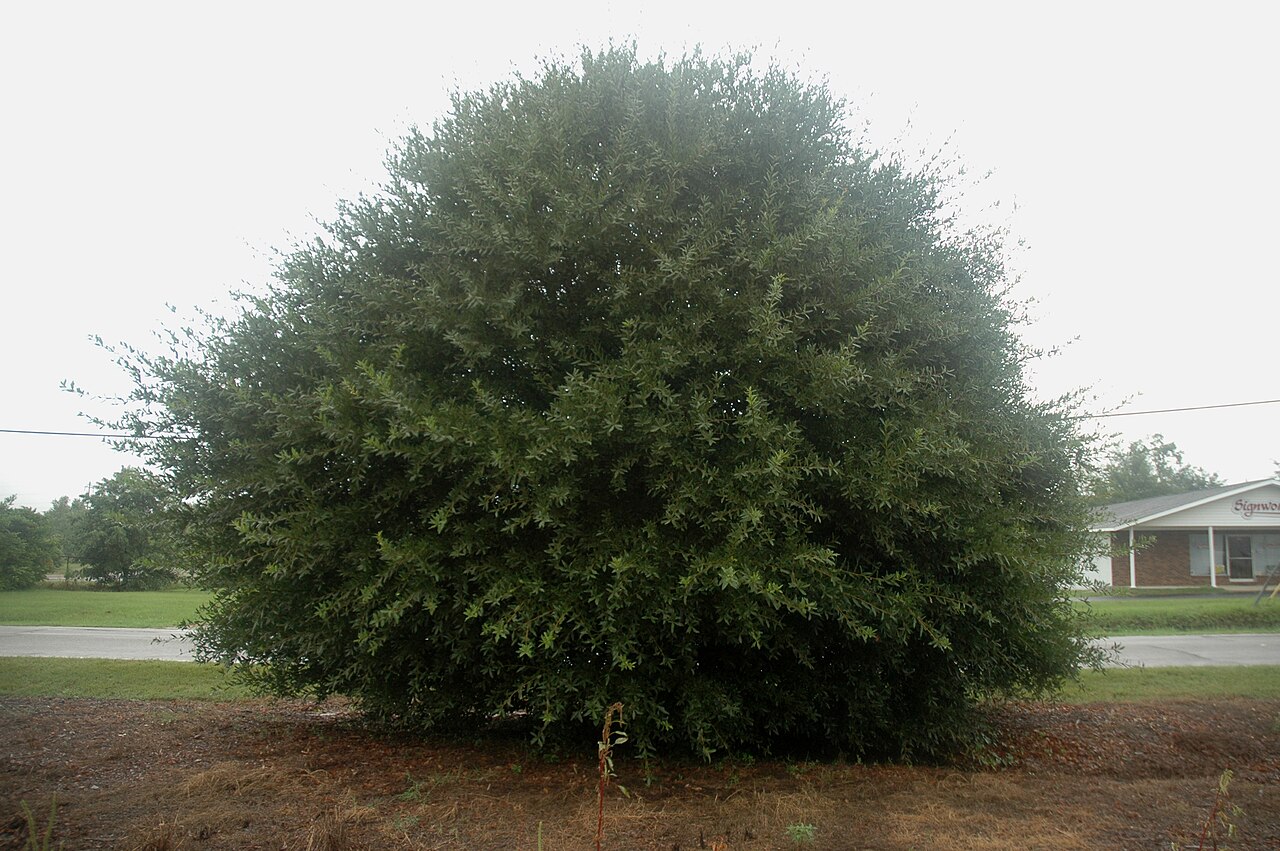
Laurel oak (Quercus laurifolia) is a fast-growing native oak of the southeastern United States, especially associated with low woods, river margins, and moist coastal-plain landscapes. Its relatively narrow, glossy leaves create a finer-textured canopy than the deeply lobed foliage many gardeners associate with oaks. A young tree can develop into a substantial shade tree, while its acorns connect the canopy to wildlife on the woodland floor.
This is not a small ornamental tree. PlantNative's regional table gives a typical height of 40–60 feet; trees on favorable sites may grow taller, and their spreading crowns require generous space. The species also needs a more deliberate inspection and maintenance plan than its youthful appearance might suggest. Rapid growth does not guarantee strong structure or a long service life beside buildings and paths.
The name laurel oak can cause confusion. Quercus hemisphaerica, an oak of better-drained uplands, is also called laurel oak or diamond-leaf oak. This page follows the accepted Quercus laurifolia concept used by Kew, with emphasis on the moisture-associated southeastern species. When buying a tree, ask the nursery to confirm the scientific name and origin rather than relying on the common name alone.
Identification
Crown, trunk, and bark
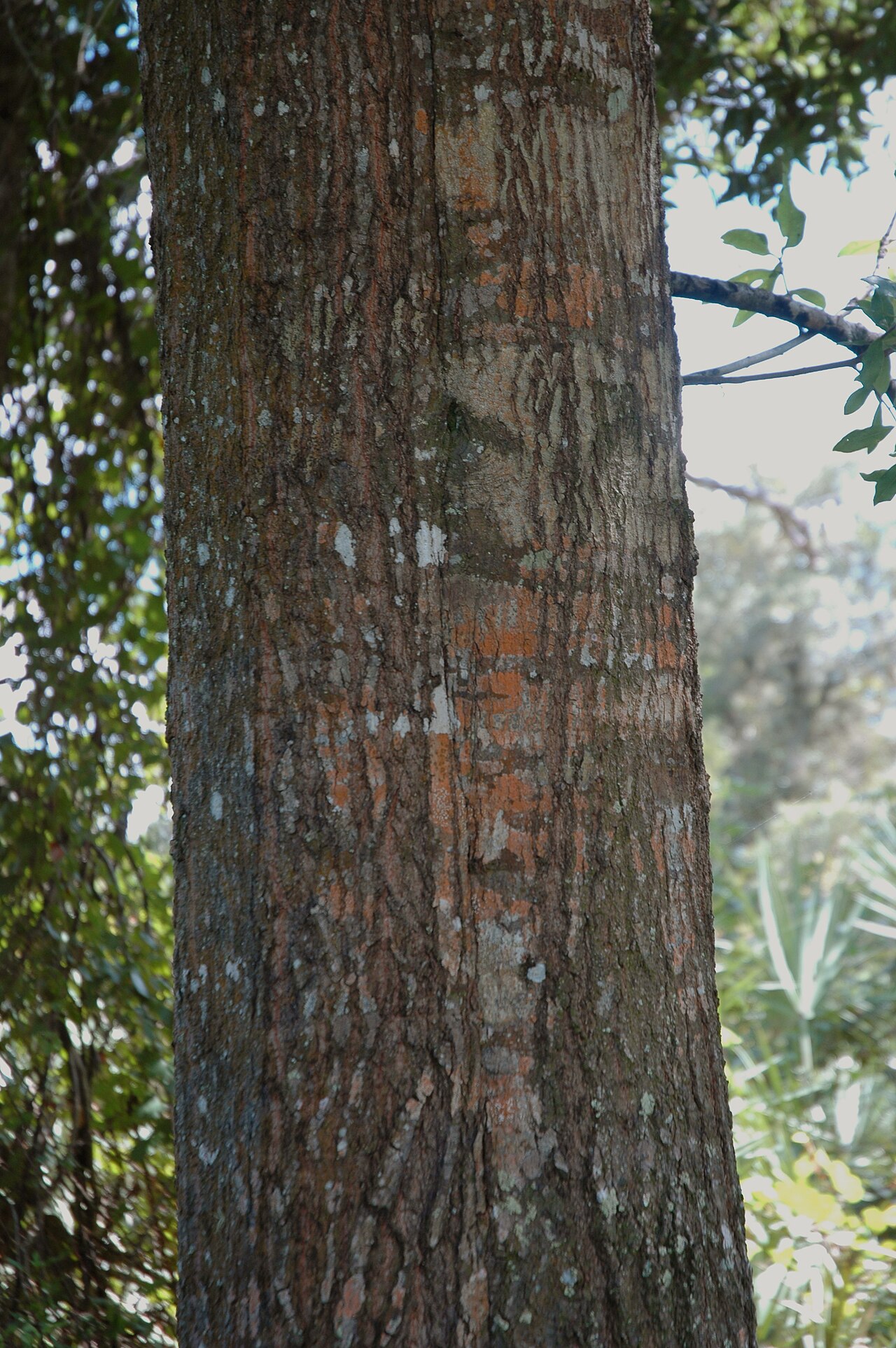
Expect an upright young tree that broadens into a rounded or oval crown. Older trunks develop darker, furrowed bark; the transition from smoother juvenile surfaces is not by itself diagnostic. Inspect the entire plant, including foliage and acorns, rather than identifying an oak from a distant silhouette. Nursery pruning and growing conditions can make trees of the same species look quite different.
Leaves and seasonal behavior
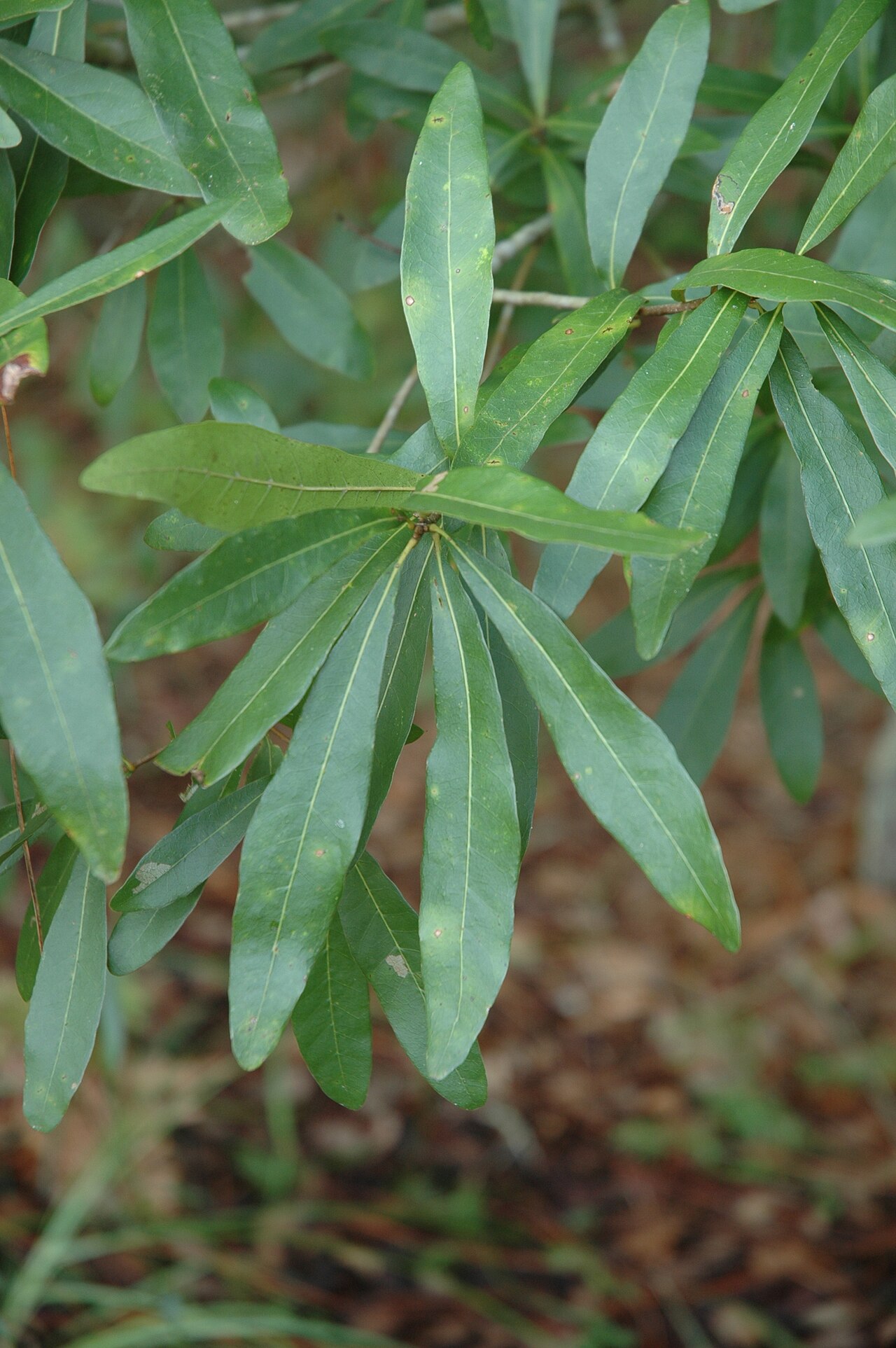
Leaves are alternate, glossy above, and generally narrow to oblong or elliptic, often about 3–5 inches long. Margins on ordinary adult growth are usually unlobed, although variable leaves occur, especially on vigorous shoots. Foliage may be deciduous toward the colder part of the range and remain through much of winter in warmer locations. It is therefore more accurate to call this species deciduous to semi-evergreen than to promise a permanently evergreen screen.
Flowers and acorns
Spring flowers are small and wind-pollinated: dangling male catkins and much less conspicuous female flowers occur on the same tree. The familiar rounded acorn sits in a shallow cup. Laurel oak belongs to the red-oak group, whose acorns mature over two growing seasons. Acorns and cups are useful identification material, but compare mature examples with a regional key rather than interpreting an undeveloped fruit.
Distinguishing related southeastern oaks
Compare laurel oak with Quercus hemisphaerica and water oak, Quercus nigra. Water oak often has leaves that broaden toward a rounded or shallowly lobed tip; laurel oak foliage is commonly narrower and more evenly shaped. Moist habitat supports an identification of Q. laurifolia but does not prove it, because planted trees and altered drainage blur habitat clues. If a tree is intermediate or lacks mature fruit, obtain local botanical help before treating it as a species reference.
Quick Facts
| Scientific Name | Quercus laurifolia |
| Family | Fagaceae — Beech family |
| Plant Type | Large deciduous to semi-evergreen native tree |
| Mature Height | 40–60 feet in the regional table; often 60–70 feet on favorable sites |
| Mature Spread | About 35–45 feet; allow additional room for roots |
| Growth Rate | Fast |
| Sun Exposure | Full sun to partial shade |
| Water Needs | Wet to average in the regional table; moist sites with periods of drainage |
| Soil Type | Acidic, moisture-retentive soils; avoid permanently stagnant sites |
| Flowers | Inconspicuous, wind-pollinated spring flowers |
| Fruit | Acorns; red-oak group with two-season maturation |
| Landscape Caution | Large size and age-related decay require good placement and inspection |
| Foliage | Glossy, narrow leaves; deciduous to semi-evergreen |
| Bloom Time | Spring |
Native Range
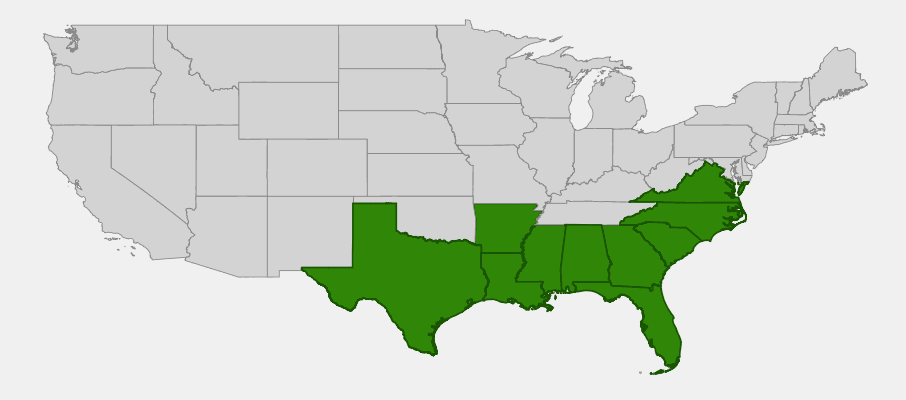
Kew records the native United States range in Alabama, Arkansas, Florida, Georgia, Louisiana, Mississippi, North Carolina, South Carolina, Texas, and Virginia. USDA's silvical account describes the main coastal-plain distribution from southeastern Virginia through Florida and west to southeastern Texas. A highlighted state is a broad botanical summary, not a statement that every county or planting site supports this oak.
Natural settings include low woods, sandy alluvial sites, river margins, and other moist ground. The association with wet landscapes should not be translated into a recommendation for continuous deep flooding. Hydrology changes over a year: a site that is damp in spring may still provide oxygen to roots later in the growing season. Permanent impoundment, compacted fill, or a sealed urban tree pit can be very different from a natural floodplain.
The regional list also covers eastern Oklahoma, but Oklahoma is not included in the native state set used here. Retaining this tree in a multi-state table does not make it native to every part of that region. Gardeners outside the southeastern coastal-plain range should prioritize locally native oaks and ask an extension forester about both soil suitability and provenance.
📋 Regional plant list: Arkansas, Louisiana, Eastern Oklahoma and Eastern Texas
Growing & Care Guide
Choose the site before choosing the tree
Allow for the full crown, trunk flare, and an extensive root zone. Keep the tree away from overhead utilities, narrow strips between pavement, and locations where future root expansion would inevitably be cut off. A large oak can shade a yard beautifully when its mature dimensions fit the site; forcing it into a small ornamental bed creates recurring pruning and infrastructure conflicts. Consider where falling acorns and branches would land as the tree ages.
Light and establishment
Full sun is the most straightforward choice for a freestanding shade tree, while partial shade can suit a young tree at a woodland edge. Select nursery stock with a healthy root flare and no major circling roots. Set the flare at the finished soil level, not at the bottom of a deep mulch bowl. Water the root ball and surrounding soil during establishment according to actual moisture conditions. Rain on foliage does not necessarily wet a compact nursery root ball.
Moisture without permanent stagnation
The regional W–A code indicates wet to average moisture, not a mandate to keep the planting hole flooded. Test drainage before planting and consider seasonal groundwater changes. A low area that drains after rain can be very different from a compacted depression full of anaerobic water. After establishment, adjust irrigation to rainfall, soil texture, and canopy demand. Long dry spells may require support, but routine shallow sprinkling encourages an unnecessarily restricted root zone.
Soil, mulch, and root protection
Favor a moisture-retentive, acidic soil compatible with the species' natural settings. Avoid trying to repair an unsuitable site with a pocket of heavily amended soil inside an otherwise hostile root environment. Apply organic mulch across a broad surface area while keeping it away from the trunk. Do not raise the soil grade over established roots or use the root zone for construction storage. These practical protections are more valuable than repeated fertilizer applications without a diagnosed deficiency.
Develop structure while the tree is young
Choose a tree with a sound central framework and address competing leaders and poorly attached branches early with qualified guidance. Small, well-timed corrections are preferable to removing large limbs after conflicts become obvious. Do not top the tree to contain its height. Topping creates wounds and vigorous replacement growth without solving the basic problem of an oversized tree in an undersized location.
Inspect mature trees
University of Florida guidance emphasizes the potential for trunk and branch decay as laurel oaks age. Have a qualified arborist assess trees near occupied areas, especially after storms or when cavities, major dead limbs, fungal fruiting bodies, or sudden crown changes appear. No photograph or general lifespan estimate can diagnose the safety of an individual tree. Inspection should consider the tree's condition, targets beneath it, soil history, and local storm exposure.
Growing from seed
Use correctly identified, locally sourced acorns obtained with permission, or buy propagated plants from a nursery that can explain its seed source. Acorn condition and storage matter: dried, damaged, or insect-destroyed seed is not equivalent to healthy fresh seed. Red-oak-group acorns typically require a cold, moist period before spring germination; obtain a species-specific nursery protocol for timing and temperature. Protect germinating seed from rodents without sealing it in waterlogged soil. Seedlings will not necessarily match every trait of the parent tree.
Landscape Uses
- A large shade tree in suitable southeastern landscapes with room for its mature crown and roots.
- A component of native lowland woodland restoration where local reference vegetation supports its use.
- An acorn-producing wildlife tree away from narrow pavements and high-conflict utility corridors.
- A transition tree at a moist woodland edge, paired with regionally appropriate understory plants.
- Not a substitute for a small ornamental tree, nor a guaranteed solution for permanently flooded ground.
Wildlife & Ecological Value
Acorns and food webs
Acorns are the most conspicuous wildlife resource. Squirrels and other mammals consume and cache them, and a variety of birds use acorns where they can handle the fruit. Production varies among years and individual trees. Do not promise a constant annual crop from one young tree; a diverse landscape distributes food production across species and seasons.
Insects and the oak canopy
Native oaks collectively support substantial insect diversity, including leaf-feeding caterpillars that help feed birds. This broad ecological role should not be converted into a fabricated list of specialist species for every individual oak. Some chewed foliage is a normal part of the food web. Diagnose serious decline before applying pesticides, and avoid treating ordinary insect activity as a defect in a wildlife planting.
Shelter and forest structure
A spreading crown supplies cover, perches, and shaded habitat beneath it. Leaf litter contributes organic material and shelters small organisms. Retaining some litter in a suitable bed can support these functions, but it should not conceal the trunk flare or obstruct drains. The best habitat value comes from combining the tree with native shrubs and ground-layer plants appropriate to the same moisture regime.
Balance wildlife and public safety
Decaying wood has ecological value in a forest, but a defective limb over a frequently used path presents a different management question. Preserve habitat where it can be retained responsibly, using a qualified assessment of trees near people and buildings. Planting future canopy trees in spacious locations helps reduce this conflict over the long term.
Cultural & Historical Uses
Laurel oak has been widely planted as a southeastern shade tree because of its relatively rapid growth and attractive foliage. Those same traits can encourage planting without adequate consideration of mature size. Modern site planning should evaluate structure, expected maintenance, and available rooting space rather than selecting solely for fast shade.
Historical forestry treatments and nursery names sometimes combined or confused laurel oak with other oaks, particularly Q. hemisphaerica. That naming history helps explain conflicting habitat descriptions. A source discussing upland diamond-leaf oak is not automatically a suitable care reference for this moisture-associated Q. laurifolia page.
The name laurifolia refers to laurel-like leaves, not a close relationship to culinary bay laurels. Do not use foliage or untreated acorns as food based on a common name. This guide covers landscape identification and ecology, not food processing or medicinal use.
Frequently Asked Questions
Is laurel oak evergreen?
It is deciduous to semi-evergreen, with winter leaf retention influenced by climate and site. Do not depend on it for a uniformly evergreen screen throughout its range.
Does it belong in a small front yard?
Usually only if the yard and surrounding open space can accommodate a large tree and extensive roots. Its potential size and maintenance needs make cramped sites a poor choice.
Can I plant it in standing water?
Moisture tolerance is not the same as tolerance of permanent stagnant flooding. Assess seasonal drainage and consult local guidance before selecting it for a wet site.
Is it the same as Quercus hemisphaerica?
No. These names refer to separate accepted species in the treatment used here, although common names overlap and older literature can blur the distinction.
Why does the regional table say 40–60 feet?
That is a useful typical landscape range, not a maximum biological limit. Favorable sites can produce larger trees, so placement should leave room beyond the minimum estimate.
Should an old tree be removed automatically?
No. Age alone is not a complete risk assessment. A qualified arborist should examine structure, decay, site history, and what could be struck if a part failed.
Sources & Further Reading
- Kew Plants of the World Online — Quercus laurifolia
- USDA Forest Service — Laurel Oak silvics
- University of Florida IFAS — Quercus laurifolia
- University of Florida — native tree profile
- University of Florida — Florida oaks
Find Native Plants
Ask growers about nursery propagation and regional provenance. Browse our Arkansas native plant nurseries, Louisiana native plant nurseries, Oklahoma native plant nurseries, Texas native plant nurseries directory for suppliers.