Little Pussytoes (Antennaria microphylla)
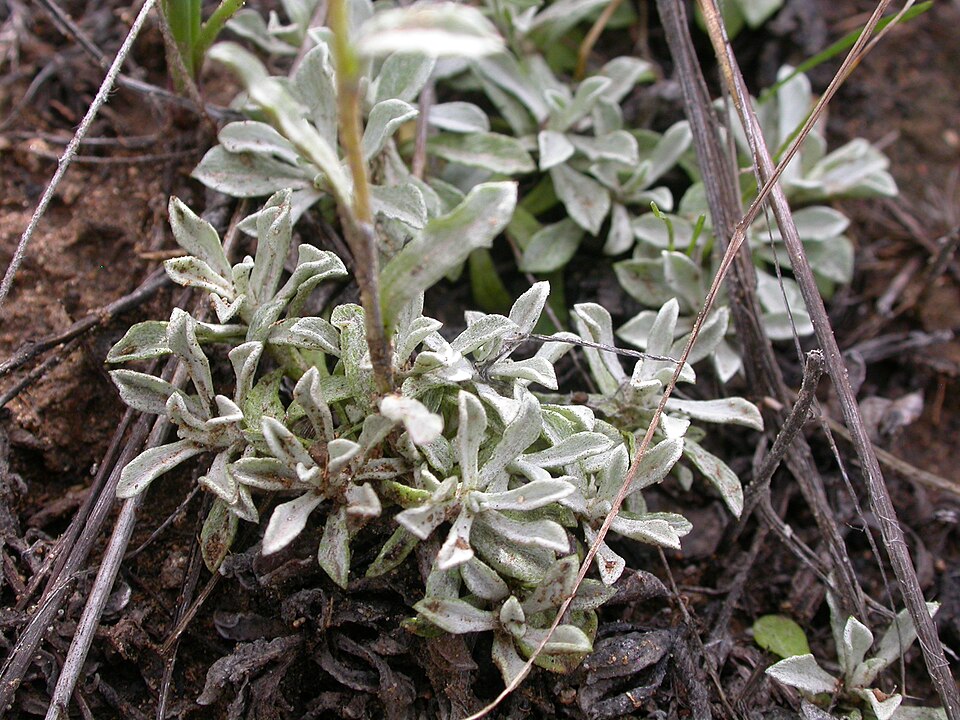
Antennaria microphylla, commonly known as Little Pussytoes or Rosy Pussytoes, is a charming native perennial groundcover found across much of North America. One of approximately 40 Antennaria species in the continent — all sharing the distinctive fuzzy, cat-paw-like flower heads that give the genus its common name — Little Pussytoes is among the smaller and more delicate members, forming dense mats of silver-green foliage just a few inches above the ground. The tiny white to pinkish flower heads, each barely ½ inch across, rise on slender stems to about 12 inches tall in spring and early summer.
This modest but ecologically significant plant is a colonizer of dry, open habitats across a remarkably wide range: from grasslands and dry meadows to rocky slopes, open ponderosa pine forests, and disturbed roadsides throughout the Rocky Mountain West, Great Plains, and eastern North America. In Montana and Wyoming, Little Pussytoes is a characteristic species of dry, sun-baked hillsides, gravelly glacial outwash flats, and the open understory of pine-fir forests. Its mat-forming growth habit suppresses weeds, prevents erosion, and provides habitat structure for ground-nesting insects.
Perhaps the most fascinating ecological trait of Little Pussytoes is that it is largely apomictic — plants reproduce primarily without pollination, producing seeds without fertilization. This allows stable populations to maintain themselves in challenging environments where pollinators may be scarce, while still retaining the flexibility of occasional sexual reproduction when conditions favor it. The result is a remarkably resilient, versatile plant that persists and spreads in conditions that would challenge most other forbs.
Identification
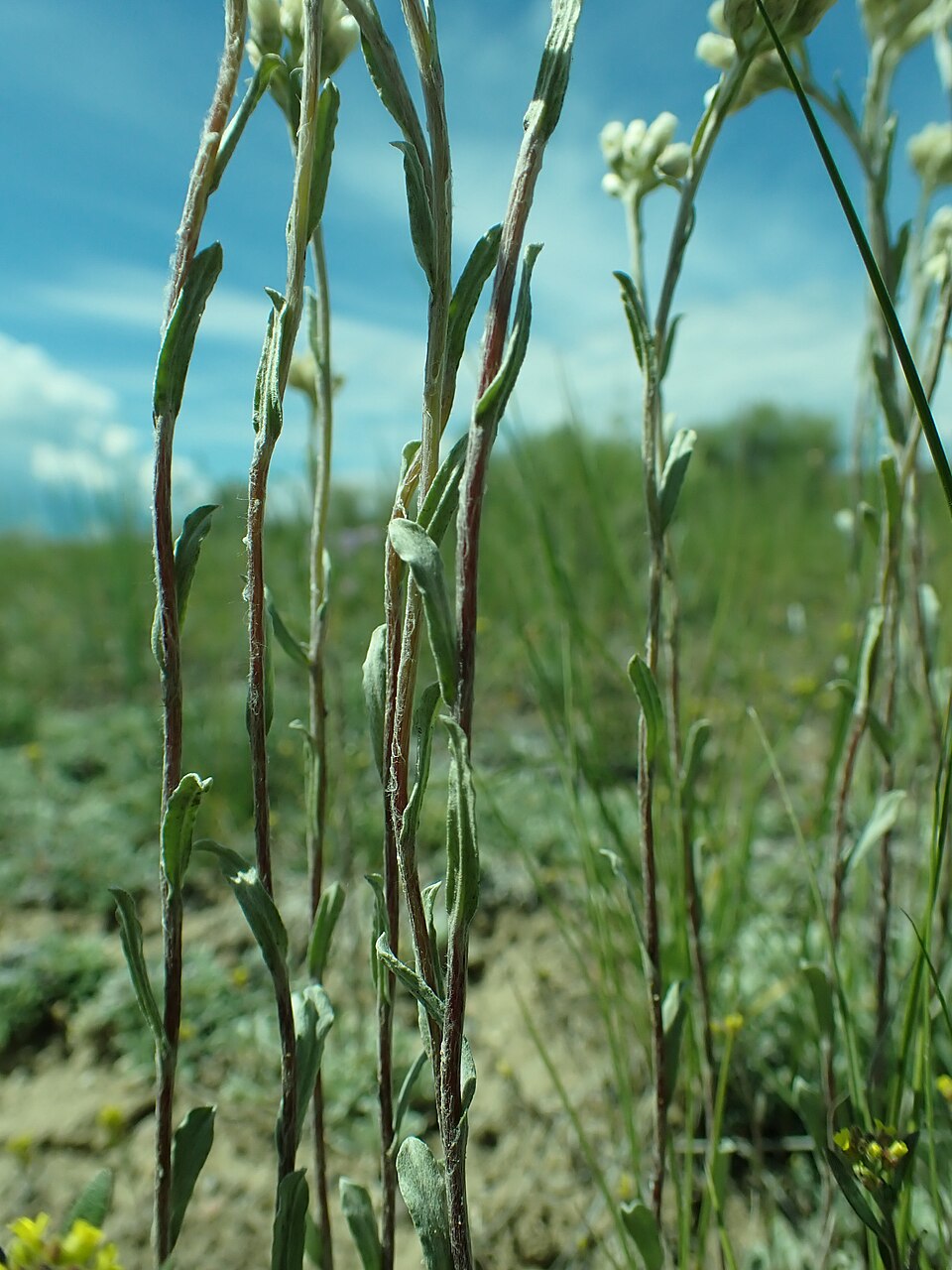
Little Pussytoes is a low-growing mat-forming perennial, spreading by stolons (runners) to create dense colonies. The vegetative mats are typically 2 to 4 inches tall; the flowering stems are erect and rise 4 to 12 inches above the mat. The plant has a distinctly silver-woolly texture due to dense white or grayish hairs on leaves and stems — an adaptation to sun and drought.
Leaves
The basal leaves are the most prominent — spatula-shaped to narrowly oblong, ½ to 1 inch long and about ¼ inch wide, densely covered in white woolly hairs on both surfaces (though slightly greener above). The leaves are noticeably small relative to other Antennaria species — reflected in the species name microphylla (“small-leaved”). Stem leaves are smaller and more linear. The silver-gray basal rosettes persist through winter, providing ground-level texture even in the dormant season.
Flowers
The flower heads are small discoid composites — about ¼ to ½ inch across — with no strap-shaped ray florets, only central disc florets enclosed in papery bracts (phyllaries). The phyllaries are typically white to pinkish, sometimes with rose-colored tips, giving the flower heads a soft, fluffy appearance that resembles the pads of a cat’s foot. Flower heads are borne in compact corymbs of 3 to 12 heads at the top of the flowering stems. Bloom time is April through July in Montana and Wyoming, depending on elevation. The plant is dioecious — male and female flowers occur on separate plants — though apomictic (seed-producing without fertilization) populations consist primarily of female plants.
Quick Facts
| Scientific Name | Antennaria microphylla |
| Family | Asteraceae (Aster / Composite) |
| Plant Type | Perennial Groundcover Herb |
| Mature Height | 1 ft (mat 2–4 in; flowers to 12 in) |
| Sun Exposure | Full Sun |
| Water Needs | Moderate |
| Bloom Time | April – July |
| Flower Color | White to rosy-pink |
| Soil Type | Well-drained, sandy, gravelly, or rocky |
| Spreading Habit | Mat-forming via stolons |
| USDA Hardiness Zones | 3–8 |
Native Range
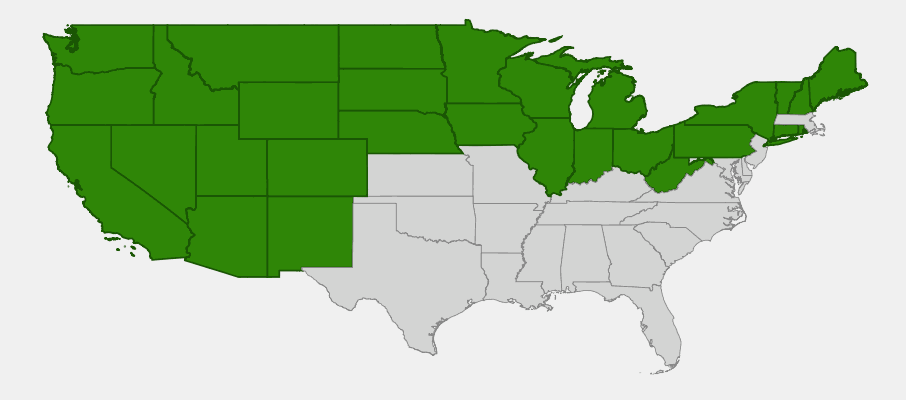
Little Pussytoes has an extensive native range across North America, spanning from Alaska south through the Rocky Mountains to the southwestern United States, and east across the Great Plains and upper Midwest to the Atlantic coast. In the West, it is found from British Columbia south to Nevada and New Mexico; in the East, it occurs as far south as the Appalachians. This broad distribution reflects the species’ remarkable adaptability to varied climates, soils, and elevations.
In Montana and Wyoming, Little Pussytoes is common at elevations from the valley floors to well above treeline, thriving in the open, sun-exposed habitats that characterize much of the region’s landscape. It is particularly abundant on dry, gravelly slopes, open ponderosa pine and Douglas-fir parklands, shortgrass and mixed-grass prairies, and rocky mountain ridges. Its mat-forming growth makes it one of the most visible groundcover plants in open, well-drained sites throughout the Northern Rockies and adjacent plains.
The species shows remarkable resilience to disturbance, quickly recolonizing after fire, overgrazing, or road construction. Its ability to reproduce apomictically (without pollination) means populations can persist and spread even when pollinators are scarce — a significant advantage in the challenging environments it typically occupies.
📋 Regional plant lists featuring Little Pussytoes: Montana & Wyoming
Growing & Care Guide
Little Pussytoes is one of the most rewarding native groundcovers for dry, sunny gardens in the Rocky Mountain region. Once established, it requires almost no attention — spreading slowly to form a beautiful silver-gray carpet that suppresses weeds and provides spring color.
Light
Little Pussytoes requires full sun to thrive. In shaded conditions, the mats thin out, plants become leggy, and flowering diminishes. Site it in the sunniest part of your garden for best results — south-facing slopes and rock garden exposures are ideal. Even the reflected heat of pavement or walls does not deter this sun-loving native.
Soil & Water
Well-drained soil is non-negotiable for Little Pussytoes — it will not tolerate clay, compacted, or waterlogged soils. Sandy, gravelly, or rocky substrates are ideal, mirroring the well-drained hillside soils of its natural habitat. Once established, it is moderately drought tolerant but performs best with occasional deep watering during extended dry spells. Avoid overhead irrigation, which can promote fungal diseases in the dense mats. Do not fertilize — rich soil leads to rank, open growth that loses the plant’s characteristic tight, silver mat appearance.
Planting Tips
Little Pussytoes can be grown from seed or transplanted from divisions or container plants. For seed propagation, seeds require cold stratification (30–60 days at 35–40°F) for good germination. Surface-sow seeds on a sandy medium after stratification — seeds need light to germinate. Division of established mats is the easiest propagation method: simply remove rooted sections of stolons in early spring and replant in the desired location. Space transplants 12–18 inches apart to allow mats to fill in over 2–3 seasons. Plant in spring after frost risk has passed.
Pruning & Maintenance
Very little maintenance is needed. After flowering, the spent flower stems can be cut back to the mat level to maintain a neater appearance, or left to provide winter texture. If the mat becomes too dense or begins to form thick thatch, divide and thin every 3–4 years. The stolons root readily when they contact soil, making this one of the easiest plants to propagate and share.
Landscape Uses
- Rock gardens — perfect between boulders or at the edge of raised beds
- Dry slope groundcover — prevents erosion while providing visual interest
- Lawn alternative in full-sun areas of low-traffic zones
- Stepable groundcover for paths and stepping stone gaps (tolerates light foot traffic)
- Border edging — the silver mat contrasts beautifully with darker-foliaged plants
- Native meadow plantings — fills the gaps between taller native forbs and grasses
- Butterfly gardens — larval host plant for American Lady butterfly
Wildlife & Ecological Value
Though small and easily overlooked, Little Pussytoes provides surprisingly significant wildlife value, particularly for specialist invertebrates that depend on native Antennaria species.
For Butterflies
Little Pussytoes is a larval host plant for the American Lady butterfly (Vanessa virginiensis), one of the most widespread and recognizable butterflies in North America. Female American Ladies specifically seek out Antennaria species to lay their eggs, and the caterpillars construct silk-webbed leaf nests among the woolly foliage. Planting any Antennaria species in your garden virtually guarantees visits from American Lady butterflies and provides a breeding site in your landscape.
For Birds
The tiny seeds of Little Pussytoes are consumed by small finches, particularly American Goldfinches and Pine Siskins, that comb through the dried flower heads in late summer and fall. The dense mats provide ground-level cover for sparrows and other ground-foraging birds seeking shelter and foraging opportunities in open habitats.
For Other Insects
The flowers of Little Pussytoes attract a variety of small native bees and flies in early spring, providing an important early-season nectar source when few other flowers are blooming in dry, open habitats. Small metallic bees in the genus Lasioglossum (sweat bees) are frequent visitors, collecting pollen for their spring nests.
Ecosystem Role
Little Pussytoes is a mat-forming pioneer that stabilizes bare and disturbed soils in open, dry habitats. The dense woolly mats trap wind-blown seeds and organic matter, gradually building up a thin humus layer that makes colonization by other plants more feasible. In fire-disturbed landscapes, it is often one of the first plants to recolonize, playing a crucial early-succession role in community recovery. Its fibrous root network anchors hillside soils against erosion, especially in the rocky, steep terrain it typically colonizes.
Cultural & Historical Uses
Antennaria species, including Little Pussytoes, were used medicinally by numerous Indigenous peoples across North America. The Blackfoot used pussytoes preparations as a treatment for throat problems and as a ceremonial smoking plant, mixing the dried leaves with tobacco. The Flathead (Salish) people used a preparation of pussytoes for respiratory ailments. Several tribes used the woolly white hairs from the flower heads as a substitute for cotton in dressing wounds — the absorbent, soft fibers made effective wound dressings when more conventional materials were unavailable.
The plant’s common name reflects a simple observation that the fuzzy flower heads resemble the soft paw pads of a kitten — an apt description that has made it one of the most universally recognized of the genus. Early European settlers in Montana and Wyoming took note of the plant’s spring blooming as a seasonal marker, and it appears in early regional herbals as a reliable indicator of spring’s arrival in dry grassland areas.
In modern horticulture, Antennaria species are increasingly valued as drought-tolerant, deer-resistant groundcovers for difficult dry sites. The silver foliage provides a long season of visual interest even outside of bloom time, and the plant’s adaptability to poor soils makes it a practical choice for landscape areas where more demanding plants fail. The dried flower heads can be used in dried flower arrangements and crafts, where they retain their shape and soft texture for months.
Frequently Asked Questions
How is Little Pussytoes different from other Antennaria species?
Little Pussytoes (A. microphylla) is distinguished by its particularly small, narrow leaves (hence microphylla) and pinkish flower bracts. The most commonly confused relative is Field Pussytoes (A. neglecta), which has slightly larger leaves, and Rosy Pussytoes (A. rosea), which has more distinctly rosy-pink bracts. All Antennaria species serve similar ecological functions and can be used interchangeably in gardens.
Is Little Pussytoes deer resistant?
Yes — the woolly, bitter foliage is generally avoided by deer, making it a reliable choice for landscapes with heavy deer pressure. It is also largely ignored by rabbits, which find the dense matted growth difficult to graze.
Can Little Pussytoes be used as a lawn substitute?
In dry, full-sun situations, yes — it forms a dense mat that can tolerate occasional light foot traffic and requires no mowing. It is most effective as a lawn alternative in areas where conventional lawn grasses struggle due to dryness, poor soil, or slope. Combine with other groundcovers like Blue Grama grass for a more diverse, resilient low-maintenance carpet.
Does it spread invasively?
Little Pussytoes spreads via stolons but is not considered invasive — it expands slowly and stays within bounds in typical garden conditions. Its spread can be easily controlled by removing stolons that venture beyond the desired area.
Is it easy to grow from seed?
Growing from seed is possible but requires patience and cold stratification. Division of existing mats is much easier and faster. Many native plant nurseries in Montana and Wyoming carry Little Pussytoes in 4-inch or quart-size pots — the easiest way to get started.