
Mangroveberry (Mosiera longipes)
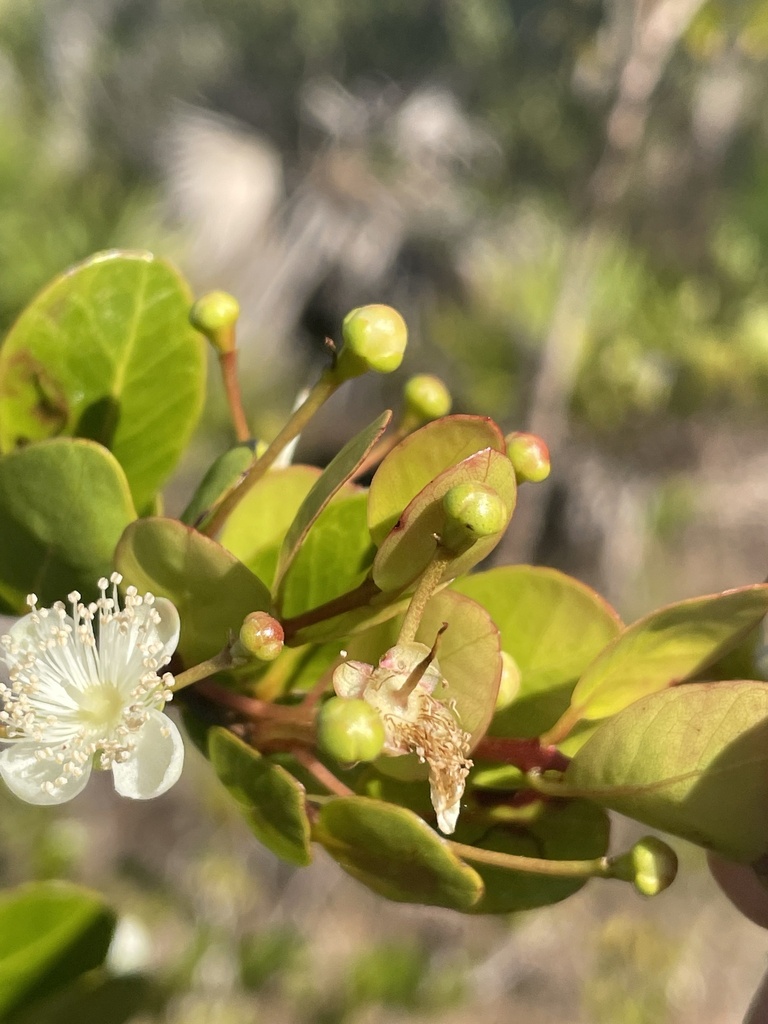
Mosiera longipes, known as Mangroveberry, Bahama stopper or longstalked stopper, is a small evergreen shrub of the myrtle family (Myrtaceae) that grows in the United States only in the pine rocklands and rockland hammocks of Miami-Dade County and the lower Florida Keys. It usually stays 3 to 6 feet tall and wider than tall, with small, glossy, rounded leaves, white flowers full of stamens held out on long, thin stalks, and round berries that ripen black. Despite the name, it has nothing to do with mangroves; it grows on dry limestone uplands, not in tidal swamps.
Botanists have placed it in several genera. The Atlas of Florida Plants and many Florida references use Mosiera longipes, the name used here, while USDA PLANTS treats it as a variety of a guava, Psidium longipes var. longipes. Older books call it Eugenia longipes or Myrtus verrucosa. Whatever the name, it is a close relative of the guavas and the native Florida stoppers.
Mangroveberry is listed as Threatened by the State of Florida (FDACS Regulated Plant Index, as reported by the Atlas of Florida Plants). Its habitats, especially the pine rocklands of the Miami area and Big Pine Key, have been reduced to small fragments by development. It is rarely offered by nurseries, so anyone who wants to grow it should look for nursery-propagated plants from a native plant nursery and never dig plants or collect seed from the wild. Outside Florida it grows in the Bahamas and the Greater Antilles.
Identification
Mangroveberry is easiest to recognize in flower, when its long-stalked white blossoms stand out among the leaves. Out of flower it can be confused with several other small-leaved shrubs of the pine rocklands, including stoppers and locustberry.
Growth Habit & Bark
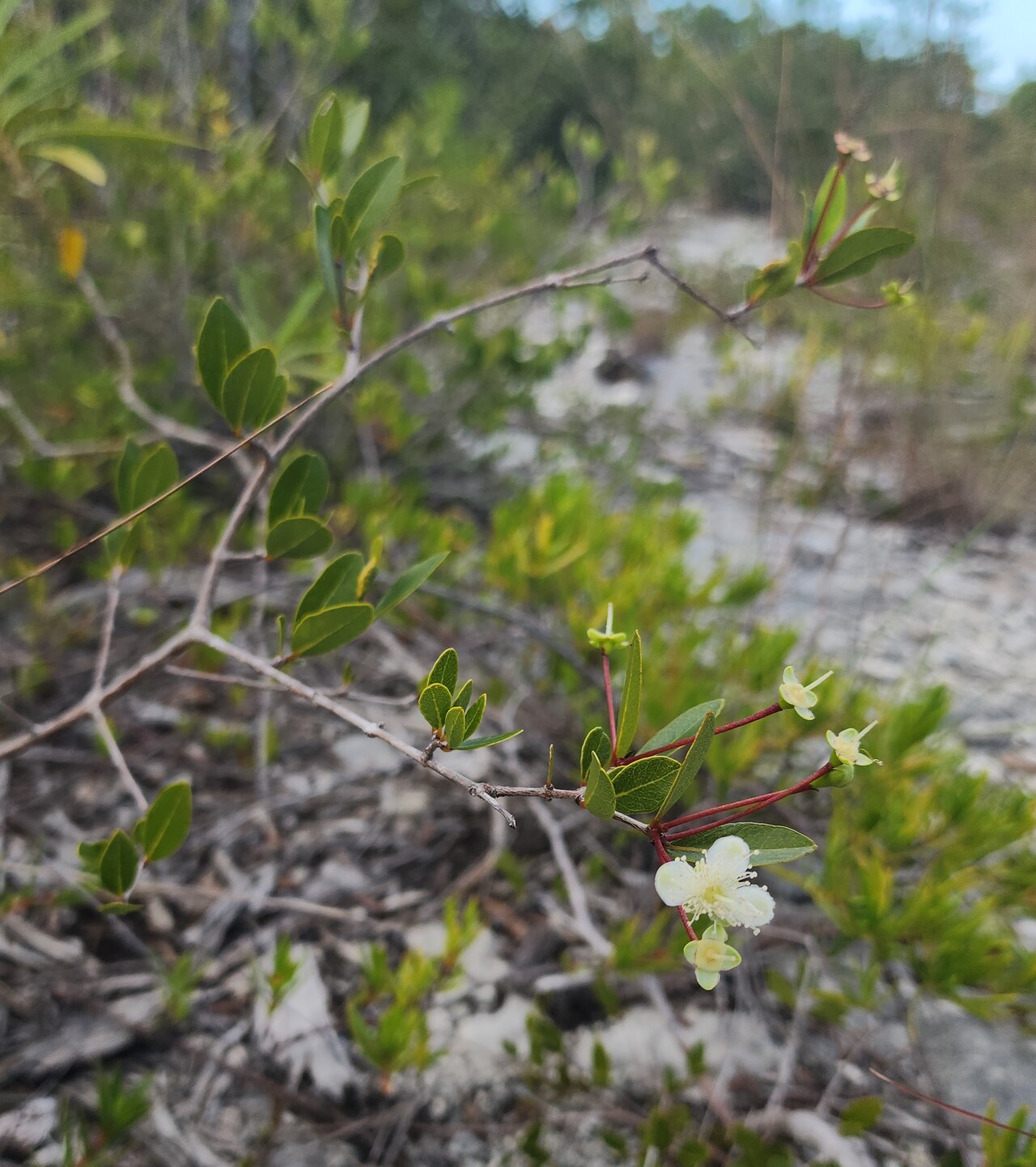
It is a much-branched shrub, usually 3 to 6 feet tall, occasionally taller in protected hammock edges, and typically broader than tall. On exposed limestone it may stay low and spreading, forming loose mats. The trunks are short, and the bark is smooth and gray on older stems, while young twigs are often reddish.
Leaves
The leaves are opposite, simple and leathery, roughly elliptic to nearly round, mostly about an inch long, with a rounded or slightly notched tip. They are shiny, light to medium green above and paler beneath, and new growth is often tinged pink or bronze. Held to the light, they show tiny translucent oil glands typical of the myrtle family, and crushed leaves have a faint spicy scent.
Flowers
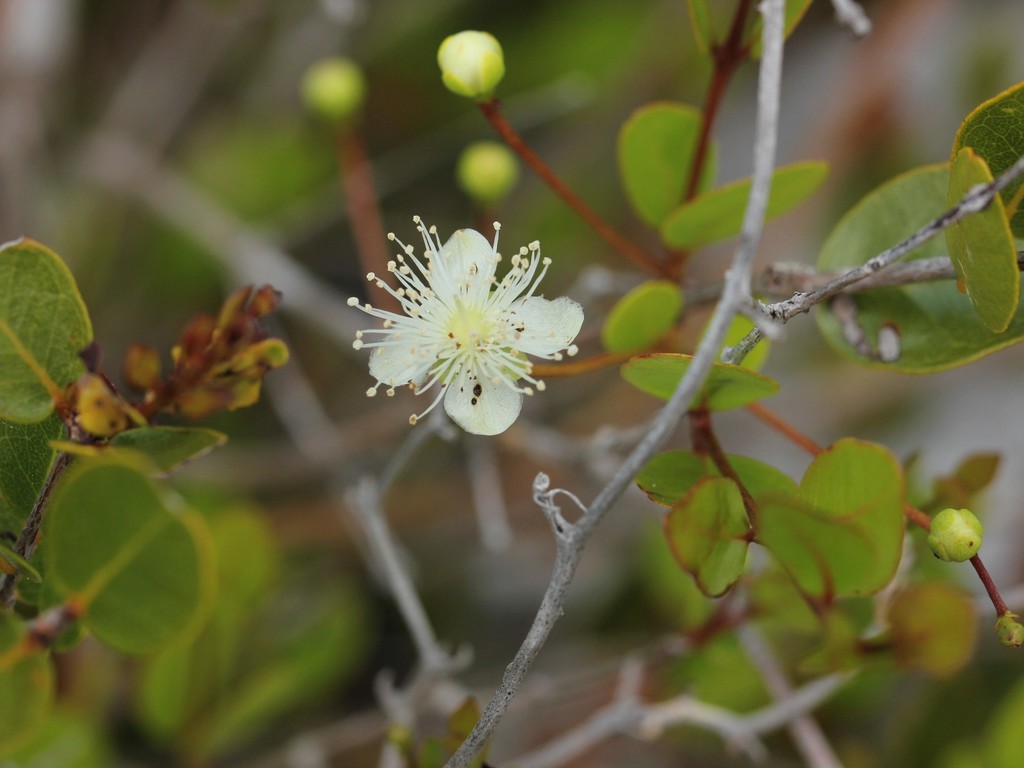
Flowers are borne singly in the leaf axils on unusually long, slender stalks, often longer than the leaves, which is the source of the name longipes (“long foot”). Each flower is about half an inch across, with four or five white to pinkish petals and a dense tuft of many white stamens, like a small guava blossom. The round buds are pale green or pinkish. Mangroveberry can bloom in any month in south Florida.
Fruit
The fruit is a small, round berry about a quarter to half an inch across, crowned by the remains of the calyx. It turns from green to red and finally purplish black when ripe and holds a few seeds. The berries are eaten by birds. Long-stalked flowers and fruit are the best way to tell it apart from the true stoppers (Eugenia), which bear their flowers on short stalks in clusters.
Quick Facts
| Scientific Name | Mosiera longipes (USDA: Psidium longipes var. longipes; syn. Eugenia longipes, Myrtus verrucosa, Mosiera bahamensis) |
| Family | Myrtaceae (myrtle family) |
| Plant Type | Evergreen shrub, rarely a small tree |
| Mature Height | 3–6 ft (occasionally taller) |
| Mature Spread | 4–8 ft; usually broader than tall |
| Growth Rate | Moderate |
| Sun Exposure | Full sun to light shade |
| Water Needs | Low to moderate; drought tolerant once established |
| Soil Type | Well-drained limestone (oolite) soils, with or without a humus layer |
| Soil pH | About 7.0–8.5 (alkaline) |
| Bloom Time | Year-round |
| Flower Color | White, sometimes tinged pink |
| Fall Color | None; evergreen |
| Fruit | Small round berry ripening purplish black |
| Deer Resistant | Unknown; generally not heavily browsed |
| USDA Hardiness Zones | 10b–11 |
Native Range
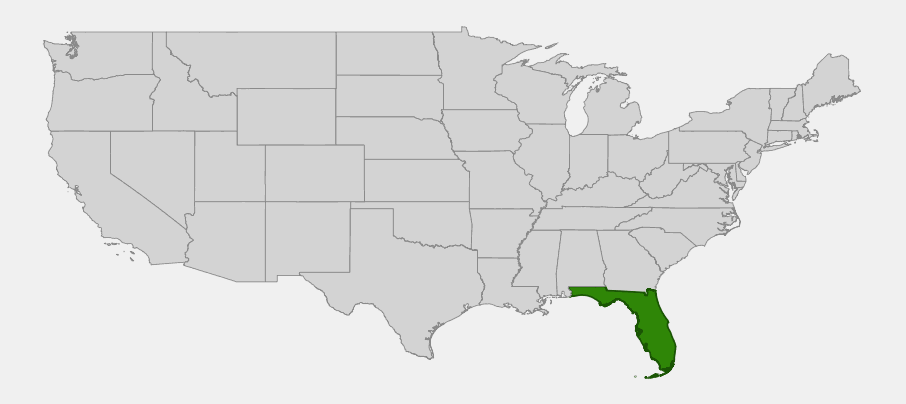
In the United States, mangroveberry is found only in southern Florida. USDA PLANTS records it as native in Florida, where it grows in two separate areas: the pine rocklands and rockland hammocks of Miami-Dade County, including Everglades National Park’s Long Pine Key and remnant rocklands near Miami, and the lower Florida Keys around Big Pine Key and nearby islands in Monroe County. The Institute for Regional Conservation notes that it has apparently never been collected on Key West.
Outside Florida it grows in the Bahamas and the Greater Antilles, including Cuba. South Florida is the northern edge of its range, and it does not tolerate hard frost.
Within this small range it depends on the open, fire-maintained pine rocklands and the sunny edges of rockland hammocks. Most of the original pine rockland outside Everglades National Park has been cleared, and remaining fragments need prescribed fire and removal of invasive plants to stay healthy. The Atlas of Florida Plants records mangroveberry as Threatened under Florida’s Regulated Plant Index.
📋 Regional plant lists featuring Mangroveberry: North & South Florida
Growing & Care Guide
Mangroveberry is an attractive, tidy shrub for south Florida gardens, but it is rarely available. Because it is listed as Threatened in Florida, buy only nursery-propagated plants from a reputable native plant nursery, ask about the source of the stock, and never dig plants or collect seed or cuttings from wild populations, including those in parks and preserves. It is best suited to zone 10b and 11 gardens on limestone soils.
Light
Plant it in full sun or light shade. It flowers and fruits best in sun, as in an open pine rockland. In heavy shade it grows thin and blooms sparsely.
Soil & Water
Mangroveberry is adapted to thin, well-drained limestone soils, with or without a layer of leaf litter. It does well in the rocky, alkaline soils of the Miami Rock Ridge and the Keys and should also grow in well-drained sandy soils amended with some organic matter. Water regularly the first year; afterward it is moderately to highly drought tolerant, although plants on very dry, shallow soils can die back during long droughts. It does not tolerate flooding by salt or brackish water, and salt wind can burn the leaves, so keep it away from the immediate coast.
Planting Tips
Plant in the rainy season, from late spring through summer, so the roots establish with natural rainfall. Give it room to spread, about 4 to 6 feet between plants, and set it where its flowers can be seen up close along a path or at the front of a native shrub bed. Because mangroveberry is listed as Threatened in Florida, use only nursery-propagated plants and never transplant it from the wild.
Pruning & Maintenance
It needs little pruning. Remove dead wood and trim lightly to shape if needed. Avoid shearing into tight hedges, which removes the flowers and fruit. Little or no fertilizer is needed. Mulch lightly, but keep mulch away from the stems.
Propagation
Mangroveberry can be grown from cleaned, fresh seed sown in a well-drained mix. Remove the pulp first, since it can inhibit germination and encourage rot. Seedlings grow at a moderate pace. Collect seed only from cultivated plants, never from wild populations.
Landscape Uses
- Accent shrub: a small, glossy evergreen with flowers and fruit through much of the year
- Pine rockland gardens: with saw palmetto, silver palm and other rockland natives
- Bird gardens: its small black berries feed resident and migrating birds
- Pollinator gardens: its open, many-stamened flowers attract bees and other small insects
- Habitat restoration: in Miami-Dade and Keys pine rocklands, using propagated stock
Wildlife & Ecological Value
Mangroveberry is a small part of the diverse shrub layer of the pine rocklands, but its long flowering season and fleshy fruit make it useful to wildlife there.
For Pollinators
The flowers, like those of other members of the myrtle family, offer abundant pollen and are visited by native bees, honey bees, flies and other small insects. Because it can bloom in any month, it is a dependable food source in a habitat where flowering varies with fire and season.
For Birds
The small dark berries are eaten by birds such as mockingbirds, catbirds and other fruit-eating songbirds, and the seeds are probably spread by them. Its dense branches also offer cover for small birds.
For Mammals
Small mammals may eat fallen fruit. On Big Pine Key it shares the pine rocklands with the endangered Key deer, a habitat whose health depends on the same fire management that benefits mangroveberry.
Ecosystem Role
Pine rocklands are a globally rare, fire-dependent ecosystem found only in south Florida and the Bahamas. Frequent fires keep hardwoods from shading out the many small shrubs and herbs, including mangroveberry, which resprouts from the base after fire. Its presence is a sign that a rockland fragment still holds much of its original plant diversity.
Cultural & Historical Uses
The species was first described as Eugenia longipes by the German botanist Otto Berg in the 1850s, and John Kunkel Small, who studied the flora of south Florida for decades, later placed it in the genus Mosiera. Botanists still debate where it belongs. Some treat Mosiera as distinct, while others, including USDA PLANTS, include it within the guava genus Psidium.
The common name “mangroveberry” is something of a puzzle, since the plant does not grow in mangrove swamps. The other names, Bahama stopper and longstalked stopper, link it to the stoppers, a group of related Florida shrubs in the myrtle family whose name is often said to come from folk use of their bark or fruit to “stop” diarrhea.
There is little recorded use of mangroveberry by people. Its importance today is as a component of the vanishing pine rockland ecosystem and as an example of the many West Indian plants that reach the United States only at the southern tip of Florida.
Frequently Asked Questions
Is mangroveberry a mangrove?
No. Despite its name, mangroveberry grows on dry limestone in pine rocklands and the edges of rockland hammocks, not in tidal mangrove swamps. It is in the myrtle family, related to guavas and stoppers.
Is mangroveberry protected in Florida?
Yes. It is listed as Threatened by the State of Florida in the FDACS Regulated Plant Index, as reported by the Atlas of Florida Plants. Buy nursery-propagated plants only and never collect plants, seed or cuttings from the wild.
Why does it have so many scientific names?
It has been placed in Eugenia, Myrtus, Mosiera and Psidium as botanists have revised the myrtle family. The Atlas of Florida Plants uses Mosiera longipes; USDA PLANTS uses Psidium longipes var. longipes.
Can I grow mangroveberry outside south Florida?
It is a tropical shrub that tolerates little frost, so it is suited only to zones 10b and 11. It can be grown in a large container in cooler areas if protected from freezing.
Is it salt tolerant?
Not very. It does not tolerate flooding with salt or brackish water, and salt spray can burn its leaves, so plant it inland or behind more salt-tolerant shrubs.

Looking for a nursery that carries Mangroveberry?
Browse our native plant nursery directory: Florida