Marsh Blue Violet (Viola cucullata)
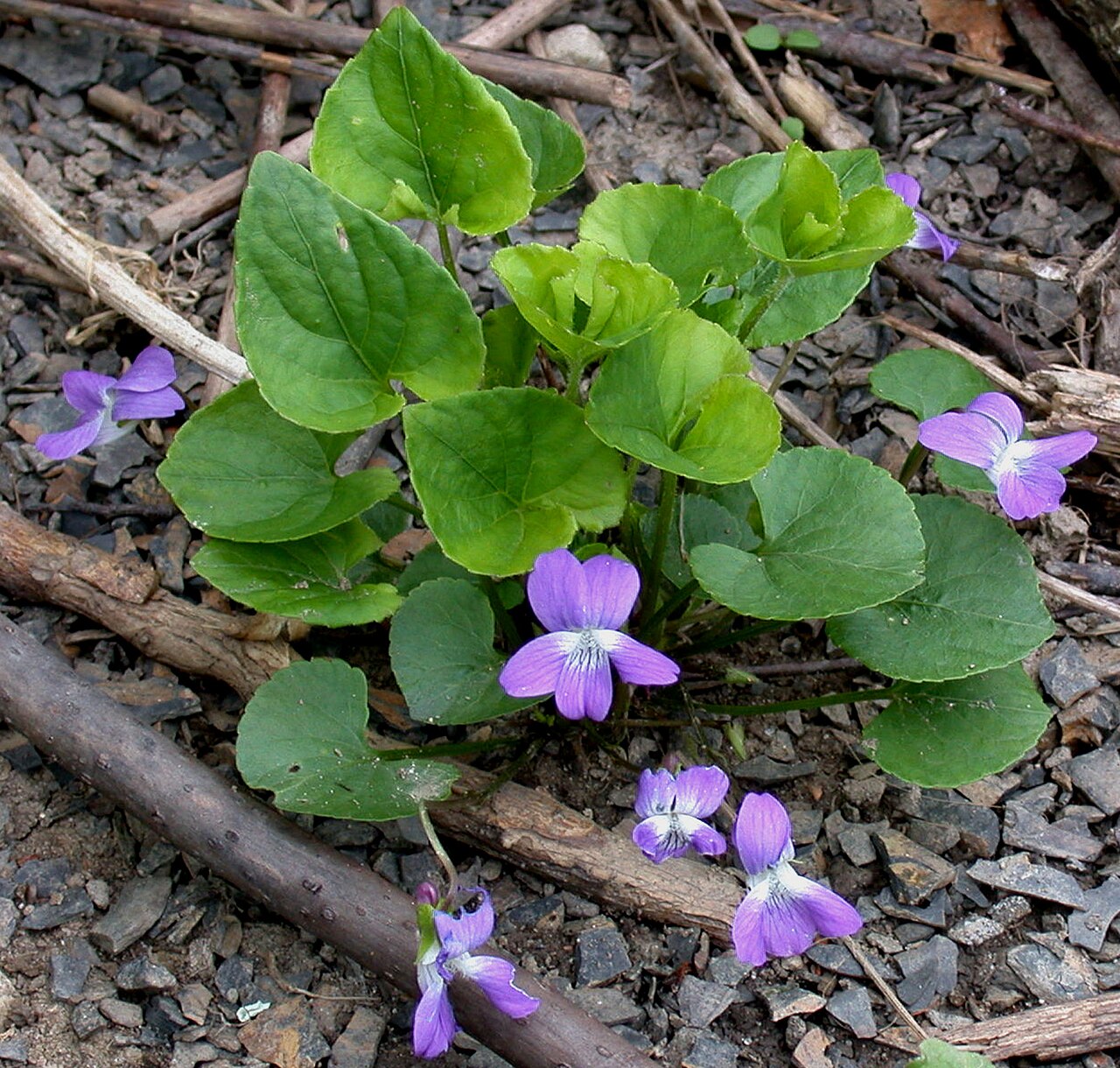
Marsh blue violet (Viola cucullata) is a native perennial for places where the soil remains reliably moist. Its blue-violet flowers rise on stalks above a low rosette of heart-shaped leaves, giving a small plant an unexpectedly airy display. Around a pond margin, in a damp meadow edge, or in a suitable rain garden, it can add spring color without requiring a tall flowering stem.
The word marsh is a useful clue but not a complete planting instruction. This violet needs a steady moisture supply; it is not a drought-tolerant substitute for common lawn violets. It can grow in sun when water is sufficient and in partial or dappled shade, but dry soil is a poor match. Evaluate the proposed site in summer as well as after spring rain.
Identification matters because several eastern blue violets look similar. Flower-stalk height, petal hairs, and leaf characters are more informative than flower color alone. Obtain nursery-propagated plants identified as Viola cucullata, and allow a modest patch to develop where its moisture needs fit the garden. The result can be a useful low layer among taller, compatible native plants.
Identification
Leaves & Rosette
The smooth green leaves arise near the ground from a horizontal rhizome. They have heart-shaped bases, rounded teeth, and veins that spread outward from the leaf base. The leaves enlarge after flowering, so their relationship to the flowers changes through the season. Some leaf bases fold inward, a hooded appearance reflected in the scientific name. Do not identify a plant from one unusually shaped young leaf without examining the rest of the rosette.
Flower Stalks
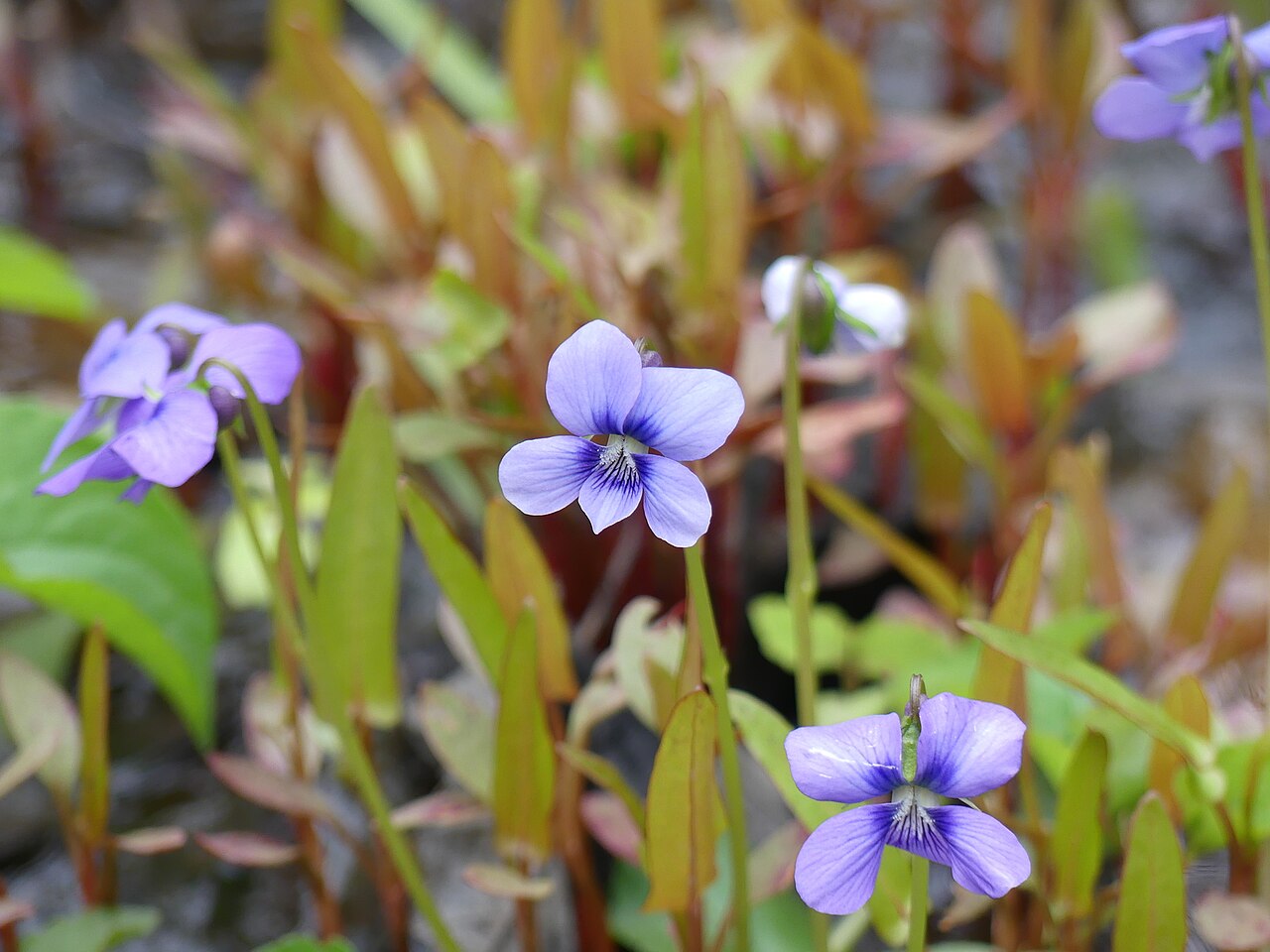
The conspicuously long, leafless flower stalks are an important clue. At flowering they generally carry the blossoms higher than the leaves. Many other eastern blue violets have flowers at or below the level of their foliage, although a complete identification still requires additional characters. Photograph the entire plant from the side when documenting this feature; a tightly cropped flower photograph cannot show the height relationship.
Petals & Spur
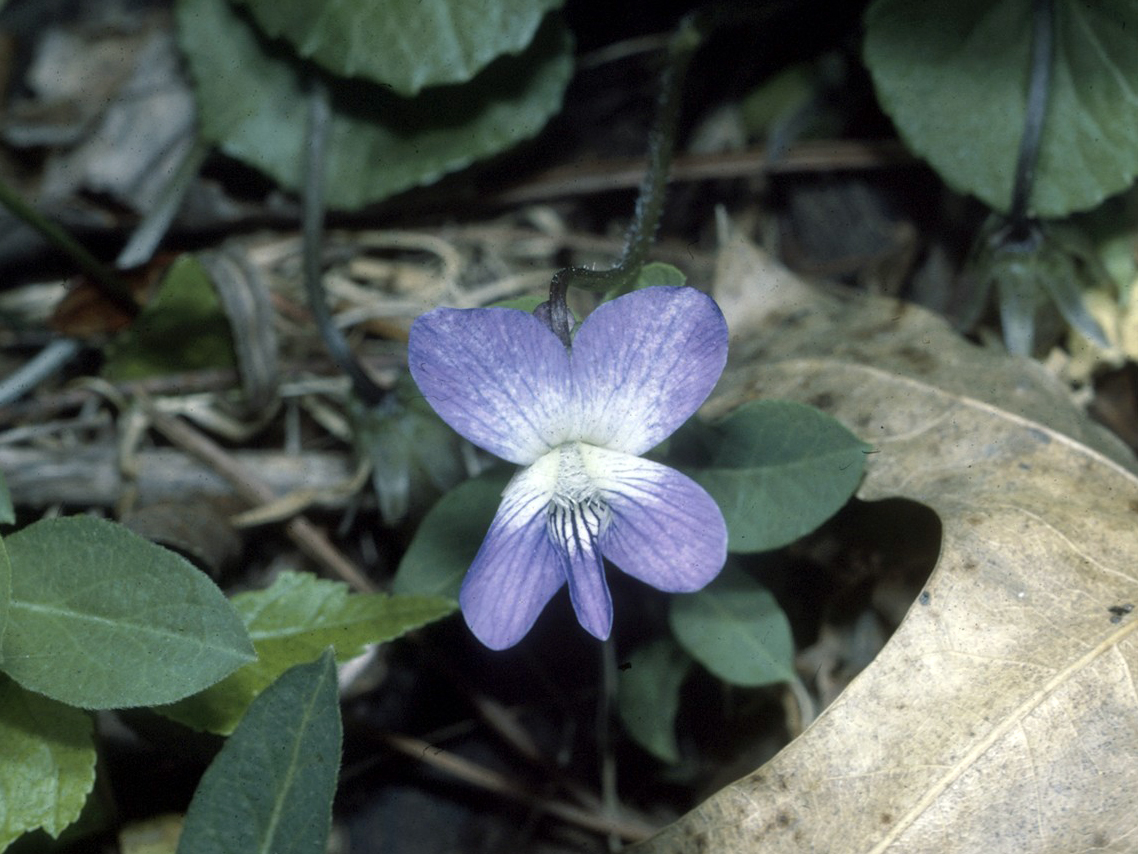
The five-petaled flowers are usually light blue to blue-violet, often with a pale central area and darker lines. The lower petal has a short nectar spur at the back. Club-tipped hairs on the lateral petal beards help distinguish this species from similar violets and are best examined with magnification. White-flowered plants can occur, but a pale flower by itself is not proof of species identity.
Fruit & Reproduction
Small green capsules develop after flowering and split into three parts as they mature. The plant can also produce inconspicuous self-pollinating flowers rather than relying only on the showy spring blossoms. These are part of its normal reproductive cycle. Leave some capsules to mature if natural recruitment is welcome, or manage seedlings later if the patch begins to occupy more space than intended.
Avoiding Look-Alikes
Common blue violet and other stemless violets may share the heart-shaped foliage and blue flowers. Use the tall flower stalks together with petal hairs and a regional key. Hybrids are also documented among eastern violets, so an intermediate plant may resist a simple photograph-based identification. A qualified local botanist can assess detailed images of the flower face, side, sepals, leaves, and whole plant without requiring wild collection.
Quick Facts
| Scientific Name | Viola cucullata Aiton |
| Family | Violaceae |
| Plant Type | Native rhizomatous herbaceous perennial |
| Mature Height | Usually about 6–12 inches including flowering stalks |
| Mature Spread | A low rosette around 6 inches across; patches expand through recruitment |
| Growth Rate | Moderate in suitable moist conditions |
| Sun Exposure | Sun to partial or dappled shade; moisture must match exposure |
| Water Needs | Consistently moist to wet; not tolerant of dry soil |
| Soil Type | Clay, loam, or sand with a dependable moisture supply |
| Soil pH | Near-neutral conditions are suitable; NC State lists approximately pH 6–8 |
| Bloom Time | Spring; timing varies by location |
| Flower Color | Blue to blue-violet, sometimes white |
| Fall Color | Not grown for a reliable autumn color display |
| Fruit | Small dry capsule that opens into three parts |
| Deer Resistant | Do not assume immunity; monitor local browsing |
| USDA Hardiness Zones | 3–7 in NC State horticultural guidance |
Native Range
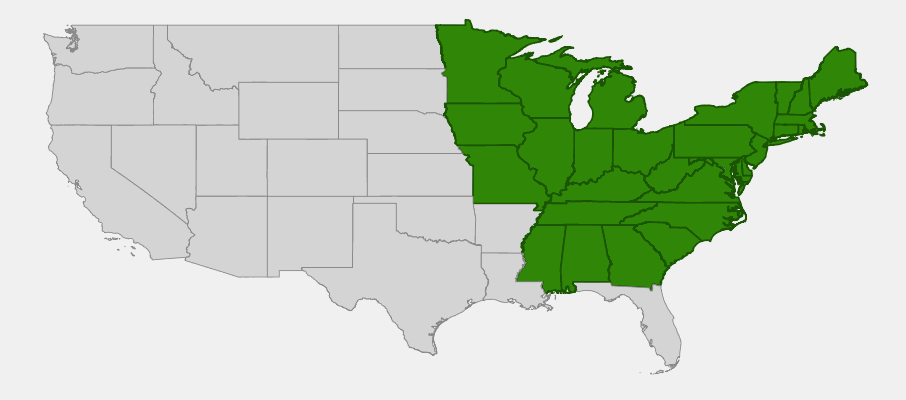
Marsh blue violet is native to eastern Canada and much of the eastern and north-central United States. Kew’s native distribution includes the New England states, the Great Lakes region, and portions of the southeastern United States. It is also present as an introduced plant in some other countries, illustrating why a photograph or observation outside the native range should not automatically expand a native-range map.
The state map here follows Kew’s native list. Other references differ at the edges; NC State, for example, includes Arkansas in its distribution list while Kew does not. This overview does not shade Arkansas on that uncertain basis alone. For a restoration project, consult a local flora and county-level evidence before specifying provenance or assuming that the species belongs at a particular site.
Natural habitats include wet or moist fields, prairie openings, stream edges, and pond margins. In North Carolina the plant is particularly associated with the mountains, but it is not restricted to one broad habitat label. The important garden distinction is persistent moisture. A rain garden that dries hard between storms may have a suitable low pocket and an unsuitable upper edge only a few feet apart.
📋 Regional plant list: New England
Growing & Care Guide
Start With Water Availability
Before planting, observe how long the soil remains moist after rain and how it behaves during summer. A damp-looking spring bed can become much too dry by July. Choose a location with naturally dependable moisture or a realistic irrigation plan. The table’s moisture code refers to the soil environment, not to drought tolerance. This distinction is especially important for marsh blue violet, whose leaves and roots should not repeatedly dry out.
Balance Sun & Shade
Sun can be suitable when the root zone remains wet enough, while partial or dappled shade reduces heat stress in many gardens. Do not move a plant from a protected nursery setting directly into a hot exposed position without considering water demand. In a mixed planting, leave enough light and open space that taller wetland plants do not overwhelm the low rosette. Seasonal canopy changes can alter both moisture use and exposure.
Soil & Planting Depth
The species can grow in several soil textures; moisture is more decisive than a requirement for one exact mix. Set the plant at its original nursery depth and water it into the surrounding soil. Avoid burying the crown beneath a heavy layer of mulch or placing it where moving water will scour away the soil. If using a container, ensure that the moisture regime remains appropriate without assuming that permanent deep submersion is required.
Rain Garden Placement
Use the plant in a rain garden only where the local water pattern suits it. It may fit a moist lower margin or a shallow area that drains while retaining moisture, but every installation has different inflow, soil, and drawdown conditions. Watch a few storms before selecting the precise position. Keep it away from concentrated runoff that can flatten the foliage or erode the roots, and pair it with plants that tolerate the same hydrology.
Mulch & Weed Management
Keep a thin, loose protective layer around the planting and remove competing weeds while they are small. Do not smother the low leaves beneath deep bark mulch. A carefully maintained edge can keep the garden readable without disturbing the entire patch. When new violet seedlings appear, confirm their identity before deciding whether to keep them, especially if several violet species grow nearby.
Feeding & Maintenance
A healthy plant in appropriate soil generally does not need a program of heavy fertilizer. If growth is weak, check moisture, root competition, and light before adding nutrients. Avoid fertilizer runoff into an adjacent pond or stream. Remove damaged foliage selectively when useful, but leave enough healthy leaf area for the plant to replenish its underground reserves after flowering.
Propagation
Seed is a recognized propagation route, and established plants may recruit naturally in a suitable bed. Use species-specific guidance for seed handling and dormancy rather than assuming that native violet seed behaves like an annual bedding-plant packet. Garden divisions should retain healthy roots and be kept moist during the move. Buy responsibly propagated stock for new plantings; digging a wild wetland edge can damage more than the individual violet.
Diagnose Problems Before Treating
Slugs, snails, browsing, or disease may affect individual plants, but wilted or scorched foliage can also reflect a dry root zone. Examine the actual damage and nearby conditions before applying a treatment. In a pollinator planting, broad insecticide use may undermine the reason for growing the violet. Keep any response targeted and proportionate, and correct an unsuitable site rather than repeatedly treating the symptoms.
Landscape Uses
- A low spring-flowering layer in a reliably moist native garden.
- A suitable rain-garden pocket after observing drainage and summer moisture.
- A pond or stream-margin planting above areas of destructive scour.
- A close-view pollinator garden where flowers and leaf characters can be observed.
Wildlife & Ecological Value
Butterflies & Bees
NC State identifies marsh blue violet as a host for fritillary butterfly larvae and notes that the flowers attract bees and butterflies. The foliage therefore has value beyond looking perfect. Minor feeding can be part of a functioning native planting, not an automatic reason to spray. Keep other flowering species nearby to extend the season of food availability after the violet’s spring display.
Specialist Relationships
Some bees specialize on violets, but genus-level associations should not be exaggerated into a promise that every named bee will use every planting. Provide a pesticide-conscious garden with appropriate nesting habitat as well as flowers. Observe visitors over time, and distinguish a general violet relationship from a documented local species interaction when describing the garden to others.
The Ground Layer
A low violet patch adds structure beneath taller moisture-loving herbs and sedges. Its roots and foliage occupy a part of the garden that might otherwise be bare or repeatedly disturbed. Keep the planting diverse rather than allowing one vigorous neighbor to dominate. The ecological value is strongest when the species is regionally appropriate and the water regime supports healthy long-term growth.
Cultural & Historical Uses
The epithet cucullata means hooded and refers to the inward-folded basal portions of the leaf. Common names include marsh blue violet, blue marsh violet, and bog violet. Because these names can be applied loosely, the scientific name and diagnostic flower characters are important when comparing old records or buying plants.
Violet classification has a long history of synonyms and changing species boundaries. Viola obliqua is among the names associated with this species in botanical treatments, while other older names have been applied to different blue violets. A modern regional key is more reliable than assuming that every historical use of a familiar violet name refers to the same plant.
This guide focuses on gardening and ecology. It does not recommend consuming or using an unidentified violet medicinally. Garden plants can be confused with other species or exposed to treatments, and a broad traditional-use statement is not an identification method. Enjoy the flowers and support their ecological relationships through accurate sourcing and suitable culture.
Frequently Asked Questions
How is it different from common blue violet?
The flower stalks usually rise above the leaves, and the lateral petal hairs have club-shaped tips. Use these together with a regional key rather than relying on blue color alone.
Can I use it in a dry shade garden?
No, not as a dependable choice. It needs consistent moisture and does not tolerate dry soil well, even though some other violets can handle drier conditions.
Does marsh mean it must be underwater?
No. Moist or wet soil is the key. Its precise placement should match the site’s flooding and drainage pattern rather than a generic assumption of permanent submersion.
Will it grow in sun?
It can, when moisture is sufficient. Partial or dappled shade is also suitable, and hot exposed sites require particular attention to water supply.
Why do the leaves look bigger after flowering?
Post-flowering leaf expansion is normal. Record the whole plant in spring and summer to learn its seasonal form.
Should I prevent all leaf feeding?
Not automatically. The foliage can support fritillary larvae. Identify the cause and severity of damage before deciding whether intervention is necessary.
Sources & Further Reading
- NC State Extension: Viola cucullata
- Kew Plants of the World Online: Viola cucullata
- USDA PLANTS: Viola cucullata
Find Native Plants
Ask growers about nursery propagation and regional provenance. Browse our Maine native plant nurseries, New Hampshire native plant nurseries, Vermont native plant nurseries, Connecticut native plant nurseries directory for suppliers.