
Moujean Tea (Nashia inaguensis)
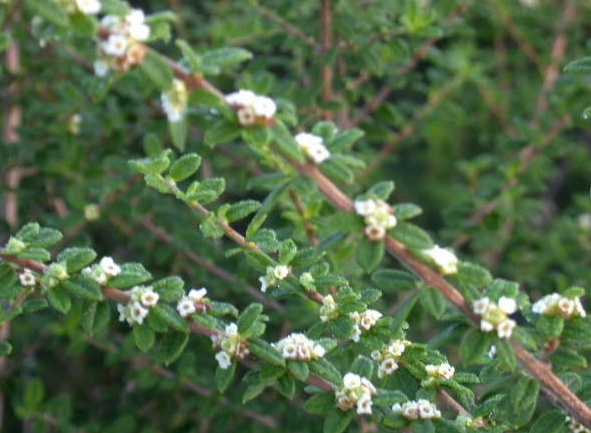
Nashia inaguensis, best known as Moujean Tea and called el tuque in Puerto Rico, is a small, densely twiggy, aromatic shrub of dry Caribbean limestone scrub. It has tiny, crinkled, strongly scented leaves, clusters of minute white flowers through much of the year, and small orange fruits. Crush a leaf and it gives off a sweet, spicy, herbal fragrance, which is why the leaves have long been steeped as a tea in the Bahamas.
Most gardening sources describe Moujean tea as a native of the Bahamas and the Turks and Caicos Islands, and that is where it is best known and most common. It is also native to a small area of Puerto Rico: USDA PLANTS lists it as native there, the World Checklist of Vascular Plants (the data behind Kew’s Plants of the World Online) includes Puerto Rico in its native range, and herbarium specimens document wild plants on dry limestone hills near Peñuelas and Ponce on the island’s south coast. That Puerto Rico record is why it is included here as a U.S. native.
Outside its native islands, Moujean tea is grown mostly as a bonsai and as a fragrant shrub for frost-free gardens, and it is a favorite of bonsai growers in Florida because of its tiny leaves, fine branching and fast response to pruning. This guide covers how to identify it, where it grows wild, how to grow it outdoors or as a bonsai, and what is and isn’t known about the herbal tea.
Identification
Moujean tea is easy to recognize up close: a fine-textured shrub with slender, often arching twigs, very small wrinkled leaves that are strongly aromatic when crushed, and small clusters of white flowers or orange fruits along the branches.
Habit & Bark
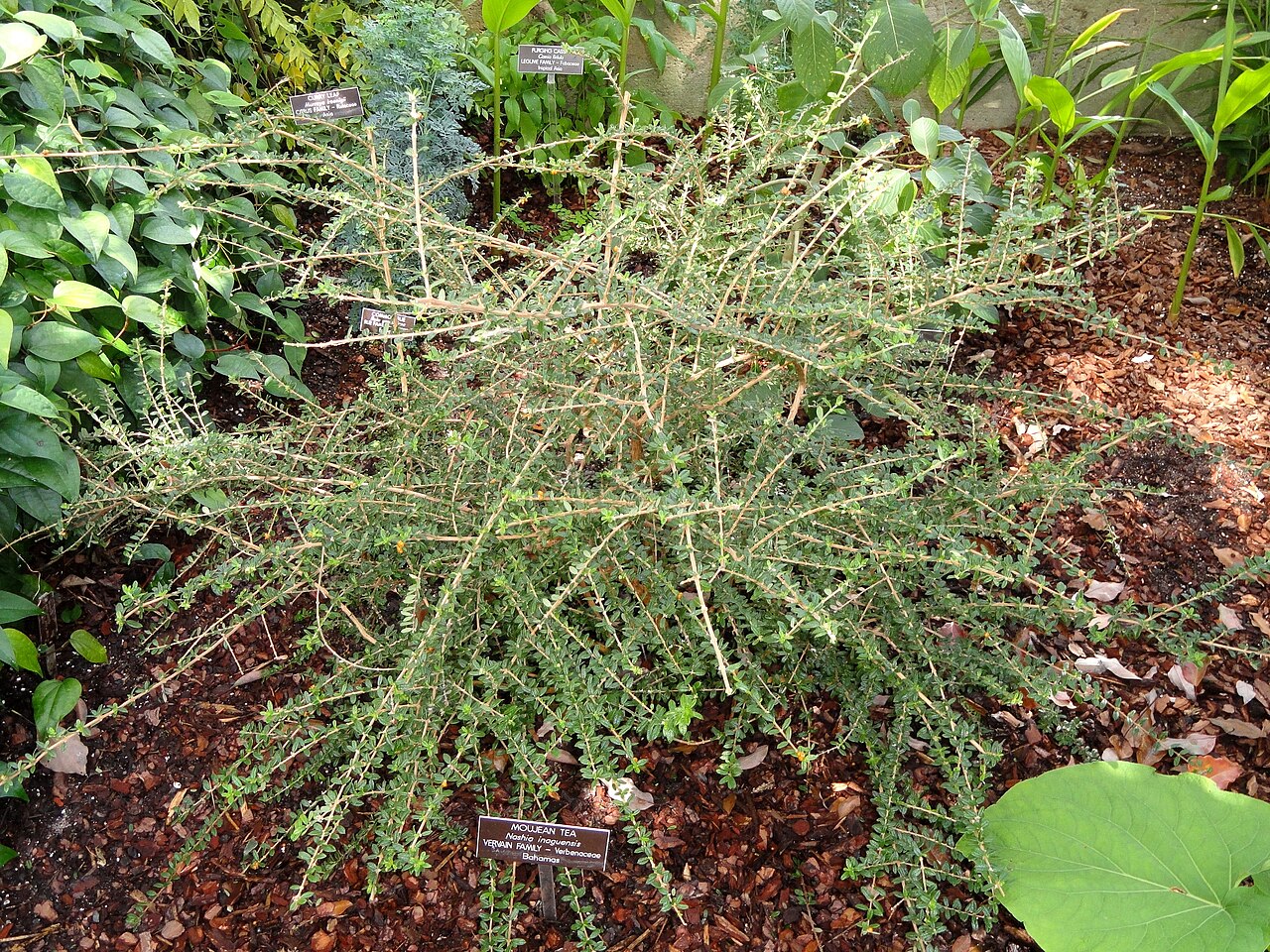
It is a small, much-branched shrub, usually 2 to 6 feet tall in the wild and in gardens, with slender, stiff to arching twigs that give it a fine, airy texture. Young twigs are often reddish to tan and slightly rough; older stems develop gray bark. Plants in exposed coastal scrub stay low and dense, while plants in sheltered gardens can sprawl wider than they are tall.
Leaves
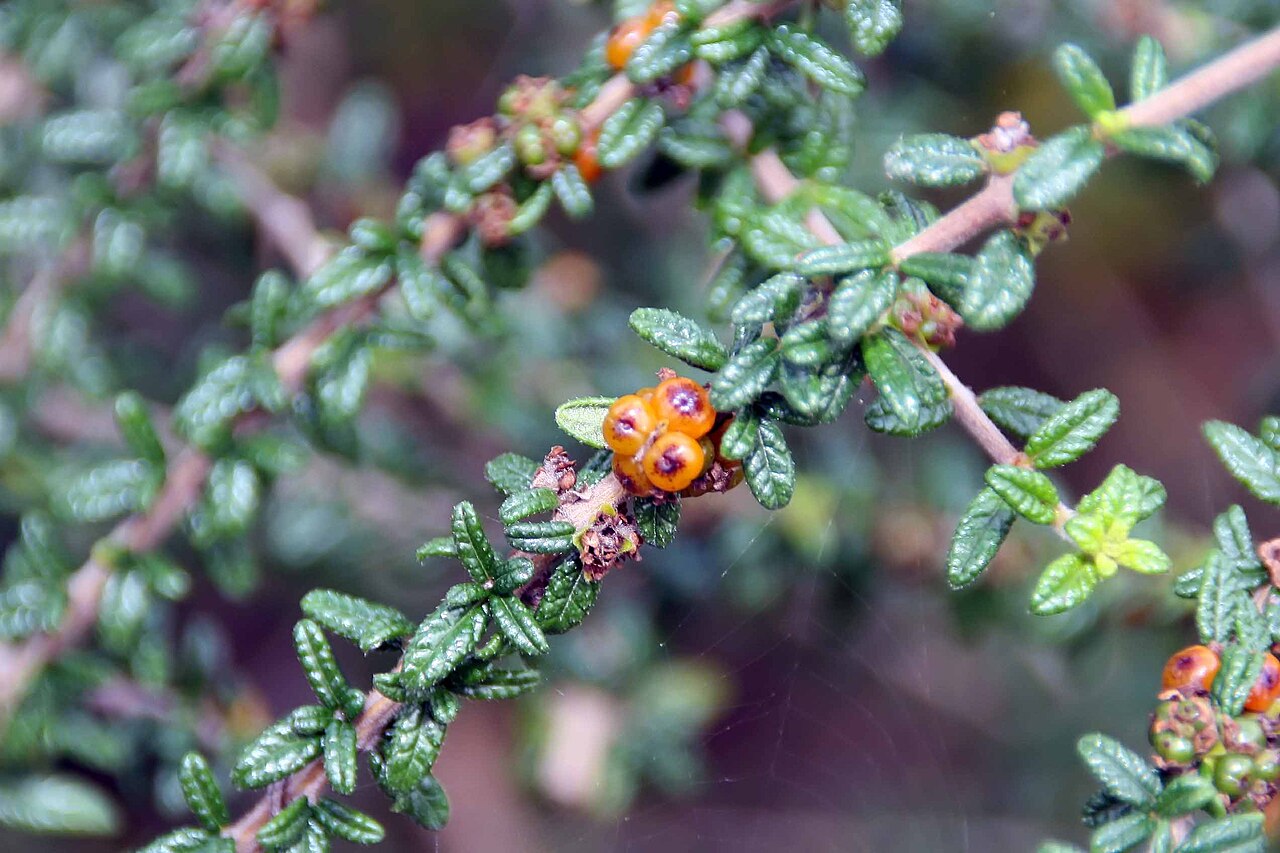
The leaves are tiny, mostly well under ½ inch long, oval to spoon-shaped, and crowded along the twigs. Their upper surface is distinctly wrinkled (quilted) with sunken veins, and the edges are wavy to bluntly toothed. They are dark green to grayish green and rough to the touch. The strong, sweet herbal scent of the crushed leaves is the best single field mark.
Flowers
The flowers are minute, white and tubular, in small rounded clusters or short spikes at the tips of short side shoots. They are lightly fragrant and attract small bees, flies and butterflies. In frost-free climates plants can bloom on and off through much of the year, especially after rain.
Fruit
The fruits are small, roughly 1/8 inch across, and ripen from green to bright orange or orange-red, splitting into small seed-bearing sections. Like the related lantanas, Moujean tea belongs to the verbena family (Verbenaceae), and its fruits are eaten by birds.
Look-alikes
In Caribbean dry scrub, several small-leaved shrubs can look similar from a distance, including lantana relatives (Lantana, Lippia) and small-leaved myrtles. Moujean tea’s combination of very small, wrinkled, wavy-edged leaves, the strong sweet herbal smell when crushed, tiny white flower clusters and orange fruits sets it apart. In nurseries it is sometimes sold as “Bahama berry.”
Quick Facts
| Scientific Name | Nashia inaguensis Millsp. |
| Family | Verbenaceae (verbena family) |
| Plant Type | Small aromatic evergreen shrub |
| Mature Height | 2–6 ft |
| Mature Spread | 2–5 ft |
| Growth Rate | Moderate |
| Sun Exposure | Full sun to light shade |
| Water Needs | Low to moderate; drought tolerant once established |
| Soil Type | Very well-drained limestone, rocky or sandy soil |
| Soil pH | About 6.5–8.5 (neutral to alkaline) |
| Bloom Time | Intermittently through much of the year in frost-free climates |
| Flower Color | White |
| Fall Color | None; evergreen |
| Fruit | Tiny orange to orange-red fruits |
| Deer Resistant | Likely; strongly aromatic foliage |
| USDA Hardiness Zones | 10–12 (frost sensitive) |
Native Range
USDA PLANTS lists Moujean tea as native to Puerto Rico. Beyond U.S. territory it is native to the Bahamas, including Great Inagua, the island that gives the species its name, and to the Turks and Caicos Islands. Many popular and gardening sources describe it as endemic to the Bahamas and the Turks and Caicos, so the Puerto Rico record surprises some readers, but it is supported by the World Checklist of Vascular Plants, which lists Puerto Rico in its native range, and by herbarium collections.
In Puerto Rico it has been collected in a small area of dry, low limestone hills between Peñuelas and Ponce on the south coast, in arid scrubland and dry forest over limestone, near the Peñón de Ponce. Specimens from dry rocky scrub on St. Croix in the U.S. Virgin Islands are also on record, and some checklists include the Virgin Islands in its range. Throughout its range it is a plant of hot, dry, sunny coastal scrub and coppice on limestone.
Because the Puerto Rico population appears to be very small and localized, it should be treated as rare there. Plants in Florida, Hawaii and elsewhere in the United States are cultivated, mostly in botanical gardens and bonsai collections, and should not be counted as part of its wild range.
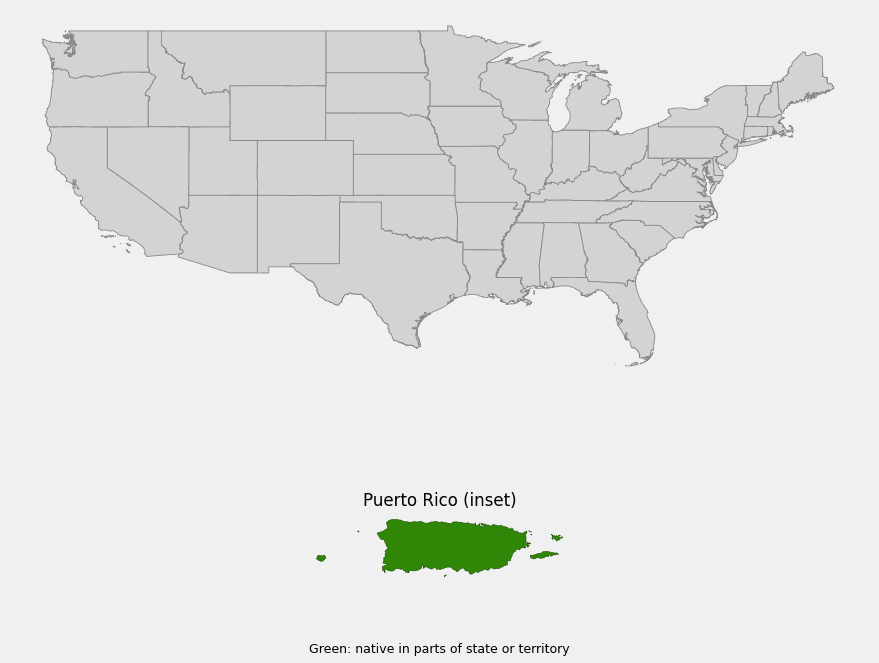
📋 Regional plant lists featuring Moujean Tea: Puerto Rico
Growing & Care Guide
Moujean tea is an easy, tough shrub in a frost-free, sunny climate with sharp drainage, and a forgiving bonsai subject. Most plants in the trade are cutting-grown in Florida. If you live in Puerto Rico, do not dig plants from the wild: the native population there is very small. Buy nursery-propagated plants or root cuttings from cultivated stock.
About the tea: in the Bahamas the leaves are steeped as a fragrant herbal tea, and Moujean tea has a folk reputation as a tonic and aphrodisiac. Those claims have not been established by scientific study, and the safety of drinking it regularly has not been well studied. Treat it as a traditional beverage, not a medicine: avoid it if you are pregnant or nursing, check with a health-care provider if you take medications, and only use leaves from plants you know have not been sprayed with pesticides.
Light
Full sun gives the densest growth, the smallest leaves and the most flowers. It tolerates light shade but becomes looser and leggier. Indoor bonsai need the brightest possible window or grow lights, and do best outdoors in summer.
Soil & Water
Plant in very well-drained soil: limestone rubble, sandy or rocky soil, or a gritty bonsai mix. It handles alkaline soil well. Water regularly until established; afterward it is quite drought tolerant in the ground. Bonsai in small pots dry out quickly and should be watered when the surface of the mix starts to dry, but never left sitting in water.
Planting Tips
Outdoors it suits zones 10 to 12 (south Florida, Puerto Rico, Hawaii and similar frost-free areas). It is damaged by frost, so in cooler areas grow it in a container and bring it indoors or into a greenhouse before temperatures drop toward freezing; many growers protect it once nights fall below about 40°F. Give it a hot, sunny spot with good air circulation.
Pruning & Maintenance
It takes pruning very well and back-buds readily, which is why it is popular for bonsai, low hedges and clipped shapes. Trim new growth back to one or two pairs of leaves to keep it compact. Feed lightly during active growth. Wiring works on young twigs, which are flexible but brittle when old.
Propagation
It roots readily from semi-hardwood cuttings taken in warm weather, which is how most nursery plants are produced. It can also be grown from seed collected from ripe orange fruits, sown fresh in a gritty mix.
Landscape Uses
- Bonsai: one of the most popular tropical bonsai species, with tiny leaves, fine ramification and fragrant foliage
- Fragrant garden shrub: for sunny, dry, frost-free gardens and rock gardens, where brushing the foliage releases its scent
- Low hedge or clipped shape: takes regular shearing well
- Coastal and xeriscape gardens: tolerates heat, drought and alkaline, rocky soil
- Container plant: for patios in cooler climates, moved indoors in winter
Wildlife & Ecological Value
In the dry limestone scrub where it grows wild, Moujean tea is one of many small-leaved, aromatic shrubs that provide cover, nectar and fruit in a harsh, sunny habitat.
For Pollinators
The tiny white flowers produce nectar for small bees, wasps, flies and small butterflies, and because plants bloom intermittently through much of the year they can offer food when little else is flowering in dry scrub.
For Birds
Birds eat the small orange fruits and help spread the seeds. The dense, twiggy branches provide shelter for small birds in open scrub.
For Mammals
It is not an important food plant for mammals. The aromatic foliage is unlikely to be browsed heavily.
Ecosystem Role
As a long-lived, drought-tolerant shrub, it helps hold thin soil on exposed limestone hills and is part of the diverse shrub layer of Caribbean dry forest and coastal scrub, one of the most threatened tropical habitat types because so much of it has been cleared for development.
Cultural & Historical Uses
The genus Nashia was named by the American botanist Charles F. Millspaugh in the early 1900s in honor of George V. Nash of the New York Botanical Garden, who collected plants in the Bahamas. The species name inaguensis refers to Great Inagua, the southernmost large island of the Bahamas, where it was collected.
In the Bahamas, Moujean tea (also spelled Mujean or Moujeant tea) is a well-known bush tea. The aromatic leaves are steeped in hot water and drunk as a fragrant beverage, and the plant appears in Bahamian folk medicine and lore, including a popular reputation as an aphrodisiac. These traditional uses are part of the islands’ cultural heritage, but they are not evidence that the tea treats any condition.
In Puerto Rico, where it is called el tuque, the species is much less familiar because its native population is so small. Elsewhere in the United States, Moujean tea is best known in bonsai circles, especially in Florida, where it is valued for its tiny leaves, sweet scent and the ease with which it can be styled.
Frequently Asked Questions
Is Moujean tea native to Puerto Rico?
Yes. Although most sources describe it as a native of the Bahamas and the Turks and Caicos Islands, USDA PLANTS lists it as native to Puerto Rico, the World Checklist of Vascular Plants includes Puerto Rico in its native range, and herbarium specimens document wild plants on dry limestone hills near Peñuelas and Ponce. The Puerto Rico population is small and localized.
Can you drink Moujean tea?
In the Bahamas the leaves are traditionally steeped as an herbal tea. Its folk reputation as a tonic and aphrodisiac has not been confirmed by scientific study, and its safety has not been well studied, so treat it as a traditional beverage rather than a remedy. Avoid it if pregnant or nursing, and ask a health-care provider if you take medications.
Is Moujean tea good for bonsai?
Yes. It is one of the most popular tropical bonsai species because of its tiny leaves, fine branching, fragrant foliage, white flowers and orange fruits, and because it back-buds readily after pruning. Keep it in full sun and protect it from cold.
How cold can Moujean tea tolerate?
It is a frost-sensitive tropical shrub suited to zones 10 to 12. Frost damages it, and many growers bring container plants and bonsai indoors once nights fall below about 40°F.
Why does Moujean tea smell so strong?
The leaves contain aromatic oils, like many members of the verbena family. Crushing or brushing the foliage releases a sweet, spicy, herbal scent, which is the reason it has been used for tea and is enjoyed in gardens.

Looking for a nursery that carries Moujean Tea?
Our nursery directory does not yet include Puerto Rico. Browse the native plant nursery directory by state: Alabama–Arkansas · California · Colorado–Hawaii · Idaho–Kansas · Kentucky–Montana · Nebraska–Oklahoma · Oregon · Pennsylvania–Virginia · Washington · West Virginia–Wyoming

