
Western Prairie Fringed Orchid (Platanthera praeclara)
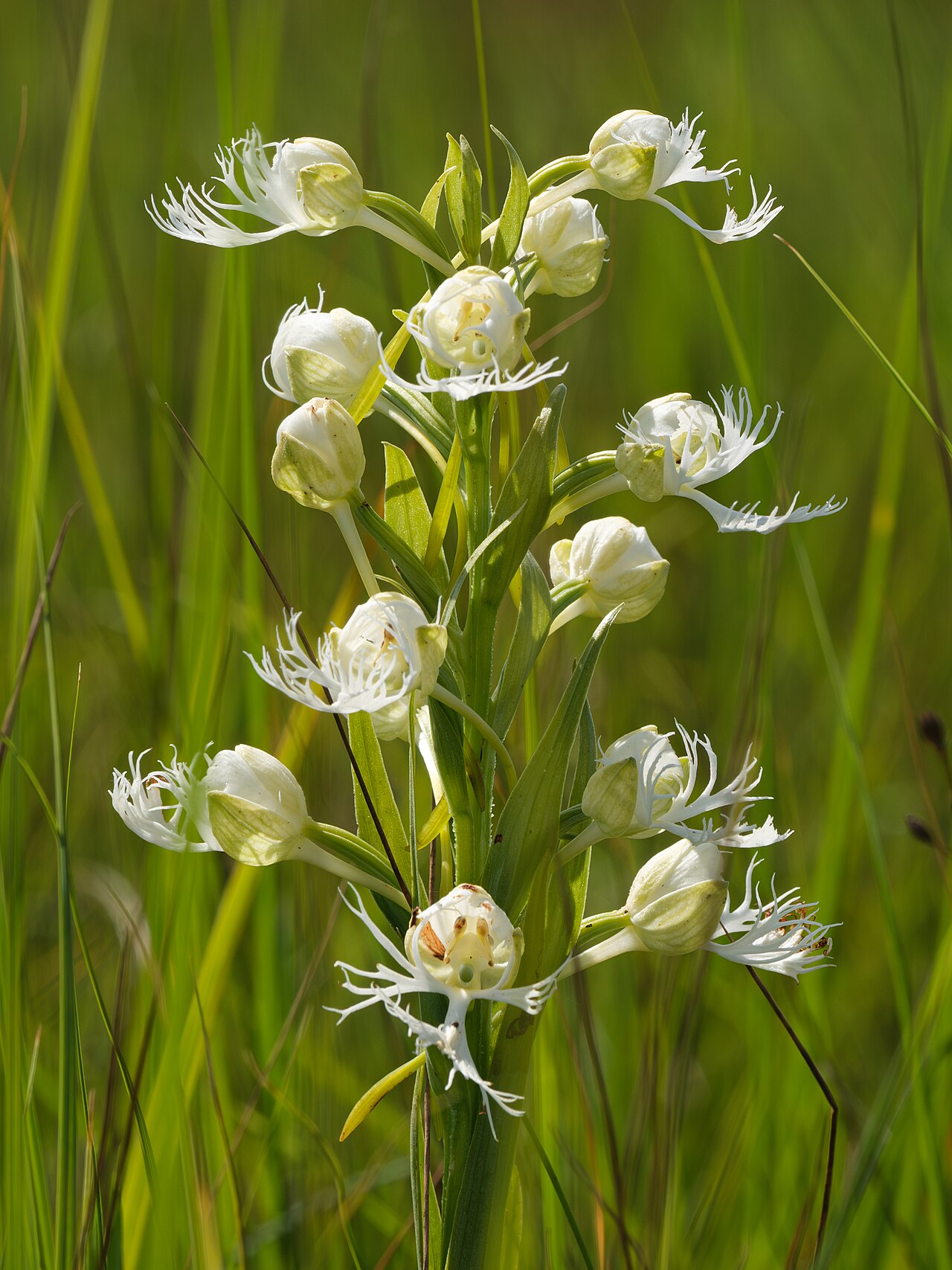
Platanthera praeclara, the Western Prairie Fringed Orchid (also called western prairie white fringed orchid or Great Plains white fringed orchid), is one of the most striking wildflowers of the tallgrass prairie. In early summer it raises a spike of up to two dozen large, creamy white flowers, each with a lacy, deeply fringed lip and a long nectar spur. The species name praeclara means “very bright” or “splendid.”
It grows only in moist tallgrass prairies and sedge meadows west of the Mississippi River, from Manitoba south through the Dakotas, Minnesota, Iowa and Nebraska to Kansas, Missouri and formerly Oklahoma. Nearly all of its original habitat has been plowed or drained, and it is listed as threatened under the U.S. Endangered Species Act and endangered in Canada.
This is an identification and appreciation page. The orchid cannot be bought as legitimately propagated nursery stock, cannot be transplanted, and must never be dug up. Below you will find how to identify it, where it grows and where to see it, how its life depends on fungi and hawkmoths, and how prairie protection keeps it alive.
Identification
Look for a single, stout, leafy stem in wet prairie in late June or July, topped by a loose spike of large, white, fringed flowers that seem to glow in the evening.
Size & Form
Flowering plants are usually 1 to 3 feet tall, with a single upright, hairless stem rising from a fleshy, tuberous root. Plants that do not flower in a given year may appear only as a single leaf, or not at all, since this orchid can remain dormant underground for one or more years.
Leaves
Two to five thick, smooth, lance-shaped leaves clasp the stem, the lower ones largest, up to about 8 inches long. They are bright green and fleshy, with parallel veins.
Flowers
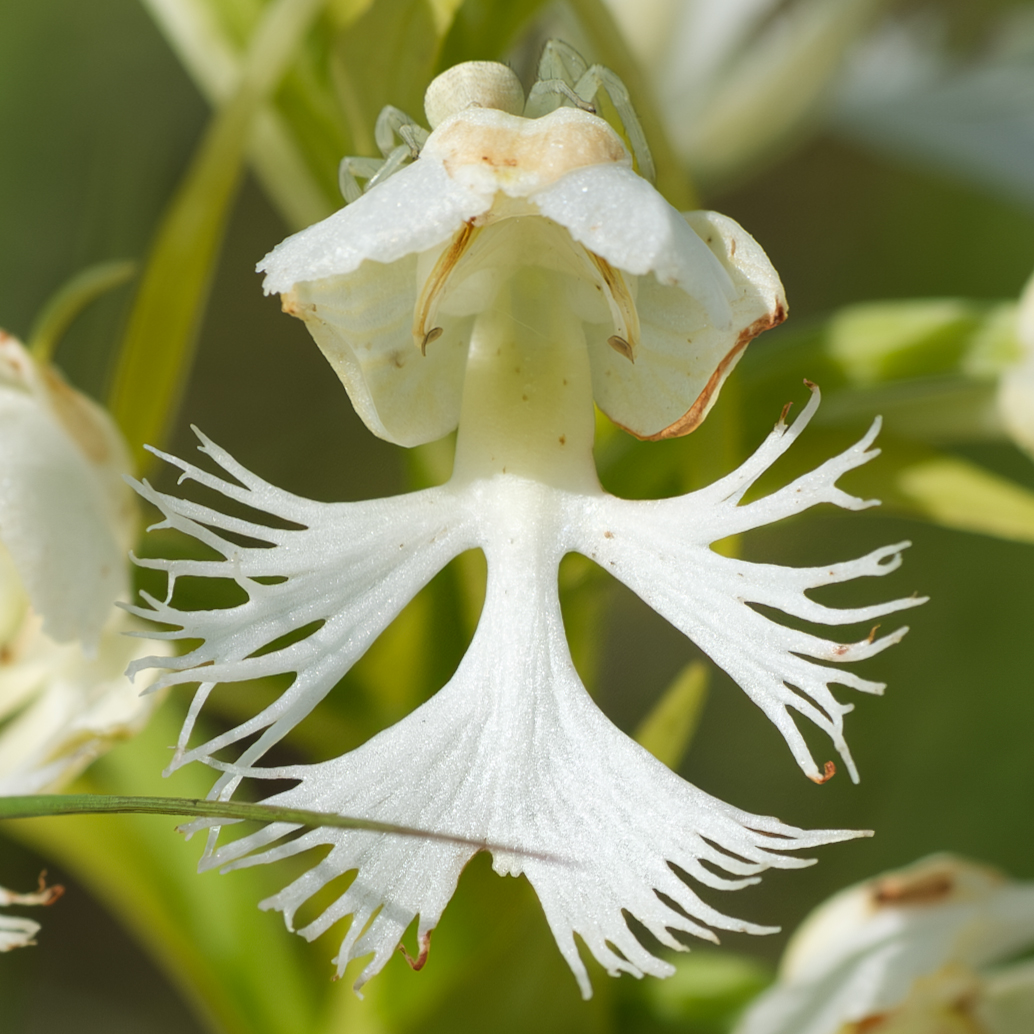
The open spike carries roughly 5 to 25 flowers, each about an inch across, among the largest flowers of any North American Platanthera. They are creamy to greenish white and fragrant at night. The petals and upper sepal form a hood over the column; the lip is divided into three fan-shaped lobes, each deeply cut into a fine fringe. Behind the lip hangs a slender nectar spur about 1 1/2 to 2 1/2 inches long.
Fruit
Pollinated flowers develop into upright, ribbed capsules that split in late summer to release vast numbers of dust-like seeds, which drift on the wind. The seeds contain almost no stored food.
Similar Species
The closely related eastern prairie fringed orchid (Platanthera leucophaea), found east of the Mississippi River and also federally threatened, has smaller flowers in a denser spike and a different column structure; the two were recognized as separate species only in 1986. Ragged fringed orchid has smaller, greenish flowers with thread-like fringes, and white bog orchid has small, unfringed white flowers.
Quick Facts
| Scientific Name | Platanthera praeclara Sheviak & M.L. Bowles |
| Family | Orchidaceae (orchid family) |
| Plant Type | Long-lived perennial orchid with a tuberous root |
| Mature Height | 1–3 ft in flower |
| Mature Spread | About 6 in (single stem) |
| Growth Rate | Slow; seedlings take years to flower |
| Sun Exposure | Full sun (open prairie) |
| Water Needs | High; moist to wet soil, never permanently flooded |
| Soil Type | Moist, calcareous prairie loams and sandy loams |
| Soil pH | About 6.5–8.0 (neutral to slightly alkaline) |
| Bloom Time | Late June–July |
| Flower Color | Creamy white |
| Fall Color | None; leaves wither in late summer |
| Fruit | Ribbed capsule with dust-like seeds |
| Deer Resistant | No; grazed and browsed by deer and livestock |
| USDA Hardiness Zones | 3–5 in the wild; not cultivated |
Native Range
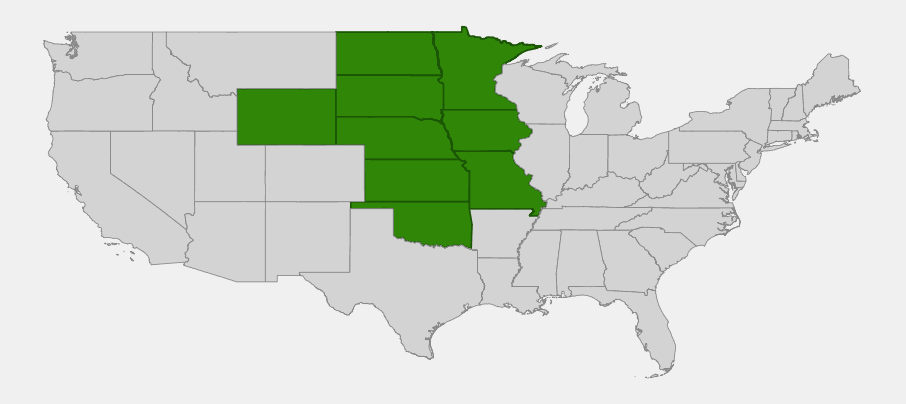
USDA PLANTS lists western prairie fringed orchid as native in Iowa, Kansas, Minnesota, Missouri, Nebraska, North Dakota, Oklahoma, South Dakota and Wyoming, and in Manitoba in Canada. Today most plants grow in a handful of large prairie remnants: the Sheyenne National Grassland in southeastern North Dakota and the adjacent prairies of northwestern Minnesota and southern Manitoba hold the largest populations.
Smaller, scattered populations survive in Iowa, Nebraska, Kansas and Missouri, many of them in hay meadows and prairie preserves. It is considered historical or extirpated in Oklahoma and South Dakota, and the Wyoming record is an outlying one at the western edge of the range. Its historical range was far larger, but conversion of tallgrass prairie to cropland and drainage of wet prairies removed most of its habitat.
It is listed as threatened under the U.S. Endangered Species Act (since 1989) and as endangered under Canada’s Species at Risk Act. Collecting or disturbing plants on federal land is prohibited, and several states list it as well.
📋 Regional plant lists featuring Western Prairie Fringed Orchid: Illinois, Iowa & Missouri · Michigan, Wisconsin & Eastern Minnesota · Nebraska, Kansas & Eastern Colorado · North Dakota, South Dakota & Western Minnesota · Montana & Wyoming
Can You Grow It?
Honestly, no. Western prairie fringed orchid is not a garden plant. It cannot be grown from ordinary nursery stock, it does not survive transplanting, and digging wild plants is both illegal on protected land and fatal to the orchid. Any plant offered for sale should be treated as suspect.
Why It Can’t Be Grown
Like other orchids, it produces dust-like seeds with almost no food reserves. A seed germinates only after it is colonized by specific soil fungi (mycorrhizae), which feed the tiny seedling underground for several years before a leaf appears. The adult plant continues to depend on these fungal partners and on the stable moisture of undisturbed prairie soil.
Why You Should Never Dig It
Wild plants that are dug up lose their fungal partners and their root system, and they almost always die within a year or two. Every plant removed also takes seed away from a population that may already be very small. On federal and many state and private preserves, collecting it is prohibited.
Conservation Propagation
Researchers and botanic gardens have germinated this orchid in laboratories using its symbiotic fungi, as part of recovery work. These efforts are for restoring wild populations, not for home gardens.
How Gardeners Can Help
Plant native prairie species, especially long-tubed, night-blooming flowers that support hawkmoths, and avoid broad-spectrum insecticides, which kill the moths that pollinate it. Support land trusts and agencies that protect wet prairies, and report sightings to your state natural heritage program rather than sharing exact locations publicly.
Prairie Management
On preserves, the orchid benefits from fire, haying or light grazing that keeps woody plants and tall litter from crowding it, timed to avoid the flowering and seed season. Drainage, heavy grazing during flowering, herbicide spraying and invasive plants such as leafy spurge are its main threats.
Where to See It
- Sheyenne National Grassland, North Dakota: the largest U.S. population; look in moist swales in early to mid-July
- Manitoba Tall Grass Prairie Preserve: southern Manitoba, home to one of the largest populations anywhere
- Northwestern Minnesota prairies: preserves on the old Lake Agassiz beach ridges and wet prairies, such as Pembina Trail and Glacial Ridge
- Prairie preserves in Iowa, Nebraska, Kansas and Missouri: small populations in hay meadows and protected prairies; ask local managers about guided visits
- Viewing etiquette: stay on trails, never pick flowers, and keep exact locations private
Wildlife & Ecological Value
Western prairie fringed orchid is tied to an intricate web of prairie life, above and below the ground.
For Pollinators
Its long nectar spur and nighttime fragrance are adapted to hawkmoths (sphinx moths) with tongues long enough to reach the nectar. As a moth feeds, the orchid’s pollen masses (pollinia) stick to its eyes or head and are carried to the next flower. Without these moths, the plant sets little or no seed.
For Birds
The orchid offers little direct food for birds, but its wet prairie habitat supports grassland birds such as bobolinks, sedge wrens and sandhill cranes.
For Mammals
Deer, rabbits and livestock eat the flowering stems, and grazing during the bloom season can wipe out a year’s seed production. Its tubers are eaten by burrowing rodents.
Ecosystem Role
Its dependence on specific soil fungi and night-flying moths makes it an indicator of healthy, intact wet prairie. Where it survives, a rich community of other prairie plants and insects usually does too.
Cultural & Historical Uses
Botanists Charles Sheviak and Marlin Bowles described the western prairie fringed orchid as a new species in 1986, separating it from the eastern prairie fringed orchid on the basis of its larger flowers, different column and pollinator fit. The two were listed together as threatened under the U.S. Endangered Species Act in 1989.
Populations of this orchid rise and fall dramatically from year to year with rainfall: in a wet summer a site may produce thousands of flowering stems, and in a drought year only a few. Because plants can stay dormant underground, counting it is difficult, and long-term monitoring by volunteers and agency staff in North Dakota, Minnesota and Manitoba has been central to its recovery.
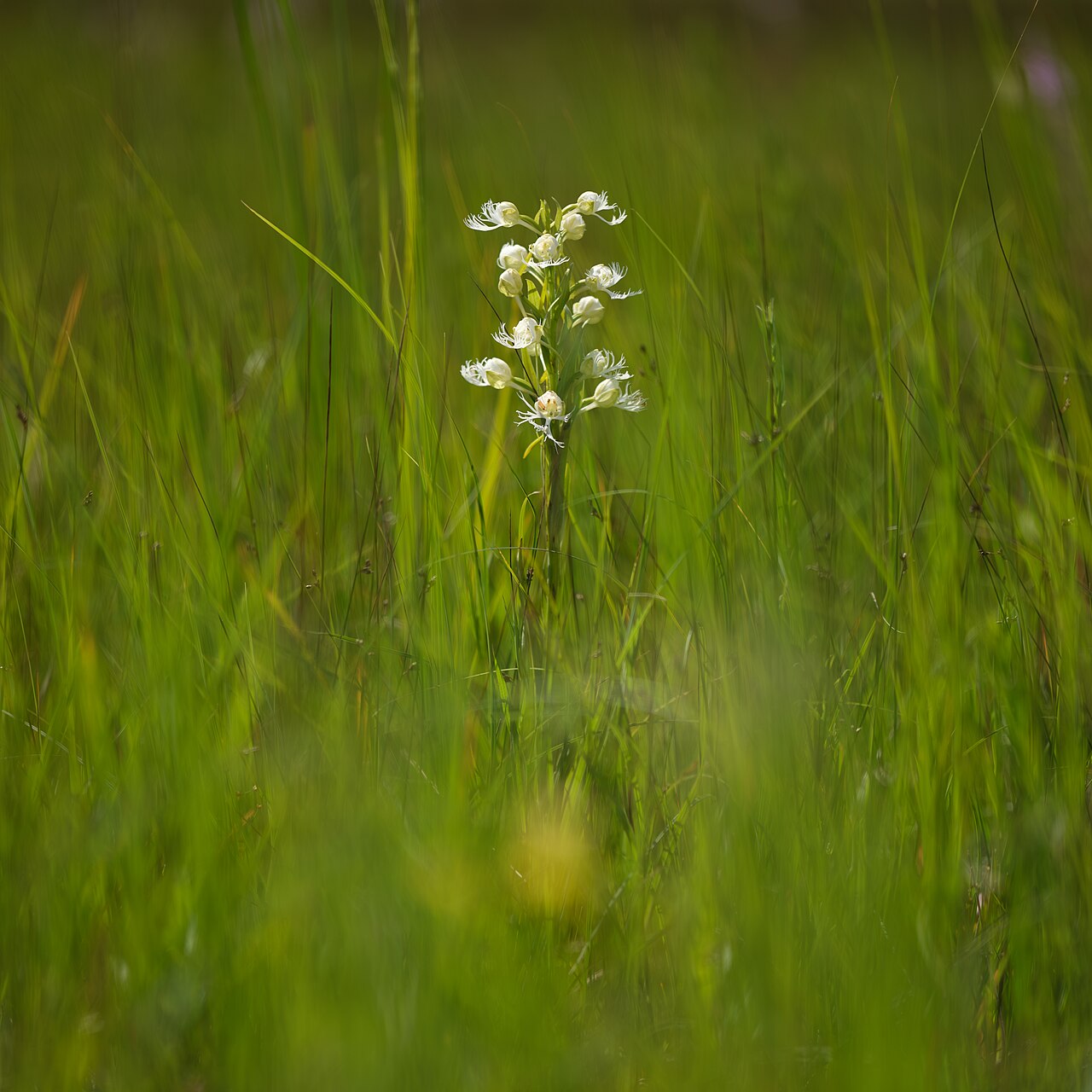
For prairie lovers, finding one in bloom on a July evening, glowing white among the grasses, is an unforgettable sight and a reminder of the vast wet prairies that once covered the northern plains.
Frequently Asked Questions
Is the western prairie fringed orchid endangered?
It is listed as threatened under the U.S. Endangered Species Act and as endangered in Canada. Most of its tallgrass prairie habitat has been converted to farmland or drained.
Where does the western prairie fringed orchid grow?
It grows in moist tallgrass prairies and sedge meadows from Manitoba and the Dakotas south to Kansas and Missouri. The largest populations are in southeastern North Dakota, northwestern Minnesota and southern Manitoba.
Can I buy or grow a western prairie fringed orchid?
No. It depends on specific soil fungi and wild prairie conditions, it does not survive transplanting, and digging it is prohibited on protected land. Treat any plant offered for sale as suspect, and support prairie conservation instead.
What pollinates the western prairie fringed orchid?
Night-flying hawkmoths (sphinx moths) with long tongues pollinate it. While feeding on nectar at the end of the long spur, they pick up the orchid’s pollen masses and carry them to other flowers.
When does the western prairie fringed orchid bloom?
It blooms from late June through July, depending on latitude and weather. The number of flowering plants varies greatly from year to year with rainfall.

Looking for a nursery that carries Western Prairie Fringed Orchid?
Browse our native plant nursery directory: Iowa & Kansas · Minnesota & Missouri · Nebraska, North Dakota & Oklahoma · South Dakota · Wyoming

