Mountain Pride (Penstemon newberryi)
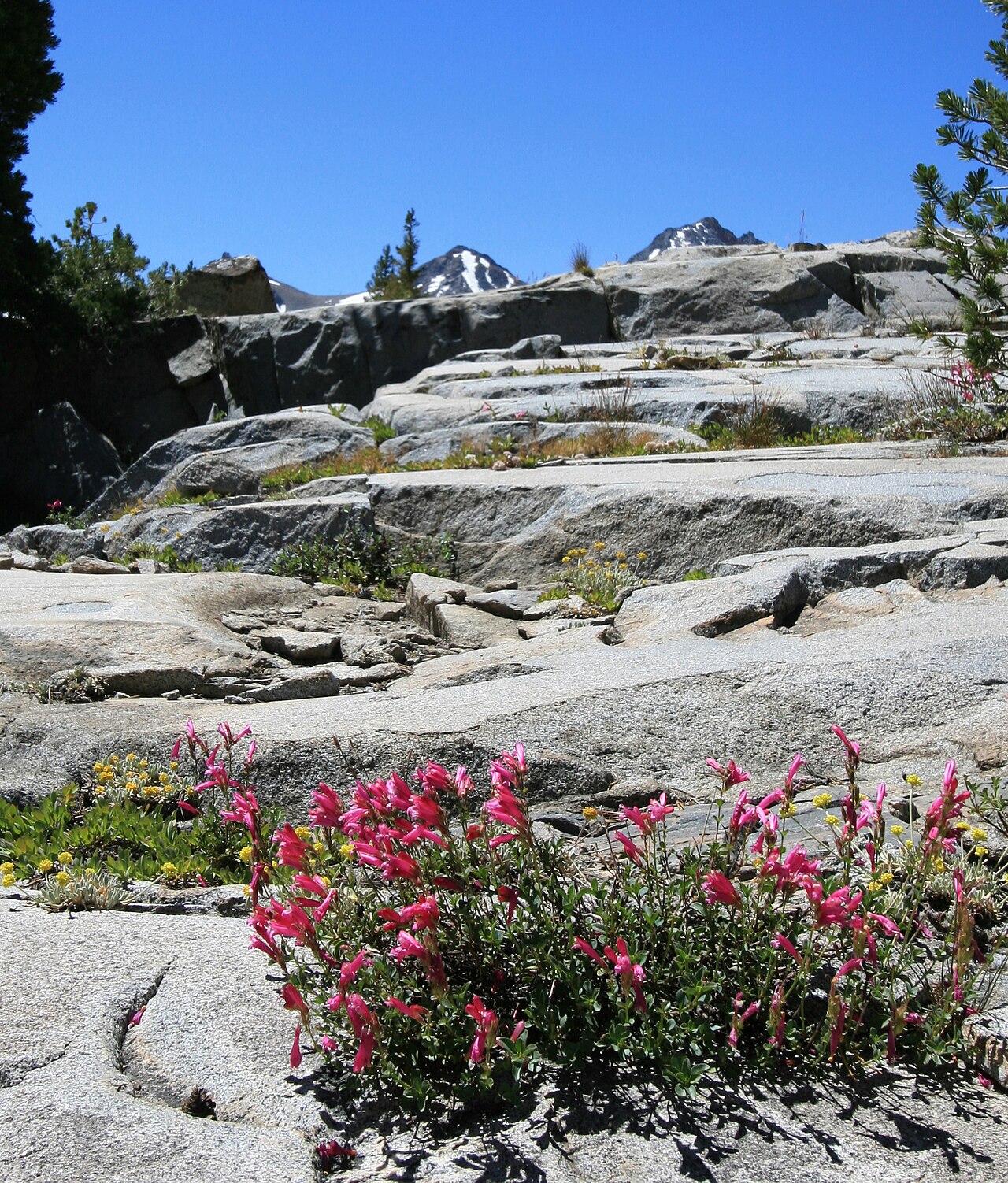
Penstemon newberryi, commonly called Mountain Pride, is a low, mat-forming evergreen shrub in the plantain family (Plantaginaceae) native to the high country of the Sierra Nevada and southern Cascades. It is one of California’s signature alpine and subalpine wildflowers, forming dense woody mounds that wedge themselves into cracks in granite outcrops and rocky slopes, then burst into vivid magenta-pink bloom in early-to-mid summer against the pale gray stone.
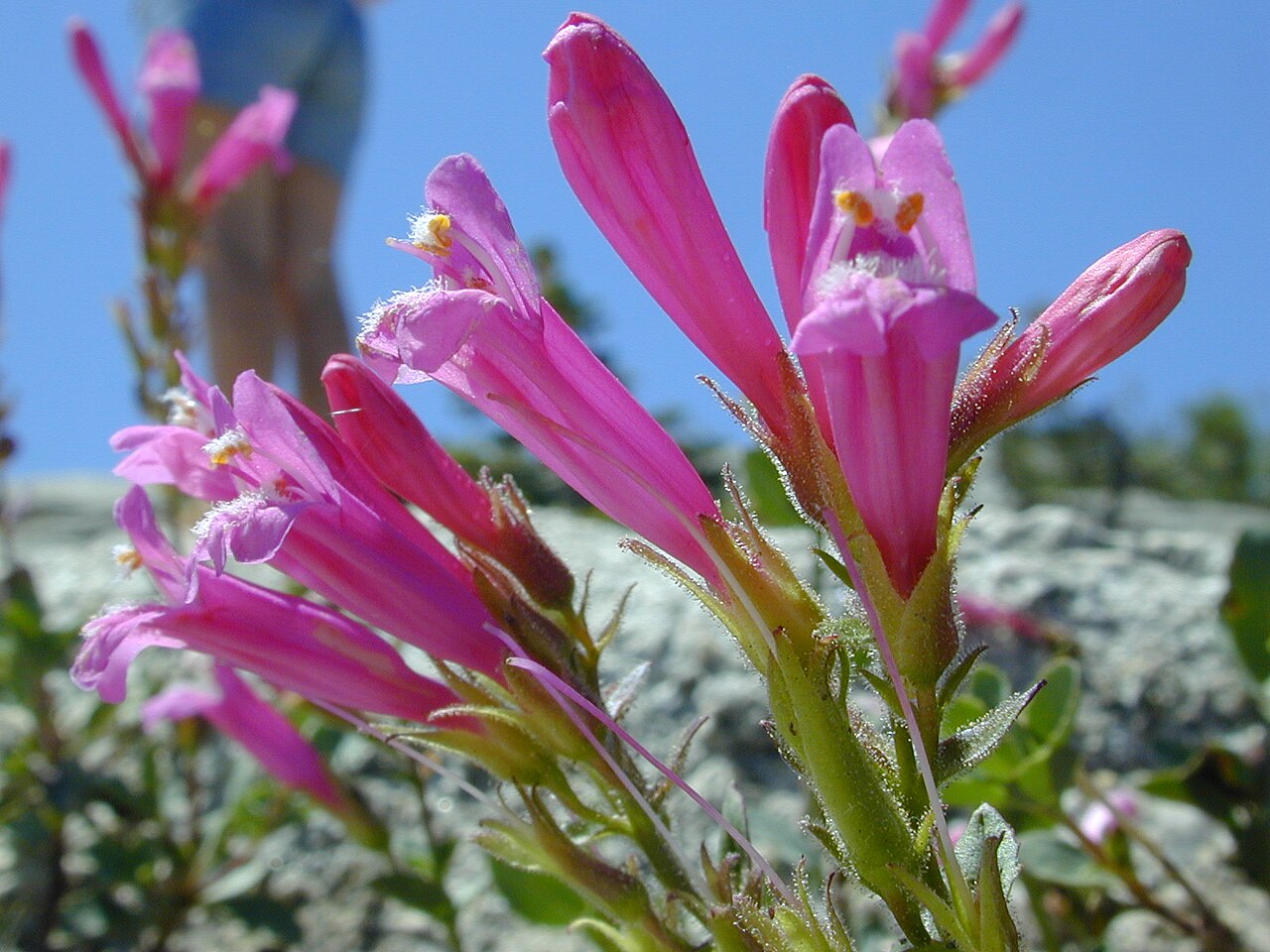
Mountain pride grows from roughly 4,000 to over 10,000 feet in elevation, typically on exposed rock faces, talus, and gravelly ridges where little else can get a foothold. Its tough, woody base and shallow but wiry root system let it hold on in crevices with almost no soil, while its glossy, leathery leaves resist the intense high-elevation sun and desiccating wind. The bright rose-pink to magenta flowers are a magnet for hummingbirds working their way up mountain trails in summer.
For California gardeners at higher elevations, or anyone building a rock garden or dry stone wall at lower elevation, mountain pride is a superb choice: evergreen structure, long-lived woody habit, drought tolerance once established, and weeks of eye-catching bloom. It needs excellent drainage and is best tucked into rock crevices or raised beds that mimic its native granite ledges rather than planted in ordinary garden soil.
Identification
Mountain pride is a low, spreading, mat- or mound-forming subshrub, usually 4 to 12 inches tall but spreading 1 to 3 feet wide as it ages, with a woody, semi-prostrate base and numerous short, ascending flowering branches.
Stems & Leaves
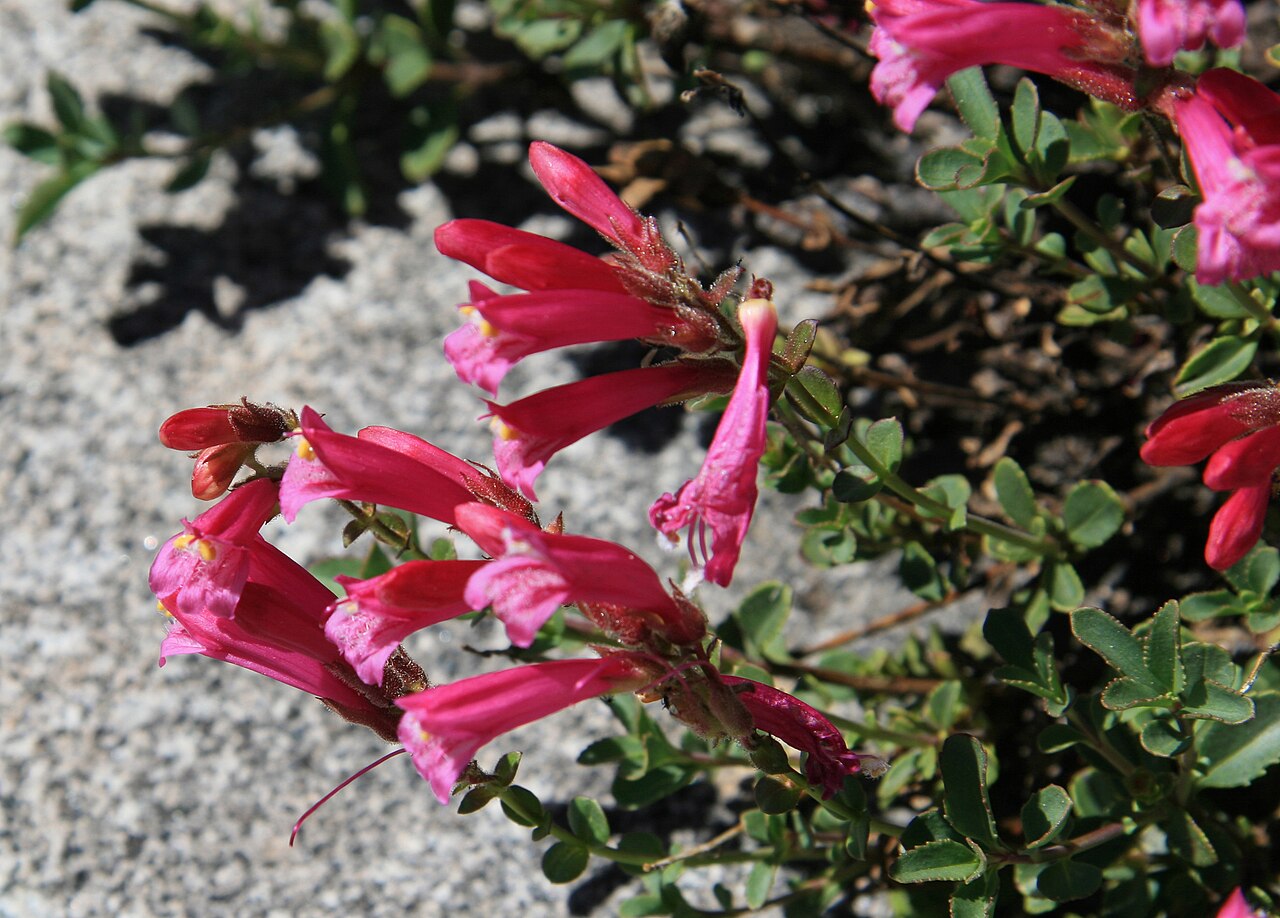
The stems are woody at the base and often root where they touch soil in rock crevices, building up a dense, long-lived mat over many years. Leaves are opposite, thick, leathery, and glossy dark green, oval to oblong, ½ to 1½ inches long, with finely toothed margins. The evergreen foliage gives the plant structure and interest even when not in bloom, and it often takes on a slightly bronzed or reddish cast in winter cold.
Flowers
Flowers are tubular and two-lipped, 1 to 1½ inches long, in a vivid rose-pink to magenta that can look almost fluorescent against gray granite. They are borne in short, dense clusters at the branch tips, with each stem typically carrying several to a dozen blooms open at once. Bloom runs from June through August depending on elevation and snowmelt timing, with higher sites blooming later in summer.
Fruit & Seeds
After flowering, small woody capsules develop and split open to release numerous tiny seeds, which sift into rock crevices and germinate in the thin soil and organic debris that accumulates there — the same strategy that lets the species colonize bare granite.
Quick Facts
| Scientific Name | Penstemon newberryi |
| Family | Plantaginaceae (Plantain) |
| Plant Type | Evergreen, mat-forming subshrub |
| Mature Height | 4–12 in |
| Mature Spread | 1–3 ft |
| Growth Rate | Slow |
| Sun Exposure | Full Sun to Part Sun |
| Water Needs | Low once established |
| Soil Type | Rocky, gravelly; sharply drained, low fertility |
| Soil pH | 6.0–7.5 (neutral to slightly acidic) |
| Bloom Time | June – August |
| Flower Color | Rose-pink to magenta |
| Fall Color | Evergreen; foliage may bronze in cold |
| Fruit | Small woody capsules with tiny seeds |
| Deer Resistant | Yes, generally avoided by deer |
| USDA Hardiness Zones | 5–8 |
Native Range
Mountain pride is native to California, where it occurs through the Sierra Nevada from the southern Cascades at the state’s northern edge south through the central and southern Sierra, typically between about 4,000 and 10,500 feet in elevation. BONAP county-level data confirm native populations concentrated along the Sierra Nevada crest and its western and eastern flanks, with the heaviest concentration in the central and southern Sierra counties.
Within this range it is a plant of exposed granite: cliff faces, talus slopes, rocky ridgelines, and glaciated outcrops in the upper montane, subalpine, and alpine zones. It is especially characteristic of the bare granite domes and ledges of Yosemite and the high Sierra backcountry, where it is often the showiest flowering plant rooted directly in rock.
Although mountain pride is sometimes grown in gardens in Oregon, Nevada, and other nearby states, it is not documented as naturally occurring outside California; populations occasionally reported near the Oregon Cascades and the Nevada state line have not been confirmed as native at the county level. Gardeners outside California should treat this as a California endemic and check a locally native penstemon for true regional plantings.
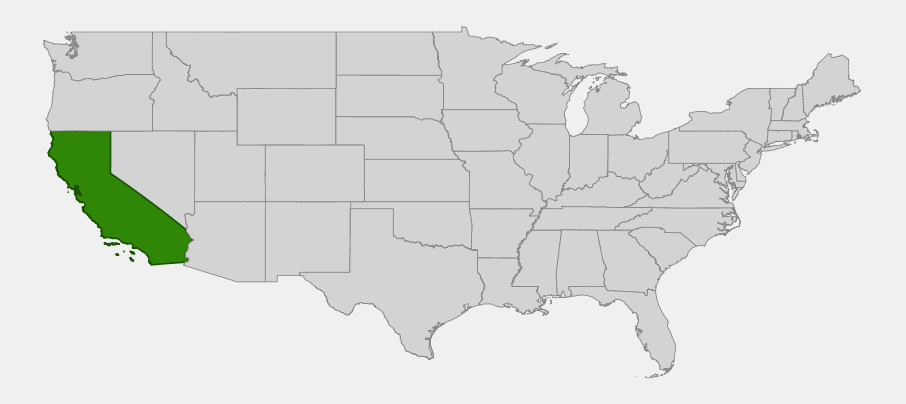
📋 Regional plant lists featuring Mountain Pride: California & Nevada
Growing & Care Guide
Mountain pride is a rewarding but particular garden plant: it needs the sharp drainage and mineral soil of its native granite ledges, and it will not tolerate the rich, moisture-retentive soil of a typical garden bed. Give it a rock garden, crevice planting, or raised bed and it can be long-lived and nearly maintenance-free.
Light
Full sun is best at higher, cooler elevations; in hotter, lower-elevation gardens, light afternoon shade helps protect the foliage from scorch while still allowing good bloom.
Soil & Water
Plant in gritty, mineral soil with excellent drainage — decomposed granite, rocky scree mixes, or a crevice garden are ideal. Water to establish, then reduce sharply; established plants are drought tolerant and are far more likely to die from soggy roots than from dry soil. Avoid rich, organic garden soil, which tends to hold too much moisture around the woody base.
Planting Tips
Plant in fall or spring from container stock, tucking the crown slightly above grade so water drains away from the base. Mountain pride is well suited to crevice gardens and dry-stacked rock walls, where it can wedge its roots into a narrow gap exactly as it does in the wild. Space plants 12 to 24 inches apart to allow mature mats to spread without crowding.
Pruning & Maintenance
Little pruning is needed; shearing spent flower stems lightly after bloom can tidy the mound and may encourage a modest rebloom. Avoid heavy cutting into old woody growth, which the plant recovers from slowly.
Landscape Uses
Mountain pride’s rock-hugging habit and brilliant color suit several specific garden situations:
- Rock gardens and crevice gardens — its natural habitat in miniature
- Dry stone walls, tucked into gaps between stones
- Raised beds with lean, sharply drained mix
- High-elevation and mountain-cabin gardens within its native range
- Hummingbird gardens at elevation, alongside other subalpine natives
Wildlife & Ecological Value
Mountain pride is a high-value nectar plant in a habitat — bare subalpine granite — where flowering resources are otherwise scarce.
For Pollinators
The tubular magenta flowers attract hummingbirds, particularly Anna’s and Calliope Hummingbirds moving through the high Sierra in summer, as well as native bumblebees and other long-tongued bees capable of reaching the nectar. In the sparse alpine and subalpine flora, mountain pride’s dense summer bloom makes it a locally important nectar source.
Ecosystem Role
As one of relatively few flowering plants able to establish directly in bare granite crevices, mountain pride plays a pioneering role in high-elevation plant communities, helping stabilize thin soils that accumulate in rock cracks and creating microhabitat for other crevice-dwelling plants and the insects that visit them.
Cultural & Historical Uses
Mountain pride does not have a widely documented history of traditional use; its significance has always been primarily aesthetic and ecological rather than practical, owing to its habitat high in the Sierra Nevada backcountry, far from the lower-elevation areas where most plant-use traditions were recorded.
The species was named for John Strong Newberry, a 19th-century American naturalist and geologist who surveyed western landscapes during early government expeditions. In the 20th century, mountain pride became a favorite subject for Sierra Club and Yosemite-area nature photographers and hikers, prized for its vivid color against bare granite, and it remains one of the most photographed wildflowers of the high Sierra trail corridor.
Today mountain pride is grown almost exclusively as a specialty rock-garden and alpine-garden plant by native plant enthusiasts, valued for bringing a piece of the high Sierra’s granite-and-magenta scenery into cultivation at lower elevations.
Frequently Asked Questions
Why won’t my mountain pride grow in regular garden soil?
Mountain pride evolved to root in thin, mineral soil in rock crevices with excellent drainage. Rich, organic garden soil holds too much moisture around the woody crown and roots, which commonly leads to rot. A gritty, rocky mix or a crevice garden setting works much better.
Is mountain pride native outside California?
No. It is a California endemic, native to the Sierra Nevada and the southern Cascades within the state. It is sometimes grown as a garden plant elsewhere, but is not documented as naturally occurring in Oregon, Nevada, or other neighboring states.
How long does mountain pride live?
Given sharp drainage and a suitable rocky site, mountain pride can live for many years as a slow-growing, long-lived subshrub — considerably longer-lived than many herbaceous penstemons.
Can I grow mountain pride at low elevation?
Yes, with care. Gardeners at lower, warmer elevations should provide afternoon shade, excellent drainage, and avoid summer humidity around the crown; a raised bed or rock garden with a cooling mulch of gravel helps replicate high-elevation conditions.
What pollinates mountain pride?
Hummingbirds are the primary pollinators, drawn to the tubular magenta flowers, along with bumblebees and other large native bees that can access the nectar.

Looking for a nursery that carries Mountain Pride?
Browse our native plant nursery directory: California