Mountain Mahogany (Cercocarpus montanus)
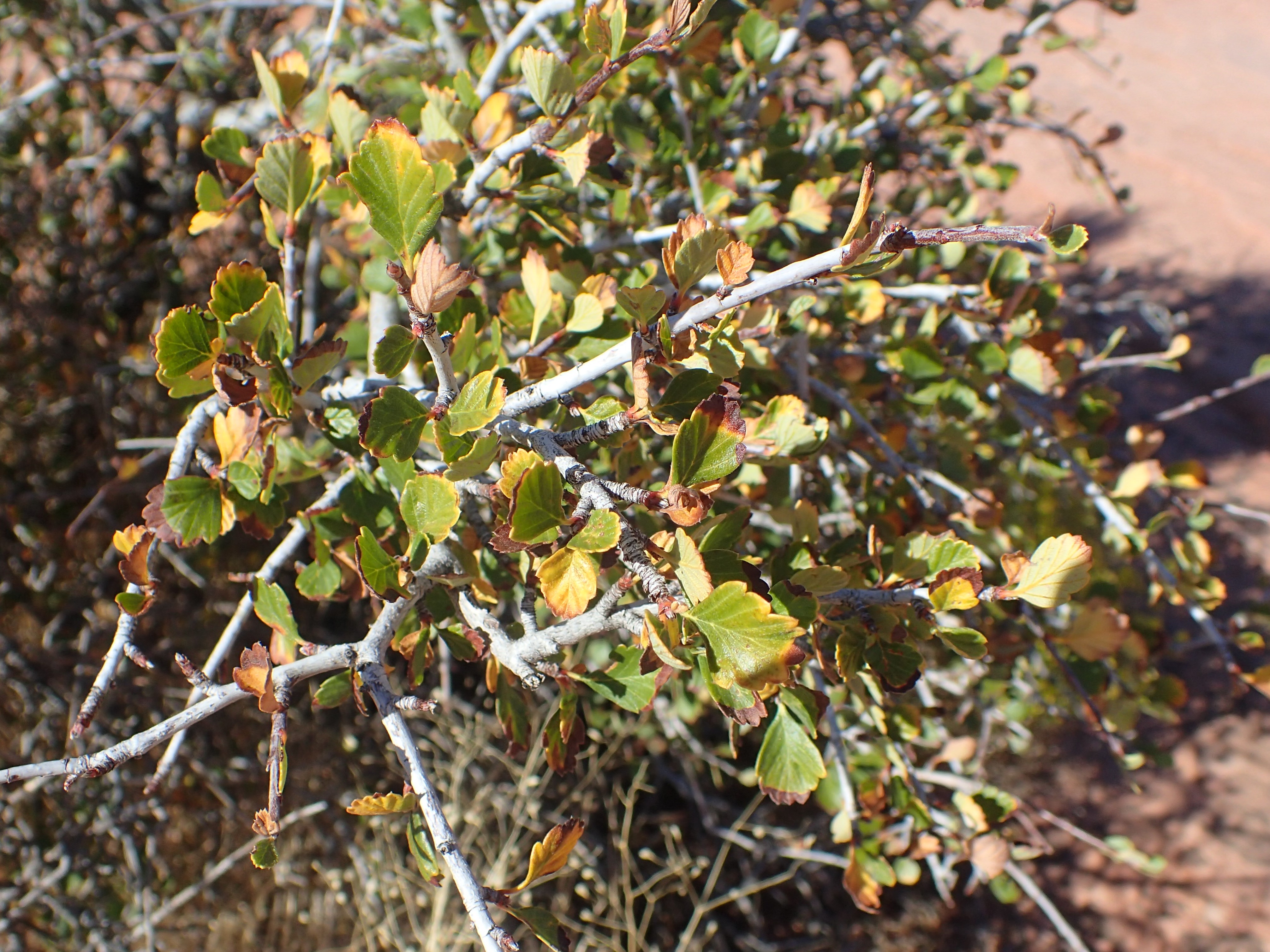
Cercocarpus montanus, commonly known as Mountain Mahogany, Alderleaf Mountain Mahogany, or Birch-leaf Mountain Mahogany, is a native evergreen to semi-evergreen shrub of the Rocky Mountains and Intermountain West that earns a place of distinction in the native plant landscape. A member of the Rosaceae (rose) family, it grows on dry, sunny hillsides from the foothills to subalpine elevations, where it forms dense thickets that provide critical habitat for wildlife throughout the year. The species is named for its leaves, which resemble those of alder or birch — broad, toothed, and prominently veined.
Mountain Mahogany is perhaps best known for its spectacular fruiting display: each small achene is tipped with a feathery, spiraling tail 1 to 2 inches long that glistens silver in sunlight and creates a smoke-like haze over fruiting shrubs in late summer. These ornamental seed plumes, combined with the attractive white to pink-tinged spring flowers, dense evergreen foliage, and wildlife-friendly character, make Mountain Mahogany one of the most versatile native shrubs for dry gardens in the Rocky Mountain region.
Beyond aesthetics, Mountain Mahogany plays an essential ecological role. Its nitrogen-fixing root associations improve poor soils, its dense branching provides essential cover and nesting habitat for birds, and its leaves serve as important browse for mule deer, elk, and bighorn sheep — particularly during spring and fall when high-quality forage is needed for growth, reproduction, and pre-winter fattening. For wildlife-focused landscaping and restoration in the Intermountain West, Mountain Mahogany is a top-tier selection.
Identification
Mountain Mahogany grows as an upright to spreading, multi-stemmed shrub or small tree typically 5 to 16 feet (1.5–5 m) tall, occasionally taller in favorable sites. The bark is gray-brown on older stems, reddish-brown and smooth on younger growth. The crown is rounded to irregular, with stiff branches that develop a somewhat gnarled character with age. Unlike its close relative Curl-leaf Mountain Mahogany (C. ledifolius), Mountain Mahogany has broader, more conventionally shaped leaves and is semi-deciduous rather than fully evergreen in cold climates.
Leaves
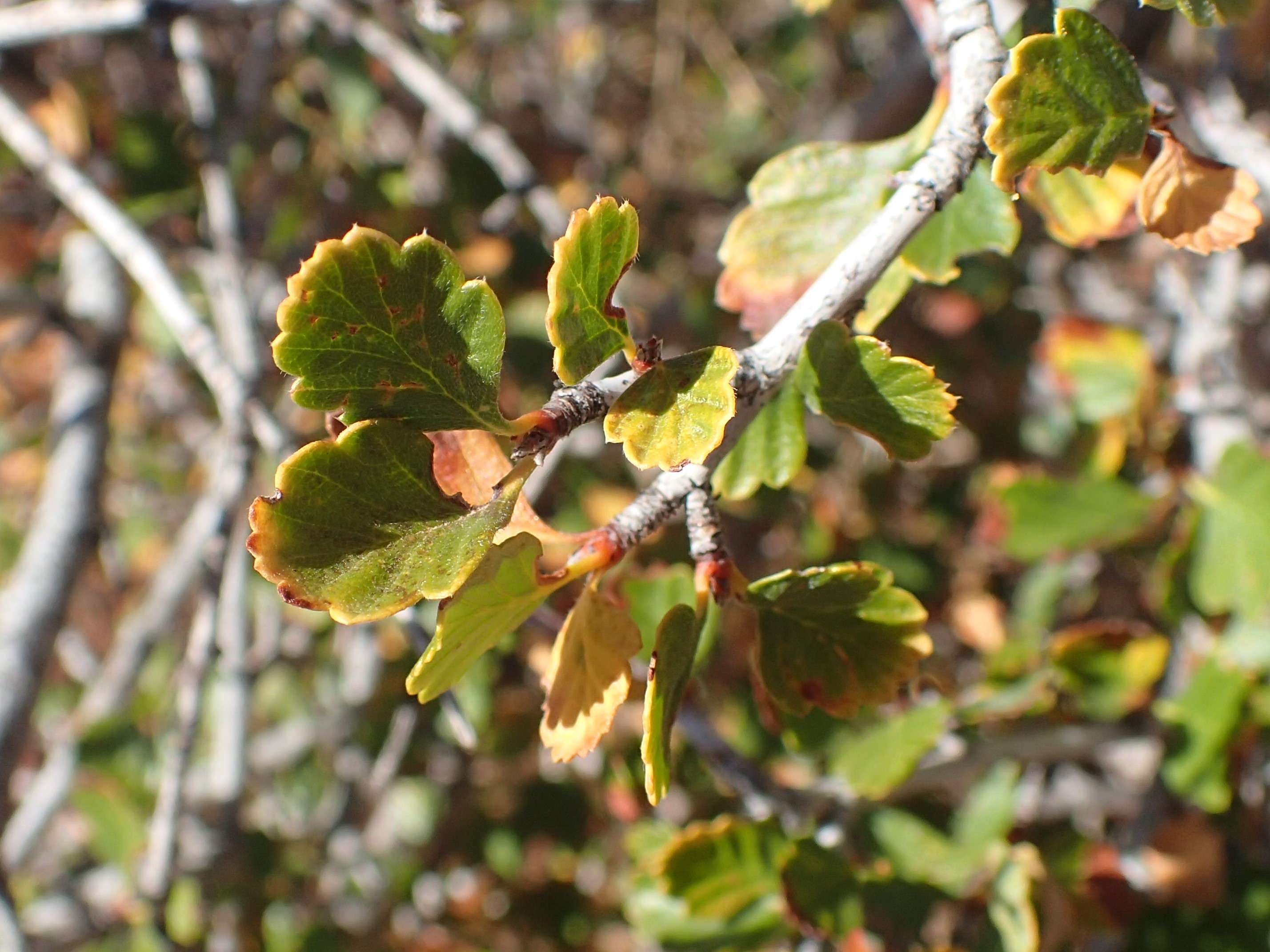
The leaves are oval to broadly wedge-shaped, ½ to 1½ inches (12–38 mm) long, with distinctly toothed margins on the upper half (the lower half is typically untoothed). The upper surface is dark green and somewhat hairy; the underside is lighter, prominently veined, and covered with white or grayish hairs. The leaf shape resembles birch or alder leaves, hence the alternate common names. In mild areas, leaves persist through winter; in colder climates they drop in fall. The leaves are aromatic when crushed.
Flowers
The flowers are small but attractive — white to pale pink, tubular, about ¼ to ½ inch (6–12 mm) across, emerging from the leaf axils singly or in small clusters in spring. The corolla is absent (no separate petals), but the calyx forms a cream to whitish funnel that appears petal-like. Flowering occurs from April to June, and while individual flowers are small, plants in full bloom can be quite showy when the branches are covered with white flowers.
Fruit & Seed Plumes
Like its relative Curl-leaf Mountain Mahogany, the most ornamental feature is the feathery fruiting awn — a silky, spiraling tail 1 to 2½ inches (2.5–6 cm) long attached to each achene. The plumes twist as they dry, and the hygroscopic action of the tail literally screws the seed into the soil as moisture levels fluctuate — an elegant adaptation for desert survival. The fruiting display peaks in August–September and can make a shrub appear to be shrouded in silver smoke.
Quick Facts
| Scientific Name | Cercocarpus montanus |
| Family | Rosaceae (Rose) |
| Plant Type | Evergreen / Semi-deciduous Shrub |
| Mature Height | 16 ft |
| Sun Exposure | Full Sun to Part Shade |
| Water Needs | Low (Drought Tolerant) |
| Bloom Time | April – June |
| Flower Color | White to pale pink |
| Ornamental Feature | Feathery silver seed plumes, white-pink blossoms |
| Soil Type | Rocky, sandy, well-drained; tolerates poor soils |
| USDA Hardiness Zones | 4–8 |
Native Range
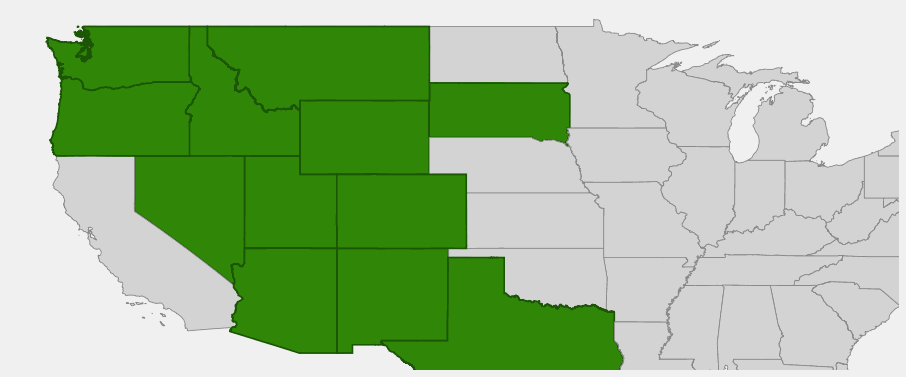
Mountain Mahogany is native to the mountains and foothills of the western and central United States, ranging from Washington and Oregon east through Idaho, Montana, Wyoming, Colorado, Utah, Nevada, Arizona, New Mexico, and extending into the Great Plains of South Dakota, Nebraska, and Oklahoma. Its range is extensive but generally restricted to rocky, dry, well-drained slopes and ridges at elevations from 3,000 to 9,500 feet. The species is most common in the southern Rocky Mountains and Colorado Plateau, where it is a dominant component of the foothill shrubland and dry montane forest understory.
In its natural habitat, Mountain Mahogany typically grows on south- and west-facing slopes with thin, rocky soils — sites that are too dry and exposed for most competing shrubs and trees. It is commonly associated with Ponderosa Pine (Pinus ponderosa), Gambel Oak (Quercus gambelii), One-seed Juniper (Juniperus monosperma), and Big Sagebrush. At lower elevations, it grows with Bitterbrush, Four-Wing Saltbush, and various native grasses.
Mountain Mahogany stands are often managed specifically for their wildlife value, particularly for mule deer and elk. The plants are browsed heavily during spring and fall when deer are moving between summer and winter ranges, and the nitrogen-rich, evergreen foliage provides high-quality nutrition during these critical periods. Wildlife biologists use the condition of Mountain Mahogany stands as an indicator of deer range quality.
📋 Regional plant lists featuring Mountain Mahogany: Intermountain West
Growing & Care Guide
Mountain Mahogany is a rugged, low-maintenance native shrub that rewards patient gardeners with decades of wildlife habitat, ornamental appeal, and ecological service. It is well-suited to the challenging conditions of western gardens — heat, drought, poor soils, and cold winters.
Light
Mountain Mahogany grows best in full sun to light partial shade (up to 4 hours of shade daily). In full sun it develops the densest, most compact form and the best flowering and fruiting display. It tolerates the dappled shade of open ponderosa pine forest — a condition that mimics its natural habitat in many areas. Avoid deep shade, which causes leggy growth and poor flowering.
Soil & Water
This shrub prefers well-drained, rocky or sandy soils and is highly drought tolerant once established. It will not tolerate wet, clay, or poorly drained soils. During establishment (1–2 years), water deeply every 2–3 weeks. Established plants survive on natural rainfall in most of its native range. Avoid summer irrigation once established — this can promote fungal diseases and root rot in the hot-dry conditions Mountain Mahogany prefers. The nitrogen-fixing root associations mean fertilization is unnecessary and may be counterproductive.
Planting Tips
Plant in fall or early spring from container stock. Choose the sunniest, best-draining site available. Mountain Mahogany does well on slopes where water drains away quickly. Space plants 6–10 feet apart for a naturalistic screen or wildlife planting. Bare-root plants (when available) establish particularly well if planted in early spring. Seed sowing in fall after stratification is also effective.
Pruning & Maintenance
Mountain Mahogany requires very little pruning. The natural multi-stemmed, arching form is attractive and functional. Remove dead stems in late winter as needed. If rejuvenation is desired, the plant can be cut back hard in late winter and will resprout vigorously. Avoid heavy pruning during the growing season. The plants are naturally pest- and disease-resistant in appropriate garden conditions.
Landscape Uses
- Wildlife screen or hedgerow — dense cover and food for birds and deer
- Dry slope planting on rocky hillsides and eroding banks
- Specimen plant — feathery seed plumes and white flowers are ornamental
- Mixed xeric shrub borders with sagebrush, bitterbrush, and native grasses
- Restoration of foothill shrubland and montane zones
- Pollinator-friendly gardens — spring flowers attract native bees
Wildlife & Ecological Value
Mountain Mahogany is one of the most wildlife-rich native shrubs for the Rocky Mountain and Intermountain West region, providing food, shelter, and nesting habitat for a wide variety of species.
For Browsers & Mammals
Mule Deer, Elk, and Bighorn Sheep are the primary large mammal consumers. The protein-rich, evergreen to semi-evergreen leaves are an important spring and fall browse when deer need high-quality nutrition for reproduction and pre-winter fat accumulation. Jackrabbits and cottontails browse the lower branches. Small mammals including Chipmunks, Pikas, and various mice use Mountain Mahogany thickets for cover and consume the seeds.
For Birds
The dense branching provides outstanding nesting habitat for many shrubland birds, including Green-tailed Towhees, Spotted Towhees, Black-throated Gray Warblers, and various sparrow species. The seeds are eaten by sparrows, finches, and Juncos. The associated insect community supports insectivorous birds including flycatchers, vireos, and warblers during migration and breeding.
For Pollinators
The white to pale pink spring flowers are visited by native bees, including bumble bees, mining bees, and sweat bees. The flowers bloom in the open, dry shrubland where few other early-season food sources are available, making Mountain Mahogany an important spring nectar source for bees in foothill communities.
Ecosystem Role
Like other Cercocarpus species, Mountain Mahogany fixes nitrogen through Frankia associations, enriching poor soils over time. Its leaf litter decomposes relatively quickly, contributing organic matter and nutrients to the surface soil. Dense stands trap snow and create cool, moist microclimates in exposed, rocky terrain. The deep root system stabilizes slopes and intercepts runoff, reducing erosion.
Cultural & Historical Uses
Mountain Mahogany was an important resource for many Indigenous peoples of the Rocky Mountains and Great Plains, including the Navajo, Apache, Cheyenne, Arapaho, and various Pueblo peoples. The extremely hard, dense wood — which sinks in water — was prized for making tools requiring exceptional hardness: digging sticks, awls, needles, arrow points, bows, and fire-making equipment. The Navajo used Mountain Mahogany bark to produce a reddish-orange dye for wool and buckskin — the dye was among the most important traditional textile colorants in the Southwest.
Medicinally, bark preparations were used by multiple groups for treating skin ailments, infections, and wounds. The astringent tannins in the bark have genuine antiseptic properties. Bark tea was used to treat fever, stomach complaints, and as a general tonic. The Navajo used roots and bark in elaborate healing ceremonies, recognizing Mountain Mahogany as a plant with significant spiritual as well as physical healing properties.
As a landscape plant, Mountain Mahogany has been used in the American West since the early 20th century, particularly in dryland revegetation and erosion control projects. Its combination of drought tolerance, nitrogen fixation, wildlife value, and ornamental appeal makes it a frequently recommended native shrub for Rocky Mountain gardens, where it can serve as a long-lived, low-maintenance cornerstone of a native plant landscape.
Frequently Asked Questions
What is the difference between Mountain Mahogany and Curl-leaf Mountain Mahogany?
Mountain Mahogany (Cercocarpus montanus) has broader, toothed leaves and is more deciduous; Curl-leaf Mountain Mahogany (C. ledifolius) has narrow, curled, fully evergreen leaves. Both have feathery seed plumes, but C. ledifolius generally grows on drier, rockier sites at higher elevations and can live much longer (over 1,000 years).
Does Mountain Mahogany need a lot of water?
No — Mountain Mahogany is a drought-tolerant shrub that thrives with minimal water once established. In its native range, it gets by on rainfall alone. In the garden, water deeply during the first 1–2 years, then transition to little or no supplemental irrigation. Overwatering is more likely to kill it than underwatering.
Is Mountain Mahogany deer-resistant?
Paradoxically, no — deer are among the primary browsers of Mountain Mahogany, particularly in fall and spring. If you’re planting to attract wildlife, that’s a benefit. If you’re planting in an area with very high deer pressure, protect young plants until they’re large enough to withstand browsing.
When do the feathery seed plumes appear?
The decorative seed plumes appear in summer, typically July–September, and persist on the plant for several weeks. A mature shrub covered in silver-white plumes is one of the most striking sights in a dry-climate garden. This is Mountain Mahogany’s most ornamentally spectacular season.
How do I start Mountain Mahogany from seed?
Seeds benefit from cold stratification — mix with moist sand and refrigerate for 30–60 days before planting, or sow outdoors in fall to receive natural stratification over winter. Plant seeds in a well-drained mix and cover lightly. Germination occurs in spring. Seedlings are slow-growing but become increasingly drought-tolerant as they mature.