Pacific Dogwood (Cornus nuttallii)
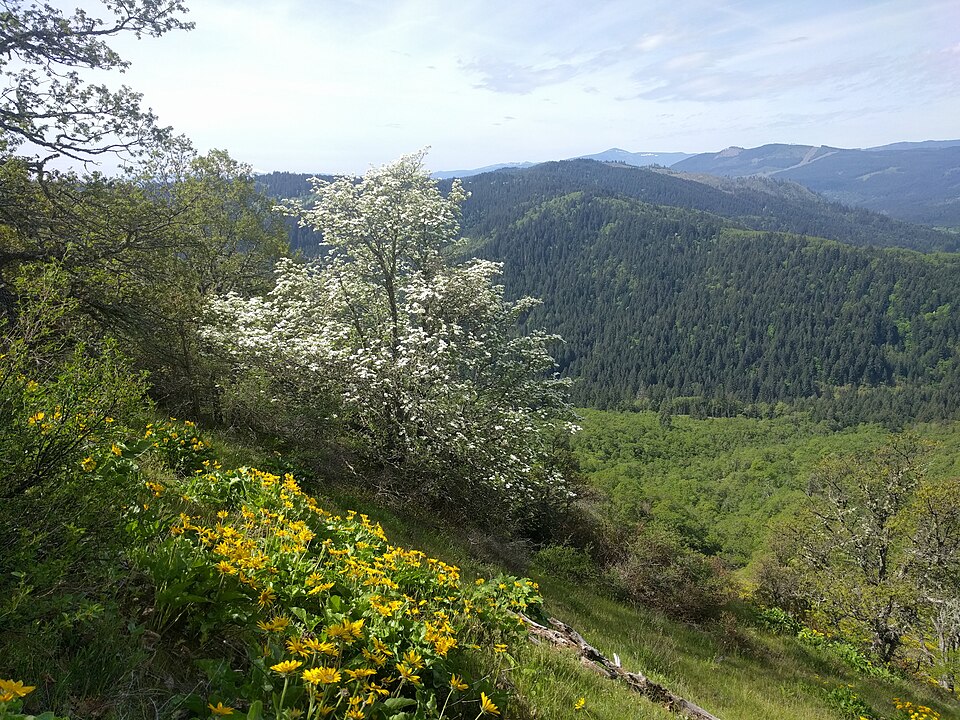
Cornus nuttallii, commonly known as Pacific Dogwood, is undoubtedly one of the most spectacular native flowering trees of the Pacific Northwest. This elegant deciduous tree, British Columbia’s official floral emblem, creates breathtaking displays of large white “flowers” (actually bracts) that can measure up to 6 inches across—among the largest of any North American dogwood. When in full bloom in spring and often again in fall, Pacific Dogwood transforms entire forest understories into ethereal landscapes of pristine white blossoms set against the deep green backdrop of coniferous forests.
Beyond its unrivaled ornamental value, Pacific Dogwood holds deep ecological and cultural significance in Pacific Northwest ecosystems. The tree provides critical resources for wildlife throughout the year, from spring nectar for pollinators to fall berries for migrating birds, while its distinctive layered branching pattern and seasonal transformations make it a cornerstone species in the visual character of Northwest forests. Its cultural importance to Indigenous peoples and its selection as British Columbia’s floral symbol reflect the profound connection between this remarkable tree and the identity of the region.
Named in honor of Thomas Nuttall, the renowned botanist who documented much of the Pacific Northwest’s flora in the early 1800s, Pacific Dogwood represents one of nature’s most perfect combinations of beauty and ecological function. The tree’s remarkable ability to bloom twice in a single year—with spectacular spring displays followed by smaller but equally beautiful fall flowers—makes it unique among temperate zone flowering trees and has earned it recognition as one of the finest ornamental trees native to North America.
Quick Facts
| Scientific Name | Cornus nuttallii |
| Family | Cornaceae (Dogwood) |
| Plant Type | Deciduous Tree |
| Mature Height | 30–50 ft |
| Spread | 20–30 ft |
| Growth Rate | Moderate |
| Sun Exposure | Full Sun to Part Shade |
| Water Needs | Moderate |
| Soil Type | Well-drained, organic-rich |
| Soil pH | 5.5–7.0 (slightly acidic to neutral) |
| Bloom Time | April – June (often again in fall) |
| Flower Color | White bracts (4–6 inches across) |
| Fruit | Red-orange clusters |
| Fall Color | Yellow, orange, red |
| Provincial Flower | British Columbia |
| USDA Hardiness Zones | 7–9 |
Identification
Pacific Dogwood is easily recognized by its distinctive layered branching pattern and enormous white “flowers.” The tree typically develops a pyramidal to oval crown with horizontal branching that creates distinct tiers—a growth pattern that becomes more pronounced with age and makes mature specimens architecturally stunning in the landscape. The bark on young trees is smooth and gray, becoming slightly furrowed with age but never developing the deep furrows of many other large trees. This smooth bark texture, combined with the tree’s elegant form, gives Pacific Dogwood a refined appearance that distinguishes it from more rugged forest trees.
Bark
The bark of Pacific Dogwood is notably smooth and thin, with a distinctive gray to brown coloration that becomes slightly mottled with age. Unlike many forest trees that develop deeply furrowed bark, Pacific Dogwood maintains its relatively smooth surface throughout its life, developing only shallow furrows and ridges on very old specimens. The thin bark makes the tree somewhat susceptible to mechanical damage and sunscald, which is why it often thrives in the partial shade of forest understories where it receives protection from the harsh elements.
Leaves
The leaves are opposite, simple, and oval-shaped with prominent parallel veins curving toward the leaf tip—a characteristic feature of all dogwoods. Each leaf measures 3 to 5 inches long and 2 to 4 inches wide, with a smooth margin and a distinctive pointed tip. The upper surface is dark green and slightly glossy, while the underside is paler and may have fine hairs along the veins. The venation pattern is particularly striking, with 6 to 8 pairs of prominent veins that arc gracefully from the midrib to the leaf margins. They emerge bright green in spring, remain dark green through summer, and transform to brilliant shades of yellow, orange, and red in fall, making Pacific Dogwood spectacular in autumn as well as spring. The fall color can vary significantly between individual trees and from year to year, with some specimens producing more intense reds while others favor golden yellows.
Flowers
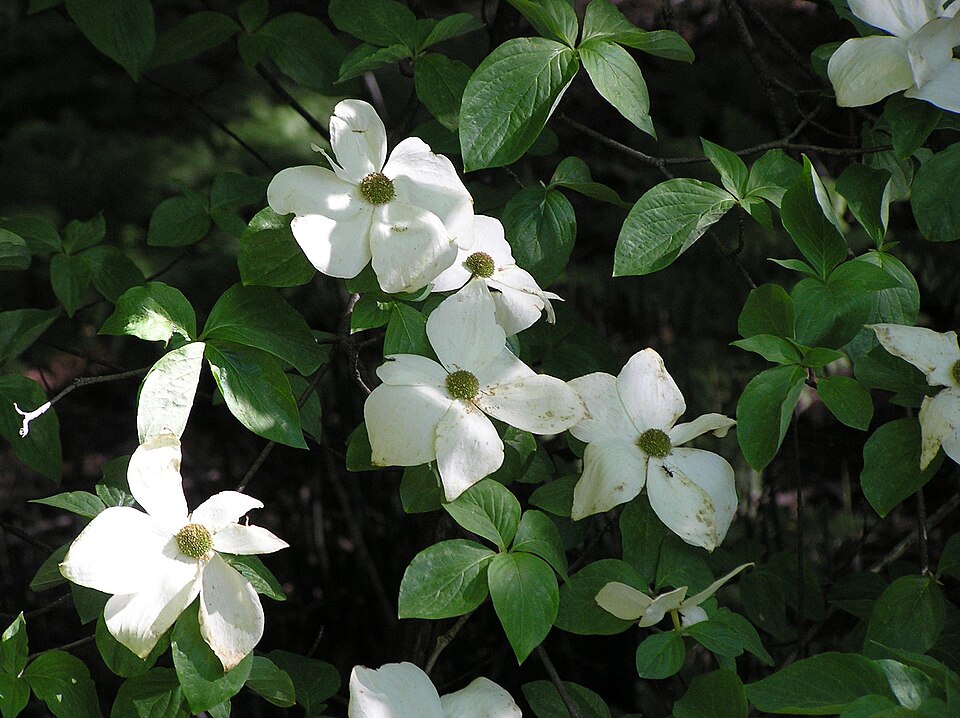
What appear to be enormous white flowers are actually small greenish-yellow flowers surrounded by 4 to 6 large, showy white bracts. These bracts can measure 3 to 6 inches across, making them among the largest “flowers” of any native North American tree. The true flowers are tiny and clustered in the center of the bracts, forming a dense head about 1 inch across. The bracts are actually modified leaves that have evolved to attract pollinators, and their large size and bright white color make them visible from considerable distances.
Blooming typically occurs from April through June, with the peak display usually in May when entire trees become covered in what appears to be pristine white blossoms. Many trees produce a second, smaller flush of blooms in fall, typically September through October, though this fall blooming is less predictable and not all trees exhibit this trait every year. The fall blooms are generally smaller and less numerous than the spring display but equally beautiful and provide a welcome surprise in the autumn landscape.
Fruit
The fruits develop as dense, rounded clusters of bright red-orange berries, each about ½ inch in diameter. These colorful fruit clusters ripen in late summer and fall, providing a striking contrast against the autumn foliage. The fruits are technically drupes, each containing 1 to 2 seeds surrounded by a thin layer of orange to red flesh. While beautiful, the fruits are not particularly palatable to humans, having a bitter taste, though they are eagerly consumed by wildlife. The fruit clusters can persist on the tree well into winter if not eaten by birds, adding winter interest to the bare branches.
Native Range
Pacific Dogwood has a relatively narrow Pacific Coast distribution, ranging from southern British Columbia south through western Washington and Oregon to central California. It is found primarily west of the Cascade Range crest, though it extends eastward in the Columbia River Gorge and occurs in scattered locations east of the Cascades where microclimate conditions provide sufficient moisture. The species typically grows at elevations from sea level to about 5,000 feet, with optimal habitat between 1,000 and 3,000 feet elevation where conditions are neither too wet nor too dry.
In its native habitat, Pacific Dogwood most commonly occurs as an understory tree in mixed coniferous forests dominated by Douglas fir, western hemlock, and western red cedar. It shows a strong preference for north-facing slopes and moist, well-drained soils with abundant organic matter. The tree is particularly abundant in the Cascade Range foothills and the Coast Range, where the maritime climate provides the cool, moist conditions it prefers. Within its range, Pacific Dogwood often grows in association with other understory trees and shrubs such as bigleaf maple, vine maple, hazelnut, and Pacific rhododendron, forming diverse plant communities that provide complex habitat structures for wildlife.
The distribution of Pacific Dogwood closely follows the region’s maritime climate zone, rarely extending far into areas with hot, dry summers or extremely cold winters. This climate sensitivity has important implications for the tree’s future distribution as climate patterns change, and may limit its adaptability to cultivation outside its native range.
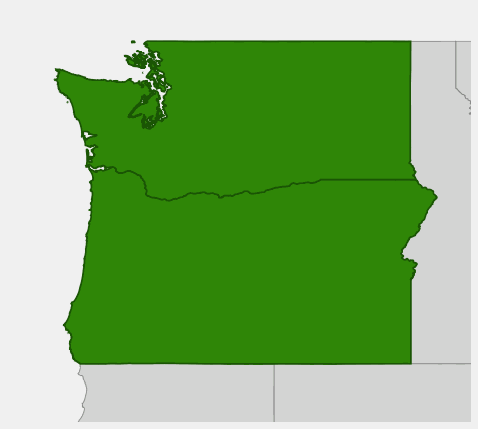
📋 Regional plant lists featuring Pacific Dogwood: Western Oregon & Western Washington
Growing & Care Guide
Pacific Dogwood can be challenging to cultivate outside its native range, but with proper siting and care, it makes an exceptional ornamental tree for Pacific Northwest gardens. Success depends on understanding and replicating its native forest habitat conditions, particularly the cool, moist environment it prefers. The key to successful cultivation is providing the right balance of light, moisture, and soil conditions while protecting the tree from environmental stresses that can predispose it to disease problems.
Light
Pacific Dogwood performs best with morning sun and afternoon shade, or in locations that receive bright, filtered sunlight throughout the day. While it can tolerate full sun in cooler coastal areas, it benefits from protection during the hottest part of the day, especially in inland locations. In deep shade, flowering may be reduced and the tree may develop a more open, leggy growth habit. The ideal location provides 4-6 hours of direct morning sunlight followed by dappled shade or protection from intense afternoon heat.
Soil & Water
Provide well-drained but consistently moist soil rich in organic matter. The soil should be slightly acidic to neutral (pH 5.5-7.0) and have excellent drainage—Pacific Dogwood cannot tolerate waterlogged conditions but also struggles in soils that dry out completely. Amend planting areas with compost or aged leaf mold to replicate forest soil conditions, and consider creating raised planting beds in areas with poor drainage. The tree benefits from a 3-4 inch layer of organic mulch to maintain consistent soil moisture and moderate soil temperatures.
Water requirements are moderate but consistent. During the establishment period (first 2-3 years), provide regular deep watering, especially during dry summer months. Once established, the tree is somewhat drought tolerant but performs best with supplemental irrigation during extended dry periods. Avoid frequent shallow watering, which can lead to shallow root development and increased stress during dry periods.
Planting Tips
Plant Pacific Dogwood in early spring or fall when temperatures are cool and rainfall is more reliable. Choose the planting location carefully, as the tree does not transplant well once established due to its sensitive root system. Dig the planting hole twice as wide as the root ball but no deeper, and backfill with a mixture of native soil and compost. Plant at the same depth as it was growing in the nursery container, and water thoroughly after planting.
Space trees at least 20-25 feet apart to allow for mature spread, and avoid planting near driveways, sidewalks, or buildings where reflected heat might stress the tree. Consider the mature size when selecting a location, as Pacific Dogwood can eventually reach 40-60 feet in height under optimal conditions.
Pruning & Maintenance
Pacific Dogwood requires minimal pruning and should be pruned sparingly, if at all. The natural growth form is attractive and should be preserved. If pruning is necessary, do it in late winter while the tree is dormant to minimize stress and disease risk. Remove only dead, damaged, or crossing branches, and avoid making large cuts that can provide entry points for disease organisms.
The tree benefits from annual applications of organic fertilizer or compost around the root zone in early spring. Keep the area around the base free of weeds and competing vegetation, and maintain a consistent mulch layer to conserve moisture and suppress weeds. Avoid cultivating around the tree, as the roots are shallow and easily damaged.
Disease Considerations
Pacific Dogwood can be susceptible to anthracnose, a fungal disease that has caused significant mortality in some populations, particularly in stressed trees or those growing in less than ideal conditions. The disease causes leaf spots, branch dieback, and can eventually kill trees if severe. Prevention is key: ensure good air circulation, avoid overhead watering, plant in appropriate light conditions, and maintain tree health through proper watering and fertilization.
Other potential problems include powdery mildew, canker diseases, and various insect pests. Most problems can be avoided by providing appropriate growing conditions and avoiding stress factors such as drought, soil compaction, or mechanical damage to the trunk and roots.
Wildlife & Ecological Value
Pacific Dogwood provides exceptional wildlife value throughout the year, serving as both a food source and habitat provider for numerous species. Its ecological importance extends far beyond its ornamental value, making it a keystone species in Pacific Northwest forest ecosystems.
For Birds
The bright red-orange fruit clusters are consumed by numerous bird species, including band-tailed pigeons, American robins, Steller’s jays, cedar waxwings, and various thrush species. These birds are particularly important for seed dispersal, carrying the seeds to new locations where they can germinate and establish new populations. The fruits ripen during fall migration, providing critical nutrition for birds preparing for winter or long-distance flights.
The layered branching structure provides excellent nesting sites for songbirds, with the horizontal branches offering stable platforms for nest construction. Species that commonly nest in Pacific Dogwood include various warblers, vireos, and flycatchers. The dense foliage provides cover and protection from predators, while the tree’s understory location offers additional protection from weather and aerial predators.
For Pollinators
The spring flowers attract numerous pollinators, including native bees, butterflies, and other insects. The large white bracts serve as landing platforms for insects, while the small central flowers provide nectar and pollen. Native bees are particularly important pollinators and can often be seen working the flower clusters during peak bloom. Hummingbirds are also attracted to the flowers, especially Anna’s hummingbirds and rufous hummingbirds, which are common throughout the tree’s range.
The extended blooming period, especially when trees produce a second fall flush of flowers, provides valuable nectar sources during times when few other trees are in bloom. This late-season nectar can be crucial for pollinators preparing for winter or for late-emerging species.
For Other Wildlife
Small mammals, including squirrels and chipmunks, consume the fruits and may cache some for winter food stores. Deer occasionally browse the foliage, particularly on young trees, though mature trees are generally too tall to suffer significant browsing damage. The tree’s bark and twigs may be used by various mammals for nest building and shelter construction.
The complex structure created by Pacific Dogwood’s tiered branching pattern contributes significantly to forest habitat complexity. This structural diversity provides microhabitats for insects, spiders, and other small creatures, which in turn support larger predators and contribute to the overall biodiversity of the forest ecosystem.
Cultural & Historical Uses
Pacific Dogwood holds profound cultural significance as the official floral emblem of British Columbia, adopted in 1956 after a province-wide vote. This selection reflected the deep connection between the tree and the natural identity of the Pacific Northwest, cementing its status as an iconic symbol of the region’s unique flora.
The tree has deep cultural meaning for Indigenous peoples of the Pacific Northwest, who traditionally used various parts of the plant for practical and ceremonial purposes. The hard, dense wood was prized for making tools, utensils, and implements that required durability and fine workmanship. The wood was particularly valued for making knitting needles, arrows, fishing hooks, and small carved implements due to its fine grain and hardness.
Various parts of the plant were used medicinally by different tribes throughout its range. The bark was sometimes used to treat fevers and other ailments, while leaf preparations were used for treating various conditions. However, these traditional uses required specialized knowledge and proper preparation methods that are not widely known today.
In modern times, Pacific Dogwood has become an important horticultural plant, valued for its spectacular spring bloom display and attractive fall color. The tree is widely planted in botanical gardens, arboreta, and ornamental landscapes throughout temperate regions with suitable climates. Its image has become synonymous with Pacific Northwest natural beauty and is frequently featured in tourism materials, art, and literature celebrating the region’s unique character.
The tree’s spectacular spring bloom has made it an enduring symbol of renewal and natural beauty, frequently featured in art, literature, and tourism promotion for the Pacific Northwest. Its image appears on British Columbia license plates and official government documents, cementing its role as an iconic representative of the region’s native flora and cultural identity.
Frequently Asked Questions
Why doesn’t my Pacific Dogwood bloom every year?
Pacific Dogwood can be somewhat unpredictable in its blooming, especially the fall bloom. Stress factors such as drought, disease, or poor site conditions can reduce flowering. Young trees may not bloom heavily until they are well-established. Some years may simply be better than others due to weather conditions during flower bud development.
Is Pacific Dogwood susceptible to the same diseases as Eastern Dogwood?
Yes, Pacific Dogwood can be affected by anthracnose, the same disease that has severely impacted Eastern Dogwood populations. However, some Pacific Dogwood trees appear to have better resistance. Providing optimal growing conditions and avoiding stress factors can help prevent disease problems.
Can I grow Pacific Dogwood outside the Pacific Northwest?
Pacific Dogwood is very climate-specific and rarely succeeds outside its native range or similar maritime climates. It requires cool, moist conditions and struggles in areas with hot summers, cold winters, or low humidity. Even within its native range, it can be challenging to grow in gardens.
How can I tell if my Pacific Dogwood is healthy?
Healthy Pacific Dogwoods have bright green foliage during the growing season, good flower production (at least every few years), and steady but not excessive growth. Warning signs include yellowing or browning foliage during the growing season, reduced flowering, dieback of branches, or spots on the leaves.
Should I fertilize my Pacific Dogwood?
Pacific Dogwood generally doesn’t need heavy fertilization if planted in good soil with adequate organic matter. An annual application of compost or balanced organic fertilizer in early spring can be beneficial, but avoid high-nitrogen fertilizers that may promote rapid growth at the expense of flowering and disease resistance.
When is the best time to plant Pacific Dogwood?
Plant in early spring or fall when temperatures are mild and rainfall is more reliable. Avoid planting during hot summer months or during freezing weather. Fall planting allows the roots to establish before the spring growing season, but spring planting works well if you can provide adequate water during the first summer.

Looking for a nursery that carries Pacific Dogwood?
Browse our native plant nursery directory: Oregon · Washington